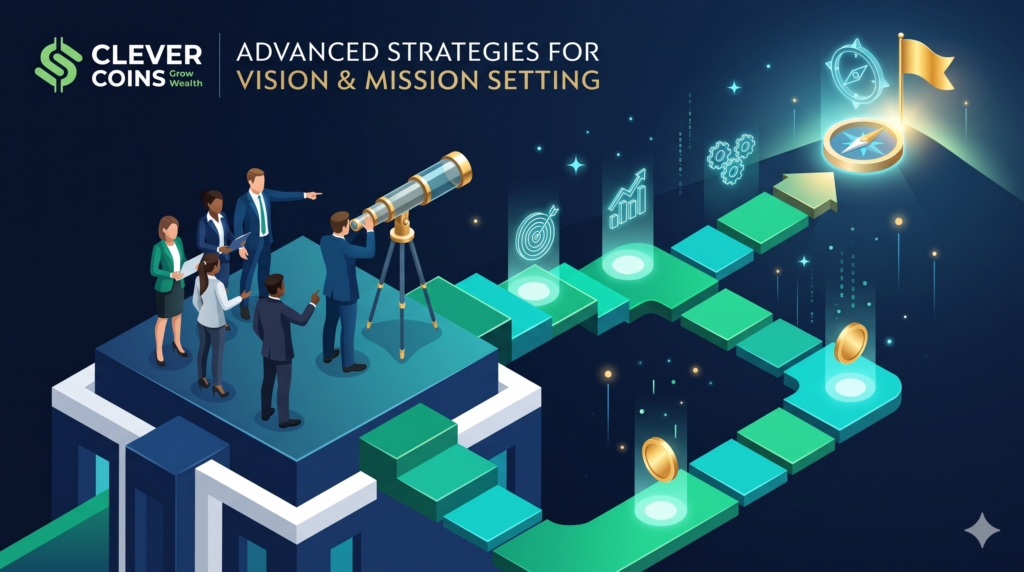
Advanced Strategies for Vision and Mission Setting: How High-Growth Enterprises Turn Abstract Statements into Operational Dominance
Most corporate vision and mission statements fail before the ink dries on the annual strategy deck. They hang on lobby walls, sit buried in the “About Us” footer of company websites, and elicit polite nods during town halls—yet they exert zero influence over how capital is allocated, which products get greenlit, or how frontline managers resolve daily trade-offs.
The root cause is rarely a lack of ambition. Rather, it is a flaw in strategic architecture. Most organizations treat vision and mission setting as a copywriting exercise—a wordsmithing workshop designed to produce inspirational platitudes—rather than an engineering discipline that governs organizational behavior under pressure.
When markets shift, margins compress, or rapid scaling fractures internal alignment, generic statements collapse. High-performing enterprises treat vision and mission setting as a rigorous operating system. They separate enduring core ideology from time-bound strategic targets, anchor purpose in falsifiable trade-offs, and cascade high-level intent directly into quarterly Objectives and Key Results (OKRs) and capital budgets.
This comprehensive guide breaks down the advanced frameworks, cognitive mechanics, alignment protocols, and governance systems required to build a vision and mission architecture that drives measurable enterprise value.
1. Deconstructing the Strategic Hierarchy: Purpose, Mission, Vision, and Values
Before applying advanced formulation techniques, leadership teams must eliminate the semantic confusion that plagues corporate strategy. When executives use purpose, mission, vision, and values interchangeably, operational execution suffers. Each element performs a distinct structural function within the enterprise.
| Strategic Element | Core Question Answered | Time Horizon | Operational Function | Falsifiability Test |
| Core Purpose | Why do we exist beyond making a profit? | Perpetual (100+ years) | Acts as the ethical and existential anchor; prevents mission drift during pivots. | Would the world lose something meaningful if our company disappeared tomorrow? |
| Mission Statement | What do we do, for whom, and how do we create unique value today? | Present to 3–5 years | Defines operational boundaries, target customer segments, and core competencies. | Does this statement clearly tell us which revenue opportunities to say “no” to? |
| Vision Statement | What concrete, measurable state will we achieve in the future? | 5 to 15 years | Serves as the North Star for capital allocation, R&D, and market expansion. | Can an objective observer verify in 10 years whether we succeeded or failed? |
| Core Values | How do we behave when no one is watching—and when doing so costs us money? | Permanent | Governs hiring, firing, promotion, and daily decision-making trade-offs. | Have we ever turned down a profitable client or fired a top performer over this value? |
The Strategic Distinction Between Mission and Vision
A common failure mode in boardrooms is writing a mission statement that sounds like a dream and a vision statement that sounds like a job description.
The Mission is your Operational Engine: It describes the company’s daily mandate—the specific problem you solve, the customer you serve, and the mechanism by which you deliver superior value. It is grounded in present reality and near-term execution.
The Vision is your Strategic Destination: It paints a vivid, audacious picture of the future state your organization is building toward. Unlike a mission, a true vision has a finish line or a distinct evolutionary milestone. Once achieved, a vision must be replaced by a new, higher-order vision.
2. Why Traditional Vision and Mission Setting Fails
Understanding why conventional approaches fail is essential to engineering a resilient strategic foundation. Across mid-market companies and enterprise corporations alike, five structural pathologies consistently undermine vision and mission initiatives.
1. The “Committee Wordsmithing” Trap
When executive teams spend six hours debating whether to use the word empower, enable, or catalyze, they mistake linguistic polish for strategic clarity. Consensus-driven drafting strips out sharp edges, resulting in homogenized, interchangeable prose. If you can swap your company’s name with your primary competitor’s name and the statement still makes sense, the strategy has failed.
2. Zero Cost of Commitment (Non-Falsifiability)
A strategic statement has zero value if its opposite is absurd. Saying “Our mission is to deliver high-quality products with exceptional customer service” is strategically useless because no competitor claims their mission is to deliver low-quality products with terrible service. Advanced mission setting requires strategic sacrifice—explicitly defining what the organization will not do, which customers it will not serve, and which margins or methods it rejects.
3. Disconnect from Capital Allocation
If a company’s vision proclaims “We will be the global leader in AI-driven supply chain automation,” yet 85% of its R&D budget remains locked in legacy manual logistics software, the vision is merely corporate theater. Strategy is what you fund, not what you announce.
4. Static Formulation in Dynamic Markets
Many organizations treat their mission and vision as sacred tablets carved in stone, refusing to revisit them even when technological disruption, regulatory shifts, or macroeconomic realities render their foundational assumptions obsolete. While Core Purpose should remain timeless, Mission and Vision require structured, periodic stress-testing.
5. The Execution Chasm
Even well-crafted statements fail when leadership lacks a translation mechanism to convert macro-level aspirations into micro-level daily behaviors. Frontline engineers, sales representatives, and operations managers rarely know how their Tuesday afternoon decisions advance a 10-year corporate vision.
3. Advanced Frameworks for Architecting Vision and Mission
To move beyond superficial brainstorming, executive teams should deploy proven strategic architecture frameworks. Combining the best elements of these methodologies creates a multi-dimensional strategic blueprint.
Framework 1: Jim Collins’ Core Ideology and Envisioned Future
Developed through extensive empirical research into enduring, high-performing companies, Jim Collins and Jerry Porras established a two-part architecture that remains the gold standard for enterprise strategy:
Core Ideology (The Anchor — What Never Changes):
Core Values: A small set (3 to 5) of timeless guiding principles that require no external justification. They have intrinsic value to those inside the organization.
Core Purpose: The organization’s fundamental reason for being, captured through the “Five Whys” root-cause excavation (explored in detail in Section 4).
Envisioned Future (The Catalyst — What Must Change):
10-to-30-Year BHAG (Big Hairy Audacious Goal): A crystal-clear, compelling, and measurable target that pulls the entire organization forward. A true BHAG has a 50% to 70% probability of success—hard enough to require extraordinary effort, yet believable enough to ignite collective commitment.
Vivid Description: A vibrant, engaging, and specific narrative translating the BHAG from dry numbers into a human, tangible reality. It describes what the organization will look, feel, and operate like once the BHAG is achieved.
Framework 2: Simon Sinek’s Golden Circle Applied to Enterprise Architecture
While widely known in marketing, the Golden Circle (Why → How → What) is fundamentally a biological and organizational alignment tool:
WHY (Core Purpose): The belief system that drives the organization. It dictates culture, talent attraction, and customer loyalty.
HOW (Differentiating Value Proposition & Values): The proprietary processes, cultural norms, and strategic advantages that distinguish the enterprise from competitors.
WHAT (Mission & Product Portfolio): The tangible products, services, and operational deliverables produced every day.
Advanced Application: Most companies communicate and strategize from the outside in (What → How → Why). High-growth leaders invert the sequence, locking in the Why and How first so that the What can evolve fluidly as technologies and customer demands shift.
Framework 3: The OGSM Strategic Cascade Model
Originated in post-war Japan and perfected by global consumer giants like Procter & Gamble, OGSM (Objectives, Goals, Strategies, Measures) bridges the gap between high-level vision and granular execution on a single page:
Objective (Qualitative Vision/Mission): What we want to achieve qualitatively (e.g., “Become the undisputed financial operating system for mid-market exporters”).
Goals (Quantitative Targets): Specific, time-bound financial and market share milestones proving the Objective is met (e.g., “Achieve $150M ARR and 22% market share across Tier-1 export corridors by Q4 2029”).
Strategies (Resource Choices): The specific strategic pillars, product bets, and go-to-market choices required to hit the Goals—explicitly excluding competing initiatives.
Measures (KPIs & Dashboards): The weekly and monthly operational metrics used to track whether each Strategy is working in real time.
Framework 4: Roger Martin’s “Playing to Win” Cascade
For organizations operating in hyper-competitive markets, Roger Martin’s five-question cascade turns mission and vision into a sharp competitive weapon:
What is our winning aspiration? (Vision & Mission)
Where will we play? (Geographies, customer segments, product categories, channels)
How will we win? (Cost leadership vs. differentiation, proprietary moats)
What capabilities must be in place? (Core competencies, talent, tech stack)
What management systems are required? (Governance, incentives, reporting cadence)
By forcing executives to answer “Where will we play?” and “How will we win?” directly beneath their winning aspiration, the framework eliminates vague, unactionable vision statements.
4. Step-by-Step Execution Playbook: Engineering Your Vision & Mission
Facilitating an executive vision and mission offsite requires structured rigor. Follow this six-phase engineering protocol to extract, refine, and validate your strategic foundation.
Phase 1: Pre-Work & Empirical Diagnostic Audit
Never walk into a strategy offsite with a blank whiteboard. Two weeks prior, conduct a confidential diagnostic across three stakeholder groups:
Executive Leadership: Ask each leader independently to write down the company’s current mission, top three strategic priorities, and biggest existential threat. Compare the responses—misalignment here exposes the exact fractures the workshop must heal.
Top-Performing Frontline Employees: Interview 10–15 high performers to uncover what actually motivates them, which company values are real versus performative, and where daily bottlenecks occur.
Most Profitable & Churned Customers: Analyze win/loss interviews to identify the true job customers hire your company to do, rather than what executives assume they buy.
Phase 2: Excavating Core Purpose via the “Five Whys” Method
To uncover a purpose deeper than “making money” or “building software,” run the Five Whys exercise with the founding or executive team:
Start with a descriptive statement: “We provide automated compliance and tax reconciliation software for mid-sized businesses.”
Why is that important? “Because tax and regulatory compliance is complex, error-prone, and consumes massive amounts of administrative time.”
Why does that matter? “Because when business owners are buried in compliance anxiety, they can’t focus on innovation, hiring, or serving their customers.”
Why is that important to us? “Because small and mid-sized enterprises are the primary engines of job creation and economic mobility in our communities.”
Why does that ultimately matter? “Because when entrepreneurs are freed from bureaucratic friction, human potential and economic prosperity expand exponentially.”
Resulting Core Purpose: “To liberate entrepreneurs from operational friction so they can build thriving, resilient enterprises.”
Phase 3: Defining Mission Boundaries & Strategic Trade-Offs
Draft your operational mission using the Target–Value–Mechanism–Boundary formula:
Target: Who specifically do we serve? (Be narrow enough to dominate).
Value: What measurable transformation or outcome do we deliver?
Mechanism: What is our unique, repeatable methodology or technology?
Boundary (The “Even If” Clause): What will we refuse to do, even if it generates short-term revenue?
Example of a High-Precision Mission:
“We empower independent B2B logistics operators to achieve 30%+ operating margins through real-time predictive route and freight auditing—and we never compromise data privacy or lock clients into punitive multi-year contracts.”
Phase 4: Constructing a 10-Year BHAG and Vivid Description
Select one of four classic BHAG archetypes to anchor your long-term vision:
Target-Oriented BHAG: Quantitative and time-bound (e.g., Walmart’s 1990 goal: “Become a $125 billion company by the year 2000”).
Common-Enemy BHAG: Focused on defeating a dominant incumbent or industry status quo (e.g., Nike’s 1960s battle cry: “Crush Adidas”).
Role-Model BHAG: Emulating the standard of excellence from an adjacent industry (e.g., “Become the Stripe of cross-border agricultural trade”).
Internal-Transformation BHAG: Reinventing an established enterprise for a new era (e.g., General Electric’s classic mandate: “Become #1 or #2 in every market we serve and revolutionize this company to have the speed and agility of a small enterprise”).
Pair the chosen BHAG with a 300-word Vivid Description written in the present tense, dated 10 years in the future, describing customer reactions, industry headlines, internal culture, and market impact.
Phase 5: The Strategic Stress-Test (The 5-Filter Validation)
Before finalizing any draft, pass both the Mission and Vision through five rigorous filters:
The Competitor Swap Test: Replace your company name with your top three rivals. If it still reads plausibly, rewrite it until it reflects your proprietary DNA.
The Capital Allocation Test: Look at next year’s budget. Does your mission/vision immediately clarify which three projects should receive 2x funding and which two should be killed?
The Frontline Decision Test: Present a realistic customer escalation or product trade-off to a junior manager. Does the mission statement give them a clear tie-breaker without escalating to a VP?
The Jargon & Buzzword Purge: Eliminate empty corporate filler (synergy, best-in-class, holistic, cutting-edge, world-class, leverage, solutions). Replace abstract nouns with concrete verbs and measurable outcomes.
The Memory & Recitation Test: Can an employee recite the core essence of the mission and vision from memory after hearing it once? If it exceeds 15–20 words for the core statement, tighten the phrasing.
Phase 6: Stakeholder Co-Creation Without Design-by-Committee
While a 50-person group cannot write a sharp strategy, excluding key leaders breeds passive resistance. Use the “Draft–Critique–Commit” governance loop:
Core Tiger Team (3–5 executives): Drafts the initial architecture.
Extended Leadership & Cultural Ambassadors (15–25 leaders): Reviews the draft in structured feedback sessions, identifying blind spots, operational friction points, and terminology issues.
Core Tiger Team: Synthesizes feedback, makes final executive calls, and explains why certain suggestions were accepted or rejected—creating procedural fairness and deep buy-in.
5. Bridging the Execution Gap: Cascading Vision into Daily Operations
A world-class vision and mission statement delivers zero ROI until it is wired into the company’s operating cadence. High-performing organizations use four synchronization mechanisms to ensure strategic continuity from the boardroom to the front line.
1. Cascading Vision into Annual & Quarterly OKRs
Objectives and Key Results (OKRs) act as the transmission gears connecting a 10-year vision to 90-day execution sprints:
10-Year Vision (BHAG): Become the primary financial intelligence platform powering 1 million SMEs across emerging markets by 2035.
3-Year Strategic Pillar: Establish market leadership in automated tax compliance and working capital forecasting across three core regional hubs.
Annual Company Objective: Achieve 95% automated reconciliation accuracy and scale active SME adoption from 40,000 to 120,000 businesses.
Q1 Product Team OKR:
Objective: Eliminate manual onboarding friction for multi-currency SMEs.
Key Result 1: Reduce average time-to-first-reconciliation from 4.5 days to under 15 minutes.
Key Result 2: Increase 30-day onboarding completion rate from 58% to 84%.
Key Result 3: Achieve a Net Promoter Score (NPS) of +62 among newly onboarded finance controllers.
2. Aligning Resource Allocation & Budgeting (Zero-Based Strategy)
During annual financial planning, require every department head to tag each budget line item and headcount request to a specific Strategic Pillar derived from the Mission and Vision. Any expenditure that cannot be directly traced to advancing the Mission or Vision is flagged for reduction or elimination. This prevents “strategic drift,” where legacy departments consume disproportionate capital simply because they existed last year.
3. Embedding Values into Talent Architecture
Core values only become real when they carry career consequences. Integrate your mission and values into four HR systems:
Structured Behavioral Interviewing: Assign each core value to a dedicated interviewer with standardized behavioral rubrics. Reject candidates who score high on technical skill but fail a core value threshold.
Performance Reviews (The “What” vs. “How” Matrix): Evaluate employees on two axes—Results Achieved (Mission Execution) and Values Embodied (Cultural Alignment). High performers who violate core values must be coached out rapidly; tolerating toxic high performers destroys organizational trust in leadership’s word.
Promotion Criteria: Require documented evidence of advancing the broader company vision—not merely optimizing local departmental metrics—for any promotion to Director or VP.
Peer Recognition Rituals: Tie spot bonuses and weekly all-hands shout-outs explicitly to specific core values and mission milestones.
4. Strategic Narrative & Internal Communication Cadence
Repetition creates strategic clarity. As leadership theorist Patrick Lencioni notes, executives must act as “Chief Reminding Officers.”
Weekly Leadership Syncs: Open every executive meeting with a 5-minute check-in on mission alignment and customer impact before diving into operational metrics.
Monthly All-Hands Storytelling: Share concrete customer case studies and internal wins that illustrate the vision coming to life.
Quarterly State-of-the-Vision Reviews: Review progress against the 10-year BHAG transparently, celebrating breakthroughs and addressing shortfalls candidly.
6. Advanced Scenarios: Adapting Vision & Mission Across Business Lifecycles
Strategic requirements evolve dramatically as an enterprise matures. Applying a seed-stage startup framework to a post-merger conglomerate—or vice versa—creates severe operational friction.
Scenario A: Early-Stage Startups (Seed to Series B)
Strategic Focus: Speed, hypothesis validation, and narrow wedge dominance.
Approach: Keep the Core Purpose inspiring, but treat the Mission as a focused, 18-to-24-month beachhead mandate. Avoid overly rigid 15-year visions before achieving strong product-market fit; instead, articulate a compelling 3-to-5-year Vision that attracts top talent and venture capital while preserving room to pivot as customer data emerges.
Scenario B: High-Growth Scale-Ups (Series C to Pre-IPO)
Strategic Focus: Preventing cultural dilution and departmental silos during rapid headcount expansion.
Approach: When headcount doubles every 12 months, tribal knowledge breaks down. Formalize the Core Ideology and Strategic Trade-Offs into an explicit “Operating Playbook” taught during week-one onboarding. Deploy OGSM or OKRs rigorously so newly hired VPs from disparate corporate backgrounds operate from a single strategic playbook.
Scenario C: Enterprise Turnarounds & Strategic Pivots
Strategic Focus: Breaking organizational inertia and overcoming cynicism.
Approach: Acknowledge past reality candidly—never pretend a pivot is merely “business as usual.” Separate the timeless Core Purpose (which honors the company’s heritage and retains loyal employees) from a bold new Transformation BHAG and Modernized Mission that cleanly breaks from obsolete business models. Back the new vision immediately with visible capital reallocation and symbolic leadership actions within the first 30 days.
Scenario D: Mergers, Acquisitions & Multi-Brand Holdings
Strategic Focus: Harmonizing distinct corporate cultures without destroying acquired entrepreneurial value.
Approach: Establish a clear Parent-Level Vision and Core Values that govern ethics, capital allocation, and cross-portfolio synergies, while allowing individual business units to maintain tailored Unit-Level Missions optimized for their specific customer segments and competitive dynamics.