Bootstrapping vs Funding Case Study for SMEs: How Two Indian Enterprises Scaled Differently
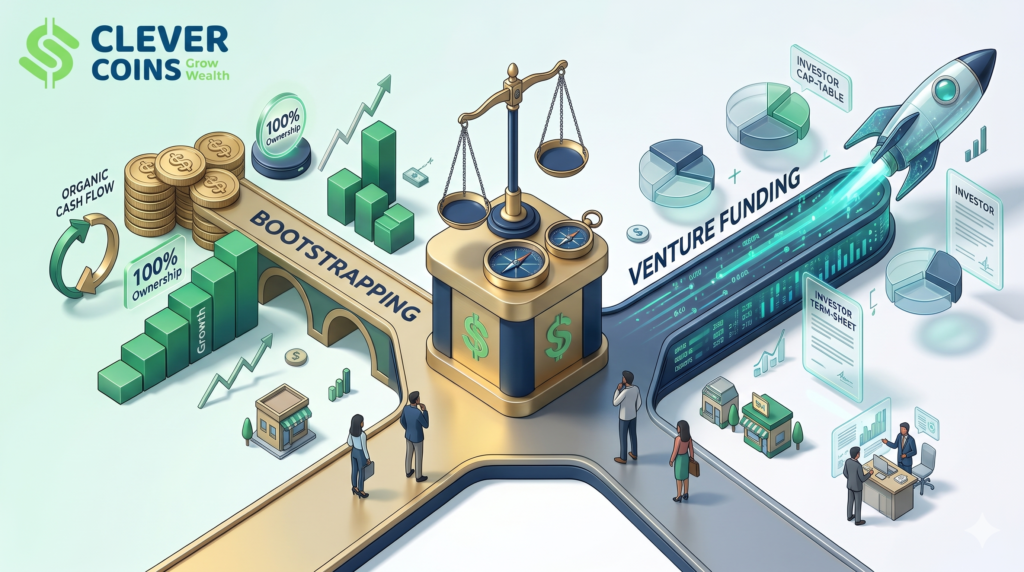
Every small and medium enterprise (SME) founder eventually hits a defining capital crossroads. On one side lies bootstrapping—building brick by brick through customer revenue, personal savings, disciplined working capital management, and zero equity dilution. On the other side lies external funding—raising capital from angel investors, venture capital (VC) funds, or institutional lenders to capture market share rapidly, outspend competitors, and build infrastructure ahead of revenue.
In 2026, the Indian SME and startup landscape has matured dramatically. The era of “growth at any cost” has given way to unit-economics discipline, tighter regulatory scrutiny under updated GST and corporate governance frameworks, and a sharp rise in alternative financing options like Revenue-Based Financing (RBF) and government-backed credit schemes. Yet founders still struggle to translate abstract pros and cons into concrete numbers. What does choosing bootstrapping over equity funding actually look like on a balance sheet over five years? How does it affect founder take-home wealth, tax liability, statutory compliance, hiring velocity, and stress levels?
To answer these questions with precision, this Bootstrapping vs Funding Case Study for SMEs examines two parallel Indian enterprises operating in the B2B supply-chain and SaaS-enabled commerce space between 2021 and 2026. Both started with comparable founding teams, similar initial capital, and identical market opportunities. One chose strict bootstrapping; the other raised institutional seed and Series A capital.
By dissecting their five-year financial statements, capitalization tables, compliance overheads, and exit outcomes, you will gain a practical decision-making framework for your own business.
Understanding the Two Capital Philosophies in 2026
Before diving into the numbers, let us establish clear operational definitions for how both models function in today’s SME ecosystem.
What Is Bootstrapping for an SME?
Bootstrapping is the practice of launching and scaling a business using internal cash flows, founder savings, supplier credit, and customer advances—without surrendering equity to external investors. In a bootstrapped SME, revenue is the primary source of financing. Every new hire, marketing campaign, or warehouse expansion must be earned through gross margin generated by existing operations.
Key characteristics of bootstrapped SMEs include:
100% Founder Ownership: No external board seats, veto rights, or liquidation preferences.
Immediate Unit-Economics Discipline: Products and services must be priced profitably from day one because there is no venture cushion to subsidize customer acquisition.
Organic Compounding: Growth is linear or steadily compounding rather than exponential in the early years.
Lean Compliance Footprint: Many bootstrapped SMEs begin as Limited Liability Partnerships (LLPs) or closely held Private Limited Companies, optimizing tax outgo and avoiding complex shareholder agreements.
What Is External Funding for an SME?
External funding involves raising capital from outside parties—typically Angel Investors, Micro-VCs, Venture Capital firms, or Private Equity funds—in exchange for equity ownership (compulsorily convertible preference shares or common equity). In this model, capital precedes revenue. Founders raise money based on a thesis, a minimum viable product (MVP), or early traction to compress a ten-year growth timeline into three years.
Key characteristics of funded SMEs include:
Accelerated Speed to Market: Immediate liquidity to hire senior leadership, build proprietary tech, and acquire customers aggressively.
Progressive Equity Dilution: Founders typically surrender 15% to 25% equity in a seed round and another 15% to 25% in Series A.
Institutional Governance: Mandatory Private Limited structure, statutory audits, board meetings, investor reporting, and strict adherence to valuation rules under the Companies Act and Income Tax Act.
Exit Orientation: Investors operate on 7-to-10-year fund cycles and require a liquidity event—such as an IPO, strategic acquisition, or secondary buyout—to realize returns.
Introducing the Case Study Subjects: Two SMEs, One Market
To make this Bootstrapping vs Funding Case Study for SMEs realistic and actionable, we examine two representative Indian B2B businesses launched in early 2021 in the industrial procurement and inventory software sector. (Names have been anonymized, while financial ratios, tax impacts, and dilution mechanics reflect real-world Indian SME benchmarks.)
Company A: ApexFlow Systems (The Bootstrapped Path)
Location: Pune, Maharashtra
Founders: Two domain engineers with 8 years of manufacturing supply-chain experience.
Initial Capital: ₹18 Lakhs pooled from personal savings.
Entity Structure: Started as an LLP in Year 1 to minimize compliance cost, converted to a Private Limited Company in Year 3 once annual turnover crossed ₹4 Crore.
Core Strategy: Build a niche inventory optimization tool for auto-component manufacturers, charge annual upfront implementation fees to fund product development, and expand strictly out of net profits.
Company B: NexaScale Technologies (The Venture-Funded Path)
Location: Bengaluru, Karnataka
Founders: Two product and sales professionals from the same industrial ecosystem.
Initial Capital: ₹15 Lakhs personal savings, followed within 6 months by a ₹2.5 Crore Angel/Seed round at a ₹12.5 Crore post-money valuation (20% dilution), and a ₹14 Crore Series A round in Year 3 at a ₹70 Crore post-money valuation (another 20% dilution).
Entity Structure: Incorporated as a Private Limited Company from Day 1 to accommodate investor preference shares and ESOP pools.
Core Strategy: Build a full-stack B2B procurement platform, offer free onboarding to capture rapid market share across Western and Southern India, and build a 45-person sales and engineering team ahead of profitability.
Year-by-Year Financial & Operational Breakdown (Years 1 to 5)
Let us trace how both SMEs performed across five critical years, examining revenue, net profit/burn, team size, and founder ownership.
Year 1: Validation and Foundation
ApexFlow (Bootstrapped): The founders acted as their own sales team, onboarding 14 SME factories in Pune and Nashik. By charging ₹2.5 Lakhs per client upfront for annual licenses and customization, they generated ₹35 Lakhs in revenue. Operating out of a small co-working space with two junior developers, total expenses were ₹24 Lakhs. They closed Year 1 with ₹11 Lakhs in net profit and 100% founder equity.
NexaScale (Funded): Armed with ₹2.5 Crore in seed capital, NexaScale hired 12 engineers and 4 business development managers immediately. They priced their software aggressively low (₹60,000/year) to win logos quickly, onboarding 45 clients and generating ₹27 Lakhs in revenue. However, payroll, cloud infrastructure, and paid marketing resulted in ₹1.45 Crore in expenses—a net burn of ₹1.18 Crore. Founder ownership stood at 80% (after 20% seed dilution).
Year 2: The Divergence in Growth Mechanics
ApexFlow (Bootstrapped): Reinvesting Year 1 profits, ApexFlow hired two senior customer-success managers and expanded to Gujarat. Word-of-mouth referrals kept Customer Acquisition Cost (CAC) near zero. Revenue grew to ₹1.15 Crore, expenses were ₹78 Lakhs, and net profit reached ₹37 Lakhs. Cash reserves climbed to ₹66 Lakhs without a single rupee of debt.
NexaScale (Funded): NexaScale launched aggressive digital acquisition and trade-show sponsorships across four states. Client count surged to 180, pushing revenue to ₹1.40 Crore. However, total expenditure reached ₹2.40 Crore, exhausting the remaining seed capital by Month 22. The founders spent four months pitching institutional VCs while managing a tight cash runway, eventually closing their ₹14 Crore Series A just in time. Founder ownership dropped to 60% (accounting for a 10% ESOP pool creation alongside Series A dilution).
Year 3: Scaling Infrastructure and Compliance
ApexFlow (Bootstrapped): Crossing ₹2.5 Crore in annual recurring revenue, ApexFlow converted into a Private Limited Company to qualify for enterprise vendor tenders. They introduced a modular analytics add-on, lifting average contract value to ₹4.2 Lakhs. Revenue hit ₹2.85 Crore, generating ₹82 Lakhs in net profit (28.7% net margin). The team stood at 16 highly productive employees.
NexaScale (Funded): Flush with Series A capital, NexaScale scaled its team to 58 employees, opened offices in Mumbai and Chennai, and built AI-driven demand forecasting features. Revenue jumped to ₹5.20 Crore, outpacing ApexFlow’s top line by nearly 82%. Yet high customer acquisition costs and enterprise onboarding subsidies resulted in a net loss of ₹3.10 Crore for the year.
Year 4: Market Headwinds and Unit Economics
In Year 4, an industrial slowdown tightened SME software budgets across India. This macro test exposed the structural differences between the two models.
ApexFlow (Bootstrapped): New client acquisition slowed by 20%, but because ApexFlow had zero debt and 94% annual retention, the business remained effortlessly profitable. Revenue grew steadily to ₹4.60 Crore, with ₹1.35 Crore in net profit. The founders declared a healthy dividend and reinvested the rest into product R&D.
NexaScale (Funded): Facing board pressure to maintain 2x year-over-year growth despite market headwinds, NexaScale had to discount contracts heavily and spend more on outbound sales. Revenue reached ₹9.80 Crore, but burn remained at ₹2.60 Crore. The board mandated a restructuring—freezing non-sales hiring and shifting KPIs from gross customer additions to net dollar retention.
Year 5: Maturity, Valuation, and Founder Wealth
By the end of Year 5, both companies had established strong reputations in the Indian SME ecosystem—but their financial realities looked worlds apart.
Side-by-Side 5-Year Financial Comparison Table
| Financial & Operational Metric (Year 5) | ApexFlow Systems (Bootstrapped SME) | NexaScale Technologies (Funded SME) |
| Total External Equity Raised | ₹0 | ₹16.50 Crore (Seed + Series A) |
| Year 5 Annual Revenue | ₹7.40 Crore | ₹18.50 Crore |
| Year 5 Net Profit / (Loss) | +₹2.25 Crore (30.4% Net Margin) | -₹0.85 Crore (Approaching Breakeven) |
| Cumulative 5-Year Cash Reserves | ₹4.90 Crore (Unencumbered) | ₹5.45 Crore (Remaining VC Capital) |
| Total Team Size | 28 Employees | 84 Employees |
| Revenue per Employee | ₹26.43 Lakhs | ₹22.02 Lakhs |
| Founder Equity Ownership | 100% (50% each) | 54% (27% each after dilution & ESOPs) |
| Enterprise Valuation (Year 5) | ₹37.00 Crore (5x Revenue / ~16x PAT) | ₹92.50 Crore (5x Revenue Multiple) |
| Value of Founders’ Combined Stake | ₹37.00 Crore | ₹49.95 Crore (Subject to Liquidation Prefs) |
| Annual Founder Compensation + Dividends | ₹1.40 Crore combined | ₹72 Lakhs combined (Board-capped salaries) |
| Decision-Making Autonomy | Absolute (100% Founder Control) | Shared (Board approvals & Veto rights) |