Section 80JJAA Deduction for Hiring New Employees by MSMEs Under the Income Tax Act 2025: The Complete Guide
Scaling a Micro, Small, or Medium Enterprise (MSME) in India requires a bold leap of faith: hiring full-time talent. For most business owners, payroll is one of the largest recurring fixed overheads on the Profit & Loss statement. While salaries and wages are routinely allowed as a standard business expenditure under Section 37(1) of the erstwhile Income-tax Act, 1961 (and the corresponding business expenditure provisions of the Income-tax Act, 2025), the Government of India offers a massive, often overlooked tax incentive specifically designed to reward formal job creation.
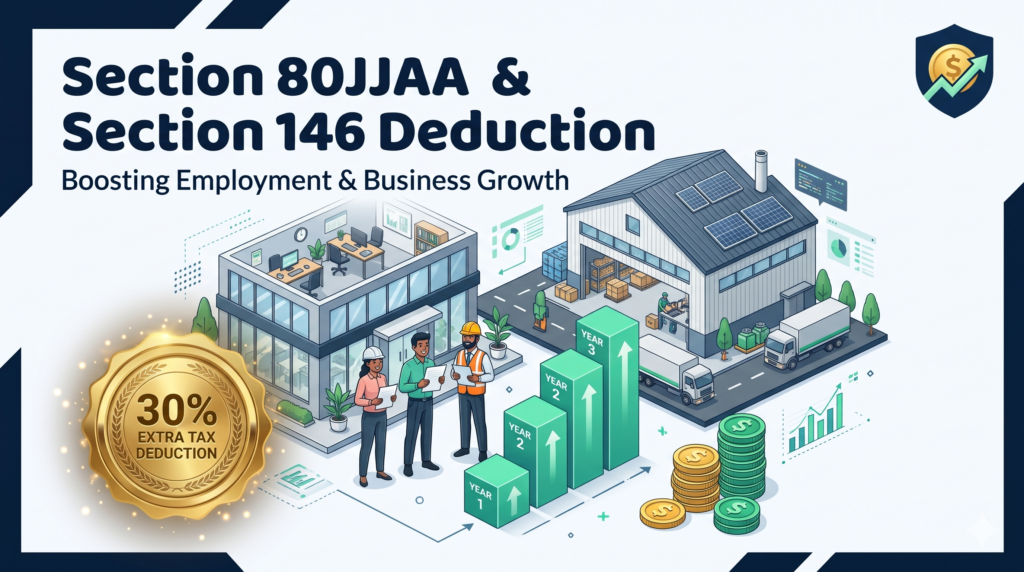
Popularly known across boardrooms and Chartered Accountant offices as the Section 80JJAA deduction, this provision grants eligible businesses an additional 30% deduction on the cost of hiring new employees for three consecutive years. That means for every ₹100 spent on qualifying new staff, an MSME effectively claims ₹130 in tax deductions—100% as a normal revenue expense, plus an extra 30% bonus deduction in Year 1, Year 2, and Year 3 (totaling 190% cumulative deduction over the three-year window).
With the Income-tax Act, 2025 coming into effect from 1 April 2026 (applicable from Tax Year 2026–27 onwards), the statutory architecture of Indian direct tax law has undergone a complete renumbering and structural overhaul. Under the new Act, the legendary Section 80JJAA has been re-enacted as Section 146 of the Income-tax Act, 2025, and the mandatory accountant’s certification previously filed in Form 10DA has transitioned to Form 34 under Rule 68 of the Income-tax Rules, 2026.
Whether you are an MSME founder, a manufacturing unit director, or a finance manager looking to optimize your tax outflow legally, this comprehensive guide breaks down every statutory nuance, eligibility gate, calculation formula, compliance trap, and transition rule between Section 80JJAA and Section 146.
1. From Section 80JJAA (1961 Act) to Section 146 (Income-tax Act, 2025): What Changed?
Before diving into the mechanics of the tax break, it is vital to align your compliance terminology with the statutory transition taking place in 2026.
For financial years up to FY 2025–26 (Assessment Year 2026–27), the deduction is governed by Section 80JJAA under Chapter VI-A of the Income-tax Act, 1961, supported by Rule 19AB and Form 10DA. From 1 April 2026 (Tax Year 2026–27) onwards, the Income-tax Act, 2025 replaces the 1961 statute. In the new Act, the terminology “Assessment Year” and “Previous Year” is unified into “Tax Year,” and Section 80JJAA is placed in Chapter VIII as Section 146 (“Deduction in respect of additional employee cost”).
| Compliance Parameter | Income-tax Act, 1961 (Up to FY 2025–26) | Income-tax Act, 2025 (From 1 April 2026) |
| Governing Section | Section 80JJAA (Chapter VI-A) | Section 146 (Chapter VIII) |
| Tax Period Terminology | Previous Year / Assessment Year | Tax Year (e.g., Tax Year 2026–27) |
| Quantum of Deduction | 30% of Additional Employee Cost | 30% of Additional Employee Cost |
| Duration of Benefit | 3 consecutive Assessment Years | 3 consecutive Tax Years |
| Tax Audit Gate | Section 44AB | Section 63 |
| Accountant’s Report Form | Form 10DA (under Rule 19AB) | Form 34 (under Rule 68, IT Rules 2026) |
| New Tax Regime Availability | Allowed under Sec 115BAC / 115BAA / 115BAB | Allowed under Sec 202 (New Tax Regime) |
Crucial Takeaway for MSMEs: While the section numbers and form numbers have changed under the Income-tax Act, 2025, the core substantive conditions, the 30% deduction rate, the ₹25,000 monthly salary cap, the 240/150-day employment rule, and its availability under the New Tax Regime remain intact. Because business owners, banks, and tax portals still widely search for and cross-reference Section 80JJAA, understanding both Section 80JJAA and its successor Section 146 ensures your tax filings are completely audit-proof.
2. Why Section 80JJAA / Section 146 Is a Goldmine for MSMEs
Many small and medium enterprise owners assume that tax deductions are either locked behind complex SEZ rules or wiped out if they opt for concessional tax rates. Section 80JJAA (now Section 146) breaks both myths:
Works Under Both Old and Concessional/New Tax Regimes: Unlike Section 80C, 80D, or 80G, which are forfeited when opting for lower tax slabs, Section 80JJAA / Section 146 is explicitly preserved under the New Tax Regime. Whether your MSME operates as a Private Limited Company under the 22% corporate rate (Section 115BAA of the 1961 Act), a new manufacturing company under the 15% rate (Section 115BAB), or a Proprietorship/LLP/Partnership Firm under the New Tax Regime (Section 115BAC of the 1961 Act / Section 202 of the 2025 Act), you can claim this deduction without sacrificing lower slab rates.
No Overall Upper Rupee Cap: The statute places a per-employee monthly emolument ceiling of ₹25,000, but there is no aggregate upper ceiling on the total deduction an MSME can claim. Whether you hire 5 eligible workers or 500, 30% of the entire qualifying additional payroll is deductible.
Three-Year Multiplier Effect: A single hiring cohort in Year 1 unlocks tax deductions not just in Year 1, but repeats the exact same deduction in Year 2 and Year 3—provided the business remains compliant.
3. Employer Eligibility: Which MSMEs Can Claim This Deduction?
Not every Udyam-registered MSME automatically qualifies for Section 80JJAA / Section 146. The law imposes strict entity-level gates that must be cleared before looking at individual employees:
A. Business Income vs. Professional Income
The assessee’s Gross Total Income must include profits and gains derived from a business.
Eligible: Manufacturing units, trading companies, e-commerce sellers, logistics operators, hospitality businesses, IT/software product companies, and commercial service agencies structured as businesses.
Ineligible: Individuals or firms carrying on a specified profession (such as independent Chartered Accountants, doctors, lawyers, architects, or solo consultants assessed under professional receipts) cannot claim this deduction. However, if a consultancy or service operation is incorporated as a Private Limited Company or LLP carrying on a commercial business, it crosses this hurdle.
B. Mandatory Tax Audit Applicability (The Section 44AB / Section 63 Gate)
This is the single biggest gatekeeper for micro and small enterprises. The deduction is strictly restricted to an assessee whose accounts are required to be audited under Section 44AB of the 1961 Act (now Section 63 of the Income-tax Act, 2025).
What this means for MSMEs: If your business turnover is below the mandatory tax audit threshold (₹1 Crore, or ₹10 Crore where cash receipts and cash payments do not exceed 5% of total receipts/payments) and you opt for presumptive taxation (Section 44AD / Section 45 of the 2025 Act) without undergoing a compulsory tax audit, you cannot claim Section 80JJAA / Section 146.
No Voluntary Audit Loophole: Getting your books audited voluntarily when Section 44AB / Section 63 does not legally apply will not make you eligible. Conversely, if you fall under tax audit because your profits are lower than presumptive limits and your total income exceeds the basic exemption limit, the audit gate is satisfied.
C. Genuine Business Expansion (Anti-Splitting & Anti-Reorganisation Rule)
To prevent business owners from shutting down an old firm and shifting existing staff to a new entity just to harvest tax breaks, the law disqualifies any business that is:
Formed by splitting up, or the reconstruction, of an existing business; or
Acquired by the assessee by way of transfer from any other person or as a result of any business reorganisation (such as a demerger or slump sale transfer of an existing unit).
Exception: If an existing business was discontinued due to extensive damage or destruction caused by natural calamities (floods, earthquakes), riots, accidental fire/explosion, or enemy action, and is re-established, reconstructed, or revived within 3 years from the end of that tax year, it remains eligible for this deduction.
4. Who Counts as an “Additional Employee”? The 5 Statutory Tests
Hiring ten people does not mean all ten qualify. Under Section 80JJAA(2) / Section 146(5)(b), a new hire qualifies as an “Additional Employee” only if they increase the total number of employees as on the last day of the preceding tax year AND pass all five of the following exclusion filters:
Test 1: Net Increase in Total Headcount (Net Addition Rule)
For an existing MSME, the deduction is based on net job creation, not gross hiring.
How it works: Compare your closing employee headcount on 31 March of the current year with your closing employee headcount on 31 March of the preceding year.
Example: You had 30 employees on 31 March 2026. During Tax Year 2026–27, 6 employees resigned and you hired 10 new employees. Your closing headcount on 31 March 2027 is 34. Even though you hired 10 people, your net headcount increase is only 4 employees. Only those 4 net additions can generate “additional employee cost.” If your closing headcount stays at 30 or drops to 29, your additional employee cost for the year is NIL.
First-Year Startup Relaxation: If your business is newly set up during the tax year (first year of operations), there is no preceding year headcount to compare against. Every eligible employee hired during that first year counts toward the additional employee cost.
Test 2: The ₹25,000 Per Month Emoluments Ceiling
An employee whose total emoluments exceed ₹25,000 per month is completely excluded.
Watch the “Cliff” Effect: This is not a threshold deduction where you claim up to ₹25,000 and ignore the excess. If an employee earns ₹25,001 per month, ₹0 of their salary qualifies.
What Counts Inside ₹25,000? “Emoluments” means any sum paid or payable to an employee in lieu of employment. It includes Basic Salary, Dearness Allowance (DA), House Rent Allowance (HRA), conveyance, special allowances, and performance bonuses.
What Is Excluded from Emoluments? Employer contributions to Provident Fund (EPF), ESIC, pension funds, and terminal lump-sum payouts (gratuity, leave encashment, severance pay, VRS compensation) are excluded from the definition of emoluments. Thus, if an employee’s gross take-home/CTC excluding employer PF is ₹24,800 per month, they qualify—even if adding employer PF pushes total CTC above ₹25,000.
Test 3: Minimum Employment Tenure (240 Days vs. 150 Days Rule)
To prevent MSMEs from hiring temporary workers in March just to inflate year-end headcount, the law mandates a minimum working duration during the tax year:
General Rule (All Businesses): The employee must be employed for at least 240 days during the tax year (roughly joining on or before August 3/4 in a non-leap year).
Special Relaxation for Labour-Intensive Sectors: For MSMEs engaged in the manufacture of apparel, footwear, or leather products, the minimum employment period is reduced to 150 days (roughly joining on or before November 1/2).
The “Second-Year Carry-Forward” Safety Net: What happens if a full-time employee joins your MSME on 15 November 2026? In Tax Year 2026–27, they only complete 137 days, so they fail the 240-day test in Year 1. Under the statutory proviso (originally clarified via CBDT Circular No. 1/2019 and codified in Section 146(5)(b) of the 2025 Act), you do not lose the deduction permanently. If that employee continues working and completes 240 days (or 150 days for apparel/footwear/leather) in the immediately succeeding tax year (Tax Year 2027–28), they are deemed to be an additional employee of that succeeding year, and your 3-year deduction window starts from Tax Year 2027–28!
Test 4: Mandatory Participation in a Recognised Provident Fund (EPF)
The employee must participate in a Recognised Provident Fund (EPFO).
Employees who are outside the EPF net—such as unpaid interns, independent freelancers on Section 194J, contract labourers on a third-party agency’s payroll, or employees in firms below the 20-employee EPF threshold that have not opted for voluntary EPF coverage—do not qualify.
Strategic Tip for MSMEs: Even if your MSME has fewer than 20 employees (where EPF registration is not compulsory), registering voluntarily with EPFO under Section 1(4) of the EPF Act unlocks massive Section 80JJAA / Section 146 tax savings that often exceed the employer’s PF contribution cost!
Test 5: Exclusion of Government-Funded EPS Employees
If the Central Government pays the entire contribution under the Employees’ Pension Scheme (EPS) notified under the Employees’ Provident Funds and Miscellaneous Provisions Act, 1952 for that employee (such as under specific government employment subsidy schemes), that employee is excluded from Section 80JJAA / Section 146 to prevent double government subsidy on the same worker.
5. Mandatory Payment Mode Rule: Zero Tolerance for Cash Wages
For an existing business, Section 80JJAA / Section 146(5)(a) imposes a strict banking-channel mandate. The additional employee cost is treated as NIL if emoluments are paid otherwise than by:
Account payee cheque;
Account payee bank draft;
Electronic Clearing System (ECS) through a bank account; or
Prescribed electronic payment modes (NEFT, RTGS, IMPS, UPI, Debit/Credit Card under Rule 6ABBA / Rule 48).
Warning: Paying even a portion of a new employee’s salary in physical cash disqualifies that employee’s entire wage cost for the deduction. Every rupee of salary, overtime, and bonus must have a clean bank-to-bank audit trail.
6. Step-by-Step Practical Illustration: How Much Tax Can an MSME Save?
Let us look at a realistic scenario for a Thane-based MSME manufacturing unit, Apex Precision Components Pvt. Ltd. (taxed under the 22% corporate regime, effective tax rate 25.168% including surcharge and cess), during Tax Year 2026–27:
Opening Headcount (as on 31 March 2026): 40 employees
Attrition during Tax Year 2026–27: 5 employees left the company.
New Hires during Tax Year 2026–27: 15 new full-time employees joined and were enrolled in EPFO, paid via NEFT:
Group A (8 Machine Operators): Joined on 1 May 2026 at a monthly salary of ₹22,000. Worked 335 days in Tax Year 2026–27.
Group B (4 Quality Inspectors): Joined on 1 June 2026 at a monthly salary of ₹24,500. Worked 304 days in Tax Year 2026–27.
Group C (3 Floor Supervisors): Joined on 1 May 2026 at a monthly salary of ₹28,000. Worked 335 days in Tax Year 2026–27.
Closing Headcount (as on 31 March 2027): $40 – 5 + 15 = 50$ employees.
Step 1: Check Net Headcount Increase
Closing headcount (50) minus Opening headcount (40) = 10 net additional employees. Even though 15 people were hired, the deduction is capped at the net increase of 10 employees.
Step 2: Filter Employees Against Statutory Tests
Group C (3 Supervisors): Excluded because their monthly salary (₹28,000) exceeds the ₹25,000 limit.
Group A (8 Operators) & Group B (4 Inspectors): Both groups earn ₹25,000 or less, worked more than 240 days, are enrolled in EPF, and were paid via NEFT. Together, there are 12 qualifying new hires, which comfortably covers the net headcount increase of 10 employees. (Note: Where eligible new hires exceed the net headcount increase due to attrition, businesses typically select the highest-paid eligible new hires up to the net increase count—here, 4 from Group B and 6 from Group A).
Step 3: Compute Additional Employee Cost
4 Inspectors (10 months: June–March @ ₹24,500/month): $4 \times ₹24,500 \times 10 = ₹9,80,000$
6 Operators (11 months: May–March @ ₹22,000/month): $6 \times ₹22,000 \times 11 = ₹14,52,000$
Total Qualifying Additional Employee Cost: $₹9,80,000 + ₹14,52,000 = \mathbf{₹24,32,000}$
Step 4: Calculate 3-Year Tax Savings
Annual Section 146 (80JJAA) Deduction (30%): $30\% \text{ of } ₹24,32,000 = \mathbf{₹7,29,600 \text{ per year}}$
Cumulative Extra Deduction Over 3 Years (Tax Years 2026–27, 2027–28, and 2028–29): $₹7,29,600 \times 3 = \mathbf{₹21,88,800}$
Direct Cash Tax Saved (@ 25.168%): $₹21,88,800 \times 25.168\% = \mathbf{₹5,50,877}$
That is over ₹5.50 Lakh in pure cash tax savings—on top of the regular 100% salary expense deduction already claimed in the Profit & Loss account!
7. Mandatory Compliance & Filing Procedure: Form 10DA vs. Form 34
Even if your MSME satisfies every single substantive condition, missing the procedural reporting deadline results in 100% disallowance of the deduction.
Obtain Chartered Accountant Certification:
For filings relating to FY 2025–26 (AY 2026–27) under the 1961 Act: File Form 10DA electronically.
For filings from Tax Year 2026–27 onwards under the Income-tax Act, 2025: File Form 34 (under Rule 68 of the Income-tax Rules, 2026), digitally verified by a practicing Chartered Accountant via DSC.
Respect the “One Month Prior” Due Date:
Form 10DA / Form 34 is not due on the ITR filing date—it must be furnished on or before the specified date for the Tax Audit Report (which is one month prior to the due date for filing the Income Tax Return under Section 139(1) / corresponding 2025 Act filing provisions, i.e., normally 30 September where the audit ITR due date is 31 October).
Carry Forward the Schedule for Years 2 and 3:
Ensure your CA attaches the continuing tranche details in Part B/Schedule of Form 34 (and ITR Schedule 80JJAA / Section 146) in Year 2 and Year 3 so you do not accidentally leave two-thirds of your tax benefit unclaimed.
8. Top 7 Common Mistakes That Trigger Disallowance During Scrutiny
Giving Increments to Existing Staff: Raising an old employee’s salary from ₹18,000 to ₹23,000 does not count. Only newly employed staff who increase headcount qualify.
Ignoring Attrition in Headcount Math: Counting 10 new hires when 10 old workers resigned leaves net headcount growth at zero—making the deduction zero.
Misreading ₹25,000 as Basic Pay: Checking only Basic Salary instead of total monthly emoluments (Basic + HRA + Allowances + Bonus) leads to wrongful claims and tax notices.
Late EPF Registration: Hiring workers in May 2026 but registering them on the EPFO portal in September 2026 can jeopardize their qualifying days of PF participation.
Rehiring Ex-Employees on Paper: Terminating staff in March and rehiring them in April to simulate “new employment” is treated as a colourable device and disallowed in scrutiny.
Filing Form 10DA / Form 34 After the Audit Due Date: Filing the CA certificate along with the ITR in October/November instead of one month prior is a fatal procedural error.
Forgetting Year 2 and Year 3 Claims: Changing accountants or ERP software mid-way often causes businesses to forget claiming the 2nd and 3rd installments of a prior year’s hiring cohort.
9. Frequently Asked Questions (FAQs)
Q1. Can a Proprietorship or Partnership Firm MSME claim Section 80JJAA / Section 146? Yes. Any assessee—Individual/Proprietorship, HUF, Partnership Firm, LLP, or Private Limited Company—carrying on a business and liable for compulsory tax audit under Section 44AB (now Section 63 of the Income-tax Act, 2025) can claim this deduction.
Q2. What if our MSME incurs a business loss in Year 1? Is the deduction wasted? Because Section 80JJAA / Section 146 is a Chapter VI-A / Chapter VIII deduction from Gross Total Income, it can only be claimed to the extent you have positive Gross Total Income in that year (it cannot create or enhance a carry-forward business loss). However, if your business turns profitable in Year 2 and Year 3, you can still claim the 30% deduction for those remaining two years of the three-year block.
Q3. Are contractual workers hired through a manpower agency eligible? No. Casual workers and contract labourers on a third-party vendor’s payroll are excluded. The employee must be directly on your MSME’s payroll and enrolled under your EPFO establishment code.
Q4. Does an employee need to work 240 days in Year 2 and Year 3 as well to continue getting the deduction?Once an employee qualifies as an “additional employee” in Year 1 (by working 240/150 days and earning ≤ ₹25,000/month), the 30% deduction on that Year 1 additional employee cost continues for the next two consecutive tax years. Even if their salary crosses ₹25,000 in Year 2 due to an annual appraisal, your Year 1 cohort deduction remains protected for Years 2 and 3.
Q5. How can CleverCoins help MSMEs claim Section 80JJAA / Section 146 safely? At CleverCoins, our tax and compliance specialists conduct a complete payroll-to-EPFO audit, compute exact eligible employee cohorts under both the 1961 Act and Section 146 of the Income-tax Act, 2025, prepare working schedules, and coordinate timely Form 10DA / Form 34 certification before the statutory deadline.