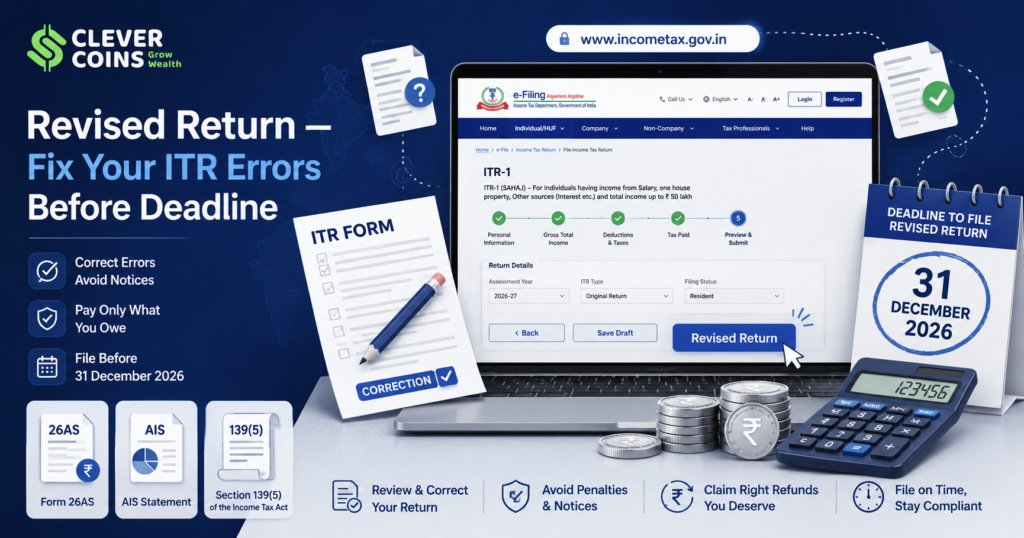
Why You May Need to File a Revised Return
Filing an Income Tax Return (ITR) is one of the most important annual financial responsibilities for every Indian taxpayer. Yet, even the most diligent taxpayers sometimes make mistakes — a missed income entry, an incorrectly claimed deduction, a forgotten bank interest, or even a simple data entry error. What happens when you file your ITR and then realise something is wrong?
The answer lies in Section 139(5) of the Income Tax Act, 1961, which provides the legal mechanism for filing a Revised Return. A Revised Return allows any taxpayer who has already filed an original ITR to correct mistakes, add omitted income, rectify wrong deductions, or update any other detail — all without facing any penalty or adverse consequence, provided the revision is done within the specified deadline.
In 2026, with the Income Tax Department’s sophisticated Annual Information Statement (AIS), Taxpayer Information Summary (TIS), and 360-degree data matching with financial institutions, it has become more important than ever to ensure your ITR accurately reflects your complete income and financial transactions. Even small discrepancies between your ITR and the AIS can trigger automated notices and scrutiny proceedings.
This comprehensive blog covers every aspect of filing a Revised Return in India in 2026 — what it is, when you can file it, what mistakes it can fix, how to file it step by step, the important differences from belated and updated returns, and how to avoid common pitfalls that Indian taxpayers face when revising their ITR.
What Is a Revised Return? Understanding Section 139(5)
A Revised Return is a fresh Income Tax Return filed to correct or update information contained in a previously filed original return. It is governed by Section 139(5) of the Income Tax Act, 1961. The key principle behind a Revised Return is that it completely replaces the original return — it is not an addendum or supplement. When you file a Revised Return, the entire ITR is refiled from scratch with the corrected information, and the original return is superseded.
Legal Framework: Section 139(5)
Section 139(5) states: ‘If any person, having furnished a return under Sub-section (1) or Sub-section (4), discovers any omission or any wrong statement therein, he may furnish a revised return at any time before the expiry of one year from the end of the relevant assessment year or before the completion of the assessment, whichever is earlier.’
In plain language for AY 2026-27 (FY 2025-26): You can file a revised return of income up to 31st December 2026 (one year from the end of AY 2026-27 which ends 31st March 2027 — but the practical deadline as notified is 31st December 2026), or before the completion of assessment by the Income Tax Officer, whichever is earlier.
Key Characteristics of a Revised Return
- It completely replaces the original return — the original stands void once the revised return is filed and processed.
- No additional fee or penalty is charged for filing a revised return (unlike belated returns which attract Section 234F fee).
- The revised return can be filed multiple times — there is no restriction on how many times you can revise (subject to the deadline).
- It can be filed both to increase tax liability (disclosing additional income) and to reduce tax liability (correcting wrong deductions or over-reported income).
- The revised return carries the same ITR form number as the original return (or can switch to a different form if the income category changes).
- All credits, deductions, and TDS claims are recalculated fresh in the revised return.
Important 2026 Update: Deadline for Revised Return
|
📅 Deadline: For FY 2025-26 (AY 2026-27), the last date to file a Revised Return under Section 139(5) is 31st December 2026. This is the same date as the last date for filing a Belated Return under Section 139(4). If you miss this deadline, you cannot file a Revised Return — your only option is the Updated Return under Section 139(8A) using ITR-U form. |
Who Can File a Revised Return? Eligibility Criteria
Not every taxpayer in every situation is eligible to file a Revised Return. Understanding the eligibility conditions is essential to avoid confusion and take the right action.
Eligibility Condition 1: Original Return Must Be Filed First
To file a Revised Return under Section 139(5), you must have already filed an original return — either a regular return under Section 139(1) (filed on or before the due date) OR a belated return under Section 139(4) (filed after the due date but before 31st December of the AY).
Important: You cannot file a Revised Return if you have not filed any return at all. If you have not filed any ITR yet, you must file a fresh belated return under Section 139(4) (if within the December 31 deadline) or an Updated Return under Section 139(8A) — not a Revised Return.
Eligibility Condition 2: Discover an Omission or Wrong Statement
The law specifically says a revised return can be filed if you ‘discover any omission or any wrong statement’ in the original return. The phrase ‘omission or wrong statement’ is broadly interpreted and covers virtually any type of error — computational mistakes, missed deductions, wrong income figures, forgotten income sources, incorrect TDS claims, and so on.
Eligibility Condition 3: Within the Time Limit
The revised return must be filed before the expiry of one year from the end of the relevant Assessment Year OR before the completion of assessment by the AO, whichever is earlier. For AY 2026-27: deadline is 31st December 2026 (or completion of assessment, if earlier).
Who Cannot File a Revised Return?
- Taxpayers who have not filed any original return for the relevant year.
- Taxpayers whose assessment has already been completed by the Assessing Officer (AO) under Section 143(1) scrutiny assessment — although this is debated in case law, it is the generally accepted position.
- Taxpayers who have missed the 31st December 2026 deadline (they must use ITR-U instead).
- Taxpayers filing under certain special provisions where revision is restricted (rare cases involving Search/Seizure under Section 132).
|
Return Type |
Who Can File Revised Return Under 139(5) |
|
Original Return (Section 139(1)) — filed on time |
YES — fully eligible for revision |
|
Belated Return (Section 139(4)) — filed late |
YES — eligible for revision (per latest legal position and CBDT practice in 2026) |
|
No Return Filed |
NOT eligible — must file belated (Sec 139(4)) or updated return (Sec 139(8A)) instead |
|
Return after assessment completed |
NOT eligible for revision; must seek rectification under Section 154 instead |
|
Updated Return (Section 139(8A)) |
NOT eligible for further revision; ITR-U cannot be revised |
When Should You File a Revised Return? Common Triggers
Knowing when to file a Revised Return is as important as knowing how. Here are the most common situations that should prompt you to revise your ITR in 2026:
Trigger 1: Forgot to Include an Income Source
This is the most common reason for filing a Revised Return. Taxpayers often forget to include income from freelance work, interest from savings accounts, fixed deposits, recurring deposits, dividends received from mutual funds or shares, rental income from a second property, or income from part-time consulting. In 2026, the AIS (Annual Information Statement) comprehensively tracks most of these incomes — so even if you miss them in your ITR, the department will know.
Action: File a Revised Return with the omitted income included, recalculate the tax liability, and pay the differential tax along with applicable interest under Section 234B/234C before filing the revised return.
Trigger 2: Missed a Deduction or Claimed Wrong Deduction
Taxpayers sometimes forget to claim eligible deductions under Chapter VI-A — such as Section 80C (PPF, ELSS, LIC premium, home loan principal), Section 80D (health insurance premium), Section 80G (donations), Section 80E (education loan interest), or Section 24(b) (home loan interest). Conversely, a wrong deduction may have been claimed (e.g., claiming 80C deduction in the new tax regime, which is not allowed, or over-stating 80C investments).
Action: File a Revised Return with corrected deduction figures. If you were over-claiming, the revised return will show higher tax — pay the differential. If you missed a valid deduction, the revised return will show lower tax and potentially generate a refund.
Trigger 3: Wrong Bank Account Details for Refund
If you entered incorrect bank account details (wrong account number or IFSC code) in your original ITR, your tax refund cannot be credited. The Income Tax Department will attempt refund but it will fail and reflect as ‘Refund Failure’ in your portal dashboard. Filing a Revised Return with correct bank details resolves this issue.
Note: For simple bank detail corrections, you may also use the ‘Refund Re-issue Request’ facility on the portal (under ‘Services → Refund Reissue’) without filing a full revised return. However, if there are other errors too, a full revised return is recommended.
Trigger 4: Received AIS/AIS Mismatch Notice from Income Tax Department
In 2026, the Income Tax Department sends proactive AIS mismatch notices (called ‘Compliance Portal Notices’) to taxpayers where the income reported in the ITR does not match the data in the AIS/TIS. If you receive such a notice, you can either confirm the AIS data is correct (in which case you must file a Revised Return to include the omitted income) or dispute the AIS data (by raising an objection on the AIS portal).
Trigger 5: Wrong ITR Form Selection
Using the wrong ITR form is a surprisingly common mistake. For example, a salaried taxpayer with capital gains from mutual fund redemptions should use ITR-2, not ITR-1 (Sahaj). If the wrong form was used, the return is technically defective and may be treated as invalid. A Revised Return using the correct form should be filed immediately.
Trigger 6: Missing TDS Credits or Wrong PAN
If a TDS deductor used your wrong PAN, the TDS credit will not reflect in your Form 26AS or AIS. After getting the PAN corrected by the deductor (who needs to file a TDS correction statement), you should file a Revised Return to correctly claim the TDS credit and adjust your tax liability accordingly.
Trigger 7: Change in Residential Status
If you initially filed as a ‘Resident’ but later realised you qualify as a ‘Non-Resident’ (NRI) or ‘Resident but Not Ordinarily Resident’ (RNOR), your tax liability changes significantly. Foreign income that is not taxable for NRIs would have been wrongly included. A Revised Return with the correct residential status and corresponding income adjustments must be filed.
Trigger 8: Employer Issues Revised Form 16
Companies sometimes issue revised Form 16 to employees due to year-end salary adjustments, revised perquisite calculations, or TDS corrections. If your employer issues a revised Form 16 after you have already filed your ITR, you should file a Revised Return based on the corrected Form 16 figures.
Trigger 9: Tax Audit Report / Financial Statement Corrections
Business owners and professionals who file tax audit reports (Form 3CA/3CB/3CD) may need to revise their ITR if the auditor revises the audit report after the original filing due to accounting corrections or regulatory changes.
Trigger 10: Carry-Forward Losses Not Claimed
If you failed to claim carry-forward of capital losses or business losses in your original ITR (which requires timely filing), and those losses are still legally claimable, a Revised Return can help correct this — provided the original ITR was filed within the Section 139(1) due date. Note that a belated return cannot be revised to include carry-forward of business or capital losses.
What Can and Cannot Be Changed in a Revised Return?
While a Revised Return gives significant flexibility to correct your ITR, there are boundaries to what can be changed. Understanding these boundaries prevents taxpayers from misusing the revision facility and ensures compliance.
What CAN Be Changed in a Revised Return
- Income figures — salary income, business income, capital gains (short-term and long-term), other sources income, rental income.
- Deduction claims under Chapter VI-A (Section 80C, 80D, 80E, 80G, 80TTA, 80TTB, 80U, etc.).
- House property income calculations — including home loan interest under Section 24(b).
- Choice between Old Tax Regime and New Tax Regime (Section 115BAC) — can be switched in the revised return if originally made an error, subject to the provisions of the respective regime.
- Bank account details for refund credit.
- Residential status (from Resident to NRI or vice versa with appropriate income adjustments).
- ITR form type — if originally filed the wrong form.
- Carry-forward of losses (only if original return was timely under Section 139(1)).
- Personal details like address, email, mobile number.
- Tax credit claims — TDS, TCS, advance tax paid challan details.
- Foreign assets and income disclosure schedules (Schedule FA, Schedule FSI).
What CANNOT Be Changed in a Revised Return
- The Assessment Year (AY) for which the return is filed — you cannot revise an AY 2025-26 return after 31st December 2025.
- PAN of the taxpayer — if you filed under wrong PAN, the issue must be resolved through the department; a revision alone will not fix it.
- A return that was filed after assessment is completed under Section 143(3) scrutiny.
- Conversion of a belated return into an original return (a belated return remains belated even after revision).
- Opting out of the new tax regime retroactively using a revised return, if the original option was made validly (special conditions apply for business taxpayers).
|
Action |
Can Be Fixed via Revised Return? |
|
Missed salary income from second employer |
YES |
|
Forgot to declare savings bank interest |
YES |
|
Claimed wrong Section 80C deduction amount |
YES |
|
Entered wrong bank account for refund |
YES |
|
Selected wrong ITR form |
YES |
|
Missed foreign asset disclosure (Schedule FA) |
YES |
|
Wrong residential status declared |
YES |
|
AY correction (e.g., filed AY 2026-27 instead of 2025-26) |
NO — contact IT Helpdesk |
|
Change PAN details |
NO — requires official PAN correction |
|
File after December 31, 2026 deadline |
NO — use ITR-U instead |
How to File a Revised Return Online – Step-by-Step Guide (2026)
Filing a Revised Return is done on the official Income Tax e-filing portal (www.incometax.gov.in). The process is straightforward but requires careful attention to ensure all corrections are accurately made. Here is the complete step-by-step guide:
Pre-Filing Checklist: Documents & Information Needed
- Acknowledgement Number (ITR-V number) of the original ITR filed — this is mandatory for linking the revised return to the original.
- Date of filing of the original ITR.
- Form 16 / Form 16A (revised, if applicable) from employer / TDS deductors.
- Updated Form 26AS downloaded from the portal (to check all TDS credits).
- Annual Information Statement (AIS) and Taxpayer Information Summary (TIS) from the portal.
- Bank statements, capital gains statements from broker, rental agreement, and any other income proof.
- Investment proofs for all deductions being claimed under Chapter VI-A.
- Challan copy if you are paying additional self-assessment tax before filing the revised return.
Step-by-Step Filing Process
- Log in to the Income Tax e-Filing Portal: Visit www.incometax.gov.in and log in with your PAN and password (or Aadhaar OTP).
- Navigate to File Return: Click on ‘e-File’ → ‘Income Tax Returns’ → ‘File Income Tax Return’.
- Select Assessment Year: Choose ‘2026-27’ for FY 2025-26 returns.
- Select Filing Mode: Choose ‘Online’ for the online filing method (recommended). You may also use ‘Offline’ mode for JSON upload.
- Select Return Type as Revised: When prompted to select the type of return, choose ‘Revised Return under Section 139(5)’. The portal will ask you to enter the Acknowledgement Number and Date of Filing of the original ITR.
- Enter Original Return Details: Enter the 15-digit ITR Acknowledgement Number from your original ITR (found on the ITR-V document or in your e-filing portal history). Enter the date the original ITR was filed.
- Select the Correct ITR Form: Choose the appropriate ITR form — ITR-1 (Sahaj), ITR-2, ITR-3, ITR-4 (Sugam), ITR-5, ITR-6, or ITR-7 — based on your income sources. If you filed the wrong form originally, switch to the correct one now.
- Pre-fill and Verify Data: The portal will pre-fill available data from the original return, AIS, and Form 26AS. Review carefully — the pre-filled data from AIS may include incomes you missed in the original return.
- Make All Necessary Corrections: Update all fields that require correction. Add missing income, correct wrong figures, update deduction amounts, fix bank account details, change residential status, etc.
- Recalculate Tax Liability: The portal will automatically recalculate your total tax liability based on the revised figures. Compare with the tax paid in the original return to determine if additional tax is due.
- Pay Additional Tax (If Required): If the revised return shows higher tax liability than what was paid in the original return, pay the differential amount as ‘Self-Assessment Tax’ using Challan 280 before submitting. Also calculate and pay Section 234B / 234C interest on the additional tax amount. Enter the challan details in the ITR form.
- Review Summary and Submit: Review the complete return summary — income, deductions, tax liability, TDS credits, refund or tax due. Once satisfied, click ‘Submit’.
- e-Verify Immediately: After submission, e-verify the revised return immediately using Aadhaar OTP, Net Banking EVC, Bank Account EVC, or Demat Account EVC. Without verification, the return is not considered filed. If you cannot e-verify, send a signed physical ITR-V to CPC Bengaluru (via ordinary or speed post) within 30 days of filing.
Confirmation of Revised Return Filing
After successful filing and e-verification, you will receive a new ITR Acknowledgement Number for the revised return. Save this for your records. The original return’s acknowledgement number is now superseded. Any further communications from the Income Tax Department will refer to the revised return’s acknowledgement number.
Tax Calculation & Payment Before Filing Revised Return
One of the most critical aspects of filing a Revised Return is correctly calculating and paying any additional tax before submission. Filing a revised return without paying the full tax due results in a defective return notice under Section 139(9).
How to Calculate Additional Tax Due
The additional tax payable when filing a revised return is calculated as follows:
- Calculate Total Tax on Revised Income: Apply the applicable tax slabs (old regime or new regime as chosen) to the revised total income. Add surcharge (if applicable) and Health & Education Cess at 4%.
- Deduct TDS/TCS Credits: Deduct all TDS (as per Form 26AS/AIS) and any TCS from the gross tax liability.
- Deduct Advance Tax Paid: Deduct advance tax already paid in the financial year.
- Calculate Self-Assessment Tax: The balance is the self-assessment tax payable.
- Calculate Interest Under 234A: 1% per month (or part thereof) on the self-assessment tax from the original due date (31st July 2026 for individuals) to the actual payment date.
- Calculate Interest Under 234B: 1% per month on the shortfall in advance tax (if advance tax paid was less than 90% of total tax liability).
- Total Amount Payable: Sum of self-assessment tax + 234A interest + 234B/234C interest.
How to Pay Additional Tax — Challan 280
Additional tax for a revised return is paid using Challan 280 (Income Tax on Companies / Other Than Companies) on the NSDL TIN portal or through the Income Tax e-filing portal under ‘e-Pay Tax’. Select:
- Tax Applicable: (0021) Income Tax (Other than Companies) for individuals.
- Type of Payment: (300) Self-Assessment Tax.
- Assessment Year: 2026-27 (for FY 2025-26).
- Amount: Total tax + interest calculated above.
After payment, note the BSR Code (7-digit bank branch code), Challan Serial Number, and Date of Payment from the challan receipt. Enter these details in the ‘Tax Paid’ schedule of the revised ITR.
When Is No Additional Tax Required?
If the Revised Return shows lower tax liability than the original return (e.g., you are correcting a deduction that was wrongly claimed, or you had over-reported income), no additional tax payment is required. In fact, the revised return may generate a higher refund. The excess tax paid will be refunded by the Income Tax Department after processing the revised return.
|
Revised Return Scenario |
Tax Impact |
Action Required |
|
Added missed income (salary, FD interest, capital gains) |
Higher tax liability |
Pay differential tax + 234A/B interest before filing |
|
Corrected over-stated deduction (e.g., excess 80C) |
Higher tax liability |
Pay differential tax + interest before filing |
|
Added missed deduction (valid, previously overlooked) |
Lower tax liability |
No payment needed; claim higher refund |
|
Corrected over-reported income (entered wrong figure) |
Lower tax liability |
No payment needed; higher refund generated |
|
Fixed bank account details only |
No change in tax |
No payment needed; just update bank details |
|
Corrected wrong ITR form (no income change) |
No change in tax |
No payment; re-file with correct form |
Revised Return vs Belated Return vs Updated Return – Key Differences
Understanding the difference between these three types of returns is crucial for every Indian taxpayer. Each serves a different purpose and carries different implications.
|
Parameter |
Revised Return (Sec 139(5)) |
Belated Return (Sec 139(4)) |
Updated Return ITR-U (Sec 139(8A)) |
|
Purpose |
Correct errors in filed return |
File return after due date |
File/update after all deadlines |
|
Prerequisite |
Original return must exist |
No return filed before |
Any return status (or none) |
|
Deadline (AY 26-27) |
31st Dec 2026 |
31st Dec 2026 |
Up to 31st March 2029 |
|
Fee / Penalty |
NIL — no extra fee |
Section 234F fee applies |
25% or 50% additional tax |
|
Can file to get refund? |
YES |
YES |
NO — cannot increase refund |
|
Carry forward losses |
YES (if orig filed on time) |
NO (most losses) |
NO |
|
Can be revised later? |
YES (multiple times) |
YES (via Sec 139(5)) |
NO — cannot revise ITR-U |
|
Multiple revisions? |
YES — unlimited times |
Only once (via 139(5)) |
Only once per AY |
Special Scenarios and Complex Cases for Revised Returns (2026)
Scenario 1: Salaried Taxpayer Receives Revised Form 16
Situation: Ms. Nandita, a salaried employee in Pune, filed her ITR for FY 2025-26 in July 2026 based on Form 16. In September 2026, her employer issued a revised Form 16 reflecting an additional performance bonus of ₹1.2 lakh paid in March 2026 that was inadvertently omitted from the original Form 16.
Action Required: Ms. Nandita must file a Revised Return (Section 139(5)) by 31st December 2026, adding the ₹1.2 lakh bonus to her salary income. She must calculate the additional tax on ₹1.2 lakh (at her applicable slab rate), add Section 234B interest if advance tax was short, and pay the differential before filing the revised return.
Tax Calculation Example (30% slab): ₹1,20,000 × 30% = ₹36,000 + 4% cess = ₹37,440 additional tax. Plus 234A interest for ~2 months: ₹37,440 × 1% × 2 = ₹749. Total additional payment before filing revised return: approximately ₹38,189.
Scenario 2: Missed Claiming Section 80D Health Insurance Premium
Situation: Mr. Arjun, a Delhi-based professional with income of ₹15 lakh, filed his ITR under the old tax regime but forgot to claim Section 80D deduction for health insurance premium of ₹30,000 paid for himself and his family.
Action Required: File a Revised Return under Section 139(5) with Section 80D deduction of ₹30,000 included. This will reduce taxable income by ₹30,000, resulting in a lower tax liability. The revised return will generate a refund (or reduce any amount payable).
Tax Saving: ₹30,000 × 30% (tax rate) = ₹9,000 saved + ₹360 cess saving = ₹9,360 total tax benefit. The department will process the refund after verifying the revised return.
Scenario 3: Forgot to Declare Savings Account Interest
Situation: Ms. Kavitha, a retired teacher in Chennai with pension income of ₹4.8 lakh, filed ITR-1. She forgot to include interest income of ₹28,000 from three different savings accounts. The AIS shows this interest income.
Action Required: File a Revised Return adding ₹28,000 as ‘Income from Other Sources’ (savings account interest). Note that Section 80TTA allows deduction of up to ₹10,000 for savings account interest for non-senior citizens. For senior citizens, Section 80TTB allows deduction up to ₹50,000.
Since Ms. Kavitha is a senior citizen: The ₹28,000 interest is fully exempt under Section 80TTB. However, she must still disclose the income and claim the Section 80TTB deduction — the Revised Return achieves this with no additional tax outgo.
Scenario 4: Wrong Bank Account Resulting in Refund Failure
Situation: Mr. Deepak filed ITR-2 with a refund of ₹45,000 due. He entered his old HDFC bank account number (which he had closed). The refund failed and was returned to the department. He wants to update his SBI account details.
Action Required: Option A (Simpler) — Use the ‘Refund Re-issue Request’ on the portal under Services → Refund Reissue. Select the new SBI account and authenticate. Option B (Comprehensive) — File a Revised Return with the correct SBI bank account details. The Revised Return approach is recommended if there are other corrections also needed in the ITR.
Scenario 5: Switch from New Tax Regime to Old Tax Regime
Situation: Mr. Suresh filed his ITR for FY 2025-26 under the New Tax Regime (default from FY 2023-24). He later realises that under the Old Tax Regime, his tax liability would be significantly lower due to multiple deductions (80C, 80D, home loan interest, HRA, etc.).
Action Required for Salaried Individuals: Salaried individuals (without business income) can switch between old and new regime every year. They can file a Revised Return opting for the Old Tax Regime, provided the revised return is filed before 31st December 2026. Recalculate tax under old regime with all deductions and file the revised return with the corrected tax figures. This is one of the most tax-saving uses of the revised return facility.
Note for Business Taxpayers: Persons with business or professional income who have opted for the old tax regime cannot switch back to the new regime (except under specific conditions). They must exercise their option in Form 10-IEA on or before the due date of filing return, and switching back has consequences. Consult a CA before revising for regime change as a business taxpayer.
Scenario 6: Omitted Foreign Assets / Foreign Income (Schedule FA)
Situation: Ms. Priya, a software professional in Hyderabad, had a savings account in the USA during FY 2025-26 which she opened during an overseas assignment. She forgot to disclose this in Schedule FA (Foreign Assets) of her original ITR.
Action Required: Non-disclosure of foreign assets is a serious compliance lapse under the Black Money (Undisclosed Foreign Income and Assets) and Imposition of Tax Act, 2015. Filing a Revised Return with Schedule FA correctly filled is strongly recommended to avoid penalties of ₹10 lakh per foreign asset not disclosed (under Black Money Act Section 43). File the Revised Return immediately with correct Schedule FA and Schedule FSI (foreign income) details. Consult a CA specialising in international tax for this scenario.
How AIS and TIS Impact Revised Return Decisions in 2026
The Annual Information Statement (AIS) and Taxpayer Information Summary (TIS) are among the most powerful tools the Income Tax Department uses to identify income discrepancies. In 2026, these statements are more comprehensive than ever before, and comparing them with your ITR is the single most effective way to identify whether you need to file a Revised Return.
What Is AIS (Annual Information Statement)?
AIS is a comprehensive statement that consolidates all financial transactions related to a taxpayer from multiple sources:
- Salary income from employer (as reported in Form 24Q TDS return).
- Interest income from savings accounts, fixed deposits, and recurring deposits (from banks and NBFCs).
- Dividend income from equity shares and mutual funds.
- Securities transactions — purchase and sale of equity shares, mutual funds, and bonds.
- Real estate transactions — purchase and sale of property.
- Foreign remittances received (LRS transactions).
- Cash deposits and withdrawals above threshold amounts.
- GST turnover data (for business taxpayers).
- EPF withdrawals, pension disbursements, insurance commission received.
How to Access AIS and TIS
- Log in to the Income Tax Portal: www.incometax.gov.in.
- Go to ‘Services’ → ‘Annual Information Statement (AIS)’.
- Download AIS (Full Statement) and TIS (Summary) for the relevant FY.
- Compare AIS data with your ITR — look for any income in AIS that was not reported in your original ITR.
- If discrepancies are found: (a) If AIS data is correct — file Revised Return with the income included. (b) If AIS data is incorrect — submit feedback/objection on the AIS portal to correct the data at source.
AIS Mismatch Notices and Compliance Portal
In 2026, the Income Tax Department sends automated AIS Mismatch Notices through the Compliance Portal (compliance.insight.gov.in). If you receive such a notice:
- Log in to the Compliance Portal and view the specific mismatch details.
- If the AIS data is correct: Submit response ‘Income is correct — Revising the return’ and file a Revised Return including the missing income.
- If the AIS data is incorrect: Submit response ‘Information is incorrect’ and provide explanation. Follow up with the source of data (bank, broker) to get the AIS corrected.
- Ignoring AIS Mismatch Notices can lead to escalation, scrutiny assessment under Section 143(3), and demand notices.
Impact of Revised Return on Tax Refunds
Filing a Revised Return can both increase and decrease your tax refund, depending on the nature of corrections made. Understanding how refunds are affected helps taxpayers plan their revisions strategically.
Revised Return That Increases Refund
If your revised return shows lower tax liability than the original (e.g., you claim a previously missed deduction, correct over-reported income, or switch to a more beneficial tax regime), the refund amount increases. The Income Tax Department processes the revised return and credits the higher refund to your registered bank account. The timeline for refund credit after filing a revised return is typically 4–12 weeks, depending on the nature of corrections and the department’s processing queue.
Revised Return That Decreases Refund
If your revised return shows higher tax liability (e.g., you add missed income), any refund claimed in the original return is reduced or eliminated. If you had already received the refund from the original return and the revised return shows a tax liability, you are required to return the excess refund received plus pay interest under Section 234D (interest on excess refund at 0.5% per month from the date the refund was issued to the date of revised return filing).
Section 244A – Interest on Delayed Refunds
If your revised return claims a larger refund, the Income Tax Department pays interest at 0.5% per month under Section 244A on the excess refund amount — calculated from 1st April of the AY to the date of refund credit. This interest is taxable as ‘Income from Other Sources’ in the year of receipt.
Consequences of NOT Filing a Revised Return When Needed
Some taxpayers are reluctant to file a Revised Return because they worry it will invite scrutiny. This is a misconception. The consequences of NOT revising when income was missed or errors were made are far more serious than the transparency of filing a correction:
Consequence 1: Scrutiny Assessment Under Section 143(3)
The department’s AI system matches ITR data against AIS/TIS. If significant discrepancies are found and no revised return was filed, the case may be selected for scrutiny assessment. The AO can add the unaccounted income to your taxable income and make a demand with interest and penalty.
Consequence 2: Penalty Under Section 270A for Under-Reporting
Under Section 270A, if the AO determines that income was under-reported in the ITR, a penalty equal to 50% of the tax payable on under-reported income is levied. In cases of misreporting (deliberate concealment), the penalty escalates to 200%. These are in addition to the full tax and interest already due.
Consequence 3: Section 148 Reassessment Notice
If the Income Tax Department receives information that income has escaped assessment, they can issue a notice under Section 148 for reassessment. In 2026, the time limit for issuing a Section 148 notice is 3 years from the end of the AY (for income below ₹50 lakh) and up to 10 years (for income above ₹50 lakh involving foreign assets or specified cases). Reassessment proceedings are far more invasive and costly than proactively filing a revised return.
Consequence 4: Prosecution Under Section 276C
Willful failure to disclose income or file correct returns can result in criminal prosecution under Section 276C with imprisonment from 3 months to 7 years along with fines. While prosecution is reserved for serious cases, the risk is real and growing with the department’s enhanced enforcement capabilities in 2026.
Common Mistakes to Avoid While Filing a Revised Return
Mistake 1: Not Entering Original Acknowledgement Number
The most common technical error is forgetting to enter the original return’s Acknowledgement Number when filing the revised return. Without this linkage, the revised return is treated as a fresh filing and the original return remains active in the system, creating duplicate returns. Always keep your original ITR-V acknowledgement handy.
Mistake 2: Filing Revised Return Without Paying Differential Tax
Submitting a revised return that shows higher tax without paying the differential first results in a defective return notice under Section 139(9). Pay all additional tax, interest, and fees via Challan 280 BEFORE submitting the revised ITR. Enter the challan BSR code and serial number correctly in the ITR.
Mistake 3: Only Correcting the Mistake Without Reviewing the Full Return
Many taxpayers correct only the specific error they noticed and re-submit without reviewing the entire return. Use the revision as an opportunity for a comprehensive review — check all income heads, deductions, TDS credits, and personal details against AIS/TIS. Multiple corrections can be made in a single revision.
Mistake 4: Filing the Revised Return After Receiving an Assessment Order
If a Section 143(1) intimation or Section 143(3) assessment order has been issued and accepted, filing a revised return is not valid. In such cases, use Section 154 (rectification of mistake apparent from record) or Section 263/264 (revision by Commissioner) as appropriate. Consult a CA if you are in this situation.
Mistake 5: Thinking Revised Return Invites Scrutiny
This is a widespread myth. Filing a Revised Return does NOT automatically trigger scrutiny. In fact, proactively correcting your return is viewed positively by the department as it demonstrates compliance. The real red flag that triggers scrutiny is NOT revising when the AIS shows discrepancies.
Mistake 6: Revising After the 31st December Deadline
Taxpayers sometimes wait too long and miss the 31st December deadline. If you miss the deadline for a revised return, the only option is ITR-U (Updated Return) under Section 139(8A), which comes with a significant additional tax cost of 25% or 50% of aggregate tax. Act well before the deadline.