Future of Meeting Management in India: How AI, Hybrid Equity, and Smart Governance Are Redefining Corporate Productivity
Walk into any corporate office across Bengaluru, Mumbai, Gurugram, Hyderabad, or Pune on a Tuesday morning, and you will witness a quiet revolution unfolding behind glass conference room doors. For decades, business meetings in India were treated as an unmeasured cost of doing business—sprawling calendar invites, crowded boardrooms, endless status updates, manually typed minutes of meetings (MoMs), and follow-up threads that vanished into crowded email inboxes.
That era is rapidly coming to an end.
The future of meeting management in India is no longer about simply booking a conference room or sending out a video call link. Driven by the explosive expansion of Global Capability Centers (GCCs), the maturation of hybrid work across Tier-1 and Tier-2 cities, rapid enterprise AI adoption, and strict data privacy regulations under India’s Digital Personal Data Protection (DPDP) framework, Indian organizations are fundamentally re-engineering how, why, and where people gather to make decisions.
At CleverCoins (clevercoins.org), we work closely with Indian founders, CFOs, compliance leaders, and operations heads who recognize a fundamental truth: every unproductive meeting is a direct leak on your balance sheet. When a ten-person leadership team spends ninety minutes in an unstructured review without clear pre-reads, decision frameworks, or automated accountability, the organization doesn’t just lose fifteen man-hours—it loses execution velocity, strategic clarity, and capital efficiency.
In this definitive guide, we examine the technological, regulatory, financial, and cultural forces shaping the future of meeting management in India over the next decade—and provide a practical blueprint for Indian enterprises, fast-scaling startups, and MSMEs to turn meetings from a calendar drain into a measurable competitive advantage.
1. The Macroeconomic Shift: Why India’s Workplace Landscape Is Forcing a Meeting Overhaul
To understand where meeting management in India is headed, we must first examine the structural shifts reshaping Indian workplaces right now.
The GCC Boom and Multi-City Standardization
India has cemented its position as the world’s undisputed hub for Global Capability Centers. According to commercial real estate research from JLL, India’s office leasing surged to 61 million square feet in just the first nine months of 2026 alone, with GCCs accounting for roughly 43% of total absorption. When global enterprises and domestic unicorns scale across Bengaluru, Hyderabad, Chennai, Delhi NCR, and emerging hubs like Ahmedabad, Kochi, and GIFT City, managing meetings across distributed campuses becomes an operational bottleneck.
A meeting room workflow that works on one floor in Whitefield must function identically in Hitech City or CyberHub—often supported by lean local IT and facilities teams. Organizations can no longer tolerate fragmented setups where half the meeting is spent troubleshooting HDMI cables, audio echo, or incompatible video conferencing platforms.
India’s Productivity Software Surge
The financial investment backing this transformation is massive. Market analysis indicates that India’s productivity software market—valued at roughly USD 2.4 billion in 2025—is expanding at a compound annual growth rate (CAGR) of 19.5% to reach over USD 8.35 billion by 2032, while India’s team collaboration software segment is projected to scale from USD 872 million in 2025 to more than USD 2.37 billion by 2034. Crucially, AI productivity tools are shifting from niche experiments to core enterprise infrastructure, projected to capture over 22% of productivity software revenues by the early 2030s.
The Hidden Financial Cost of Unmanaged Meetings in Indian Businesses
For Indian MSMEs and mid-market enterprises operating on tight working capital cycles, unoptimized meetings carry a steep hidden tax:
Executive Bandwidth Erosion: Senior managers and founders often spend 40% to 55% of their workweek in recurring status meetings rather than customer acquisition, product innovation, or financial governance.
Decision Latency: Without standardized decision logs, Indian teams frequently revisit the exact same operational or compliance questions across three consecutive weekly calls.
Real Estate Underutilization: Commercial office space in prime Indian business districts commands premium per-square-foot rentals. When two employees occupy a twelve-seater boardroom for an hour—or worse, when “ghost bookings” leave prime rooms empty while teams scramble for space—companies pay directly for wasted square footage.
2. Core Pillar 1: AI Meeting Copilots and Autonomous Workflow Execution
The single biggest technological leap in the future of meeting management in India is the transition from passive recording tools to autonomous AI meeting copilots.
Beyond Basic Transcription: Agentic Action-Item Execution
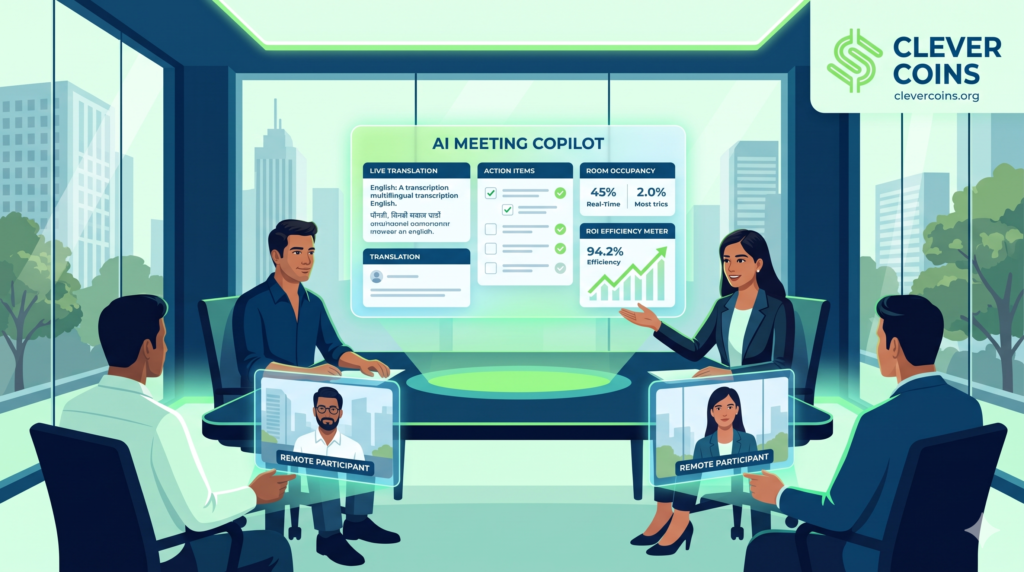
Early meeting tools merely recorded audio and generated raw transcripts. The next generation of AI meeting management platforms acts as an active, intelligent participant in the room:
Pre-Meeting Context Assembly: Before a call even begins, AI copilots automatically pull relevant financial dashboards, unresolved tickets from Jira or Zoho Projects, previous meeting commitments, and regulatory deadlines, delivering a concise 3-minute briefing packet to every attendee.
Real-Time Decision & Risk Flagging: During live discussions, AI systems detect commitments (“I will file the revised GST reconciliation by Friday”), assign owners automatically, flag potential timeline conflicts, and surface missing data points on the spot.
Post-Meeting Workflow Automation: Instead of a junior analyst spending forty-five minutes formatting Minutes of Meetings (MoMs), the AI generates role-specific summaries within seconds—sending financial action items to the CFO’s dashboard, legal compliance tasks to the Company Secretary, and sprint updates directly into engineering boards.
Multilingual and Hinglish Intelligence for Diverse Indian Teams
A uniquely Indian challenge—and competitive advantage—is linguistic diversity. In real-world Indian boardrooms, factory floor reviews, and client negotiations, conversations naturally flow across English, Hindi (“Hinglish”), Tamil, Telugu, Kannada, Marathi, Gujarati, and Bengali.
Modern Indian-ready meeting management systems are now leveraging localized speech-to-text acoustic models trained specifically on Indian accents, regional dialects, and code-switched business vocabulary. Whether a regional sales manager in Indore switches between Hindi and English during a quarterly target review or a manufacturing head in Coimbatore discusses vendor dispatch schedules in Tamil and English, AI transcription and translation engines capture nuances accurately without losing technical or financial context.
From “Buying AI Hype” to Measurable AI ROI
Indian CIOs and CFOs have grown far more disciplined about technology procurement. Industry observers note that enterprises are no longer approving software budgets simply because a vendor slaps an “AI” label on a product. Every AI meeting tool deployed in India must now justify its license cost through hard metrics:
Reduction in average meeting duration (e.g., shifting default slots from 60 minutes to 25 or 45 minutes).
Measurable decrease in follow-up clarification emails.
Faster turnaround time on board resolutions, audit closures, and client onboarding.
3. Core Pillar 2: “Meeting Equity” and the Next-Gen Hybrid Boardroom
Hybrid work in India is no longer an emergency pandemic measure—it is a permanent, structured operating model. Many Indian IT services firms, SaaS startups, consulting practices, and GCCs operate on two-to-three-day anchor office schedules, while cross-functional teams collaborate daily with remote specialists across India and global time zones.
However, traditional conference rooms created a glaring “two-tier” experience: employees sitting in the physical room enjoyed lively side conversations and clear visibility, while remote participants stared at a wide-angle bowling-alley view of the back of someone’s head, struggling to hear who was speaking.
Hardware & Room Architecture Transforming Indian Offices
To solve this, Indian workplace designers and IT teams are standardizing around Meeting Equity—ensuring every participant can see, hear, and contribute equally regardless of physical location:
AI Multi-Camera Framing & Speaker Tracking: Intelligent camera bars automatically detect active speakers in a Bengaluru boardroom and crop individual video tiles for each person around the table, placing remote and in-room colleagues on an equal visual grid.
Beamforming Ceiling Microphones & Acoustic Zoning: Open-plan Indian offices can be noisy. Advanced acoustic fencing isolates voices inside huddle zones while blocking background chatter, HVAC hum, and traffic noise.
BYOD (Bring Your Own Device) & Platform-Agnostic Rooms: Indian organizations frequently collaborate with clients, auditors, and investors across Microsoft Teams, Google Meet, Zoom, and Webex. Standardizing rooms around seamless wireless BYOD connectivity eliminates the dreaded “can you hear me?” ten-minute startup delay.
Interactive Digital Whiteboards: Distributed product and finance teams now co-edit financial models, process flowcharts, and compliance checklists simultaneously on 4K interactive touch displays that sync instantly to cloud workspaces.
4. Core Pillar 3: Data-Driven Space Utilization & Smart Facility Management
For CFOs and facilities heads managing multi-floor offices in Mumbai’s BKC, Gurugram’s Golf Course Road, or Bengaluru’s Outer Ring Road, meeting room management has become a hard real estate analytics discipline.
Eliminating “Ghost Bookings” Through IoT Sensors
A persistent headache across Indian corporate offices is the phantom reservation: recurring weekly meetings booked six months in advance that never actually happen, locking out teams that genuinely need a room.
The future of meeting room management replaces passive calendar bookings with active occupancy intelligence:
Touch-Panel Check-Ins & Auto-Release: Digital room schedulers mounted outside glass doors require a one-tap check-in (or NFC employee badge tap) within 10 minutes of the scheduled start time. If nobody checks in, the system automatically cancels the booking and releases the room back into the live pool.
mmWave & Computer-Vision Occupancy Sensors: Privacy-safe sensors count exact headcount inside a room without capturing facial identity. If data reveals that 70% of bookings in a 10-seater boardroom involve only two or three people, facilities teams can intelligently partition oversized rooms into high-demand 4-person huddle pods.
Predictive Energy & HVAC Integration: Smart building management systems (BMS) link directly to the meeting calendar—pre-cooling a boardroom 10 minutes before a verified meeting begins and powering down lighting and air conditioning the moment sensors confirm the room is empty, slashing commercial electricity bills and advancing ESG sustainability targets.