Professional Tax in India – Complete Guide to State-wise Rates, Slabs, Filing & Compliance (2025–26)
The Tax That Every Working Indian Should Know About
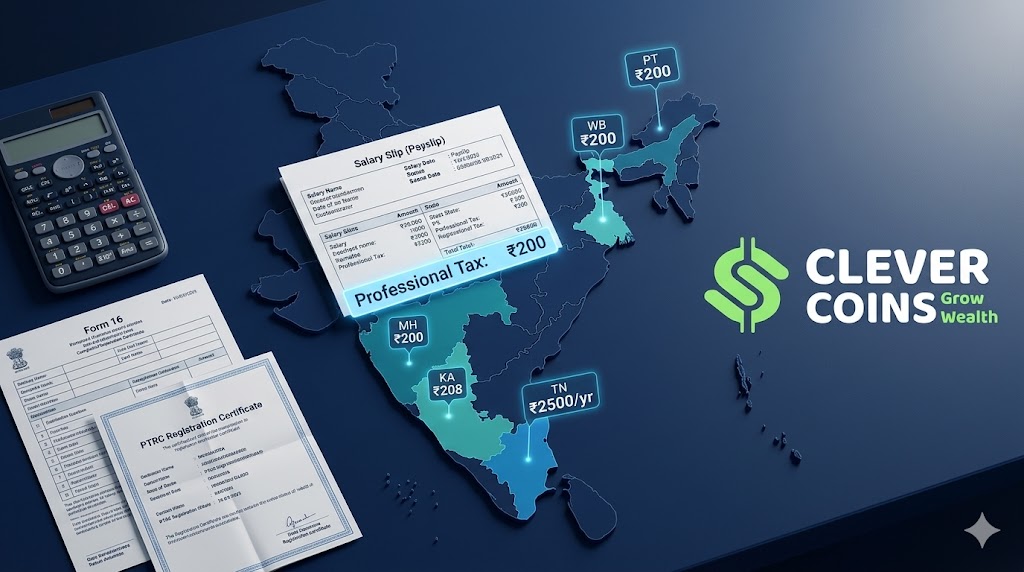
Every month, when a salaried employee in Maharashtra, Karnataka, or West Bengal receives their salary slip, they notice a small deduction — often between ₹150 and ₹200 — labelled ‘Professional Tax’ or ‘PT’. Most employees accept this deduction without ever fully understanding what it is, who levies it, where it goes, or how it is calculated.
Professional Tax (PT) is one of India’s least understood yet universally applicable taxes. Unlike GST or Income Tax — which are administered by the Central Government — Professional Tax is a state-level direct tax levied by individual state governments and municipal bodies on persons engaged in any profession, trade, calling, or employment. It is constitutional, it is mandatory in the states that levy it, and failing to comply can attract penalties and legal consequences for both employers and employees.
For business owners, MSMEs, HR managers, startups, and self-employed professionals, understanding Professional Tax is a critical compliance responsibility. Employers must register, deduct the correct amount from employee salaries based on state-specific slabs, deposit the tax with the state government, and file periodic returns. Self-employed individuals must separately enroll and pay PT on their own income.
This comprehensive 2025-26 guide by CleverCoins covers every aspect of Professional Tax in India — what it is, who pays it, the complete state-wise rate tables, how to register, how to file, due dates, penalties, exemptions, and how PT interacts with Income Tax and payroll compliance.
What is Professional Tax? — Constitutional Basis & Legal Framework
Professional Tax is authorised under Article 276 of the Indian Constitution, which empowers state legislatures to levy taxes on professions, trades, callings, and employment. The Constitution also places a cap on this tax — the maximum Professional Tax that any state can levy on any individual is ₹2,500 per year.
Despite its name, Professional Tax is NOT restricted to ‘professionals’ like doctors, lawyers, or engineers. It applies to anyone earning an income from any vocation — salaried employees, businesspersons, traders, consultants, freelancers, and even directors of companies in states where PT is enforced.
🏛️ Constitutional Basis of Professional Tax Article 276 of the Constitution of India: ‘Notwithstanding anything in Article 246, no law of the Legislature of a State relating to taxes for the benefit of the State or of a municipality, district board, local board or other local authority therein in respect of professions, trades, callings and employments shall be invalid on the ground that it relates to a tax on income; but the total amount payable in respect of any one person to the State or to any one municipality, district board, local board or other local authority in the State by way of taxes on professions, trades, callings and employments shall not exceed two thousand and five hundred rupees per annum.’ Key implication: ₹2,500/year is the MAXIMUM allowable. Each state sets its own rates within this ceiling. |
Key Characteristics of Professional Tax
- State-Level Tax: Each state that levies PT has its own dedicated Act and Rules. There is no central Professional Tax Act.
- Not Applicable Nationally: Not all states levy Professional Tax. States like Delhi, Haryana, Uttar Pradesh, Himachal Pradesh, Rajasthan, and several northeastern states do not levy PT.
- Slab-Based: PT is not a flat rate. It is levied in slabs based on the individual’s income/salary — similar to income tax but at a much smaller scale.
- Dual Registration: Employers must register under PTRC (Professional Tax Registration Certificate) to deduct and pay PT on behalf of employees. Self-employed persons and employers themselves register under PTEC (Professional Tax Enrollment Certificate).
- Deductible from Income Tax: PT paid by an individual is allowed as a deduction from taxable salary income under Section 16(iii) of the Income Tax Act.
- Municipal/Panchayat Level in Some States: In certain states, PT is collected by municipal corporations or panchayats rather than state governments directly.
States That Levy Professional Tax vs States That Do Not
Category | States / UTs |
States WITH Professional Tax | Maharashtra, Karnataka, West Bengal, Tamil Nadu, Andhra Pradesh, Telangana, Gujarat, Madhya Pradesh, Odisha, Kerala, Assam, Meghalaya, Tripura, Sikkim, Bihar (limited), Jharkhand (limited), Chhattisgarh (limited), Nagaland, Manipur, Mizoram, Arunachal Pradesh |
States WITHOUT Professional Tax | Delhi, Haryana, Uttar Pradesh, Uttarakhand, Rajasthan, Himachal Pradesh, Punjab, Jammu & Kashmir, Goa, Chandigarh, Dadra & Nagar Haveli, Daman & Diu, Lakshadweep, Andaman & Nicobar |
States with Partial / Limited PT | Bihar (only certain professions), Jharkhand (certain districts / categories), Chhattisgarh (certain categories) |
⚠️ Important Note for Multi-State Businesses If your business has employees or offices in multiple states, you must comply with Professional Tax laws in EACH state separately. There is no central PT registration. A company with offices in Mumbai, Bengaluru, Kolkata, and Chennai must maintain 4 separate PT registrations, calculate PT under 4 different state slabs, file 4 separate sets of returns, and deposit PT to 4 different state/municipal authorities. |
Complete State-wise Professional Tax Slabs & Rates (2025–26)
The following section provides the detailed Professional Tax slab rates for every major PT-levying state in India. These slabs apply to monthly salary/income unless stated otherwise.
- Maharashtra — Professional Tax Slab 2025–26
Maharashtra levies PT under the Maharashtra State Tax on Professions, Trades, Callings and Employments Act, 1975. It is one of the most comprehensive PT frameworks in India.
Monthly Gross Salary (₹) | Professional Tax Per Month (₹) |
Up to ₹7,500 | Nil |
₹7,501 to ₹10,000 | ₹175 per month |
₹10,001 and above | ₹200 per month (₹300 for February month) |
Annual Maximum | ₹2,400 (i.e., ₹200 × 11 months + ₹300 in February = ₹2,500 approx.) |
Special Note for Maharashtra: The February month PT is ₹300 to ensure the annual total reaches the ₹2,500 constitutional cap. Employers must file monthly PTRC returns by the last day of each month. PTEC (for self-employed/employers themselves) is ₹2,500 per year paid annually.
- Karnataka — Professional Tax Slab 2025–26
Karnataka levies PT under the Karnataka Tax on Professions, Trades, Callings and Employments Act, 1976.
Monthly Gross Salary (₹) | Professional Tax Per Month (₹) |
Up to ₹15,000 | Nil |
₹15,001 to ₹25,000 | ₹150 per month |
₹25,001 to ₹35,000 | ₹175 per month |
₹35,001 to ₹50,000 | ₹200 per month |
₹50,001 to ₹75,000 | ₹200 per month |
Above ₹75,000 | ₹208 per month (approx. ₹2,500/year) |
Annual Maximum | ₹2,500 |
Karnataka Note: The exemption limit was revised upward to ₹15,000/month. Women with gross monthly salary up to ₹25,000 are fully exempt from PT in Karnataka. Employers must file half-yearly returns.
- West Bengal — Professional Tax Slab 2025–26
West Bengal levies PT under the West Bengal State Tax on Professions, Trades, Callings and Employments Act, 1979. PT in West Bengal is monthly.
Monthly Gross Salary (₹) | Professional Tax Per Month (₹) |
Up to ₹10,000 | Nil |
₹10,001 to ₹15,000 | ₹110 per month |
₹15,001 to ₹25,000 | ₹130 per month |
₹25,001 to ₹40,000 | ₹150 per month |
Above ₹40,000 | ₹200 per month |
Annual Maximum | ₹2,400 |
- Tamil Nadu — Professional Tax Slab 2025–26
Tamil Nadu levies PT under the Tamil Nadu Municipal Laws (Second Amendment) Act. The PT in Tamil Nadu is levied on a half-yearly basis.
Half-Yearly Gross Salary (₹) | Professional Tax Per Half-Year (₹) |
Up to ₹21,000 | Nil |
₹21,001 to ₹30,000 | ₹135 |
₹30,001 to ₹45,000 | ₹315 |
₹45,001 to ₹60,000 | ₹690 |
₹60,001 to ₹75,000 | ₹1,025 |
Above ₹75,000 | ₹1,250 |
Annual Maximum | ₹2,500 |
Tamil Nadu Note: PT is due in September and March of each year. The employing authority (employer) collects and remits PT to the municipal corporation or local body.
- Andhra Pradesh — Professional Tax Slab 2025–26
Andhra Pradesh levies PT under the Andhra Pradesh Tax on Professions, Trades, Callings and Employments Act, 1987.
Monthly Gross Salary (₹) | Professional Tax Per Month (₹) |
Up to ₹15,000 | Nil |
₹15,001 to ₹20,000 | ₹150 per month |
₹20,001 to ₹ 35,000 | ₹180 per month |
Above ₹35,000 | ₹200 per month |
Annual Maximum | ₹2,400 |
- Telangana — Professional Tax Slab 2025–26
Post bifurcation from Andhra Pradesh in 2014, Telangana follows a similar PT framework under the Telangana Tax on Professions, Trades, Callings and Employments Act.
Monthly Gross Salary (₹) | Professional Tax Per Month (₹) |
Up to ₹15,000 | Nil |
₹15,001 to ₹20,000 | ₹150 per month |
₹20,001 to ₹35,000 | ₹180 per month |
Above ₹35,000 | ₹200 per month |
Annual Maximum | ₹2,400 |
- Gujarat — Professional Tax Slab 2025–26
Gujarat levies PT under the Gujarat State Tax on Professions, Trades, Callings and Employments Act, 1976.
Monthly Gross Salary (₹) | Professional Tax Per Month (₹) |
Up to ₹12,000 | Nil |
₹12,001 and above | ₹200 per month |
Annual Maximum | ₹2,400 |
Gujarat Note: Gujarat follows a simplified two-slab structure. The ₹12,000 threshold means most part-time and minimum wage workers are exempt. Women earning up to ₹25,000/month are exempt from PT in Gujarat.
- Madhya Pradesh — Professional Tax Slab 2025–26
Madhya Pradesh levies PT under the Madhya Pradesh Vritti Kar Adhiniyam, 1995.
Monthly Gross Salary (₹) | Professional Tax Per Month (₹) |
Up to ₹18,750 | Nil |
₹18,751 to ₹25,000 | ₹125 per month |
₹25,001 to ₹33,333 | ₹167 per month |
Above ₹33,333 | ₹208 per month |
Annual Maximum | ₹2,500 |
- Odisha — Professional Tax Slab 2025–26
Odisha levies PT under the Orissa State Tax on Professions, Trades, Callings and Employments Act, 2000.
Monthly Gross Salary (₹) | Professional Tax Per Month (₹) |
Up to ₹13,304 | Nil |
₹13,305 to ₹25,000 | ₹125 per month |
₹25,001 to ₹41,666 | ₹167 per month |
Above ₹41,666 | ₹208 per month |
Annual Maximum | ₹2,500 |
- Kerala — Professional Tax Slab 2025–26
Kerala levies PT under the Kerala Panchayat Raj Act and Municipal Acts. PT is collected by panchayats and municipalities on a half-yearly basis.
Half-Yearly Income (₹) | Professional Tax Per Half-Year (₹) |
Up to ₹11,999 | Nil |
₹12,000 to ₹17,999 | ₹120 |
₹18,000 to ₹29,999 | ₹180 |
₹30,000 to ₹44,999 | ₹300 |
₹45,000 to ₹59,999 | ₹450 |
₹60,000 to ₹74,999 | ₹600 |
₹75,000 to ₹99,999 | ₹750 |
₹1,00,000 to ₹1,24,999 | ₹1,000 |
Above ₹1,25,000 | ₹1,250 |
Annual Maximum | ₹2,500 |
- Assam — Professional Tax Slab 2025–26
Assam levies PT under the Assam Professions, Trades, Callings and Employments Taxation Act, 1947.
Monthly Gross Salary (₹) | Professional Tax Per Month (₹) |
Up to ₹10,000 | Nil |
₹10,001 to ₹14,999 | ₹150 per month |
₹15,000 to ₹24,999 | ₹180 per month |
Above ₹25,000 | ₹208 per month |
Annual Maximum | ₹2,500 |
- Meghalaya — Professional Tax Slab 2025–26
Meghalaya levies PT under the Meghalaya Professions, Trades, Callings and Employments Taxation Act, 1947.
Monthly Gross Salary (₹) | Professional Tax Per Month (₹) |
Up to ₹4,999 | Nil |
₹5,000 to ₹7,999 | ₹16 per month |
₹8,000 to ₹9,999 | ₹25 per month |
₹10,000 to ₹14,999 | ₹41.50 per month |
₹15,000 to ₹19,999 | ₹62.50 per month |
₹20,000 to ₹29,999 | ₹83 per month |
Above ₹30,000 | ₹208 per month |
Annual Maximum | ₹2,500 |
- Tripura & Sikkim — Professional Tax Summary
State | Threshold (Monthly) | Max PT Rate | Annual Maximum | Notes |
Tripura | Up to ₹7,500 — Nil | ₹208/month | ₹2,500 | Simple slab structure; 4 income bands |
Sikkim | Up to ₹20,000 — Nil | ₹200/month | ₹2,400 | Higher exemption threshold than most states |
📌 Always Verify Current State Notifications Professional Tax slabs are revised periodically by state governments through official government gazettes and notifications. The rates provided above are as per the latest available information for FY 2025-26. Always verify the current applicable rates with the official state commercial tax / profession tax department website or consult a CleverCoins tax advisor before processing payroll, as rates may differ for specific professions or categories not covered above. |
Who Must Pay Professional Tax? — Employer vs Employee vs Self-Employed
Professional Tax creates two distinct sets of obligations depending on whether you are an employer, a salaried employee, or a self-employed professional. Understanding both obligations is critical for complete compliance.
- Employers — PTRC (Professional Tax Registration Certificate)
Every employer (proprietorship, partnership firm, LLP, private limited company, public company, trust, or any other entity) that employs persons whose salary/remuneration makes them liable for PT must obtain a PTRC. Obligations include:
- Register for PTRC in each state where employees are employed.
- Calculate the correct PT for each employee based on the applicable state slab and the employee’s gross salary.
- Deduct PT from the employee’s salary every month (or half-year, depending on the state’s periodicity).
- Deposit the deducted PT to the state government / municipal authority by the due date.
- File PT returns (monthly, quarterly, or half-yearly, depending on the state).
- Maintain PT registers showing employee names, salary, and PT deducted.
- Self-Employed Professionals, Business Owners & Directors — PTEC
Individuals who are self-employed (consultants, freelancers, doctors, CAs, advocates, etc.) or who are employers paying PT on their own income must obtain a PTEC (Professional Tax Enrollment Certificate). Unlike PTRC (which covers deductions for employees), PTEC covers the PT liability of the owner/self-employed person themselves. In most states:
- PTEC holders pay a flat annual PT (typically ₹2,500 per year for income above the threshold).
- Companies and firms pay PTEC as entities separate from their employee payroll PT.
- PTEC payment is usually annual — due at the beginning of the financial year.
- Salaried Employees
Employees are the end-bearers of Professional Tax. Their employer deducts PT from their monthly salary and deposits it on their behalf. Employees do not need to separately register or file returns — but they should verify that PT is being deducted correctly based on their state’s slab and appearing on their salary slip and Form 16.
PTRC vs PTEC — Understanding the Two Types of PT Registration
Parameter | PTRC (Registration Certificate) | PTEC (Enrollment Certificate) |
Purpose | For employers to deduct & remit PT on behalf of employees | For employers/self-employed to pay PT on their own income |
Who Obtains | Every employer with PT-liable employees | Self-employed professionals, business owners, companies as entities |
Tax Borne By | Employee (deducted from salary) | Owner / self-employed person (paid from own funds) |
Return Filing | Monthly, quarterly, or annual returns on employee deductions | Annual return or challan in most states |
Typical Rate | Slab-based on employee salary | Flat ₹2,500/year for above-threshold income (Maharashtra example) |
Mumbai Example | Company deducts ₹200/month from each employee | Company itself pays ₹2,500/year as an entity under PTEC |
Applicability | Mandatory wherever PT levied and employees are present | Mandatory for all professionals, owners, entities in PT states |
How to Register for Professional Tax — State-wise Process Overview
PT registration processes vary by state. Most states have migrated to online registration portals. Here is a general overview of the registration process, with state-specific notes:
General Documents Required for PT Registration
- PAN card of the business entity / proprietor / individual
- Aadhaar card of the authorised signatory
- Business registration proof: Certificate of Incorporation / Partnership Deed / GST Certificate / Shop & Establishment Certificate
- Address proof of the principal place of business
- Bank account details: Cancelled cheque or bank statement header
- List of employees with their salary details (for PTRC applications)
- Photograph and digital signature of the authorised signatory
State-wise PT Registration Portals
State | Online Portal / Authority | Registration Process |
Maharashtra | Mahavikas / Mahavat Portal — mahavat.gov.in | Online PTRC/PTEC registration via portal; Aadhaar-based verification; GSTIN linkage |
Karnataka | Commercial Taxes Dept — ctax.kar.nic.in | Online registration; Form 1 for employers; connected to Kaveri portal for property owners |
West Bengal | eTax Portal — wbcomtax.gov.in | Online registration; employer Form IV; PTEC for self-employed |
Tamil Nadu | TN Profession Tax — tnprofessiontax.org | Online registration; municipal corporation-level for most areas |
Andhra Pradesh | Commercial Taxes Dept — apct.gov.in | Online registration via AP Commercial Tax portal |
Telangana | Commercial Taxes Dept — commercial.cgg.gov.in | Online registration; employer registration via eReturn portal |
Gujarat | Commercial Tax Dept — gst.gujarat.gov.in | Online via Gujarat Commercial Tax portal; Aadhaar-linked verification |
Madhya Pradesh | Commercial Tax Dept — mpct.gov.in | Online via MP CT portal; employer PTRC required within 30 days of hiring |
🔵 Step-by-Step PT Registration (Maharashtra Example — Most Common for MSMEs) 1. Visit mahavat.gov.in → ‘New Registration’ → ‘Profession Tax’. 2. Select registration type: PTRC (employer) or PTEC (self-employed/entity). 3. Enter PAN — system auto-populates basic details from Income Tax database. 4. Fill business details: nature of business, principal place, branches. 5. Enter employee count and payroll details (for PTRC). 6. Upload supporting documents (Aadhaar, PAN, business proof, bank details). 7. Complete Aadhaar OTP verification of authorised signatory. 8. Submit application — ARN generated immediately. 9. Registration Certificate (PTRC/PTEC) issued digitally within 2–3 working days upon verification. 10. Download and display certificate at principal place of business as mandated. |
Professional Tax Filing, Payment Due Dates & Return Schedules
PT compliance involves three key actions: depositing the tax, filing returns, and maintaining registers. Each state has its own periodicity and due dates.
State | Return Frequency | Payment Due Date | Return Filing Due Date | Mode of Payment |
Maharashtra | Monthly | Last day of each month | Last day of each month | Online — Mahavat portal |
Karnataka | Half-yearly | April 20 and October 20 | April 20 and October 20 | Online — CT portal or bank challan |
West Bengal | Monthly | 21st of each month | 21st of each month | Online — GRIPS portal |
Tamil Nadu | Half-yearly | September 30 and March 31 | September 30 and March 31 | Municipal Corporation portal / bank |
Andhra Pradesh | Monthly | 10th of following month | 10th of following month | Online — AP CT portal |
Telangana | Monthly | 10th of following month | 10th of following month | Online — Telangana eReturn portal |
Gujarat | Monthly | 15th of each month | By return filing date | Online — Gujarat CT portal |
Madhya Pradesh | Monthly | 10th of following month | 10th of following month | Online — MP CT portal |
Odisha | Annually | By 31 March each year | By 31 March each year | Treasury challan or online |
Kerala | Half-yearly | September 30 and February 28 | September 30 and February 28 | Municipal/Panchayat office or online |
Assam | Monthly | Last day of month | Last day of month | Treasury challan or online |
✅ Critical Compliance Calendar Tip Set up automated reminders for PT due dates at the start of every financial year. The most common compliance failure for small businesses is missing PT deposit deadlines — resulting in avoidable interest and penalty. Use a payroll software that automatically calculates and reminds about PT due dates for each state where you have employees. |
Penalties for Non-Compliance — Late Payment, Non-Registration & Filing Defaults
PT non-compliance attracts penalties that vary by state. Here is a summary of the most common penalty provisions:
Offence | Penalty (Maharashtra Example) | Penalty (Karnataka Example) | General Principle |
Late payment of PT | Interest @ 1.25% per month on unpaid tax | Simple interest @ 1.5% per month | Interest accrues from due date until payment |
Late filing of PT return | ₹5 per day for delay beyond due date | ₹250 per return for delayed filing | Flat late fee per day or per return |
Non-registration (PTRC/PTEC) | ₹5 per day from date registration was due | Penalty of ₹1,000 to ₹5,000 | Date from which obligation arose applies |
Non-deduction of PT from employee | Full PT amount + penalty up to 3x tax amount | Tax + penalty equal to tax amount | Employer bears full burden of non-deduction |
Failure to maintain registers | Up to ₹1,000 per default | Up to ₹500 per default | Inspections can be triggered by complaints |
Fraudulent registration/return | Up to 5x the tax amount + prosecution possible | Penalty + criminal proceedings | Rare but possible for deliberate evasion |
🚨 Multi-State Non-Compliance Risk For businesses with employees in multiple states, every state has independent penalty provisions running simultaneously. A company with 5-state operations that misses PT filings for 3 months faces penalties under 5 different state laws at the same time. This can amount to tens of thousands in penalties for relatively small tax amounts. The compliance-to-penalty ratio makes PT one of the most disproportionately penalised taxes in India — compliance is strongly advisable. |
Professional Tax Exemptions — Who is Exempt?
Most states provide specific exemptions from PT. While these vary by state, the following exemptions are commonly available:
Common Exemptions Across Most PT-Levying States
- Income Below Threshold: Individuals whose monthly salary is below the minimum slab threshold are automatically exempt. (e.g., below ₹7,500/month in Maharashtra; below ₹15,000/month in Karnataka)
- Women (State-Specific): Many states provide full PT exemption for women employees below a certain income level. Karnataka exempts women earning up to ₹25,000/month. Gujarat exempts women earning up to ₹25,000/month.
- Differently Abled / Physically Handicapped Persons: All major PT-levying states fully exempt individuals with physical disabilities certified by a competent medical authority.
- Members of Armed Forces: Personnel of the Indian Army, Navy, Air Force, and paramilitary forces are fully exempt from PT in all states.
- Persons above 65 Years: Several states (including West Bengal and Assam) provide full PT exemption for senior citizens.
- Badli Workers (Casual/Substitute Workers): Workers engaged on a casual, temporary, or substitute basis in certain industries are exempt in some states.
- Parents / Guardians of Differently Abled Children: Maharashtra specifically exempts parents or guardians of children with mental disability certified under the Mental Retardation and Multiple Disabilities Act.
- Charitable Institutions: Employees of institutions registered as charitable institutions under relevant Acts may be exempt in certain states.
State | Women Exemption | Senior Citizens | Differently Abled | Armed Forces |
Maharashtra | No specific women exemption by salary | No special exemption | Fully exempt | Fully exempt |
Karnataka | Exempt up to ₹25,000/month | No special exemption | Fully exempt | Fully exempt |
West Bengal | No specific women exemption | Exempt above 65 years | Fully exempt | Fully exempt |
Tamil Nadu | No specific women exemption | No special exemption | Fully exempt | Fully exempt |
Gujarat | Exempt up to ₹25,000/month | No special exemption | Fully exempt | Fully exempt |
Andhra Pradesh | No specific women exemption | No special exemption | Fully exempt | Fully exempt |
Telangana | No specific women exemption | No specific exemption | Fully exempt | Fully exempt |
Professional Tax & Income Tax — How PT Reduces Your Tax Liability
One of the less-known but financially meaningful aspects of Professional Tax is its deductibility from taxable salary income under Income Tax law. This makes PT not just a compliance cost but also a minor income tax planning tool.
Section 16(iii) — PT Deduction from Salary Income
Under Section 16(iii) of the Income Tax Act, 1961, the amount of Professional Tax paid during the year is allowed as a deduction from gross salary income. This applies to:
- PT deducted by the employer from the employee’s salary and deposited with the state government.
- PT paid directly by the individual (self-employed or PTEC holders).
- The deduction is available regardless of whether the new or old tax regime is used (Note: Under the New Tax Regime introduced in FY 2023-24, most deductions including 80C were removed, but standard deduction and PT deduction under Section 16 are still allowed even under the new regime).
Tax Saving Illustration
Scenario | Annual Gross Salary | PT Paid | Taxable Salary After PT Deduction | Income Tax Saved (20% bracket) |
Employee in Maharashtra | ₹8,00,000 | ₹2,400 | ₹7,97,600 | ₹480 |
Employee in Karnataka | ₹8,00,000 | ₹2,500 | ₹7,97,500 | ₹500 |
Self-Employed CA (PTEC) | ₹15,00,000 | ₹2,500 | ₹14,97,500 | ₹500 |
Employee in Tamil Nadu | ₹6,00,000 | ₹2,500 | ₹5,97,500 | ₹500 |
While the absolute income tax saving is modest (₹500 per year), the deduction ensures that PT is not an additional cost over your income tax — it forms part of a comprehensive picture of the taxes you pay and the deductions available to you.
PT in Form 16
Employers must reflect the PT deducted in Part B of Form 16 issued to employees. In the ITR, it appears as a deduction under ‘Taxes Paid’ in the salary schedule. Employees should verify that the PT shown in Form 16 matches the PT deducted on their salary slips across the year.
Integrating Professional Tax into Your Payroll System
For businesses with employees in multiple PT-levying states, integrating PT into the payroll process requires careful setup. Here is how to approach it:
- State Mapping: Identify all states where employees are located. Create a state-specific PT matrix in your payroll system.
- Slab Configuration: Configure the applicable PT slabs for each state. Ensure the system uses ‘gross monthly salary’ as the basis (not basic, not CTC — check state-specific definitions).
- Exemption Flagging: Flag exempt employees (women below threshold, differently abled, armed forces, etc.) in the system to prevent incorrect deductions.
- Monthly Deduction: Ensure PT deduction happens at salary processing time, not at payment time. PT must be deducted in the month of salary credit.
- Deposit Calendar: Set up automated payment workflows for depositing PT to each state by its due date. Bank integrations in modern payroll software (Zoho Payroll, greytHR, Keka, Zimyo) automate this.
- Return Filing: Use the portal of each state’s commercial tax department to file returns. Many payroll software platforms generate state-specific PT returns in the required format.
- Employee Communication: Provide employees with a clear PT breakdown on their salary slip — state name, gross salary basis, and PT amount.
- Annual Reconciliation: At year end, reconcile total PT deducted per employee, total deposited, and total as reflected in Form 16. Any discrepancy must be resolved before Form 16 issuance.
💜 Payroll Software Recommendations for PT Compliance The following payroll and HR software platforms support multi-state Professional Tax calculations out-of-the-box: • greytHR (greythr.com) — Excellent multi-state PT support; widely used by Indian MSMEs • Zoho Payroll — Good PT integration; cloud-based; integrates with Zoho Books • Keka HR — Strong compliance features including state-wise PT; popular with startups and tech companies • Saral PayPack — Specifically built for Indian compliance; strong PT, PF, ESI support • Spine Technologies — Comprehensive India-specific payroll; robust PT handling For businesses below 10 employees in a single state, a well-maintained Excel payroll register with PT slabs can suffice, but software is strongly recommended above that threshold. |
8 Common Professional Tax Compliance Mistakes by Indian Businesses
- Deducting PT Based on Basic Salary Instead of Gross Salary: Most states define PT liability on ‘gross salary’ (including all allowances). Deducting based on basic pay understates PT and creates a compliance gap.
- Not Registering in New States When Expanding: Businesses that open new offices or hire remote employees in new states often forget to register for PT in those states. Retrospective registration + back-dated PT can result in significant penalties.
- Ignoring PTEC (Entity-Level PT): Many employers focus on PTRC (employee PT) but forget their own PTEC liability as a business entity. In Maharashtra, the company itself owes ₹2,500/year in PTEC.
- Incorrect PT for Contract Workers vs Regular Employees: Whether contract/gig workers attract PT depends on the state and the nature of the engagement. Many businesses incorrectly exclude all contractors.
- Not Updating Slabs When State Revises Rates: State governments occasionally revise PT slabs through budget notifications. Not updating payroll software promptly leads to under- or over-deduction.
- Deducting PT in a Non-PT State: Companies sometimes mistakenly deduct PT from employees working in states like Delhi or UP — where no PT exists. This creates an over-deduction that is difficult to refund.
- Missing February Adjustment in Maharashtra: Maharashtra’s February month has ₹300 PT (instead of ₹200) to reach the annual ₹2,500 cap. Missing this adjustment results in an under-deposit.
- Not Reflecting PT in Form 16: Failing to show PT deduction under Section 16(iii) in Form 16 denies employees their legitimate income tax deduction. This is both an employee grievance issue and a Form 16 accuracy issue.
Real Example: PT Compliance for a Growing Startup — Case Study
TechNovate Solutions Pvt. Ltd. is a Bengaluru-based SaaS startup founded in 2022 with 25 employees — 18 in Bengaluru (Karnataka), 5 in Mumbai (Maharashtra), and 2 in Hyderabad (Telangana). Here is how their PT compliance was structured:
Location | Employees | Avg Monthly Salary | PT Per Employee | Monthly PT Deposit | Return Frequency |
Bengaluru (Karnataka) | 18 | ₹60,000 | ₹200/month | ₹3,600/month | Half-yearly (April 20 & Oct 20) |
Mumbai (Maharashtra) | 5 | ₹80,000 | ₹200/month (₹300 in Feb) | ₹1,000/month | Monthly (last day) |
Hyderabad (Telangana) | 2 | ₹55,000 | ₹200/month | ₹400/month | Monthly (10th of next month) |
Company PTEC (3 states) | N/A | N/A | Flat annual | ₹7,500/year | Annual per state |
TechNovate’s total annual PT liability: ₹3,600 × 12 (KA) + ₹1,000 × 11 + ₹1,200 (Feb) (MH) + ₹400 × 12 (TG) + ₹7,500 (PTEC all 3) = ₹43,200 + ₹12,200 + ₹4,800 + ₹7,500 = approximately ₹67,700 per year. Their payroll software (greytHR) handled automatic state-wise calculation, deposit reminders, and return generation — saving approximately 15 hours of compliance effort per quarter.
✅ CleverCoins PT Advisory for Multi-State Businesses Handling Professional Tax across multiple states simultaneously is one of the most complex payroll compliance tasks for growing Indian businesses. CleverCoins offers a Multi-State PT Compliance Package that covers registration, monthly/quarterly deposit management, return filing, and year-end reconciliation for all your states in one seamless service. Visit clevercoins.org to get started. |
Conclusion: Professional Tax is Small in Amount but Large in Compliance Significance
Professional Tax may seem minor — ₹200 per month per employee is easy to overlook in the broader landscape of GST, income tax, PF, and ESI compliance. But the cumulative complexity of managing PT across multiple states with different slabs, due dates, portals, penalties, and exemption rules makes it one of the most frequently defaulted-upon compliance obligations in Indian business.
For salaried employees, understanding PT helps you verify your salary slip, ensure correct Form 16 issuance, and claim your Section 16(iii) income tax deduction accurately. For employers, getting PT right is a fundamental part of being a responsible, legally compliant business — and avoiding disproportionate penalties for what are ultimately small tax amounts.
For self-employed professionals and business owners, the PTEC obligation is a simple annual payment in most states — but failing to make it year after year creates a growing liability that can complicate your overall tax compliance picture.
At CleverCoins, Professional Tax compliance is part of our comprehensive payroll and tax advisory service. Whether you need help registering for PT in a new state, cleaning up historical defaults, or setting up an automated multi-state PT compliance process, our team is equipped to help you get it right — cleanly, completely, and on time.
🌐 About CleverCoins CleverCoins (clevercoins.org) is a leading Indian tax consultancy and business compliance platform. We help MSMEs, startups, traders, and service providers with GST registration, GST return filing, Professional Tax, income tax filing, payroll compliance, and financial planning. Our mission: make compliance effortless and financial success achievable for every Indian entrepreneur. |