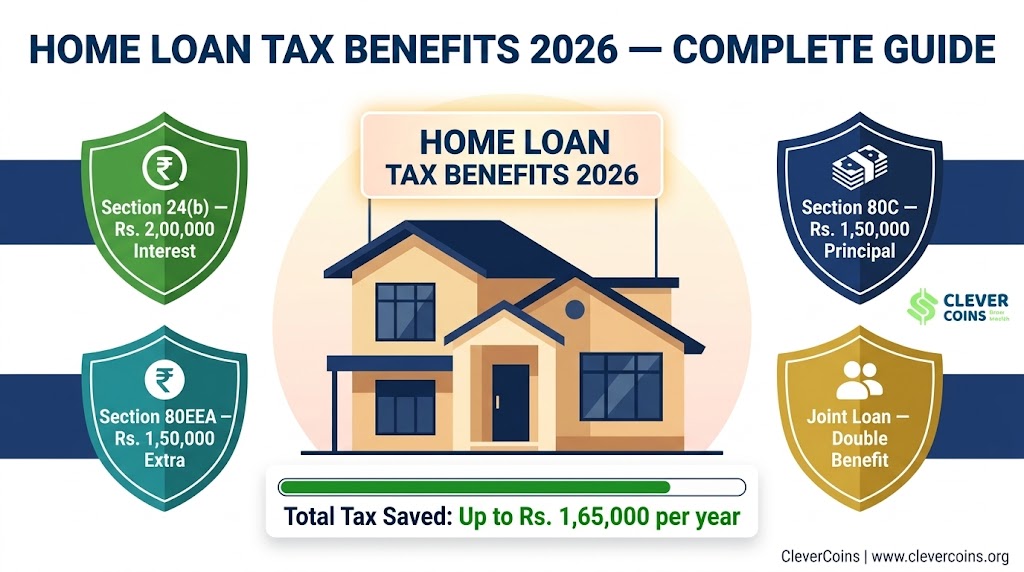
A home loan is not just a financial instrument to buy your dream home — it is also one of the most powerful tax-saving tools available to Indian taxpayers. Whether you are a salaried employee, a self-employed professional, or a business owner — a home loan can help you legally reduce your income tax liability by lakhs of rupees every year.
However, with the introduction of the New Tax Regime under Section 115BAC — and its significant restrictions on home loan deductions — choosing the right tax regime in 2026 has become more critical than ever. The wrong regime choice can cost you Rs. 1 lakh or more in lost tax savings every year.
This comprehensive 2026 guide by CleverCoins — India’s trusted tax consultancy — covers every home loan tax benefit available in India: Section 24(b) interest deduction, Section 80C principal repayment, Section 80EE and 80EEA additional deductions, pre-construction interest rules, joint loan benefits, property type-wise analysis, old versus new regime comparison, and a complete tax savings calculation example.
Why Home Loan Tax Benefits Matter in 2026
A typical home loan of Rs. 50 lakh at 8.5% interest rate for 20 years generates an annual EMI of approximately Rs. 52,000 per month — of which a significant portion in the early years is interest. In the first year, a borrower may pay Rs. 4.2 lakh in interest alone. Combined with principal repayment and other deductions:
- A taxpayer in the 30% tax bracket can save up to Rs. 1.65 lakh or more in income tax per year
- Over a 20-year loan tenure, total tax savings can be Rs. 20 to 30 lakh or more
- Under the right tax regime, the effective cost of home ownership is dramatically reduced
- Joint home loans can double the tax benefits — saving up to Rs. 3 lakh+ annually per co-borrower pair
💡 CleverCoins Insight: For a salaried taxpayer with a home loan, the Old Tax Regime almost always results in higher take-home pay — because home loan deductions (Section 24(b), 80C, 80EEA) can offset the higher slab rates. Use our tax regime calculator or contact CleverCoins for a personalised comparison.
Master Summary — All Home Loan Tax Benefits at a Glance
The following comprehensive table summarises every available home loan tax benefit under the Indian Income Tax Act, 1961:
|
Section |
Benefit Type |
Maximum Deduction |
Conditions / Key Notes |
|
24(b) |
Interest on Home Loan — Self-Occupied Property (SOP) |
Rs. 2,00,000 per year |
Loan must be taken for purchase/construction. Construction must complete within 5 years of end of FY of loan. Pre-construction interest spread over 5 years. |
|
24(b) |
Interest on Home Loan — Let Out Property (LOP) |
No limit — full interest deductible |
The entire interest on home loan for rented property is deductible. But overall loss from house property set-off capped at Rs. 2 lakh. |
|
80C |
Principal Repayment of Home Loan |
Rs. 1,50,000 per year (within overall 80C limit) |
Part of the overall Rs. 1.5 lakh 80C basket. Property must not be sold within 5 years of possession — else benefit reversed. |
|
80C |
Stamp Duty and Registration Charges |
Rs. 1,50,000 per year (within overall 80C limit) |
Allowed only in the year of payment. One-time benefit in the year of purchase. Part of 80C overall limit. |
|
80EE |
Additional Interest Deduction — First Time Home Buyers (legacy) |
Rs. 50,000 per year (over and above 24(b) Rs. 2L) |
Loan sanctioned between 01.04.2016 and 31.03.2017. Loan amount <= Rs. 35 lakh. Property value <= Rs. 50 lakh. Still deductible for old loans. |
|
80EEA |
Additional Interest Deduction — Affordable Housing (current) |
Rs. 1,50,000 per year (over and above 24(b) Rs. 2L) |
Loan sanctioned between 01.04.2019 and 31.03.2022. Stamp duty value of property <= Rs. 45 lakh. First-time buyer. Not applicable for Section 80EE loans. |
|
80EEB |
Interest on Loan for Electric Vehicle (reference) |
Rs. 1,50,000 per year |
Only for electric vehicle loans — included here for comprehensive awareness. |
|
24(b) — Joint Loan |
Each co-borrower claims interest |
Rs. 2,00,000 per co-borrower (SOP) |
Both co-borrowers who are co-owners can independently claim Rs. 2 lakh each. Total combined benefit = Rs. 4 lakh. |
|
80C — Joint Loan |
Each co-borrower claims principal |
Rs. 1,50,000 per co-borrower (within 80C) |
Both co-borrowers who are co-owners can independently claim Rs. 1.5 lakh each within their 80C limit. |
|
24(b) — Under Construction |
Pre-EMI Interest (Pre-possession interest) |
1/5th per year for 5 years after possession |
Interest paid during construction period (pre-possession) is deductible in 5 equal instalments starting from the year of possession. |
|
23(3) — Let Out |
Set-off of Loss from House Property |
Up to Rs. 2,00,000 against other income (Salary etc.) |
Loss from let-out property (where interest > rent) can be set off against salary or business income, capped at Rs. 2 lakh. Unadjusted loss can be carried forward for 8 years. |
|
New Tax Regime — 24(b) |
Interest Deduction under New Regime |
NIL for Self-Occupied Property |
Under New Tax Regime (Section 115BAC), Section 24(b) deduction is NOT available for SOP. Only available for rented/let-out property under new regime. |
⚠️ Critical 2026 Update: The New Tax Regime (Section 115BAC) has become the DEFAULT regime from FY 2023-24. If you do not actively choose the Old Tax Regime in your ITR or through your employer’s Form 12BB — you will automatically be placed in the New Regime where most home loan benefits are unavailable for self-occupied properties.
Section 24(b) — Interest Deduction on Home Loan: The Core Benefit
What is Section 24(b)?
Section 24(b) of the Income Tax Act, 1961 allows a deduction from ‘Income from House Property’ for interest paid on a loan taken for the purpose of:
- Purchase of a residential property
- Construction of a residential property
- Repair, renewal, or reconstruction of a house
Deduction Limit — Self-Occupied Property (SOP)
If the property is self-occupied (you live in it), the deduction for interest under Section 24(b) is capped at Rs. 2,00,000 per financial year. This is one of the most significant individual income tax deductions available in India.
- Condition 1: The loan must have been taken for the purpose of purchase or construction (not for repair/renovation — which has a lower limit of Rs. 30,000)
- Condition 2: If the loan is for construction — the construction must be completed within 5 years from the end of the financial year in which the loan was taken (i.e., effectively, within 5-6 years of borrowing)
- Condition 3: A certificate from the lender (banker/NBFC) showing the breakup of principal and interest is mandatory for claiming this deduction
⚠️ 5-Year Construction Rule: If construction is NOT completed within 5 years from the end of the financial year in which the loan was taken — the deduction limit drops from Rs. 2,00,000 to just Rs. 30,000 per year. This is a major financial penalty — ensure you track your construction timeline carefully.
Deduction Limit — Let-Out Property (LOP)
For a property that is rented out or deemed to be let out, there is NO upper limit on the interest deductible under Section 24(b). The ENTIRE interest paid on the home loan can be claimed as a deduction from rental income.
However, if the interest deduction creates a loss under ‘Income from House Property’, that loss can be set off against income from other heads (such as salary or business income) ONLY up to Rs. 2,00,000 in a financial year. Any remaining loss (beyond Rs. 2 lakh) is carried forward for up to 8 assessment years to be set off against house property income only.
✅ Example: You have a rented property with annual rent of Rs. 3,00,000 and home loan interest of Rs. 5,00,000. House property loss = Rs. 2,00,000. This loss can be set off against your salary income — reducing your taxable salary by Rs. 2,00,000 and saving Rs. 60,000+ in tax at the 30% bracket.
Interest Deduction Under New Tax Regime
Under the New Tax Regime (Section 115BAC) as applicable in FY 2025-26 (AY 2026-27):
- Section 24(b) interest deduction is NOT available for SELF-OCCUPIED property
- Section 24(b) interest deduction IS available for LET-OUT / RENTED property — even under the new regime
- This means: If you live in your home, switching to the new regime eliminates your Rs. 2 lakh interest deduction
- If you have rented out your home, both regimes allow interest deduction — but the new regime does NOT allow set-off of house property loss
Section 80C — Principal Repayment: Tax Benefit on EMI Principal
What Qualifies Under Section 80C for Home Loan?
- Repayment of the PRINCIPAL component of the home loan EMI — deductible up to Rs. 1,50,000 within the overall Section 80C limit
- Stamp duty paid on the registration of the property — deductible in the year of payment only
- Registration charges for transfer of property — deductible in the year of payment only
The Rs. 1,50,000 limit under Section 80C is a COMBINED limit — shared with other eligible 80C investments such as ELSS, PPF, LIC premium, NSC, 5-year FD, EPF, children’s tuition fees, etc. The home loan principal and stamp duty compete with these for the same Rs. 1.5 lakh space.
The 5-Year Lock-in Condition for Principal Deduction
There is a critical condition for the Section 80C principal repayment deduction:
⚠️ If you sell the property within 5 years of taking possession — ALL the Section 80C deductions claimed for principal repayment in previous years will be REVERSED. The total deductions previously claimed will be added back to your income in the year of sale. This can result in a significant unexpected tax liability.
Example: You claimed Rs. 4,50,000 as Section 80C deduction for principal over 3 years. You sell the property in year 4 (within 5 years of possession). The entire Rs. 4,50,000 is added back to your income in the year of sale — increasing your tax liability significantly.
Section 80EEA — The Affordable Housing Additional Deduction (2026 Status)
What is Section 80EEA?
Section 80EEA was introduced in the Union Budget 2019 to provide an ADDITIONAL interest deduction of Rs. 1,50,000 per year over and above the Rs. 2,00,000 allowed under Section 24(b) — for first-time home buyers purchasing affordable housing.
This section was specifically designed to promote the ‘Housing for All’ and Pradhan Mantri Awas Yojana (PMAY) initiatives by making affordable housing more financially attractive for first-time buyers.
Conditions for Section 80EEA Eligibility
- The home loan must have been sanctioned between 01 April 2019 and 31 March 2022
- The stamp duty value of the residential property must not exceed Rs. 45 lakh
- The taxpayer must be a FIRST-TIME HOME BUYER (must not own any other residential property on the date of loan sanction)
- The taxpayer must not be eligible for deduction under Section 80EE
- Deduction is available for the INTEREST component only — not principal
- Available to individuals only — not to HUF, companies, or firms
⚠️ 80EEA Loan Sanction Deadline: The loan must have been sanctioned by 31 March 2022. Loans taken after this date are NOT eligible for Section 80EEA benefit. For new home buyers taking loans in 2025 or 2026, the 80EEA benefit is NOT available. However, borrowers with loans sanctioned before March 2022 can STILL claim this deduction annually as long as interest continues to be paid.
Section 80EEA — Maximum Annual Benefit
For an eligible taxpayer in the 30% tax bracket who is claiming both Section 24(b) and 80EEA:
- Section 24(b) deduction: Rs. 2,00,000 × 30% = Rs. 60,000 tax saved
- Section 80EEA deduction: Rs. 1,50,000 × 30% = Rs. 45,000 additional tax saved
- Total tax saving on interest alone: Rs. 1,05,000 per year (plus health & education cess of 4%)
Section 80EE vs Section 80EEA — Complete Comparison
|
Feature |
Section 80EE |
Section 80EEA |
|
Maximum Deduction |
Rs. 50,000 per year |
Rs. 1,50,000 per year |
|
Loan Sanction Period |
01 April 2016 to 31 March 2017 |
01 April 2019 to 31 March 2022 |
|
Property Value Limit |
Stamp duty value <= Rs. 50 lakh |
Stamp duty value <= Rs. 45 lakh |
|
Loan Amount Limit |
Home loan <= Rs. 35 lakh |
No specific loan amount cap |
|
Applicability |
First-time home buyer only |
First-time home buyer only |
|
Can be claimed with 80C? |
Yes — in addition to 80C and 24(b) |
Yes — in addition to 80C and 24(b) |
|
Mutually Exclusive? |
Yes — 80EE and 80EEA cannot be claimed together for same loan |
Yes — cannot claim both 80EE and 80EEA |
|
Under New Regime? |
NOT available |
NOT available |
|
Still relevant in 2026? |
Yes — for loans sanctioned in that narrow window (FY 2016-17) |
For loans sanctioned before March 2022 — still deductible annually |
✅ 2026 Practical Guidance: If your home loan was sanctioned in FY 2016-17 — check eligibility under Section 80EE (up to Rs. 50,000 additional deduction). If sanctioned between April 2019 and March 2022 — check Section 80EEA (up to Rs. 1,50,000 additional deduction). These benefits are still available in 2026 for qualifying old loans under the OLD TAX REGIME.
Pre-Construction Interest — Deduction Rules Explained
When you take a home loan for an under-construction property, you start paying EMIs (or at least pre-EMI interest) before the property is ready. This interest paid BEFORE possession is called ‘pre-construction interest’ or ‘pre-EMI interest’.
How Pre-Construction Interest is Treated for Tax
Pre-construction interest is NOT deductible in the year it is paid. Instead, it is aggregated and deductible in 5 EQUAL ANNUAL INSTALMENTS starting from the year in which construction is completed (year of possession).
✅ Example: You take a loan in April 2022 for an under-construction flat. You pay pre-EMI interest of Rs. 60,000 per year for FY 2022-23 and FY 2023-24 (2 years before possession). Total pre-construction interest = Rs. 1,20,000. You get possession in May 2024. From FY 2024-25 onwards: Rs. 24,000 (1/5th of Rs. 1,20,000) is deductible as additional interest under Section 24(b) each year for 5 years — over and above the regular EMI interest for those years.
Pre-Construction Interest and the Rs. 2 Lakh Cap
The 1/5th pre-construction interest instalment is included WITHIN the Rs. 2,00,000 annual cap for Section 24(b) (for self-occupied property). So, if your regular EMI interest is already at Rs. 2 lakh or more — the pre-construction interest instalments may not provide additional deduction for a self-occupied property.
⚠️ For let-out properties, there is no cap — so the full pre-construction interest instalment (1/5th per year) plus the regular interest is deductible in full each year.
Joint Home Loan — Doubling Your Tax Benefits
One of the most effective but underutilised home loan tax strategies in India is taking a joint home loan — where both spouses (or family members) are co-borrowers and co-owners of the property. This can significantly amplify the total tax benefit.
How Joint Loan Tax Benefits Work
- BOTH co-borrowers can claim Section 24(b) interest deduction independently — up to Rs. 2,00,000 each (for SOP)
- BOTH co-borrowers can claim Section 80C principal repayment independently — up to Rs. 1,50,000 each
- BOTH can claim Section 80EEA (if eligible) independently — up to Rs. 1,50,000 each
- Total combined interest deduction for a couple: Rs. 4,00,000 per year (vs Rs. 2,00,000 for single borrower)
- Total combined 80C deduction: Rs. 3,00,000 per year (vs Rs. 1,50,000 for single borrower)
Conditions for Joint Loan Tax Benefits
- BOTH co-borrowers must be CO-OWNERS of the property (ownership must be registered in both names)
- BOTH co-borrowers must be REPAYING the loan from their individual bank accounts — EMI cannot be paid entirely by one person while the other claims tax benefit
- BOTH must declare the house property income and deductions in their individual ITRs independently
- For Section 80EEA, BOTH must be first-time buyers independently
⚠️ Critical Condition: Being only a co-borrower (on the loan) WITHOUT being a co-owner (on the property) does NOT entitle you to the tax deduction. Both conditions — co-borrower AND co-owner — must be satisfied simultaneously.
Joint Loan Tax Saving Example
Husband (income Rs. 18 lakh, 30% bracket) + Wife (income Rs. 12 lakh, 20% bracket) take a joint home loan on a self-occupied property. Annual interest = Rs. 4,00,000. Annual principal repayment = Rs. 3,00,000.
- Husband claims: Rs. 2,00,000 interest (24b) + Rs. 1,50,000 principal (80C) = Rs. 3,50,000 deduction → Tax saved @ 30% ≈ Rs. 1,05,000
- Wife claims: Rs. 2,00,000 interest (24b) + Rs. 1,50,000 principal (80C) = Rs. 3,50,000 deduction → Tax saved @ 20% ≈ Rs. 70,000
- TOTAL COMBINED TAX SAVING: Rs. 1,75,000 per year vs Rs. 1,05,000 for a single borrower
Old Tax Regime vs New Tax Regime — Which is Better for Home Loan Borrowers?
This is the most asked question by home loan borrowers in India in 2026. The answer depends on your total deductions — and home loan deductions are a critical factor:
|
Tax Benefit |
Old Tax Regime |
New Tax Regime (115BAC) |
|
Section 24(b) Interest — Self-Occupied Property |
✅ Deductible up to Rs. 2,00,000 per year |
❌ NOT available for Self-Occupied Property |
|
Section 24(b) Interest — Let Out / Rented Property |
✅ Full interest deductible (no cap) |
✅ Available for Let-Out Property (no cap) |
|
Section 80C — Principal Repayment |
✅ Deductible up to Rs. 1,50,000 within 80C |
❌ NOT available under new regime |
|
Section 80C — Stamp Duty & Registration |
✅ Deductible within overall 80C limit |
❌ NOT available under new regime |
|
Section 80EE — First Time Buyer (old) |
✅ Additional Rs. 50,000 deduction |
❌ NOT available under new regime |
|
Section 80EEA — Affordable Housing |
✅ Additional Rs. 1,50,000 deduction |
❌ NOT available under new regime |
|
Pre-Construction Interest (5-year spread) |
✅ Available under Section 24(b) |
❌ NOT available for SOP; available for LOP |
|
Loss from House Property set-off |
✅ Up to Rs. 2 lakh set-off against salary |
❌ Set-off of house property loss NOT allowed |
|
Carry forward of house property loss |
✅ Unadjusted loss carried forward 8 years |
❌ Carry forward NOT allowed under new regime |
|
Joint Loan — Independent Claims by Co-Borrowers |
✅ Each co-borrower claims independently |
❌ Principal (80C) not available; Interest for LOP only |
|
Net Tax Saving (SOP, Rs. 30% bracket, max deductions) |
Up to Rs. 1.05 lakh + tax saved on 80C |
Nil — no SOP interest or principal deduction |
💡 CleverCoins Decision Rule for Home Loan Borrowers: If you have a self-occupied home loan and your total Old Regime deductions (24(b) + 80C + 80EEA + 80D + HRA etc.) exceed Rs. 3,75,000 per year — the Old Tax Regime will likely result in lower tax. If your total deductions are below this threshold — compare your exact numbers. CleverCoins provides free personalised regime comparison for all home loan clients.
A rough rule of thumb: If your home loan interest alone is near the maximum Rs. 2,00,000 deductible under Section 24(b) — the Old Regime almost certainly saves more tax than the New Regime for most income levels.
Property Type-Wise Tax Benefit Matrix
Tax benefits differ significantly based on the type of property and how it is used. This matrix covers all scenarios:
|
Scenario |
Section 24(b) Interest |
Section 80C Principal |
Loss Set-Off |
Special Notes |
|
Self-Occupied Property — under Old Regime |
Up to Rs. 2,00,000 |
Up to Rs. 1,50,000 in 80C |
Up to Rs. 2L vs salary |
Construction within 5 years |
|
Self-Occupied Property — under New Regime |
NIL |
NIL |
NOT allowed |
No benefit for SOP at all |
|
Let-Out / Rented Property — Old Regime |
Full interest — no cap |
Up to Rs. 1,50,000 in 80C |
Up to Rs. 2L vs other income |
Gross Annual Value must be declared |
|
Let-Out / Rented Property — New Regime |
Full interest — no cap |
NIL (80C not available) |
NOT allowed under NR |
Rental income still taxable |
|
Deemed Let-Out (2nd property — not actually rented) |
Full interest — no cap |
Up to Rs. 1,50,000 in 80C |
Up to Rs. 2L vs income |
Notional rent taxed as income |
|
Under Construction — Pre-possession interest |
In 5 equal instalments from year of possession |
NIL (principal paid pre-possession not deductible) |
Only after possession |
Interest from construction = Pre-EMI interest |
|
Joint Home Loan — Both Co-Borrowers are Co-Owners |
Rs. 2L each = Rs. 4L total (SOP) |
Rs. 1.5L each within 80C |
Independently |
Each must pay from own account |
|
Home Loan for 2nd House (self-occupied — new regime) |
NIL |
NIL |
NOT allowed |
Both SOP benefits lost under NR |
Tax Savings Calculation — Practical Example for FY 2025-26
The following example shows the total tax savings for a first-time home buyer with an eligible 80EEA loan under the Old Tax Regime:
|
Component |
Amount (Rs.) |
Applicable Section |
Tax Saved @ 30% Bracket |
|
Home Loan Interest (Self-Occupied) |
2,00,000 |
Section 24(b) |
Rs. 60,000 + cess |
|
Home Loan Principal Repayment |
1,50,000 |
Section 80C |
Rs. 45,000 + cess (within 80C basket) |
|
Stamp Duty & Registration (Year of Purchase only) |
50,000 (example) |
Section 80C |
Part of 80C — Rs. 15,000 + cess (year of payment) |
|
Section 80EEA — Affordable Housing (if eligible) |
1,50,000 |
Section 80EEA |
Rs. 45,000 + cess (additional — over 24(b)) |
|
Total Maximum Deduction (Old Regime — 30% bracket) |
5,00,000 (approx) |
— |
Rs. 1,65,000 + cess (total tax saved) |
|
Effective Monthly Tax Saving (avg over year) |
— |
— |
Rs. 13,750+ per month |
|
Under New Regime (SOP only — 80EEA/80C not available) |
0 (SOP interest not deductible) |
— |
NIL |
📌 CleverCoins Note: The calculation above assumes the maximum deductions are claimed across all sections. Actual tax saving depends on individual EMI schedule, property type, income, and applicable tax slab. Use our free home loan tax benefit calculator on clevercoins.org or contact our experts for a personalised computation.
Interest Certificate — The Most Important Document for Claiming Deduction
To claim Section 24(b) interest deduction, you must obtain an annual Home Loan Interest Certificate from your lender (bank or NBFC) for each financial year. This certificate:
- Shows the total interest paid during the financial year
- Shows the total principal repaid during the financial year
- Shows the outstanding loan balance as of 31st March
- Is required to be submitted to your employer (for Form 16 / TDS computation) or attached to your ITR
- Must be obtained from the lender by April/May of each year for timely submission
⚠️ Many salaried employees forget to submit their Home Loan Interest Certificate to their employer’s payroll department by the deadline (usually February/March). This results in excess TDS being deducted from salary — which can only be recovered by filing an ITR. Submit your certificate to HR/payroll on time every year.
How to Claim Home Loan Tax Benefits in ITR
Step 1 — Obtain Interest Certificate from Bank
Download the annual interest certificate from your bank’s net banking portal or request it from the home loan branch. Ensure the certificate covers 1st April to 31st March of the financial year.
Step 2 — Compute House Property Income / Loss
In your ITR, compute the income (or loss) from the house property:
- Gross Annual Value (GAV): For SOP = Nil; For LOP = Actual rent or fair market rent — whichever is higher
- Less: Municipal taxes paid = Net Annual Value (NAV)
- Less: Standard Deduction of 30% of NAV (for repairs)
- Less: Section 24(b) interest paid
- Result = Income from House Property (can be positive or negative)
Step 3 — Claim 80C Deduction
Enter principal repayment amount in the 80C deductions section of your ITR — along with other 80C investments. Ensure total 80C does not exceed Rs. 1,50,000.
Step 4 — Claim 80EEA / 80EE (if eligible)
Separately claim Section 80EEA or 80EE deduction in the appropriate deduction section of your ITR — entering the eligible interest amount (up to Rs. 1,50,000 for 80EEA).
Step 5 — Set Off House Property Loss Against Other Income
If the house property computation results in a loss — this loss (up to Rs. 2 lakh) can be set off against salary income or other income in the ‘Set-Off of Losses’ section of your ITR.
Which ITR Form to Use?
- ITR-1 (Sahaj): Salaried individual with one self-occupied property — income from house property included
- ITR-2: Salaried individual with multiple properties, capital gains, or let-out property
- ITR-3: Business/professional income + house property
- ITR-4 (Sugam): Presumptive taxation + one house property (SOP only)
Home Loan for Plot Purchase + Construction — Special Tax Rules
If you take a loan specifically to buy a plot (land) and then construct a house on it — the tax treatment has nuances:
- Loan for PLOT PURCHASE ONLY (without construction): Section 24(b) interest is NOT deductible. The deduction is only available when the loan is for purchase or construction of a house — not bare land.
- Loan for PLOT + CONSTRUCTION as part of one composite loan: If the bank grants a single loan for both plot purchase and construction, the interest on the total loan is deductible under Section 24(b) — subject to completion within 5 years.
- SEPARATE loans — one for plot, one for construction: Only the construction loan interest qualifies for Section 24(b). The plot loan interest does not.
- Section 80C principal: Applies only to the construction loan (if taken from a bank/NBFC) — not to plot purchase loan.
✅ Action Point: If you are planning to buy a plot and build — take a SINGLE COMPOSITE LOAN from the bank for both the plot purchase and construction. This maximises your Section 24(b) deduction eligibility compared to two separate loans.
Home Loan Top-Up — Is the Interest Deductible?
A Home Loan Top-Up is an additional loan sanctioned on top of your existing home loan, using the same property as collateral. The tax treatment of top-up loan interest depends on the PURPOSE for which the top-up funds are used:
- Top-up used for HOME RENOVATION / REPAIR: Interest deductible under Section 24(b) — but limited to Rs. 30,000 for SOP (if the original loan was for repair only); Rs. 2,00,000 if treated as an extension of purchase/construction loan
- Top-up used for CHILD’S EDUCATION / BUSINESS / PERSONAL EXPENSES: Interest is NOT deductible under Section 24(b) — because the purpose is not related to housing
- Top-up used for PURCHASE OF ANOTHER PROPERTY: Interest deductible under Section 24(b) for the second property
⚠️ Many banks market home top-up loans as tax-saving tools — but the deduction is available ONLY if the funds are used for house-related purposes. If you use a top-up for a car, holiday, or personal expenses — the interest is NOT deductible. Keep a clear purpose document and receipts.
NRI Home Loan Tax Benefits in India
Non-Resident Indians (NRIs) who own residential property in India and have taken home loans also qualify for home loan tax deductions — subject to the following conditions:
- Section 24(b) interest: Deductible — same rules apply (Rs. 2 lakh for SOP, no cap for LOP)
- Section 80C principal: Deductible within Rs. 1.5 lakh 80C limit
- Section 80EEA: NRIs can claim if they were first-time buyers and loan was sanctioned in eligible window
- NRIs must file an Indian ITR (ITR-2) to claim these deductions — separate from their NRI bank accounts
- TDS at 30%+ may be deducted by tenant on rent paid to NRI — this can be claimed as credit in ITR
- NRIs under New Tax Regime: Same restrictions apply — SOP interest not deductible
📌 NRI Tax Planning Tip: If you own a property in India that is rented out, the full interest on home loan is deductible from rental income even under the new regime. This makes a let-out property more tax-efficient for NRIs compared to a self-occupied one — under both regimes.
Home Loan vs HRA — Can You Claim Both?
One of the most common questions from salaried employees: Can I claim BOTH House Rent Allowance (HRA) exemption AND Home Loan tax deduction in the same year?
The answer is YES — under specific circumstances:
- Scenario 1: You own a house in City A (which has a home loan) but you work and rent accommodation in City B. You can claim HRA for the rent paid in City B AND Section 24(b) interest / 80C for the home loan on your City A property.
- Scenario 2: You own a house but it is given on rent to someone else, and you yourself live in rented accommodation. You can claim HRA for your own rent AND house property deductions on the let-out property.
- You CANNOT claim HRA if you are living in your OWN HOME (for which the loan is taken) — in that case, only home loan deductions apply.
✅ This is one of the most significant tax planning opportunities: If you have a home loan but live in a rented accommodation near your workplace — BOTH HRA exemption and home loan deductions are available simultaneously. Contact CleverCoins for a personalised analysis of your specific situation.
Common Mistakes While Claiming Home Loan Tax Benefits
- Not submitting Interest Certificate to employer on time — results in excess TDS deduction
- Claiming Section 24(b) deduction without the loan being for purchase/construction (e.g., claiming for personal top-up used for vacation)
- Claiming Section 80C principal deduction after the 5-year lock-in violation (selling property within 5 years)
- Not separating principal and interest in the EMI — leading to incorrect deduction claims
- Claiming full Rs. 2 lakh interest deduction when construction is not complete within 5 years (limit drops to Rs. 30,000)
- Co-borrowers claiming interest deduction without being co-owners of the property
- Claiming 80EEA for loans sanctioned after 31 March 2022 — not eligible
- Choosing New Tax Regime without realising all home loan benefits are lost for SOP
- Not carrying forward house property loss beyond the Rs. 2 lakh set-off limit
- Failing to declare rental income while claiming interest deduction on let-out property
- NRIs not filing Indian ITR and missing all home loan deductions
How CleverCoins Helps You Maximise Home Loan Tax Benefits
- Regime Analysis: Personalised Old vs New Regime comparison factoring in your home loan, 80C investments, HRA, 80D, and other deductions
- ITR Filing with Home Loan: Accurate computation of house property income, interest deduction, loss set-off, and all applicable sections (24b, 80C, 80EEA, 80EE)
- Joint Loan Structuring Advice: Guidance on how to structure joint home loans for maximum combined tax benefit
- Pre-Construction Interest Tracking: Annual computation of 1/5th pre-construction interest deduction for under-construction properties
- NRI Tax Filing: Complete ITR-2 filing for NRIs with rental income, home loan deductions, and TDS credit management
- Home Loan Top-Up Advisory: Correct tax treatment of top-up loans based on fund utilisation
- Employer Coordination: Helping you submit correct proofs to your employer to minimise TDS on salary
- Tax Planning Consultation: Annual tax review to ensure you are claiming every legitimate deduction on your home loan
Save More Tax on Your Home Loan — Expert Help from CleverCoins!
www.clevercoins.org | Instagram @clevercoins
Frequently Asked Questions — Home Loan Tax Benefits 2026
Q1: I bought a flat in 2023. Can I still claim 80EEA?
Section 80EEA is available only for loans sanctioned between 01 April 2019 and 31 March 2022. If your loan was sanctioned after 31 March 2022 — Section 80EEA is not available. You can still claim Section 24(b) and 80C deductions.
Q2: My home loan EMI is Rs. 45,000 per month. How much can I claim?
The deductible amount depends on the interest/principal split. In the early years, most of the EMI is interest. For a 20-year loan at 8.5%, the annual interest in year 1 may be approximately Rs. 4 to 4.2 lakh — but you can only claim Rs. 2 lakh under Section 24(b) for a self-occupied property. The principal component claimed under 80C is also capped at Rs. 1.5 lakh within the overall 80C limit.
Q3: My property is still under construction. Can I claim interest now?
No. Section 24(b) interest deduction is not available during the construction period. Pre-construction interest is aggregated and deductible in 5 equal instalments starting from the year of possession. Section 80C principal repayment is also not deductible until possession is taken.
Q4: I am in the 30% tax bracket. Should I opt for Old or New Regime?
For a 30% bracket taxpayer with a home loan, the Old Regime almost always results in lower tax — because Rs. 2,00,000 interest deduction alone saves Rs. 60,000 + cess. Add 80C (Rs. 45,000 saving), 80D, HRA, and the Old Regime advantage compounds further. CleverCoins recommends a personalised calculation before making your regime choice.
Q5: Can my parents be co-borrowers and claim home loan deductions?
Parents can be co-borrowers, but to claim tax deductions, they must also be co-owners of the property. If the property is registered only in your name — your parents (even as co-borrowers) cannot claim interest or principal deductions. Both co-borrower and co-owner conditions must be met simultaneously.
Q6: I have two home loans on two properties. Can I claim benefits on both?
Yes. If you have two residential properties, you can claim Section 24(b) interest on both. For the self-occupied property (you can designate one as self-occupied) — interest deduction is capped at Rs. 2 lakh. The second property is treated as deemed let-out and full interest is deductible — but notional rent is added to income. Section 80C principal can be claimed for both loans within the Rs. 1.5 lakh combined 80C limit.
Conclusion — Home Loan is India’s Most Powerful Tax Shield in 2026
A home loan remains one of the single most effective tax planning tools available to Indian taxpayers — combining forced savings (principal repayment), asset creation (property ownership), and significant annual tax deductions (interest + principal). In the right circumstances, a home loan can save a taxpayer Rs. 1 to 3 lakh every year in income tax.
In 2026, the critical decision is choosing the right tax regime. For most home loan borrowers — particularly those with Section 24(b) interest near the Rs. 2 lakh cap and active Section 80C investments — the Old Tax Regime continues to be more beneficial. But every individual’s situation is unique.
At CleverCoins, we specialise in maximising legitimate tax savings for home loan borrowers — from accurate ITR filing to personalised regime comparison to joint loan structuring advice. Let our tax experts ensure you never leave a single rupee of home loan tax benefit unclaimed.