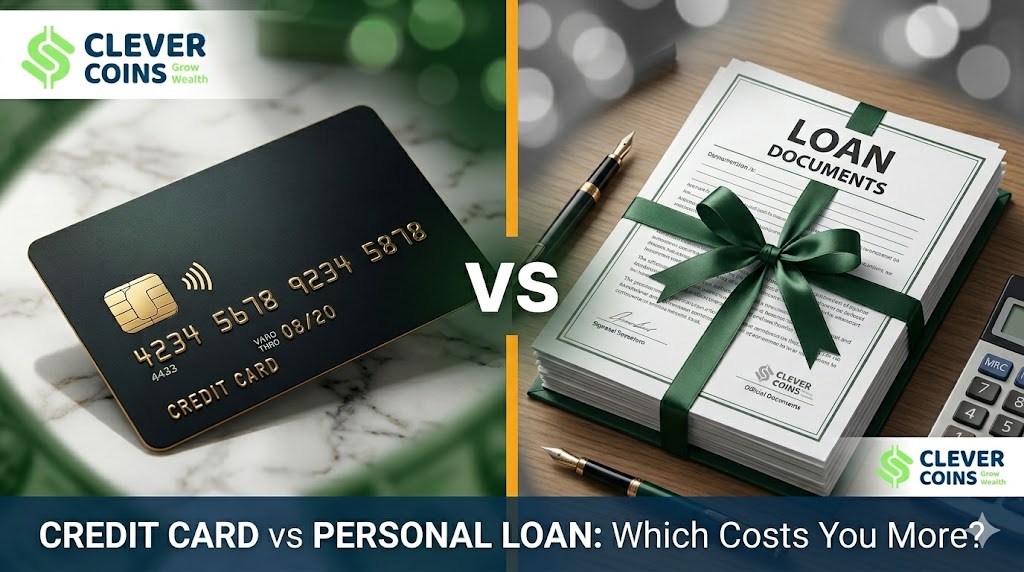
In India’s fast-evolving financial landscape, two of the most widely used credit instruments are credit cards and personal loans. Whether you need funds for a medical emergency, home renovation, wedding expenses, travel, or consumer electronics, both products promise quick access to money — but at very different costs.
The burning question most Indians face is: Which is actually cheaper — swiping a credit card or taking a personal loan? The answer is not black-and-white. It depends on your loan amount, repayment timeline, credit score, and spending behaviour. This comprehensive guide breaks down every angle so you can make an informed decision.
Understanding the Basics
What is a Credit Card?
A credit card is a revolving credit facility issued by banks or NBFCs that allows you to spend up to a pre-approved credit limit. You repay the used amount either in full by the due date (interest-free period of 20–50 days) or in minimum monthly instalments. If you carry a balance, interest — called the Annual Percentage Rate (APR) — is charged, which in India typically ranges from 36% to 48% per annum (3%–4% per month).
Key features of credit cards include reward points, cashback, zero-cost EMI on select purchases, lounge access, fuel surcharge waivers, and insurance covers. Credit cards are most economical when paid in full before the due date every month.
What is a Personal Loan?
A personal loan is an unsecured term loan where you borrow a fixed lump sum and repay it in equal monthly instalments (EMIs) over a defined tenure of 12 to 60 months. Interest rates in India range from approximately 10.50% to 24% per annum depending on your bank, NBFC, credit score, income, and employer profile.
Unlike credit cards, personal loans have a fixed interest structure — either flat rate or reducing balance rate. There are no annual fees, but there may be processing fees (0.5%–3%), prepayment charges, and GST on fees.
Key Parameters for Comparison
Parameter | Credit Card | Personal Loan |
Interest Rate (p.a.) | 36%–48% | 10.50%–24% |
Repayment Structure | Revolving / Minimum Due | Fixed EMI |
Loan Tenure | Monthly billing cycle | 12–60 months |
Processing Time | Instant (pre-approved) | 1–5 working days |
Collateral Required | No | No |
Maximum Amount | Up to credit limit (usually ₹1–10 lakh) | ₹50,000 to ₹50 lakh+ |
Interest-Free Period | 20–50 days | None |
Prepayment Charges | Not applicable | 0%–4% of outstanding |
Reward Benefits | Yes (cashback, points) | No |
Impact on Credit Score | High utilisation = negative | On-time EMI = positive |
Ideal For | Small, short-term spends repaid quickly | Large amounts over longer tenures |
Interest Rate Deep Dive: The Most Critical Factor
Credit Card Interest Rates in India (2025)
Most Indians do not realise how expensive credit card interest truly is. Here is a snapshot of major bank credit card interest rates in India:
Bank / Issuer | Monthly Rate | Annual Rate |
SBI Card | 3.50% | 42% |
HDFC Bank | 3.50%–3.75% | 42%–45% |
ICICI Bank | 3.50% | 42% |
Axis Bank | 3.50%–3.75% | 42%–45% |
Citibank (Axis) | 3.75% | 45% |
Kotak Mahindra | 3.50% | 42% |
Yes Bank | 3.50% | 42% |
These rates apply if you carry a balance from one billing cycle to the next. This makes credit card debt one of the most expensive forms of borrowing available to retail consumers in India.
Personal Loan Interest Rates in India (2025)
Lender | Interest Rate (p.a.) | Processing Fee |
SBI Personal Loan | 11.00%–14.00% | 0%–1% |
HDFC Bank Personal Loan | 10.50%–21% | 0.5%–2.5% |
ICICI Bank Personal Loan | 10.65%–16% | 0.5%–2% |
Kotak Mahindra Bank | 10.99%–24% | Up to 2.5% |
Bajaj Finserv | 13.00%–24% | Up to 3.99% |
Tata Capital | 10.99%–20% | Up to 2.75% |
Fullerton India | 11.99%–24% | 0%–3% |
IDFC First Bank | 10.75%–22% | Up to 3% |
Cost Comparison: Real Numbers
Scenario 1 – Borrowing ₹1,00,000 for 12 Months
Option | Interest Rate | EMI (approx.) | Total Interest Paid | Total Repayment |
Personal Loan | 12% p.a. | ₹8,885/month | ₹6,620 | ₹1,06,620 |
Credit Card (carried balance) | 42% p.a. | ₹11,165/month | ₹33,975 | ₹1,33,975 |
Credit Card (0% EMI offer) | 0% (subvention) | ₹8,333/month | ₹0 (+ processing fee ~₹500) | ₹1,00,500 |
Verdict for ₹1 lakh / 12 months: Personal loan saves approx ₹27,000 over a credit card revolving balance. Only 0% EMI credit card schemes are competitive — but those are merchant-specific. |
Scenario 2 – Borrowing ₹50,000 for 3 Months (Short-Term Need)
Option | Total Interest Paid | Winner? |
Personal Loan @ 14% p.a. | Approx ₹1,750 |
|
Credit Card (paid in full in 50 days) | ₹0 (within interest-free period) | ✅ Credit Card Wins |
Credit Card (revolving 3 months) | Approx ₹5,250 |
|
Verdict for ₹50,000 / 3 months: If you can repay within the interest-free window, the credit card is completely FREE. But if you roll over the balance, it costs 3x more than a personal loan. |
The Hidden Costs You Must Not Ignore
Hidden Costs of Credit Cards
- Annual / renewal fees: ₹500 to ₹10,000+ depending on card variant
- Late payment charges: ₹100 to ₹1,300 per cycle
- Over-limit fees: ₹500–₹600 if you exceed credit limit
- GST @ 18% on all fees and interest
- Cash advance fees: 2.5%–3.5% per transaction + immediate interest at 3.5%/month
- Foreign transaction markup: 2%–3.5% on international purchases
- Reward redemption restrictions and point expiry
Hidden Costs of Personal Loans
- Processing fees: 0.5%–3% of loan amount (deducted upfront from disbursement)
- GST @ 18% on processing fees
- Prepayment / foreclosure charges: 0%–5% (varies by lender and RBI rules)
- Documentation or login charges: ₹500–₹3,000 in some cases
- Stamp duty on loan agreement
- Bounce charges if EMI fails: ₹300–₹1,000 per instance
Credit Score Impact: A Long-Term Perspective
How Credit Cards Affect Your CIBIL Score
Credit utilisation ratio is the second most important factor in your CIBIL score. Using more than 30%–40% of your total credit limit can pull down your score. If you carry rolling balances on multiple cards, your creditworthiness deteriorates over time, making future loans more expensive.
How Personal Loans Affect Your CIBIL Score
A personal loan adds a new type of credit (instalment credit) to your profile, which can improve credit mix. Consistent on-time EMI payments over 12–60 months build a strong repayment history — the single biggest factor in your CIBIL score. However, applying for too many personal loans in a short span causes multiple hard inquiries, temporarily lowering your score.
When is a Credit Card Cheaper?
A credit card is the better choice in the following scenarios:
- You can repay the entire outstanding amount before the due date (0% interest during free period)
- You have access to no-cost / zero-interest EMI schemes at merchant level
- Your spending is under ₹25,000 and you need money for only 30–50 days
- You want reward points, cashback, or airline miles that offset costs
- You frequently book flights and hotels, and premium travel cards offer lounge access + points worth more than fees
- You are making purchases on curated bank offers that give 5%–15% instant discounts
When is a Personal Loan Cheaper?
A personal loan is the better choice in the following scenarios:
- You need a large sum — ₹1 lakh or more — for a defined purpose
- You need 12 months or longer to repay the amount
- You are consolidating multiple high-interest credit card debts (balance transfer or debt consolidation loan)
- You do not have a sufficient credit limit on your card
- You want financial discipline through fixed EMIs and a defined end date
- You need an amount for medical emergency, home renovation, or education
Eligibility Requirements Compared
Criteria | Credit Card | Personal Loan |
Minimum Age | 18 years | 21 years |
Employment Type | Salaried / Self-employed / Student | Salaried / Self-employed |
Minimum Income | ₹1.5–3 lakh p.a. (varies by card) | ₹15,000–₹25,000/month |
CIBIL Score | 700+ (premium cards need 750+) | 700–750+ preferred |
Documents | ID, Address proof, Income proof | ID, Address, Income, Bank statements |
Approval Time | Instant to 3 days | 1 to 5 business days |
Tax Benefits: Is There Any?
Unfortunately, neither credit card interest nor personal loan interest qualifies for income tax deductions in India under the Income Tax Act, 1961 — unless the personal loan was used for a specific purpose:
- Home purchase / renovation: Interest on personal loan used for home improvement can be claimed under Section 24(b) up to ₹2 lakh per year
- Business investment: If used for business purposes, interest is deductible as a business expense
- Education: Some banks offer education loans with tax benefit under Section 80E; general personal loans do not qualify
Digital Lending & Fintech Options in India
Beyond banks, India’s fintech ecosystem has added new players offering instant personal loans at competitive rates:
- MoneyTap – Credit lines from ₹3,000 to ₹5 lakh at 13%–24% p.a.
- KreditBee – Instant personal loans at 17%–29.95% p.a.
- LazyPay / Simpl / ZestMoney – BNPL services for e-commerce with low or zero fees
- Navi – Personal loans at competitive rates with 100% digital process
- Slice / OneCard – New-age credit cards with lower fees and transparent pricing
- CRED – Premium credit card management app with CRED Cash (personal loan) feature
RBI Regulations You Should Know
The Reserve Bank of India (RBI) actively regulates both credit card and personal loan interest rates and practices:
- RBI mandates banks to display effective annual percentage rates (APR) clearly
- Credit card issuers must disclose minimum payment warnings on statements
- RBI circular (2023) requires lenders to provide a Key Fact Statement (KFS) for retail loans including all-in costs
- The SARFAESI Act does not apply to personal loans (unsecured), so lenders cannot seize property on default — but credit score damage and legal action is possible
- NBFC-regulated entities must follow RBI Fair Practices Code on loan pricing
Step-by-Step Decision Framework for Indian Borrowers
Follow these five steps to make the right choice:
- Estimate your exact fund requirement (amount needed)
- Determine your repayment timeline (days vs months)
- Check if 0% EMI / cashback offer is available for your specific purchase
- Calculate Total Cost of Borrowing (TCB) for both options including all fees
- Choose the option with lowest TCB that matches your cash flow and credit profile
Pro Tips to Save Money Regardless of Your Choice
Credit Card Pro Tips
- Always pay the full outstanding balance, never just the minimum due
- Leverage 0% EMI offers only on branded merchants and check for processing fees
- Choose a credit card that aligns with your top spending category (fuel, travel, grocery)
- Keep credit utilisation below 30% to protect your CIBIL score
- Never use a credit card for cash withdrawal — the cost is brutal (3.5%/month from day one)
Personal Loan Pro Tips
- Compare rates on BankBazaar, Paisabazaar, and Loanbaba before applying
- Negotiate processing fees — banks often waive them for high-credit-score borrowers
- Opt for a shorter tenure to minimise total interest even if EMI is higher
- Check foreclosure charges before making part-prepayments
- Maintain 750+ CIBIL score to qualify for the lowest interest rate bands
Conclusion: The Verdict for India
The cheapest option between a credit card and a personal loan in India depends entirely on how you use it:
Your Situation | Cheaper Choice |
Repay within 30–50 days | Credit Card (0% in free period) |
0% EMI available on your purchase | Credit Card (with 0% EMI) |
Need ₹1 lakh+ for 6–48 months | Personal Loan |
Consolidating existing card debt | Personal Loan |
Emergency with uncertain repayment date | Personal Loan (predictable cost) |
Shopping with cashback / rewards | Credit Card (net cost lower) |
Medical emergency > ₹2 lakh | Personal Loan |
Bottom Line: For short-term micro-expenses, a disciplined credit card user pays nothing. For anything above ₹50,000 requiring more than 2 months to repay, a personal loan at 10.5%–14% p.a. is dramatically cheaper than a credit card’s 42%+ rate. Choose wisely, calculate before borrowing, and always read the fine print. |
FAQs – Credit Card vs Personal Loan in India
Q1. Is a personal loan interest rate always lower than a credit card?
Yes, in almost all scenarios. Personal loan rates start at 10.5% p.a., while credit card revolving interest is 36%–48% p.a. The only exception is 0% interest credit card EMI schemes.
Q2. Can I convert credit card outstanding into a personal loan?
Yes. Most major banks (HDFC, ICICI, SBI, Axis) offer ‘Balance Transfer’ or ‘Loan on Card’ facilities that convert revolving credit card debt into structured EMIs at a much lower rate.
Q3. Which is better for CIBIL score improvement?
Timely repayment of a personal loan (showing instalment credit history) tends to have a stronger positive impact on your CIBIL score than credit card usage, as long as utilisation remains low.
Q4. Does taking a personal loan affect my eligibility for a credit card?
Not significantly, if you have no repayment defaults. Active personal loans count in your debt-to-income ratio but do not automatically disqualify you from credit card eligibility.
Q5. What is the cheapest way to borrow money in India?
In ascending order of cost: Secured loans (home loan, loan against property) < Gold loans < Personal loans (top tier) < Credit card (0% EMI) < Credit card (revolving debt). Choose based on collateral availability and repayment tenure.