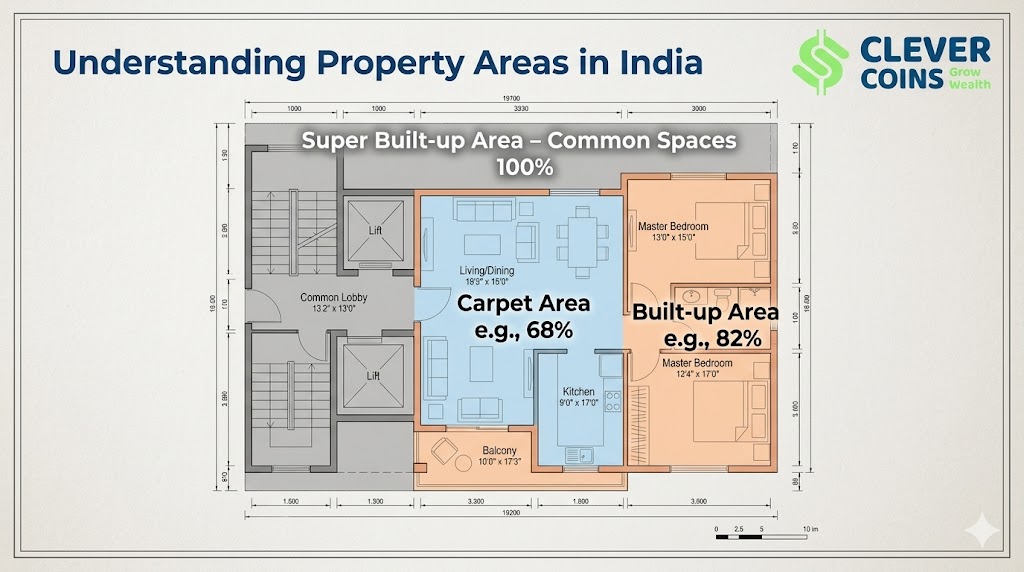
Buying a property in India can be one of the most significant financial decisions of your life. Yet, millions of homebuyers make costly mistakes simply because they do not fully understand three fundamental terms: Carpet Area, Built-up Area, and Super Built-up Area. Developers often advertise a flat’s size using the largest of these figures, which can lead to serious confusion about what you are actually paying for.
This comprehensive guide — crafted by our team of real estate experts — will break down every dimension of these three area definitions. By the end, you will know exactly how to calculate usable space, compare properties on an apples-to-apples basis, and avoid falling into marketing traps that cost lakhs of rupees.
- Why Understanding Area Definitions Matters
When you see an advertisement for a ‘1,200 sq ft 2BHK apartment,’ that number could refer to any of the three area types. A 1,200 sq ft super built-up flat may actually deliver only 720–840 sq ft of usable carpet area — a difference of nearly 40%. Understanding these distinctions helps you:
- Calculate the true cost per usable square foot
- Compare properties across different builders and projects
- Negotiate more effectively based on carpet area pricing
- Comply with RERA regulations which mandate carpet-area-based pricing
- Make an informed investment or end-use decision
- Carpet Area — The Space You Actually Live In
2.1 Definition
Carpet Area is the net usable floor area within the four walls of an apartment — the area where you can literally lay a carpet. It is the most honest measure of the actual living space delivered to a buyer.
2.2 What Is Included in Carpet Area?
- Bedrooms, living room, dining room, and kitchen
- Bathrooms and toilets
- Balcony / terrace area (partially, as per RERA guidelines)
- Internal staircases within a duplex or maisonette unit
- Store rooms or utility areas within the flat
2.3 What Is NOT Included in Carpet Area?
- Thickness of internal walls
- Thickness of outer/structural walls
- Common areas such as lobbies and corridors
- Balcony area (in some legacy definitions pre-RERA)
2.4 RERA Definition of Carpet Area
Under the Real Estate (Regulation and Development) Act, 2016 (RERA), the carpet area is officially defined as: ‘the net usable floor area of an apartment, excluding the area covered by the external walls, areas under services shafts, exclusive balcony or verandah area, and exclusive open terrace area, but includes the area covered by the internal partition walls of the apartment.’ This definition mandates that all builders must quote prices on carpet area basis in RERA-registered projects.
2.5 Typical Carpet Area Ratio
Carpet Area typically constitutes 60% – 70% of the Super Built-up Area, depending on the project’s design, common amenities, and construction quality.
- Built-up Area — Carpet Area + Wall Thickness
3.1 Definition
Built-up Area (also called Plinth Area) is the carpet area plus the area occupied by the walls — both internal and external — along with the balcony/terrace and any exclusive utility spaces attached to the flat.
3.2 Formula
Built-up Area = Carpet Area + Wall Thickness Area + Balcony/Terrace Area
3.3 What Is Included in Built-up Area?
- Everything included in Carpet Area
- Internal wall thickness
- External/structural wall thickness
- Flower beds or dry areas attached to the flat
- Exclusive balcony and open terrace areas
3.4 What Is NOT Included in Built-up Area?
- Common lobby, lift lobby, staircases
- Corridors and passages shared with neighbours
- Amenity spaces such as clubhouse, gym, pool
- Parking areas
- Electrical and service rooms
3.5 Typical Built-up Area Ratio
Built-up Area is typically 10% – 15% more than the Carpet Area. For example, a flat with 800 sq ft carpet area may have a built-up area of approximately 880–920 sq ft.
- Super Built-up Area — The Developer’s Quoted Number
4.1 Definition
Super Built-up Area (also called Saleable Area) is the built-up area of your flat plus a proportionate share of all the common areas in the building — stairways, lifts, lobby, corridors, amenity spaces, and more. This is the number most developers use in their advertisements and price sheets.
4.2 Formula
Super Built-up Area = Built-up Area + Proportionate Share of Common Areas
4.3 What Is Included in Super Built-up Area?
- Everything in Built-up Area
- Lift lobbies and common stairways
- Entrance lobbies and reception areas
- Clubhouse and gymnasium (proportionate share)
- Swimming pool area (proportionate)
- Security cabin, electrical room, pump room
- Common passages and corridors
- Garden and open landscape areas (in some projects)
4.4 Loading Factor / Loading Percentage
The difference between Super Built-up Area and Carpet Area is captured by a metric called the Loading Factor (or Loading Percentage).
Loading Factor = (Super Built-up Area − Carpet Area) / Carpet Area × 100
Typical loading percentages in India range from 25% to 45%. Luxury projects with extensive amenities often carry higher loading, while affordable housing projects have lower loading.
- Side-by-Side Comparison Table
|
Parameter |
Carpet Area |
Built-up Area |
Super Built-up Area |
|
|
|
|
|
|
|
|
|
|
|
|
|
|
|
|
|
|
|
|
|
|
|
|
|
|
|
|
|
|
|
|
|
|
|
|
Includes Wall Thickness |
No |
Yes |
Yes |
|
Includes Balcony |
Partially (RERA) |
Yes |
Yes |
|
Includes Common Areas |
No |
No |
Yes |
|
Most Honest Measure |
Yes |
Moderate |
No |
|
Quoted by Builders |
Rarely (pre-RERA) |
Sometimes |
Mostly |
|
RERA Mandated Pricing |
Yes |
No |
No |
|
Typical % of SBA |
60–70% |
75–80% |
100% |
- Practical Calculation Example
Let us assume a 2BHK apartment is advertised as 1,200 sq ft super built-up. Here is how we can reverse-calculate the actual usable space:
|
Area Type |
Calculation |
Result |
|
|
|
|
|
|
|
|
|
|
|
|
|
|
|
|
|
|
|
|
|
Super Built-up Area |
Advertised |
1,200 sq ft |
|
Loading Factor |
Assumed 30% |
— |
|
Built-up Area |
1,200 / 1.30 |
≈ 923 sq ft |
|
Wall Deduction (12%) |
923 × 0.88 |
≈ 812 sq ft |
|
Carpet Area (Usable) |
Approx. |
≈ 780–820 sq ft |
Key Insight: You pay for 1,200 sq ft but actually use only around 780–820 sq ft — nearly 33% less than advertised.
- How RERA Has Changed the Game
Before RERA (2016), builders had complete freedom to quote any area metric in their advertisements. This often led to buyers paying super built-up area rates while receiving a fraction of that space as usable area. RERA introduced the following reforms:
- Mandatory disclosure of carpet area in all project registrations
- Pricing on carpet area basis for all RERA-registered projects
- Developers must mention carpet area in the allotment letter and sale agreement
- Penalties for misrepresentation of area
- State RERA authorities publish project details including carpet area publicly
Post-RERA, buyers are far better protected. However, in states where RERA is not yet fully enforced, or for commercial properties and plotted developments, buyers must still exercise caution and verify carpet area independently.
- City-Wise Loading Factor Trends in India
Loading factors vary significantly across Indian cities based on amenity density, construction standards, and local building regulations:
|
City |
Typical Loading Factor |
Carpet to SBA Ratio |
|
|
|
|
|
|
|
|
|
|
|
|
|
|
|
|
|
|
|
|
|
|
|
|
|
|
|
|
|
Mumbai (MMR) |
30–45% |
55–70% |
|
Delhi NCR |
25–40% |
60–75% |
|
Bengaluru |
20–35% |
65–80% |
|
Pune |
22–38% |
62–78% |
|
Hyderabad |
20–32% |
68–80% |
|
Chennai |
18–30% |
70–82% |
|
Ahmedabad |
18–28% |
72–82% |
- Smart Buyer Tips: How to Use This Knowledge
9.1 Always Ask for Carpet Area in Writing
Never rely on verbal commitments from a builder’s sales team. Request the carpet area figure in writing — in the brochure, in the allotment letter, and most importantly in the registered sale agreement.
9.2 Calculate Your Own Loading Factor
Divide the carpet area by the super built-up area and subtract from 1. If the loading factor exceeds 35–40%, question whether the amenities justify such high common area charges.
9.3 Verify with RERA Portal
Every state has a RERA portal where registered projects list their carpet area details. Cross-check the builder’s claims against the RERA registration documents.
9.4 Compare Properties on Carpet Area Basis
When comparing two properties, always use carpet area per rupee as your benchmark, not super built-up area per rupee. This gives you a true apple-to-apple comparison.
9.5 Inspect the Site Plan
Review the approved floor plan and site plan. This helps you verify wall thicknesses, balcony inclusions, and common area proportions before you commit.
- Area Definitions in Commercial Real Estate
The same area terminology applies to commercial properties — offices, shops, and retail spaces — but with some nuances:
- Usable Area: Equivalent to carpet area — the actual work space inside four walls
- Rentable Area: Adds a proportionate share of common areas such as lobbies and corridors
- Gross Leasable Area (GLA): Used in retail/mall context — total floor area designed for tenant occupation
- Floor Plate Efficiency: Ratio of usable space to total floor area; higher is better for tenants
- RERA does not cover commercial projects in the same way — buyers must exercise more diligence
- Frequently Asked Questions (FAQs)
Q1. Is super built-up area always larger than carpet area?
Yes, always. Super built-up area includes carpet area plus wall thickness plus all common area allocations. It is always the largest of the three figures.
Q2. Does RERA apply to all properties in India?
RERA applies to residential projects above a certain size threshold (generally 500 sq m plot area or 8 or more apartments) registered under the respective state RERA authority. Not all commercial projects fall under RERA. Plotted developments have separate treatment.
Q3. Can I negotiate the price on carpet area?
Absolutely. In RERA-registered projects, you have the legal right to demand carpet-area-based pricing. You can negotiate the rate per sq ft on carpet area and ensure this is mentioned in your agreement.
Q4. What is a good loading factor?
A loading factor of 20–30% is considered reasonable. Projects with extensive amenities (multiple pools, large clubhouses, gardens) may have 35–45% loading, which can be acceptable if the amenities genuinely add lifestyle value. Anything above 45% should raise red flags.
Q5. Is balcony included in carpet area under RERA?
Under RERA, the exclusive balcony or verandah area is NOT included in the carpet area definition. However, it must be disclosed separately in the agreement. Some builders may include a portion of the balcony; always verify the exact RERA definition applied.
Q6. How is loading factor calculated?
Loading Factor (%) = ((Super Built-up Area – Carpet Area) / Carpet Area) × 100. For example, if carpet area is 700 sq ft and super built-up area is 1,000 sq ft, loading = (300/700) × 100 = 42.8%.
Q7. Do resale apartments also follow the same area norms?
Yes. When buying a resale flat, ask the seller for the original agreement which mentions the carpet area. Verify this against the physical space using a measuring tape or hire a certified property inspector.
- Conclusion
Understanding the difference between Carpet Area, Built-up Area, and Super Built-up Area is not just academic knowledge — it is your most powerful tool as a property buyer in India. With RERA now mandating carpet-area-based disclosure, you are better protected than ever, but vigilance remains essential.
Always ask the right questions, verify numbers independently, consult RERA portals, and ensure every area figure you rely upon is written into your legally binding sale agreement. A well-informed buyer never overpays for space they will never use.
Bookmark this guide, share it with anyone planning to buy a home, and reach out to our team for a personalised property consultation.