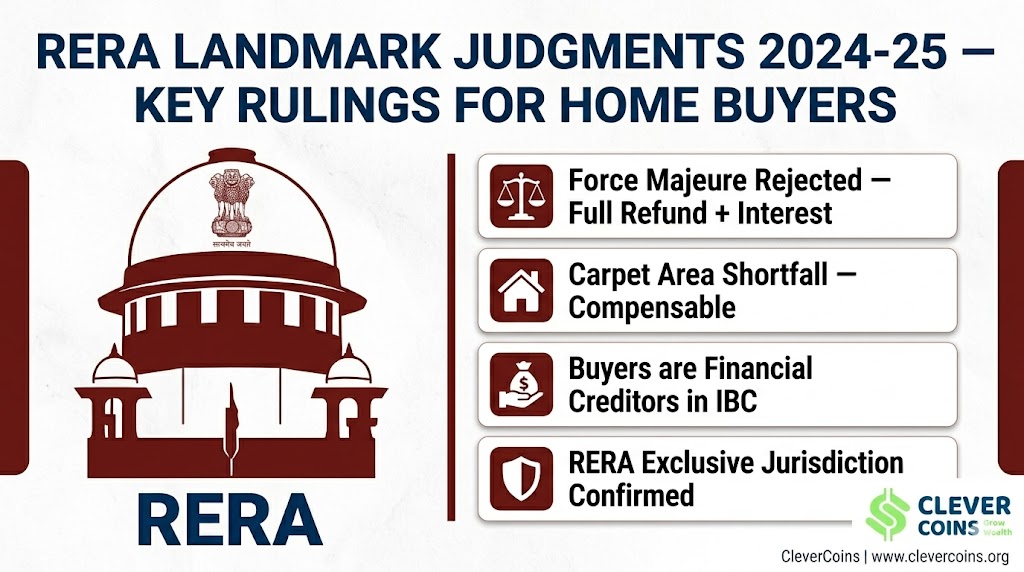
India’s Real Estate (Regulation and Development) Act, 2016 (RERA) has been a watershed moment for home buyers in India — bringing accountability, transparency, and legal recourse to a sector that was historically dominated by powerful builders. Nine years since its enactment, RERA’s impact is being felt most powerfully through a growing body of landmark court judgments and regulatory authority orders that progressively strengthen home buyer rights.
The years 2024 and 2025 have been particularly significant for RERA jurisprudence. From the Supreme Court’s ongoing supervision of the Unitech and Jaypee homebuyer crises to MahaRERA’s landmark carpet area accuracy rulings, from Haryana RERA’s rejection of force majeure claims to Karnataka High Court’s OC-before-possession mandate — these judgments are reshaping how builders operate, how courts interpret RERA, and how millions of home buyers can protect their investments.
This comprehensive legal and practical guide by CleverCoins — India’s trusted tax and financial compliance firm — covers 15 landmark RERA judgments from 2024-25, state-wise RERA developments, homebuyer rights backed by case law, force majeure versus RERA analysis, and a 10-step action guide for home buyers facing builder default.
RERA at a Glance — The Legal Framework
Before diving into the judgments, a quick refresher on RERA’s key legal architecture:
- RERA Act, 2016: Enacted to protect home buyers, regulate real estate projects, and ensure timely delivery of projects
- RERA Registration: Mandatory for all projects above 500 sqm or 8 units — under Section 3
- Section 18: The most powerful homebuyer provision — entitles buyer to FULL REFUND with interest (SBI MCLR + 2%) if builder fails to hand over possession by the agreed date
- Section 12: Interest on excess payments — if builder receives more than the payment schedule, buyer gets interest
- Section 14(3): Structural defect warranty — 5 years from date of possession
- Section 6: Force majeure — extension of project registration timeline in force majeure events (ONE time; not unlimited)
- Section 31: Any aggrieved person (buyer OR buyer’s association) can file complaint with RERA
- Section 79: Civil courts barred from entertaining matters under RERA jurisdiction
- Section 89: RERA overrides inconsistent state laws
⚖️ The core philosophy of RERA, as repeatedly affirmed by the Supreme Court, is: RERA is a BUYER-PROTECTIVE statute and must be interpreted LIBERALLY in favour of home buyers and STRICTLY against builders in cases of ambiguity. This judicial approach underlies every significant RERA judgment in 2024-25.
Master Table — 15 Landmark RERA Judgments 2024-25
The following comprehensive table covers the most significant RERA rulings from 2024 and 2025 that every home buyer must know:
|
Case Name / Judgment |
Forum |
Year |
Key Ruling / Principle |
Impact on Home Buyers |
|
Newtech Promoters & Developers Pvt. Ltd. vs State of UP & Others |
Supreme Court of India |
2021 (landmark — still cited in 2024-25) |
RERA authority has exclusive jurisdiction over matters falling under RERA Act; Civil courts barred; buyers can approach RERA for refund + interest |
Buyers cannot be diverted to civil courts; RERA is the exclusive remedy for real estate disputes |
|
Ireo Grace Realtech Pvt. Ltd. vs Abhishek Khanna & Others |
Supreme Court of India |
2021 — applied in 2024-25 cases |
Supreme Court upheld RERA’s power to grant refund with interest under Section 18; builder cannot enforce one-sided allotment agreements |
One-sided clauses in builder-buyer agreements are void if contrary to RERA; buyers have right to fair terms |
|
M3M India Pvt. Ltd. vs Haryana RERA (HRERA) |
Punjab & Haryana High Court / HRERA |
2024 |
Builder cannot forfeit buyer’s booking amount citing force majeure without showing actual impact of COVID/other event |
Builders must prove actual force majeure impact; arbitrary forfeiture of booking amount not permissible |
|
Tata Housing vs MahaRERA Appellate Tribunal |
MahaRERA / Bombay High Court (appellate) |
2024-25 |
Carpet area must be precisely defined and delivered; any reduction from registered carpet area entitles buyer to compensation or refund |
Developers must accurately deliver carpet area; shortfall in carpet area is compensable under RERA |
|
Raheja Developers Ltd. vs Harpreet Singh Sethi |
Haryana RERA / Punjab & Haryana HC |
2024 |
Delayed possession — builder’s force majeure claim rejected; buyer entitled to full refund with 10.45% interest p.a. (SBI PLR + 2%) per HRERA rules |
Establishes high-interest penalty standard for delayed possession; force majeure cannot be used indefinitely |
|
DLF Homes vs Multiple Home Buyers (Batch Petitions) |
MahaRERA / NCLT (Insolvency proceedings) |
2024 |
Homebuyers are financial creditors under IBC; have rights in insolvency proceedings of builder; RERA and IBC frameworks co-exist |
Home buyers are financial creditors with priority in insolvency proceedings — significant protection in builder bankruptcy |
|
Signature Global vs GautamBuddha Nagar RERA (UPRERA) |
Allahabad High Court |
2024 |
RERA complaint cannot be dismissed on technicality of limitation; buyer’s right to approach RERA survives even for older projects |
Limitation period interpreted liberally in favour of home buyers — older delayed project buyers can still file RERA complaints |
|
Emaar MGF Land Ltd. vs Multiple Complainants |
HARYANA RERA / NCDRC |
2024-25 |
Consumer forums retain concurrent jurisdiction for builder deficiency in cases where RERA remedy has limitations; buyers can use both forums |
Home buyers can use consumer courts as alternative forum in certain cases — dual forum protection confirmed |
|
Puravankara vs Karnataka RERA (K-RERA) |
Karnataka High Court |
2024 |
Project completion certificate vs occupancy certificate — builder must ensure OC not just CC before demanding final payment or possession |
Builders cannot demand final payment or hand over possession without a valid Occupancy Certificate |
|
Brigade Enterprises vs Karnataka RERA |
Karnataka High Court |
2025 |
RERA registration mandatory for projects above threshold; retrospective amendment to reduce project threshold challenged — court upheld stricter registration requirement |
More projects brought under RERA regulation; wider buyer protection net |
|
Supertech vs Multiple Buyers (UP RERA) |
Allahabad High Court / NCLAT |
2024-25 |
Developer’s insolvency does not extinguish RERA obligations; IRP/Resolution Professional must honour RERA registered project completion obligations |
Insolvency of builder does not wipe out home buyers’ RERA rights — protection extends to insolvency scenarios |
|
Prestige Constructions vs TNRERA |
Madras High Court |
2025 |
RERA authority can suo motu take cognisance of builder non-compliance even without specific complaint; proactive regulation confirmed |
RERA authorities can act proactively against non-compliant builders even without individual complaints |
|
Unitech Buyers — SC Appointed Committee |
Supreme Court of India |
2024-25 ongoing |
Supreme Court appointed a committee to manage Unitech’s stuck projects; builder promoters arrested; court-supervised completion of stuck projects |
Precedent for judicial intervention when thousands of home buyers are affected by fraud/insolvency of large builder |
|
3C Company vs UPRERA + Buyers |
Allahabad High Court |
2024 |
RERA authority must pass speaking orders with reasons; cannot reject complaint summarily; buyer’s right to reasoned order upheld |
RERA authorities must give detailed reasoning in orders — improving accountability and enabling meaningful appeal |
|
Jaypee Infratech Homebuyers vs IRP/NCLT |
NCLAT / Supreme Court |
2024-25 ongoing |
25,000+ buyers — court continues to protect buyers’ interest; land assets being monetised for project completion; landmark IBC-RERA intersection case |
Most complex builder insolvency case; Supreme Court actively protecting 25,000+ buyers — ongoing landmark |
⚖️ Disclaimer: Case details, party names, and specific figures in this table are based on information available as of early 2026. RERA is an evolving area of law — some cases are ongoing. Readers should verify the current status of ongoing cases. This blog is for informational purposes and does not constitute legal advice. Consult a qualified lawyer for specific case guidance.
Deep-Dive: Key Landmark Cases — Analysis and Implications
- The Newtech Principle — RERA’s Exclusive Jurisdiction
The Supreme Court’s ruling in Newtech Promoters & Developers Pvt. Ltd. vs State of UP (2021) remains the foundational jurisdictional precedent for all RERA proceedings. The court held that Section 79 of RERA creates a complete bar on civil courts entertaining matters that fall within RERA’s jurisdiction. This ruling has been consistently applied in 2024-25 proceedings:
- Builders cannot use civil court injunctions to block RERA proceedings
- Home buyers who approach civil courts for builder defaults may be redirected to RERA by the court
- RERA authority’s jurisdiction is exclusive for disputes relating to registered projects
- Only matters not covered by RERA (e.g., criminal fraud, non-registered projects) remain in civil/criminal court domain
✅ Implication for Home Buyers: If your builder has a registered RERA project and has defaulted — go directly to RERA authority. Do not file in civil court (which is slower and more expensive). RERA proceedings are faster, cheaper (nominal filing fees), and designed specifically for your situation.
- Ireo Grace — Death of One-Sided Builder Agreements
The Supreme Court’s ruling in Ireo Grace Realtech Pvt. Ltd. vs Abhishek Khanna (2021, applied extensively in 2024-25) struck down the practice of builders inserting unconscionable, one-sided clauses in allotment agreements. Key findings:
- Allotment agreements drafted entirely by builders without negotiation are ‘contracts of adhesion’ — courts can strike down unfair clauses
- A clause allowing builder to forfeit buyer’s 30-40% amount for minor default is unconscionable and void
- Interest rates charged to buyers for delayed payment cannot be dramatically higher than interest payable by builder for delayed possession
- Force majeure clauses that are drafted so broadly as to cover any commercial inconvenience are not enforceable
⚠️ Common Builder Tactic Rejected by Courts: Many builders include a clause saying ‘if the buyer cancels, only 10% of the booking amount will be refunded; rest is forfeited.’ Courts in 2024-25 have consistently held such disproportionate forfeiture clauses invalid under RERA, particularly when the buyer is seeking refund due to the builder’s own delay.
- Raheja Developers — Force Majeure Firmly Rejected
One of the most practically impactful 2024 rulings came from HRERA in the case of Raheja Developers Ltd. vs Harpreet Singh Sethi. The authority ordered Raheja to refund Rs. 18 crore+ to multiple buyers with interest at 10.45% per annum, rejecting Raheja’s force majeure claims comprehensively.
- Raheja’s force majeure claim based on COVID-19 was rejected as it had already been given a 6-month extension under RBI/RERA COVID relief
- Further delays beyond the COVID extension period were entirely the builder’s responsibility
- HRERA applied the principle that force majeure must be directly causative — not a blanket excuse for all delays
- The 10.45% interest (SBI PLR + 2%) was confirmed as the applicable rate for HRERA cases
⚖️ The Raheja judgment sends a clear message: If your builder is using COVID as an excuse in 2024 for a project that should have been delivered in 2020 — and they were already given the COVID extension — this force majeure defense will be rejected. You are entitled to refund with interest from the original delivery date.
- Carpet Area Accuracy — Tata Housing vs MahaRERA
MahaRERA’s 2024 ruling in cases involving Tata Housing established a critically important principle: the carpet area promised in the registered sale agreement is a binding commitment, and any shortfall must be compensated.
- MahaRERA held that the carpet area as registered in RERA (Section 11 disclosure) is the measurement the buyer is entitled to receive
- If the delivered apartment has less carpet area than registered — buyer is entitled to proportionate price reduction or refund of the excess amount paid
- Builder cannot rely on ‘tolerance clauses’ (commonly 2-3% variation allowed) to justify larger variations in carpet area
- MahaRERA also ruled that super built-up area (which includes common areas) cannot be substituted for carpet area in pricing
✅ Practical Impact: Before accepting possession of your flat, always measure the actual carpet area and compare it with the registered sale agreement. Even a 5% shortfall on a 1,000 sq ft flat at Rs. 5,000 per sq ft means Rs. 2.5 lakh in compensation you are legally entitled to claim from the builder.
- Homebuyers as Financial Creditors — DLF Homes and Jaypee Cases
Perhaps the most strategically important development in 2024-25 is the continued judicial and legislative recognition that homebuyers are FINANCIAL CREDITORS under the Insolvency and Bankruptcy Code (IBC). This positioning — which was confirmed by an IBC amendment in 2018 — has been practically reinforced in multiple 2024-25 cases:
- Homebuyers are treated like banks and financial institutions in insolvency proceedings of their builders
- Homebuyers can file insolvency applications against builders under Section 7 of IBC (as financial creditors)
- In the Resolution Plan, homebuyers’ claims for flats or refunds must be specifically addressed
- The Committee of Creditors (COC) for a RERA-linked insolvency must include homebuyer representatives
- Supreme Court in Jaypee cases continues to oversee that 25,000+ buyers receive either their flats or fair compensation
⚠️ IBC vs RERA — Which to Choose: If your builder has already gone into insolvency (NCLT proceedings filed) — you must file your claim in NCLT as a financial creditor within the prescribed timeline. If builder is not yet insolvent — RERA is faster and more direct. In certain cases, filing a RERA complaint can trigger the builder to comply (to avoid RERA enforcement) without needing to go to NCLT.
- MahaRERA — QR Code Revolution and Escrow Compliance
Beyond individual judgments, MahaRERA has been the most proactive RERA authority in India in 2024-25, introducing several systemic changes:
- QR Code on every RERA-registered project: Prospective buyers can scan a QR code on the project’s hoarding/brochure to instantly see real-time project status, completion percentage, and any RERA complaints filed against the builder
- Bank escrow compliance audits: MahaRERA has directed quarterly audits of builder escrow accounts to ensure 70% of collections are being maintained in the escrow account as mandated by Section 4 of RERA
- Grading of developers: MahaRERA is piloting a developer grading system based on project delivery track record, RERA compliance, and financial health
- Senior Citizen Fast Track: MahaRERA introduced a dedicated fast-track mechanism for complaints by senior citizen home buyers
📌 MahaRERA’s innovations are being watched by other state RERA authorities as best practices. The QR code system is particularly significant — it transforms the information asymmetry between builders and buyers by making real-time project data available to anyone with a smartphone.
- Unitech and the Supreme Court’s Supervisory Role
The Unitech saga — involving over 30,000+ home buyers across multiple states — remains the defining large-scale builder fraud case in Indian real estate. In 2024-25, the Supreme Court-appointed committee continues to oversee project completion. Key developments:
- Supreme Court-appointed committee is overseeing the completion of Unitech’s stuck projects through a government-backed mechanism
- The Court has taken the unprecedented step of removing the original promoters entirely from management
- Government funds have been infused to complete stuck projects
- This case establishes the precedent that the Supreme Court will intervene when tens of thousands of home buyers are victims of developer fraud
- The criminal prosecution of Unitech promoters (Sanjay and Ajay Chandra) continues alongside civil/RERA proceedings
💡 The Unitech precedent is powerful: Large-scale builder fraud is now treated as a criminal matter — not just a civil dispute. Promoters of companies that defraud thousands of home buyers can face arrest, detention, and criminal prosecution in addition to civil RERA liability.
Homebuyer Rights — Legal Provisions Backed by 2024-25 Case Law
|
Homebuyer Right |
RERA Section |
Key Case Law (2024-25) |
Practical Implication |
|
Right to Refund with Interest on Delayed Possession |
Section 18(1) |
Raheja Developers vs Harpreet Singh — 10.45% interest upheld; Newtech vs UP — RERA exclusive forum |
Buyer can demand full refund + interest from the date of payment if possession is delayed |
|
Right to Continue with Compensation without Refund |
Section 18(2) |
Multiple HRERA, MahaRERA 2024 orders — buyer can choose compensation instead of exiting |
Buyer doesn’t have to exit — can demand interest/compensation while waiting for possession |
|
Right to Accurate Carpet Area Delivery |
Section 14(3) |
Tata Housing vs MahaRERA 2024 — carpet area shortfall must be compensated |
Any carpet area shortfall from registered plan entitles buyer to price adjustment or compensation |
|
Right Against One-Sided Agreements |
Section 13 + SC in Ireo Grace |
Ireo Grace vs Abhishek Khanna (SC 2021, applied 2024-25) — unconscionable clauses void |
Any clause in builder-buyer agreement that violates RERA or is patently unfair is unenforceable |
|
Right to Claim Against Builder During Insolvency |
Section 31 + IBC Section 7 |
DLF Homes, Jaypee, Unitech (2024-25) — buyers are financial creditors |
Home buyers have priority claim as financial creditors in IBC insolvency proceedings |
|
Right to Structural Defect Warranty (5 Years) |
Section 14(3) |
Multiple RERA state authority orders 2024 — builder must fix structural defects within 5 years of possession |
Builder is legally responsible to repair structural defects for 5 years after handing possession |
|
Right to Approach RERA Directly (No Civil Court) |
Section 79 + Newtech SC Judgment |
Newtech SC 2021 cited in all 2024-25 RERA orders — civil court jurisdiction barred |
Buyers must approach RERA authority (not civil court) for all builder-related disputes |
|
Right to Interest on Excess Amount Paid |
Section 12 |
Multiple RERA state authority orders 2024 — builder cannot retain excess amount without compensation |
If buyer pays more than agreed amount, interest is payable on excess from date of receipt |
|
Right to Disclosure of All Project Information |
Section 11 + Section 4 |
Brigade, Puravankara 2024-25 — complete disclosure including OC status mandatory |
Builders must disclose all project information including legal title, encumbrances, approvals status |
|
Right to Consumer Forum as Alternative Remedy |
Not barred by RERA (Emaar MGF 2024) |
Emaar MGF vs Complainants — NCDRC/State Forums retain concurrent jurisdiction in limited cases |
Buyers can approach consumer courts as an alternative forum where RERA remedy is inadequate |
State-Wise RERA — Key Orders and Interest Rates 2024-25
RERA implementation varies significantly across states. Here is an overview of the most significant state-level RERA developments in 2024-25:
|
State RERA |
Interest Rate on Delayed Possession |
Notable 2024-25 Development |
Key Precedent Set |
|
MahaRERA (Maharashtra) |
SBI MCLR + 2% (approx 10-11% p.a.) |
MahaRERA mandated all unregistered projects to register; bank escrow compliance audits; QR code on all RERA-registered projects |
Carpet area accuracy binding on builder; OC mandatory before possession transfer |
|
UPRERA (Uttar Pradesh) |
SBI MCLR + 2% (approx 10-11% p.a.) |
UPRERA directed multiple stuck Greater Noida and Noida project builders to submit revised completion timelines |
Signature Global case — liberal limitation interpretation; Jaypee Infratech ongoing |
|
HRERA (Haryana) |
SBI PLR + 2% (Gurgaon) / SBI MCLR + 2% (Faridabad) — approx 10.45% |
Raheja Developers landmark order — Rs. 18 crore+ refund ordered; multiple DLF complaints resolved; M3M forfeiture case |
Force majeure cannot justify indefinite delay; full refund + interest standard |
|
RERA Karnataka (K-RERA) |
SBI MCLR + 2% (approx 10-11% p.a.) |
Brigade Enterprises vs K-RERA — stricter project registration thresholds; Puravankara OC compliance order |
OC before possession mandatory; wider RERA net for projects |
|
TNRERA (Tamil Nadu) |
SBI MCLR + 1% (approx 9-10% p.a.) |
Prestige Constructions — suo motu action by TNRERA confirmed by Madras HC; Casagrand and other builders issued compliance notices |
Proactive RERA regulation confirmed; authority can act without individual complaints |
|
Delhi / DDRRA |
SBI MCLR + 2% (approx 10-11% p.a.) |
Multiple DDA projects brought under RERA scrutiny; private builder project deadline extensions reviewed |
Government authority projects not exempt from RERA timelines |
|
Rajasthan RERA |
SBI MCLR + 2% |
Multiple unregistered projects penalised; agent registration compliance drive |
RERA agents must be registered; buyers protected from unlicensed agents |
|
Gujarat RERA (GujRERA) |
SBI MCLR + 2% (approx 10-11% p.a.) |
Large-scale Ahmedabad project compliance drive; multiple builders fined for escrow non-compliance |
Escrow account compliance as key builder obligation — non-compliance penalised heavily |
📌 Key Insight: MahaRERA (Maharashtra) and HRERA (Haryana/Gurgaon) are the two most active RERA authorities in India — handling the highest volume of complaints and setting the most impactful precedents. Karnataka and Tamil Nadu are emerging as proactive RERA enforcers. UPRERA handles the most complex cases by volume — Greater Noida and Noida projects have tens of thousands of pending complaints.
Force Majeure Under RERA — How Courts Ruled in 2024-25
Force majeure has been the most contested legal issue in RERA jurisprudence since COVID-19. Builders have used force majeure extensively to justify delays. Courts in 2024-25 have developed a clear, buyer-protective framework for evaluating these claims:
|
Scenario / Builder Claim |
RERA / Court Position (2024-25) |
Legal Basis |
Outcome for Buyer |
|
Builder claims COVID-19 (2020-21) as force majeure for delay in 2024 |
REJECTED by HRERA, MahaRERA, and multiple courts — 3-4 year extension unjustified; builder must show actual impact |
Section 6 RERA — force majeure is temporary extension, not indefinite excuse |
Buyer entitled to refund + interest from original possession date despite COVID claim |
|
Builder claims GST implementation delay as reason for non-delivery |
REJECTED by RERA authorities — GST was known; builder should have planned accordingly |
No separate RERA provision for GST as force majeure |
GST delays do not excuse delayed possession under RERA |
|
Builder claims labour shortage post-COVID as force majeure |
PARTIALLY ACCEPTED only for 2020-21 lockdown period; NOT for 2022-2024 period |
Section 6 — specific RBI extension of 6 months given for COVID period only |
Buyer can claim interest from June 2021 onwards (post COVID extension period) |
|
Builder claims NGT / court orders stopping construction |
ACCEPTED if actual court-ordered stoppage is proven with evidence of stay order |
Genuine force majeure — external court order beyond builder’s control |
Extension of time granted for actual court-ordered stoppage period only |
|
Builder uses force majeure clause in agreement for commercial convenience |
REJECTED — courts strike down pre-printed force majeure clauses that are over-broad or drafted to benefit only the builder |
Ireo Grace SC judgment — unconscionable clauses void; RERA Section 13 |
Buyer not bound by unfair force majeure clause in allotment agreement |
|
Builder claims land title dispute as reason for delay |
PARTIALLY ACCEPTED — but builder should have disclosed title issues before booking; compensation may still be ordered |
Section 4 RERA — title and encumbrance disclosure is mandatory at registration |
If builder failed to disclose title dispute — buyer can claim refund + interest even if genuine dispute |
⚖️ 2024-25 Judicial Consensus on Force Majeure: Courts across India have moved firmly to a position where force majeure is an exceptional, narrowly-defined defense that must be PROVEN with specific evidence of direct causation. The days of builders using COVID or ‘general market conditions’ as a blanket excuse for delays are over — at least from a legal perspective.
RERA vs Consumer Court vs Civil Court — Where Should You File?
One of the most common questions from home buyers is: where should I file my complaint — RERA, Consumer Forum, or Civil Court? The 2024-25 judgments have clarified this significantly:
RERA Authority — First Preference for Most Cases
- Mandatory for disputes under RERA Act (registered projects, delayed possession, refund, compensation)
- Fastest — orders typically in 30-180 days (vs years in civil courts)
- Cheapest — filing fees Rs. 1,000 to Rs. 5,000
- Most effective for builder compliance — RERA has enforcement powers including interest recovery and registration cancellation
- Jurisdiction confirmed by Supreme Court (Newtech judgment) as exclusive for RERA matters
Consumer Forum (NCDRC / State Commission) — Alternative or Supplementary
- Concurrent jurisdiction confirmed in Emaar MGF 2024 — available where RERA remedy is inadequate or limited
- Better for deficiency of service, quality issues, misleading advertisements
- Section 100 of Consumer Protection Act, 2019: Consumer courts can entertain real estate matters not exclusively covered by RERA
- Faster than civil courts; some consumer forums are actually faster than RERA in certain states
- Can award compensation for mental harassment and litigation costs — RERA is more limited
Civil Court — Largely Barred for RERA Matters
- Section 79 bars civil courts from RERA matters — consistently upheld in 2024-25
- Still appropriate for: criminal fraud (FIR), non-registered projects, property title disputes, partition matters
- Slowest option — civil cases can take 5-15 years
⚠️ Warning: Some lawyers advise filing a civil suit to get an ex-parte injunction against the builder quickly. While legally possible for non-RERA matters, civil courts will typically dismiss RERA matters citing Section 79. This delays the buyer’s remedy and can waste money. Always consult a RERA specialist before choosing your legal forum.
10-Step Action Guide for Home Buyers Facing Builder Default
|
Step |
Action |
Documents / Details Required |
Time Frame |
|
1 |
Verify RERA Registration of Project |
Check on state RERA portal — project must be registered; verify registration number, completion date, and complaints against builder |
Immediate — available online |
|
2 |
Document Your Grievance |
Collect: Allotment letter, Agreement for Sale, all payment receipts, bank statements, possession letter (if any), all builder communications (emails, WhatsApp, letters) |
2-3 days |
|
3 |
Send Legal Notice to Builder |
Engage a lawyer or CA firm to send a legal notice demanding possession or refund + interest; give 30-day response time to builder |
7-10 days to draft and send |
|
4 |
File RERA Complaint Online |
Approach your state RERA portal; fill online complaint form with project registration number, nature of grievance, relief sought (refund + interest or possession + compensation) |
Same day — most states have online portals |
|
5 |
Pay RERA Filing Fee |
Nominal fee (Rs. 1,000 to Rs. 5,000 depending on state and relief amount); online payment |
With complaint filing |
|
6 |
Attach All Supporting Documents |
Allotment letter, Sale Agreement, payment receipts, bank statements, correspondence, possession letters, bank loan sanction letters, RERA registration certificate of project |
During filing |
|
7 |
Appear / Submit Written Arguments |
RERA hearings are typically online (post-COVID); attend hearings; submit written submissions through your legal representative |
Over 30-180 days depending on case complexity |
|
8 |
Receive RERA Order |
RERA authority passes an order — either ordering refund + interest, compensation, or possession with penalty on builder |
30-180 days from filing (varies by state) |
|
9 |
Execute the Order if Builder Doesn’t Comply |
If builder doesn’t comply with RERA order within 45 days — approach RERA authority for recovery certificate; attach builder’s property; file execution petition with RERA |
After 45 days of non-compliance |
|
10 |
Appeal if Order is Adverse |
Unsatisfied with RERA order? Appeal to RERA Appellate Tribunal within 60 days; further appeal to High Court under Article 226/227 |
Within 60 days of order |
✅ CleverCoins RERA Advisory Service: CleverCoins provides end-to-end support for home buyers facing builder default — from documenting your case and drafting legal notices to preparing RERA complaint submissions, calculating interest and compensation entitlements, and advising on forum choice (RERA vs Consumer Court). Contact us at clevercoins.org for a consultation.
Calculating Your RERA Interest — Know What You Are Owed
If you are entitled to a refund under Section 18 of RERA, here is how to calculate the interest:
Formula for Interest on Refund
Interest = Amount Paid × (SBI MCLR + 2%) × (Number of Days of Delay / 365)
Note: ‘SBI MCLR’ means State Bank of India’s Marginal Cost of Lending Rate (1-year MCLR). As of 2024-25, SBI’s 1-year MCLR is approximately 8.75-9% — making the applicable RERA refund interest approximately 10.75-11% per annum in most states.
Worked Example
- Amount paid to builder: Rs. 40,00,000
- Agreed possession date: 31 December 2021
- Actual date of filing refund application: 1 April 2024
- Delay: Approx 27 months = 821 days
- SBI MCLR + 2% = 10.75% (approximate)
- Interest = Rs. 40,00,000 × 10.75% × (821/365) = Rs. 40,00,000 × 10.75% × 2.25 = Rs. 9,67,500
- Total refund entitlement = Rs. 40,00,000 + Rs. 9,67,500 = Rs. 49,67,500
✅ Important: The interest starts running from the date of EACH PAYMENT to the builder — not just from the agreed possession date. If you paid Rs. 5 lakh in 2018 and Rs. 35 lakh in 2020, the interest calculation must consider each payment date separately for maximum accuracy.
RERA Registration — What Every Home Buyer Should Check Before Buying
The best protection against builder fraud is due diligence BEFORE purchasing. Here is your pre-purchase RERA checklist in light of the 2024-25 judgments:
- Verify RERA registration on your state RERA portal — check if the project has been registered
- Check the registered completion date — if it has already been extended multiple times, be cautious
- Check if any complaints have been filed against the builder on the RERA portal
- Verify that the land title is clear — Section 4 requires builder to disclose encumbrances
- Confirm that the builder has proper approvals for the floors you are buying
- Check escrow account status — is the builder maintaining 70% collections in the dedicated escrow account?
- Verify the developer’s Occupancy Certificate track record for previous projects
- Check for any IBC/NCLT proceedings against the builder — indicates financial stress
- Verify the builder’s RERA compliance track record — penalties and orders on the RERA portal
⚠️ Never buy from an unregistered project if it qualifies for RERA registration. An unregistered project is a builder operating outside the law — and RERA’s protections (Section 18 refund, escrow account, complaint mechanism) do NOT apply to unregistered projects.
How CleverCoins Helps Home Buyers with RERA Disputes
- RERA Complaint Drafting: Preparing legally sound RERA complaints — identifying the correct legal provisions, calculating interest accurately, and structuring the relief sought
- Interest Calculation: Precisely computing SBI MCLR + 2% interest from each payment date to current date — ensuring you claim the maximum you are entitled to
- Legal Notice Drafting: Drafting pre-complaint legal notices to builders — often triggers compliance without needing a full RERA hearing
- Document Organisation: Helping buyers compile and organise all relevant documents for RERA proceedings
- Forum Advice: Advising on the most appropriate legal forum (RERA vs Consumer Court vs IBC/NCLT) based on your specific case facts
- Financial Analysis: Evaluating whether to accept builder’s settlement offer vs continuing with RERA proceedings based on financial merit
- Property Tax and Income Tax Implications: Advising on income tax treatment of RERA refunds, compensation received, and capital gains on property sale
- Builder Insolvency Navigation: Advising buyers whose builders have filed for insolvency on filing financial creditor claims at NCLT
Facing Builder Default? Know Your RERA Rights — CleverCoins Guides You!
www.clevercoins.org | Instagram @clevercoins
Frequently Asked Questions — RERA Judgments 2024-25
Q1: My builder says COVID is the reason for delay in 2024. Is this valid?
Generally no. Courts have been very consistent in 2024-25 that COVID-19 force majeure can only justify a delay of the specific lockdown period (approximately March-September 2020). If your builder was supposed to deliver in 2019, the COVID-extended delivery date would have been 2020-2021 at most. Any further delay beyond that is NOT COVID force majeure — and you are entitled to refund + interest. The Raheja Developers case (2024, HRERA) is the clearest judicial statement on this.
Q2: Can I file both a RERA complaint and a Consumer Court complaint simultaneously?
This is a debated legal question. The Emaar MGF 2024 ruling suggests Consumer Courts retain concurrent jurisdiction in some cases. However, filing simultaneously can create complications — some Consumer Courts may stay proceedings when they learn of a parallel RERA complaint. Best practice: File RERA first; if RERA doesn’t provide adequate relief, use Consumer Court for the balance. Consult a legal specialist for your specific facts.
Q3: My builder has gone into insolvency. What do I do?
As a homebuyer, you are a financial creditor under IBC. You must: (1) File your claim with the Interim Resolution Professional (IRP) within the prescribed time (usually 30-90 days of IRP announcement). (2) Join the Committee of Creditors as a homebuyer representative group. (3) Demand that the Resolution Plan accounts for flat delivery or fair refund. The Jaypee and Unitech cases show that the Supreme Court actively protects homebuyers in major insolvency cases.
Q4: The RERA order in my favour has not been complied with. What next?
If the builder does not comply with a RERA order within 45 days, you can: (1) Apply to the RERA authority for a Recovery Certificate — which allows attachment of builder’s property and bank accounts. (2) File an Execution Petition with the RERA authority. (3) Approach the High Court for enforcement of the RERA order. Non-compliance with RERA orders can also result in the builder’s RERA registration being cancelled.
Q5: I bought a flat without RERA registration. Am I unprotected?
For unregistered projects that should have been registered — you can still approach consumer courts or civil courts. RERA’s specific protections (Section 18 refund with interest, escrow account, RERA complaint mechanism) are not directly available for unregistered projects. You should file a complaint with the RERA authority about the unregistered project — the builder can be penalised under Section 59 (penalty for non-registration), and the authority can direct registration.
Conclusion — 2024-25 Marks a New Era of Home Buyer Empowerment Under RERA
The body of judgments from 2024-25 paints a clear picture: India’s courts and RERA authorities are firmly on the side of home buyers. Force majeure defenses are being rejected. One-sided builder agreements are being struck down. Insolvency no longer wipes out buyers’ rights. Builder fraud is being treated as a criminal matter, not just a civil dispute.
For the millions of Indian families who have invested their life savings in under-construction homes, this legal evolution is transformative. The key is knowing your rights, keeping your documents organised, and acting through the correct legal forum with proper guidance.
At CleverCoins, we are committed to helping home buyers navigate the intersection of real estate, RERA law, income tax implications, and financial planning — ensuring that your home investment is protected by the full power of India’s legal framework.