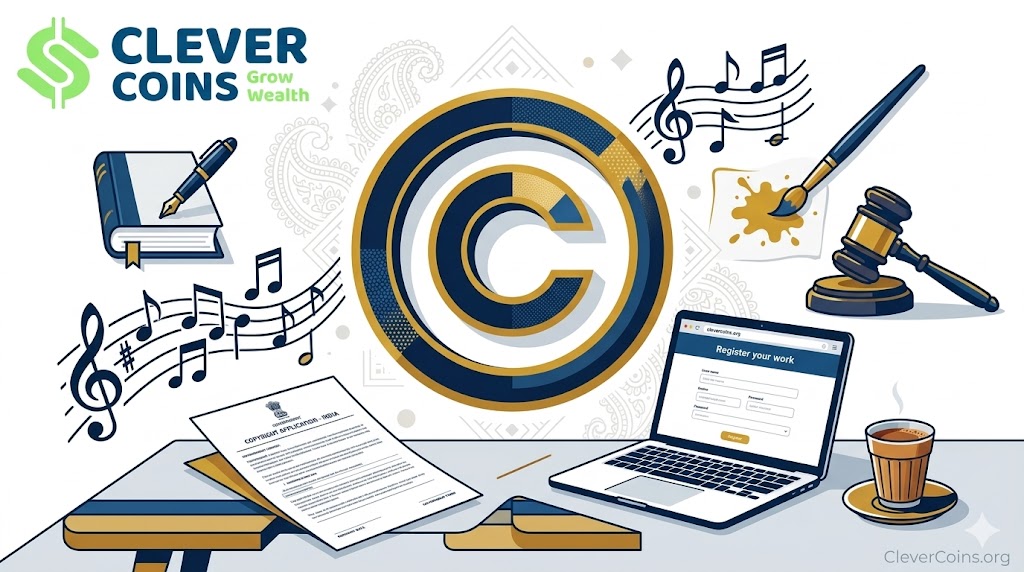
India is a country of creators — from writers and musicians to software developers, filmmakers, and artists. Every piece of original creative work deserves protection. Copyright law in India ensures that creators have exclusive rights over their work and can benefit financially and morally from it. But do you know how to formally register your copyright? This comprehensive guide by CleverCoins walks you through everything — from what copyright is, to the complete registration process, documents required, fees, timeline, and common mistakes to avoid.
What is Copyright?
Copyright is a form of intellectual property protection granted to the creators of original works. In India, it is governed by the Copyright Act, 1957, which has been amended several times, most recently in 2012. Copyright automatically exists the moment an original work is created — you do not need to register it. However, registration provides legal evidence of ownership and is critical when you need to enforce your rights in court.
Copyright covers the following types of works:
- Literary works – novels, poems, articles, books, computer programs, databases
- Musical works – compositions, lyrics, background scores
- Artistic works – paintings, sculptures, drawings, photographs, architectural designs
- Dramatic works – plays, screenplays, choreographic works
- Cinematographic films – motion pictures, documentaries, web series
- Sound recordings – audio recordings of any work
Why Should You Register Your Copyright?
While copyright exists automatically upon creation, registration offers several powerful advantages:
- Prima facie evidence: Registered copyright is treated as proof of ownership in legal disputes.
- Legal enforcement: You can file a suit for infringement only if your work is registered.
- Public notice: Registration creates a public record of your ownership.
- Monetary damages: Registered copyright holders are entitled to statutory damages and legal fees in infringement cases.
- Transfer and licensing: Easier to license or assign your rights to third parties.
- International protection: Under TRIPS and Berne Convention, Indian registration supports global protection.
- Credibility: Registered copyright adds credibility when pitching to publishers, investors, or platforms.
Who Can Apply for Copyright Registration?
The following persons can apply for copyright registration in India:
- The author of the work
- The publisher of the work (in case of unpublished works)
- The owner of the copyright (can be a company, employer, or assignee)
- Legal heirs in case of the author’s death
For works created during employment, the employer is generally the copyright owner unless agreed otherwise in the contract.
Duration of Copyright Protection in India
The duration of copyright protection in India depends on the type of work:
Type of Work | Duration of Protection |
Literary, Dramatic, Musical, Artistic (known author) | Lifetime of author + 60 years |
Anonymous/Pseudonymous works | 60 years from publication |
Posthumous works | 60 years from publication |
Cinematographic Films | 60 years from publication |
Sound Recordings | 60 years from publication |
Government works | 60 years from first publication |
Computer Programs | Lifetime of author + 60 years |
Copyright Registration Authority in India
Copyright registration in India is done through the Copyright Office, which operates under the Ministry of Commerce and Industry, Government of India. The office is located in New Delhi, but applications can be submitted online through the official portal.
Official Portal: copyright.gov.in
Applicants can also submit physical applications at the Copyright Office. The Copyright Registrar is the authority empowered to register copyrights under Section 44 of the Copyright Act, 1957.
Step-by-Step Copyright Registration Process in India
Here is the complete step-by-step guide to register your copyright online in India:
Step 1 – Create an Account on copyright.gov.in
Visit the official website copyright.gov.in and create a new user account. Enter your email ID, set a password, and verify your account via OTP sent to your registered mobile number. Once logged in, you can access the registration dashboard.
Step 2 – Fill the Online Application (Form XIV)
Click on ‘Register Copyright’ on the dashboard. You will be presented with Form XIV (the application form for copyright registration). Fill in the following details:
- Name, address, and nationality of the applicant
- Nature of the work (literary, artistic, musical, etc.)
- Title of the work
- Language of the work
- Year and country of first publication
- Name and address of the author(s)
- Details of any assignment or license (if applicable)
- Description of the work
Step 3 – Upload the Work
You will be required to upload a copy of the work being registered. This is done in digital format. Make sure the file is clear, complete, and in the accepted format (PDF, JPEG, MP3, etc., depending on the type of work).
Step 4 – Pay the Registration Fee
Pay the requisite government fee online through the payment gateway. The fee varies depending on the class of work:
Class of Work | Fee (INR) |
Literary, Dramatic, Musical & Artistic Work | Rs. 500 |
Literary, Dramatic, Musical & Artistic Work (other than above) | Rs. 2,000 |
Cinematograph Film | Rs. 5,000 |
Sound Recording | Rs. 2,000 |
Step 5 – Submit the Application
After completing the form and making the payment, submit the application online. You will receive a Diary Number (application reference number) which you can use to track your application status.
Step 6 – Mandatory Waiting Period (30 Days)
After filing, there is a mandatory waiting period of 30 days. During this period, the Copyright Office sends notices to the opposite party (if any objections are anticipated). If no objection is received within 30 days, the application moves forward for examination.
Step 7 – Examination by Copyright Office
The Copyright Examiner reviews the application for completeness and compliance. If any discrepancy or deficiency is found, a notice is issued to the applicant to rectify the issue within a specified time. Ensure that your application is complete and accurate to avoid unnecessary delays.
Step 8 – Issue of Copyright Registration Certificate
Upon successful examination and satisfaction of all requirements, the Copyright Office issues a Certificate of Registration. This certificate serves as a legal document proving your ownership of the copyright. You can download the certificate from the portal.
Documents Required for Copyright Registration
The following documents are typically required:
- Completed Form XIV (filled online on the portal)
- Copy of the work (soft copy to be uploaded)
- Identity proof of the applicant (Aadhaar Card, PAN Card, Passport)
- Address proof of the applicant
- NOC from the author (if applicant is not the author)
- NOC from the publisher (if work has been published)
- Power of Attorney (if filing through an agent/advocate)
- Details of any prior agreement, assignment, or license
- Proof of payment of registration fee
How to Track Your Application Status
After submitting the application, you can track the status online:
- Visit copyright.gov.in
- Log in to your account
- Click on ‘Track Application’
- Enter your Diary Number
- The current status of your application will be displayed
Copyright Registration Timeline
The copyright registration process in India typically takes between 2 to 12 months, depending on the workload of the Copyright Office and whether any objections are received. Here is a typical timeline:
- Day 1: Application submitted, Diary Number issued
- Days 1–30: Mandatory waiting period for objections
- Days 30–60: Examination by Copyright Examiner
- Days 60–90 (or more): Issuance of certificate (if no objections)
- 3–12 months: In case of objections or discrepancies
Can You Get Copyright Registration for Software?
Yes! Computer programs and software are classified as literary works under the Copyright Act, 1957. You can register your software code by submitting the source code (or a portion of it) along with the application. Many tech startups and SaaS companies in India register their software to protect their intellectual property.
Copyright vs Trademark vs Patent – Key Differences
Feature | Copyright | Trademark | Patent |
Protects | Original creative works | Brand names, logos, slogans | Inventions, processes |
Governs | Copyright Act, 1957 | Trade Marks Act, 1999 | Patents Act, 1970 |
Registration | Optional but recommended | Mandatory for enforcement | Mandatory |
Duration | Life + 60 years | 10 years (renewable) | 20 years |
Authority | Copyright Office | Trade Marks Registry | Patent Office |
Common Mistakes to Avoid in Copyright Registration
- Submitting incomplete Form XIV: Always double-check every field before submission.
- Incorrect classification of work: Make sure you select the correct class of work.
- Not uploading a clear copy: The uploaded work must be legible and complete.
- Skipping NOC: If you are not the author, always attach the author’s NOC.
- Using wrong fee: Verify the applicable fee for your class of work.
- Not tracking the application: Regularly check for any notices or discrepancies.
- Filing without professional help: Copyright law is nuanced — consulting an expert avoids rejections.
Copyright Infringement in India – What Happens?
Copyright infringement occurs when someone uses your registered work without permission. Under the Copyright Act, 1957, infringement is both a civil and criminal offence:
- Civil remedies: Injunction, damages, account of profits, delivery of infringing copies.
- Criminal penalties: Imprisonment of up to 3 years and a fine of up to Rs. 2 lakhs for first-time offenders.
- Enhanced penalties for repeat offenders.
With a registered copyright, enforcing these rights in court becomes significantly easier.
Can NRIs and Foreign Nationals Register Copyright in India?
Yes. Non-Resident Indians (NRIs) and foreign nationals can register their copyright in India for works first published in India or works related to Indian cultural heritage. India is a signatory to the Berne Convention, which provides reciprocal copyright protection across member countries. This means works registered in India are automatically protected in over 180 countries.
How CleverCoins Can Help You with Copyright Registration
At CleverCoins, we provide end-to-end assistance for copyright registration in India:
- Document preparation and review
- Online filing of Form XIV on copyright.gov.in
- Follow-up with the Copyright Office
- Handling objections and discrepancies
- Issuing advisory on copyright strategy for businesses and creators
We serve clients across Mumbai, Thane, Mumbra, and pan-India remotely. Our transparent pricing and quick turnaround make us the go-to partner for intellectual property registration.
Frequently Asked Questions (FAQs)
Q1. Is copyright registration mandatory in India?
No, copyright registration is not mandatory. Copyright exists automatically upon creation. However, registration provides legal evidence and is necessary to file a suit for infringement.
Q2. How long does copyright registration take in India?
Typically 2 to 12 months, depending on whether any objections are raised and the workload of the Copyright Office.
Q3. Can a company register copyright?
Yes. A company can be the owner of copyright — especially for works created by employees in the course of their employment. The company name is listed as the applicant and owner.
Q4. What is the fee for copyright registration?
The fee ranges from Rs. 500 to Rs. 5,000 depending on the class of work. Literary and artistic works are Rs. 500, while cinematographic films are Rs. 5,000.
Q5. Can I copyright my website content?
Yes. Website content including text, images, logos, and design elements can be copyrighted as literary and artistic works.
Q6. Is there any difference between copyright and trademark?
Yes. Copyright protects creative works (books, music, art), while trademark protects brand identifiers (logos, brand names, slogans). Both are separate forms of intellectual property protection.
Conclusion
Copyright registration in India is a straightforward process that provides powerful legal protection for your creative work. Whether you are a writer, musician, filmmaker, software developer, or business creating branded content — registering your copyright is a smart and affordable investment. With CleverCoins by your side, the entire process becomes seamless and stress-free.
Need help with copyright registration? Contact CleverCoins today at clevercoins.org or visit us in Mumbra, Thane. We are your trusted partners for all intellectual property and business compliance needs.