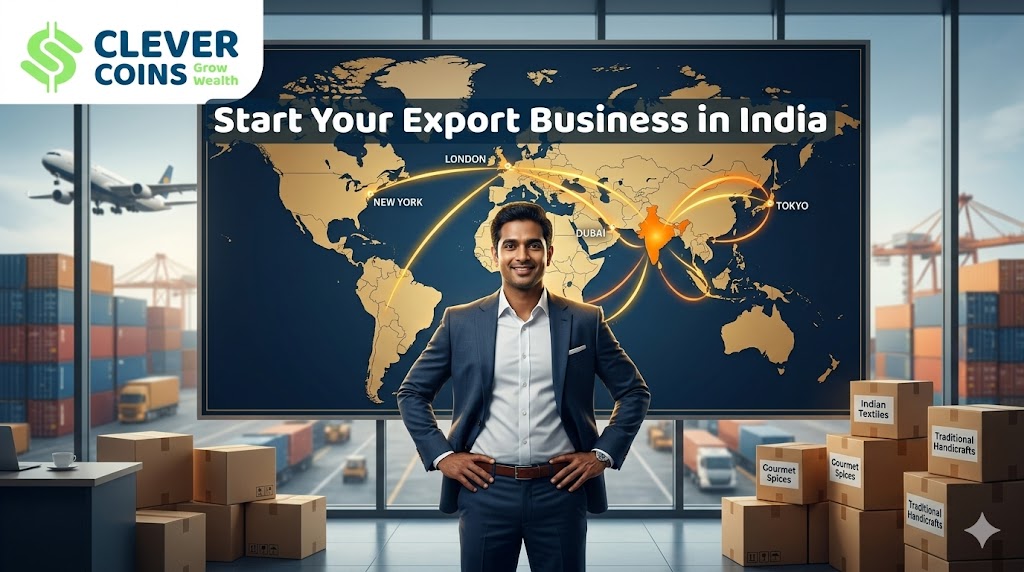
India is one of the world’s fastest-growing export economies. With a diverse product range, government support, and a massive manufacturing base, starting an export business in India has never been more rewarding. Whether you are a first-time entrepreneur or an established business looking to go global, this comprehensive guide will walk you through every step — from ideation and registration to finding buyers, shipping goods, and receiving payments.
India’s exports crossed $776 billion in FY 2023-24 (goods + services), and the government has set an ambitious target of $2 trillion in exports by 2030. This is the best time to ride this wave and build your own export empire.
Table of Contents
- What Is an Export Business?
- Why Start an Export Business in India?
- Types of Export Business Models
- Eligibility and Requirements
- Step-by-Step Process to Start an Export Business
- Important Documents Required for Export
- Government Schemes and Incentives for Exporters
- How to Find International Buyers
- Understanding Export Finance
- Shipping, Logistics & Customs Clearance
- Export Pricing Strategy
- Common Mistakes to Avoid
- Conclusion & Next Steps
1. What Is an Export Business?
An export business involves selling goods or services produced in one country (India, in this case) to buyers in another country. India exports a wide range of products including textiles, gems and jewellery, engineering goods, pharmaceuticals, spices, handicrafts, leather goods, IT services, chemicals, and agricultural products.
Export businesses can operate at various scales — from small home-based units exporting handicrafts, to large companies exporting industrial machinery. The structure and strategy differ based on the product, target market, and available capital.
2. Why Start an Export Business in India?
Here are the top reasons India is an ideal country for launching an export business:
- Massive Production Base: India manufactures thousands of products at competitive prices, making Indian exports attractive globally.
- Government Support: Schemes like MEIS (now RoDTEP), EPCG, TMA, and PLI Schemes provide financial incentives.
- Strategic Geography: India is well-positioned to serve markets in Asia, Europe, the Middle East, Africa, and the Americas.
- Growing Trade Agreements: India has FTAs with ASEAN, UAE, Australia, and more, reducing tariff barriers.
- Digital Trade Platforms: B2B platforms like IndiaMART, Alibaba, TradeIndia, and government portals (DGFT) simplify global outreach.
- Low Cost of Production: Competitive labour and raw material costs ensure healthy profit margins.
- High Domestic Skill Base: India has world-class IT, pharmaceutical, engineering, and textile industries.
- Foreign Exchange Earnings: Export business earns foreign currency, strengthening your financial position.
3. Types of Export Business Models
Before diving in, choose the right export model for your business:
a) Merchant Exporter
You buy goods from manufacturers and export them under your own name. No production involved — you act as the trading intermediary.
b) Manufacturer Exporter
You manufacture the goods yourself and export them directly. This offers better control over quality and pricing.
c) Export House / Trading House
You source from multiple suppliers and export under your brand. With sufficient export turnover, you can apply for Star Export House status.
d) Dropshipping Exporter
You take orders from international buyers and have manufacturers ship directly. Low capital investment, but thin margins.
e) E-commerce Exporter
You sell through Amazon Global, Etsy, eBay, or your own D2C website to international customers. Ideal for artisans, handicraft makers, and niche product sellers.
4. Eligibility and Requirements
To start an export business in India, you need the following basics:
- A registered business entity (Proprietorship, Partnership, LLP, Pvt Ltd, or OPC)
- PAN Card for the business or individual
- A current bank account in a bank authorised for foreign exchange
- Import Export Code (IEC) — the most critical licence
- GST Registration (mandatory for exporters)
- RCMC (Registration Cum Membership Certificate) from the relevant Export Promotion Council
5. Step-by-Step Process to Start an Export Business in India
Step 1: Conduct Market Research
Identify which products have strong demand in international markets. Use tools like Google Trends, Trade Map (ITC), Volza, and DGFT export data to analyze global demand. Study competitor pricing, target countries, and seasonal trends.
Step 2: Select Your Product & Niche
Focus on products where India has a competitive advantage — textiles, spices, handicrafts, leather, engineering goods, pharma, gems, etc. Define your niche clearly. For example, instead of ‘textiles,’ narrow down to ‘hand-embroidered cotton kurtis for women in Europe.’
Step 3: Register Your Business
Register a legal entity based on your scale:
- Sole Proprietorship — simplest, low cost, full control
- Partnership Firm — shared responsibility
- LLP (Limited Liability Partnership) — balanced option
- Private Limited Company — best for scaling and credibility
Register through the Ministry of Corporate Affairs (MCA) portal or with a CA/CS professional.
Step 4: Obtain PAN and Open a Current Bank Account
Obtain a business PAN and open a current bank account in an Authorised Dealer (AD) category bank (e.g., SBI, HDFC, ICICI) to handle foreign exchange transactions. This is mandatory before applying for IEC.
Step 5: Apply for Import Export Code (IEC)
The Import Export Code (IEC) is a 10-digit unique identification number issued by the Directorate General of Foreign Trade (DGFT). It is mandatory for all exporters and importers in India.
How to apply for IEC:
- Visit the DGFT portal: dgft.gov.in
- Click on ‘Services’ > ‘IEC’ > ‘Apply for IEC’
- Fill in the online form with your business details
- Upload PAN, Aadhaar, photograph, and cancelled cheque
- Pay the fee of Rs. 500 online
- Receive IEC via email in 2-5 working days
Step 6: Register for GST
GST registration is essential. Exports are treated as ‘zero-rated supply’ under GST — you can claim refunds on input tax credits or export under a Bond/LUT without paying IGST. Register at gstin.gov.in.
Step 7: Get RCMC from Export Promotion Council
Register with the relevant Export Promotion Council (EPC) to access government benefits, subsidies, and marketing assistance. Examples:
- APEDA — for agricultural products
- FIEO — Federation of Indian Export Organisations
- EPCH — for handicrafts
- CLE — for leather products
- EEPC — for engineering goods
- Pharmexcil — for pharmaceuticals
Step 8: Source Your Products
Find reliable suppliers through IndiaMART, TradeIndia, or local wholesale markets. If you’re a manufacturer, focus on quality certifications like ISO, BIS, or product-specific certifications like FSSAI (food), CE marking (Europe), or FDA approval (USA).
Step 9: Set Up Your Export Infrastructure
Prepare the following infrastructure:
- Professional website with export catalogue and inquiry form
- Company email ID and international phone number
- Export packaging as per international standards
- Quality control process
- Tie up with a Freight Forwarder and Custom House Agent (CHA)
Step 10: Find International Buyers
Use a combination of online and offline channels to reach global buyers. (Detailed strategies are provided in Section 8.)
Step 11: Negotiate and Finalise Orders
Once a buyer is interested:
- Share a Proforma Invoice (PI) with product specs, pricing, and payment terms
- Negotiate Incoterms (FOB, CIF, EXW, etc.)
- Agree on payment terms: Advance TT, Letter of Credit (LC), or DP/DA
- Send a Sales Contract / Purchase Order for written confirmation
Step 12: Arrange Export Finance
You may need working capital to produce or procure goods before receiving payment. Options include Pre-shipment finance (Packing Credit), Post-shipment finance, and export credit from EXIM Bank or ECGC-backed facilities.
Step 13: Prepare Export Documents
Prepare all required export documents (detailed in Section 6) and coordinate with your Freight Forwarder and CHA for customs clearance and shipping.
Step 14: Ship the Goods
Ship via sea freight, air freight, or courier depending on the product type, urgency, and buyer’s preference. Obtain the Bill of Lading (B/L) or Airway Bill (AWB) and share with the buyer for customs clearance at the destination.
Step 15: Receive Payment & Claim Incentives
Receive payment in foreign currency through your AD bank. File for GST refunds, RoDTEP benefits, and other government incentives to maximize profitability.
6. Important Documents Required for Export
The following documents are required for a typical export shipment:
- Commercial Invoice — billing document raised on the buyer
- Packing List — detailed list of goods in each package
- Bill of Lading (sea) or Airway Bill (air) — shipping contract
- Shipping Bill — filed with Indian Customs via ICEGATE
- Certificate of Origin — certifies goods are made in India
- GST Invoice — for GST compliance
- Letter of Credit (if applicable) — payment guarantee from buyer’s bank
- Inspection Certificate — if required by the buyer or destination country
- Insurance Certificate — for insured shipments
- FSSAI Certificate (for food products), Phytosanitary Certificate (for plants/agri)
7. Government Schemes and Incentives for Exporters
The Indian government offers multiple schemes to boost exports:
- RoDTEP (Remission of Duties and Taxes on Exported Products) — refund of embedded taxes
- EPCG (Export Promotion Capital Goods Scheme) — import capital goods at 0% duty
- Advance Authorization Scheme — import inputs duty-free for export production
- DFIA (Duty Free Import Authorisation) — for post-export duty-free imports
- TMA (Trade Marketing Assistance) — for MSME exporters to participate in international expos
- PLI Schemes — Production-linked incentives for specific sectors
- MAI (Market Access Initiative) — support for export promotion activities
- NIRVIK Scheme (ECGC) — enhanced insurance cover for exporters
8. How to Find International Buyers
Finding buyers is the most critical challenge for new exporters. Use the following strategies:
Online B2B Platforms
- com — world’s largest B2B marketplace
- com — popular in electronics and manufacturing
- com — leading Indian B2B portal
- com — massive buyer base
- com — focused on connecting Indian exporters globally
- Amazon Global Selling — great for branded or packaged consumer products
Government & Trade Portals
- India Trade Portal (FIEO) — buyer enquiries and market research
- Trade Map (ITC, Geneva) — global trade statistics
- com — US import data for targeted buyer outreach
- Panjiva / ImportGenius — import-export data analytics
Offline Strategies
- Participate in international trade fairs (IHGF Delhi Fair, Aapex Las Vegas, etc.)
- Attend buyer-seller meets organised by FIEO, EPCs, and Indian Embassies
- Cold email outreach to importers in target countries
- Partner with Indian Embassies and Trade Commissioners abroad
- LinkedIn outreach to procurement managers and importers
9. Understanding Export Finance
Cash flow is the backbone of an export business. Here are key financing options:
- Pre-Shipment Finance (Packing Credit) — Working capital provided by banks before shipment to purchase/manufacture goods
- Post-Shipment Finance — Finance against export documents after shipment
- Letter of Credit (LC) — Bank guarantee ensuring payment upon document compliance
- ECGC Credit Insurance — Protect against buyer default and political risks
- EXIM Bank Lines of Credit — Long-term financing for large exporters
- Factoring — Sell your export receivables to a factor for immediate cash
10. Shipping, Logistics & Customs Clearance
Efficient logistics is vital for customer satisfaction and cost control.
Shipping Modes
- Sea Freight — Most economical for large, heavy, or bulk goods (FCL/LCL)
- Air Freight — Fastest but expensive; ideal for high-value or time-sensitive products
- Courier (DHL, FedEx, UPS) — Best for small parcels, samples, and e-commerce shipments
- Road/Rail — For exports to Nepal, Bhutan, Bangladesh, Myanmar
Customs Clearance Process
- File Shipping Bill on ICEGATE portal
- Goods physically examined by Customs Officers (if selected)
- LEO (Let Export Order) granted — goods can be shipped
- Get Bill of Lading from the shipping line
- Submit export documents to bank for payment processing
11. Export Pricing Strategy
Export pricing is more complex than domestic pricing. Factor in:
- Cost of Goods (manufacturing/procurement cost)
- Export packaging cost
- Freight and insurance (based on chosen Incoterm)
- Bank charges and commission
- Customs duty (export duty, if any)
- Agent/broker commission
- Expected profit margin (typically 15-30% for exports)
- Currency exchange fluctuation buffer (2-5%)
Always quote in USD, EUR, or GBP for major markets, and hedge against currency risk through forward contracts or natural hedging.
12. Common Mistakes to Avoid
- Not verifying buyer credibility — always use credit checks (ECGC, D&B)
- Incorrect documentation — even minor errors can delay customs clearance
- Poor export packaging — international shipping is rough; invest in quality packaging
- Ignoring Incoterms — misunderstanding who pays for freight and insurance leads to losses
- Skipping crop/quality inspections for agri products
- Underpricing to win orders — leads to unsustainable business
- Not registering with an Export Promotion Council — you miss out on major benefits
- Ignoring foreign exchange regulations (FEMA) — can attract serious penalties
- Over-dependence on a single buyer — diversify your buyer base
- Neglecting after-sales service — relationship building leads to repeat orders
13. Conclusion & Next Steps
Starting an export business in India is a rewarding journey that requires careful planning, the right registrations, strong supplier relationships, and a relentless focus on finding and retaining international buyers. India’s thriving export ecosystem, supported by government schemes and a robust manufacturing base, gives you every advantage to succeed.
Your immediate next steps:
- Decide your product niche and target country
- Register your business entity
- Apply for IEC on the DGFT portal
- Register for GST
- Join the relevant Export Promotion Council
- Build your export website and digital presence
- List on B2B marketplaces and start reaching out to buyers