The Rising Cost of Higher Education — and How to Fight Back
Higher education in India and abroad has never been more expensive — or more essential. Whether it is a postgraduate MBA from an IIM, an engineering degree from a top NIT, a medical seat in a private college, or a master’s programme at a university in the USA, UK, Canada, or Australia, the financial burden on students and their families has grown exponentially over the past decade.
The average cost of an undergraduate engineering programme at a private college in India now ranges from Rs 6 lakh to Rs 20 lakh. An MBA from a top private B-school can cost Rs 20 lakh to Rs 35 lakh. And an international master’s degree, factoring in tuition, living costs, and travel, can easily touch Rs 50 lakh to Rs 1 crore or more.
This is precisely where education loans become a lifeline — enabling students to pursue their academic dreams without compromising their family’s financial stability. But education loans in India are often misunderstood. Many borrowers are unaware of the substantial tax benefits available under the Income Tax Act, or which lenders offer the best terms and lowest interest rates.
At CleverCoins, our mission is to make financial clarity accessible to every Indian. In this comprehensive guide, we break down everything you need to know about education loans — from the mechanics of how they work, to the tax deductions you can legally claim, to a detailed comparison of the best education loan options available in India in 2026.
Whether you are a student, a parent, or a working professional planning to upgrade your skills — this guide is for you.
What Is an Education Loan? Understanding the Basics
An education loan (also called a student loan or academic loan) is a financial product specifically designed to fund higher education expenses. Unlike a personal loan, it is issued specifically for educational purposes and typically carries lower interest rates, longer repayment tenures, and a moratorium period during which the student does not need to repay the principal — and in many cases, not even the interest — while studying.
What Does an Education Loan Cover?
Education loans in India generally cover the following expenses:
- Tuition fees and university admission charges
- Examination, library, and laboratory fees
- Hostel and accommodation expenses
- Cost of books, equipment, instruments, and uniforms
- Travel expenses for students studying abroad
- Purchase of computer or laptop required for the course
- Caution deposit, building fund, or refundable deposit required by institution
- Other reasonable expenses required for course completion
Key Education Loan Terms to Know
| Term | Meaning |
| Principal Amount | The total loan amount disbursed to the borrower |
| Interest Rate | Annual rate charged on the outstanding loan (simple or compound) |
| Moratorium Period | Course duration + 6 to 12 months — repayment holiday for the student |
| Repayment Tenure | Period after moratorium to repay the loan (typically 5–15 years) |
| Collateral / Security | Asset pledged for loans above a certain threshold (usually Rs 7.5 lakh) |
| Co-borrower | Parent or guardian who jointly takes the loan as co-applicant |
| Margin Money | Percentage of total cost the student must fund independently (typically 5–15%) |
Section 80E: The Education Loan Tax Benefit You Must Claim
This is the cornerstone of education loan tax planning in India. Section 80E of the Income Tax Act, 1961 provides a deduction on the interest paid on education loans taken for higher education. Understanding this section can result in significant tax savings over the loan repayment period.
What Is Section 80E?
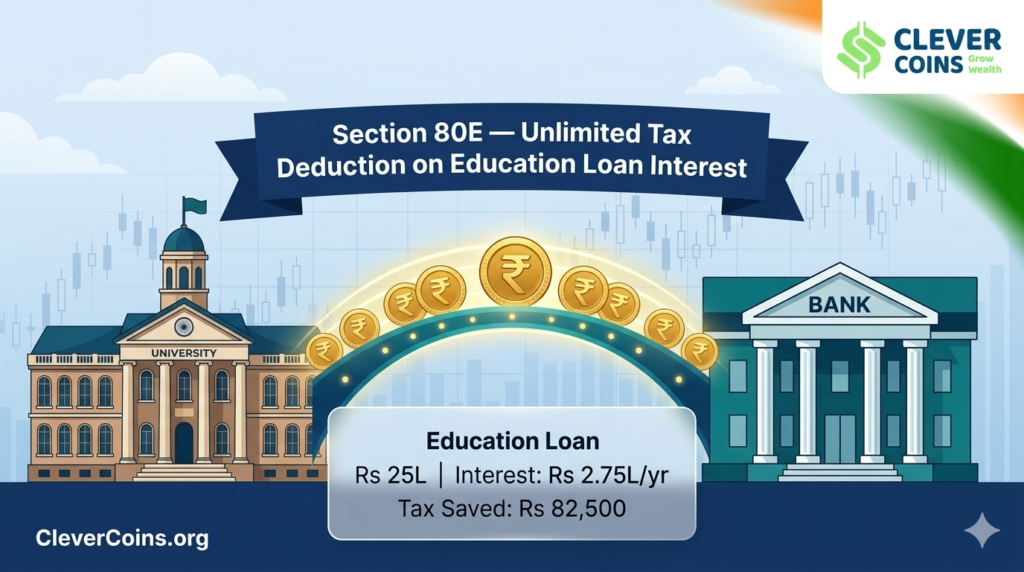
Section 80E allows an individual taxpayer to claim a deduction on the entire amount of interest paid on an education loan during a financial year. Unlike most deductions in the Income Tax Act, this deduction has no upper ceiling — you can deduct 100% of the interest paid, regardless of how large that amount is.
Key Insight: Section 80E offers an UNLIMITED deduction on education loan interest — making it one of the most powerful tax-saving tools available to Indian taxpayers.
Who Can Claim Section 80E Deduction?
The following persons are eligible to claim the deduction:
- Individual taxpayers only: Section 80E is available exclusively to individuals — it cannot be claimed by Hindu Undivided Families (HUFs), companies, or partnerships.
- The loan must be taken for the taxpayer, their spouse, their children, or a student for whom the taxpayer is the legal guardian: This covers a broad range of family-related education expenses.
- Loan must be taken from an approved financial institution: Only loans from banks approved by the central or state government, or from approved charitable institutions, qualify. Loans from employers, family members, or friends do not qualify.
- The loan must be for higher education: This includes any full-time or part-time programme pursued after passing the Senior Secondary Examination (Class XII) or equivalent — in India or abroad.
What Qualifies as ‘Higher Education’ Under Section 80E?
The definition of higher education under Section 80E is broad and includes:
- Any full-time course in management, engineering, medicine, applied science, mathematics, statistics, or related fields
- Postgraduate courses in pure and applied sciences
- Any other course pursued after completing Class XII — including arts, commerce, and humanities
- Vocational courses recognised by the central government
- Professional courses (CA, CS, CMA, LLB, MBBS, etc.)
- Courses pursued at foreign universities or institutions
Key Features of Section 80E — At a Glance
| Feature | Details |
| Who Can Claim | Individual taxpayers only |
| Deduction Type | Only Interest paid — NOT the principal repaid |
| Maximum Deduction Limit | NO LIMIT — 100% of interest paid is deductible |
| Duration of Benefit | 8 consecutive assessment years from the year repayment begins (or until interest is fully repaid, whichever is earlier) |
| Eligible Loan Source | Scheduled commercial banks, cooperative banks, financial institutions notified by government, or approved charitable institutions |
| Eligible Courses | Any higher education (after Class XII) — India or abroad |
| Applicable Tax Regime | Only under the Old Tax Regime (NOT available under New Tax Regime) |
| Documents Required | Interest certificate from the bank for the financial year |
Section 80E: Worked Example with Tax Savings
Let us calculate the real-world tax savings from Section 80E with a realistic scenario:
| Parameter | Amount |
| Education Loan Amount | Rs 25,00,000 |
| Interest Rate | 11% per annum |
| Annual Interest Paid (Year 1 of repayment) | Rs 2,75,000 (approx.) |
| Taxpayer’s Income Tax Slab | 30% (Income above Rs 10 lakh) |
| Tax Saved (30% of Rs 2,75,000) | Rs 82,500 |
| Effective After-Tax Interest Cost | Rs 1,92,500 (instead of Rs 2,75,000) |
| Effective Interest Rate After Tax Saving | Approximately 7.7% p.a. |
As the example shows, a taxpayer in the 30% bracket paying Rs 2.75 lakh in education loan interest can save Rs 82,500 in taxes in a single year. Over 8 years of eligible deduction, the cumulative tax saving could run into several lakhs — making Section 80E one of the most impactful deductions in the Indian tax code.
Important Limitations of Section 80E
- No benefit under New Tax Regime: If you opt for the New Tax Regime (introduced under Section 115BAC), you CANNOT claim the Section 80E deduction. This is a crucial consideration when choosing your tax regime.
- Only interest is deductible, not principal: The EMI on an education loan typically has both a principal and an interest component. Only the interest portion is eligible for deduction under Section 80E.
- 8-year time limit: The deduction is available for a maximum of 8 consecutive assessment years from the year you start repaying the loan. If you have not fully repaid the interest within 8 years, you lose the benefit on the remaining amount.
- Approved lenders only: Loans from relatives, employers, non-banking financial companies not notified by the government, or informal sources do not qualify.
Other Tax Benefits Related to Education in India
Beyond Section 80E, there are several other provisions in the Income Tax Act that provide relief related to education expenses:
Section 80C — Tuition Fees Deduction
Under Section 80C (within the overall Rs 1.5 lakh limit), you can claim a deduction for tuition fees paid to schools, colleges, universities, or other educational institutions in India — for a maximum of two children. This covers:
- School tuition fees for up to 2 children
- College tuition fees for up to 2 children
- Only tuition fees qualify — NOT development fees, capitation fees, or other charges
- Applicable for full-time education in India only
Note: Section 80C does not cover foreign education fees, and it is separate from and in addition to the Section 80E deduction.
Scholarship Exemption Under Section 10(16)
Any scholarship received for education — whether from the government, an institution, or a foreign entity — is fully exempt from income tax under Section 10(16). This covers merit scholarships, need-based scholarships, and government fellowships.
House Rent Allowance (HRA) for Student Accommodation
If a working professional is paying rent for accommodation while pursuing a course, they may be eligible to claim HRA exemption under Section 10(13A) — provided the conditions for HRA exemption are otherwise met.
Tax Benefits for Employers Sponsoring Employee Education
When an employer pays for an employee’s higher education as part of skill development, the reimbursement may be tax-exempt as a perquisite up to certain limits under Rule 3 of the Income Tax Rules, reducing the effective cost of the education to the employee.
Best Education Loan Options in India for 2026
With over 50 banks and financial institutions offering education loans in India, choosing the right lender can be overwhelming. We have analysed the most popular options based on interest rates, loan limits, moratorium periods, processing fees, and special schemes:
1. State Bank of India (SBI) — SBI Scholar Loan & SBI Student Loan Scheme
| Parameter | SBI Education Loan |
| Interest Rate | 8.15% – 11.15% p.a. (varies by scheme and institution) |
| Maximum Loan Amount | Rs 1.5 crore (for premier institutions); Rs 7.5 lakh – Rs 20 lakh (general) |
| Moratorium | Course duration + 12 months |
| Repayment Period | Up to 15 years after moratorium |
| Collateral | Required for loans above Rs 7.5 lakh (property, FD, LIC, etc.) |
| Processing Fee | Nil for loans up to Rs 20 lakh; 1% + GST for higher amounts |
| Special Feature | SBI Scholar Loan: No collateral, lower rates for IITs, IIMs, NITs, AIIMs, and other premier institutions |
2. HDFC Bank — Education Loan
| Parameter | HDFC Education Loan |
| Interest Rate | 9.50% – 13.50% p.a. |
| Maximum Loan Amount | Rs 20 lakh (India); Rs 45 lakh (abroad) |
| Moratorium | Course duration + 12 months |
| Repayment Period | Up to 14 years |
| Collateral | Unsecured up to Rs 7.5 lakh; collateral may be required beyond |
| Special Feature | Fast processing, doorstep service, dedicated student counsellors |
3. Punjab National Bank (PNB) — PNB Saraswati & PNB Udaan
| Parameter | PNB Education Loan |
| Interest Rate | 8.55% – 10.75% p.a. (PNB Saraswati); 9.25% – 10.75% (PNB Udaan for abroad) |
| Maximum Loan Amount | Rs 10 lakh (India); Rs 20 lakh (abroad) — higher for premier institutions |
| Moratorium | Course duration + 12 months |
| Repayment Period | Up to 15 years |
| Special Feature | Concession of 0.5% for girl students; PNB Udaan covers GRE / GMAT coaching fees |
4. Bank of Baroda — Baroda Scholar & Baroda Vidya
| Parameter | Bank of Baroda Education Loan |
| Interest Rate | 8.70% – 10.85% p.a. (India); 9.70% – 11.85% (abroad) |
| Maximum Loan Amount | Rs 4 lakh (Baroda Vidya — no collateral); Rs 80 lakh+ (Baroda Scholar) |
| Moratorium | Course duration + 12 months |
| Special Feature | Baroda Scholar specifically designed for studies at top global universities; special concession for girl students |
5. Axis Bank — Education Loan
| Parameter | Axis Bank Education Loan |
| Interest Rate | 13.70% – 15.20% p.a. |
| Maximum Loan Amount | Rs 75 lakh (India); Rs 75 lakh (abroad) |
| Moratorium | Course duration + 12 months |
| Special Feature | Fast digital processing; covers GRE, GMAT, IELTS coaching and exam fees |
6. IDBI Bank — Education Loan
IDBI Bank offers competitive rates of 8.90% – 10.75% p.a. for loans up to Rs 20 lakh (India) and Rs 30 lakh (abroad), with a moratorium of course duration + 12 months. It features a special concession for girl students and offers loans without collateral up to Rs 7.5 lakh.
7. Vidya Lakshmi Portal — Government Education Loan Gateway
The Vidya Lakshmi Portal (vidyalakshmi.co.in), launched by the Government of India, is a one-stop digital platform where students can apply to multiple banks simultaneously for education loans. It also links to central and state government scholarship schemes, making it an invaluable resource for students seeking affordable financing.
- Apply to up to 3 bank loan schemes simultaneously through a single application
- Check eligibility for government scholarships and subsidy schemes
- Monitor application status in real time
- Access the National Scholarship Portal (NSP) for government scholarships
8. NBFC Options — Credila (HDFC), Avanse, Auxilo, InCred
Non-Banking Financial Companies (NBFCs) have emerged as significant players in education finance, particularly for students who do not meet the stricter eligibility criteria of public sector banks. Key players include:
- HDFC Credila: India’s first dedicated education loan NBFC — known for flexible terms, loans covering 100% of cost, and expertise in international education finance. Interest rates typically range from 11% – 14% p.a.
- Avanse Financial Services: Specialises in education loans, offering customised solutions for both domestic and international courses. Covers a wide range of courses and institutions.
- Auxilo Finserve: Technology-driven NBFC offering fast processing and loans for courses not covered by traditional banks. Suitable for vocational and non-traditional courses.
- InCred Finance: Offers education loans with flexible collateral requirements and coverage for a wide range of international universities.
Note: Interest rates at NBFCs are generally higher than public sector banks. However, they offer greater flexibility in terms of eligible institutions, courses, and documentation requirements.
Government Education Loan Schemes & Interest Subsidies
The Government of India operates several schemes to reduce the burden of education loan interest for deserving students:
1. Central Sector Interest Subsidy Scheme (CSIS)
Under CSIS, the central government pays the interest on education loans during the moratorium period (course duration + 12 months) for students from economically weaker sections (annual family income up to Rs 4.5 lakh). This effectively makes the loan interest-free during the study period.
- Applicable for technical and professional courses at approved institutions in India
- Loans must be taken from scheduled commercial banks listed on the Vidya Lakshmi Portal
- The benefit is applied directly by the bank — students do not need to separately apply
2. Dr. Ambedkar Central Sector Scheme
Provides interest subsidy for Other Backward Classes (OBC) and Economically Backward Classes (EBC) students pursuing overseas studies. Family income limit: Rs 8 lakh per annum for OBC; Rs 2.5 lakh for EBC.
3. Padho Pardesh Scheme
Specifically designed for minority community students (Muslims, Christians, Sikhs, Buddhists, Parsis, Jains) pursuing master’s, MPhil, or PhD programmes abroad. Provides 100% interest subsidy during the moratorium period.
4. State Government Subsidy Schemes
Several state governments — including Maharashtra, Tamil Nadu, Karnataka, Andhra Pradesh, and Telangana — run their own education loan subsidy or scholarship schemes for students from their states. These can be in addition to central government schemes and can significantly reduce the net cost of education loans.
Education Loan Eligibility: What Lenders Look For
Understanding the eligibility criteria helps you prepare a stronger application:
| Criterion | Typical Requirement |
| Age of Applicant | 18 – 35 years (for student); co-borrower (parent/guardian) typically up to 60–70 years |
| Academic Record | Good academic track record; some banks require minimum 50–60% in qualifying exam |
| Admission Status | Confirmed admission letter from a recognised institution is mandatory |
| Co-borrower | Parent, guardian, or spouse with regular income source — required by most banks |
| Income Proof (Co-borrower) | Salary slips, ITR, Form 16, bank statements for 6–12 months |
| Collateral | Immovable property, fixed deposits, LIC policy, NSC, or mutual fund units (for loans above threshold) |
| Credit Score | Co-borrower should ideally have CIBIL score of 700+ |
| Institution Recognition | Course must be at a UGC / AICTE / MCI / government-recognised institution in India, or accredited university abroad |
Documents Required for Education Loan Application
Prepare the following documents to ensure a smooth loan application process:
Identity and Address Proof
- Aadhaar Card, PAN Card, Passport (mandatory for abroad studies)
- Voter ID or Driving Licence for address proof
Academic Documents
- Mark sheets of Class X, XII, and graduation (as applicable)
- Entrance exam scorecard (JEE, NEET, CAT, GRE, GMAT, IELTS, TOEFL, etc.)
- Admission confirmation letter / offer letter from the institution
- Fee structure / cost of attendance from the institution
Financial Documents (Co-borrower)
- Last 3 years’ Income Tax Returns (ITR) and Form 16
- Salary slips for the last 3 months
- Bank account statements for the last 6–12 months
- Business proof and audited financials (if self-employed)
Collateral Documents (if applicable)
- Property documents (sale deed, title deed, encumbrance certificate)
- Latest property tax receipt and valuation report
- Fixed deposit receipts / LIC policy documents
How to Apply for an Education Loan: Step-by-Step
- Research & Compare Lenders: Use comparison platforms, the Vidya Lakshmi portal, and bank websites to compare interest rates, loan limits, processing fees, and special schemes. Shortlist 2–3 lenders.
- Check Eligibility: Verify that your course, institution, and co-borrower’s income profile meets the lender’s eligibility criteria before applying.
- Gather Documents: Prepare all required documents (identity, academic, financial, collateral) in advance to avoid delays.
- Submit Application: Apply online (through bank website or Vidya Lakshmi portal) or visit the nearest branch. Some banks offer doorstep application services.
- Loan Processing & Verification: The bank reviews your application, verifies documents, and may conduct a site visit for collateral. This typically takes 7–15 working days.
- Loan Sanction Letter: Upon approval, the bank issues a sanction letter specifying the loan amount, interest rate, repayment terms, and conditions.
- Disbursement: The loan amount is typically disbursed directly to the institution in instalments as per the fee schedule. Living expenses may be credited to the student’s account.
- Repayment: Repayment begins after the moratorium period. Set up auto-debit (ECS/NACH) to avoid missed EMIs and protect your credit score.
How to Claim Section 80E Deduction While Filing ITR
Claiming the Section 80E deduction is straightforward if you follow the correct process during Income Tax Return (ITR) filing:
- Obtain Interest Certificate: Every financial year, request an interest certificate from your bank or NBFC showing the total interest paid on your education loan during that year. This is the primary document required.
- Choose Old Tax Regime: Ensure you are filing under the Old Tax Regime — the Section 80E deduction is not available under the New Tax Regime (Section 115BAC).
- Fill Chapter VI-A Deductions: In your ITR form (ITR-1 or ITR-2, as applicable), go to the Chapter VI-A deductions section and enter the interest amount in the field for Section 80E.
- No Supporting Document Required at Filing: You do not need to attach the interest certificate when filing ITR. However, retain it safely as the Income Tax Department may request it during assessment or scrutiny.
- File Within Due Date: Ensure you file your ITR by the due date (typically July 31 for salaried individuals) to claim all eligible deductions.
Pro Tip: If your employer does not include the Section 80E deduction in Form 16 (TDS certificate), you can still claim it directly when filing your ITR — the deduction is available regardless of whether your employer accounts for it.
Education Loan Comparison: Top Banks at a Glance (2026)
| Bank | Interest Rate | Max Loan | Moratorium | Collateral Limit |
| SBI Scholar Loan | 8.15%–11.15% | Rs 1.5 Cr | Course + 12 mo. | Above Rs 7.5L |
| PNB Saraswati / Udaan | 8.55%–10.75% | Rs 20 L (Ind) | Course + 12 mo. | Above Rs 7.5L |
| Bank of Baroda Scholar | 8.70%–10.85% | Rs 80 L+ | Course + 12 mo. | Above Rs 7.5L |
| HDFC Bank | 9.50%–13.50% | Rs 45 L (Abr) | Course + 12 mo. | Above Rs 7.5L |
| Axis Bank | 13.70%–15.20% | Rs 75 L | Course + 12 mo. | Varies |
| HDFC Credila (NBFC) | 11.00%–14.00% | 100% of cost | Course + 12 mo. | Flexible |
| Avanse (NBFC) | 11.00%–14.50% | 100% of cost | Course + 6 mo. | Flexible |
Note: Interest rates are indicative and subject to change. Always verify current rates directly with the lender before applying.
Smart Tips to Maximise Your Education Loan Benefits
- Start interest servicing early: If your financial situation allows, consider paying the interest during the moratorium period instead of letting it accumulate. This significantly reduces the total repayment burden.
- Opt for the Old Tax Regime if interest payments are substantial: If your annual education loan interest is high (say, Rs 2 lakh or more), the Section 80E deduction alone may make the Old Tax Regime more beneficial.
- Compare NBFC vs bank carefully: NBFCs often cover a wider range of institutions and courses but at higher interest rates. Calculate the total cost (EMI × tenure) before choosing.
- Leverage interest subsidy schemes proactively: Check your eligibility for CSIS, Dr. Ambedkar scheme, or state government schemes — these can make your loan effectively interest-free during the study period.
- Build your co-borrower’s CIBIL score: A higher CIBIL score for the co-borrower can help negotiate a lower interest rate, especially at private banks.
- Understand margin money: Most banks finance 90–95% of the total cost. Plan for the margin money (5–10%) to be funded from savings, scholarships, or part-time income.
- Keep the moratorium period in mind for tax planning: The 8-year Section 80E benefit clock starts when repayment begins — not when the loan is taken. Plan your repayment schedule accordingly.
- Consider prepayment: If you receive a lump sum (bonus, gift, foreign remittance), consider prepaying a portion of the principal — most education loans allow prepayment without penalty.
Frequently Asked Questions (FAQs)
Q1. Can I claim Section 80E if my parents took the loan on my behalf?
Yes. Section 80E allows the deduction to be claimed by the individual who is repaying the loan — whether it is the student or the parent (if the loan was taken for the student’s education). If the parent is the primary borrower and is repaying, they can claim the deduction on their ITR.
Q2. Is there a maximum limit on the amount I can deduct under Section 80E?
No. Unlike most other deductions in the Income Tax Act, Section 80E has no upper ceiling. 100% of the interest paid during the financial year is eligible for deduction.
Q3. Can I claim both Section 80C (tuition fees) and Section 80E in the same year?
Yes, absolutely. Section 80C tuition fees deduction and Section 80E interest deduction are completely separate provisions and can both be claimed in the same assessment year. They are counted independently and do not reduce each other’s limit.
Q4. Does the Section 80E deduction apply to loans taken for vocational courses?
Yes, Section 80E applies to vocational courses recognised by the central government, provided they qualify as higher education (after Senior Secondary level). Check with your bank and a tax advisor to confirm eligibility for your specific course.
Q5. What happens to the Section 80E benefit if I prepay my loan in Year 5?
The 8-year benefit period is a maximum limit — not a guarantee. If you prepay your loan and the interest is fully paid by Year 5, the benefit simply ends at that point. You do not lose anything — you have just finished repaying the interest sooner.
Q6. Can NRIs claim Section 80E on education loans?
Yes, provided the NRI is an Indian citizen and the loan is taken for higher education from an approved financial institution. The deduction can be claimed while filing the ITR for the assessment year in which the interest is paid — under the Old Tax Regime.
Q7. Are education loans for online or distance learning programmes eligible for Section 80E?
This depends on whether the programme qualifies as ‘higher education’ as defined under Section 80E and whether the institution is recognised. Many online programmes from accredited institutions qualify. It is advisable to confirm with your lender and a tax consultant.
Q8. My education loan interest is Rs 5 lakh this year. What is my exact tax saving?
If you are in the 30% tax bracket, you save Rs 1,50,000 (30% of Rs 5 lakh) in income tax. If you are in the 20% bracket, you save Rs 1,00,000. If you are in the 5% bracket, you save Rs 25,000. In all cases, the full Rs 5 lakh is deductible under Section 80E.
Q9. Can I get an education loan for studying in a country not in the approved list?
Most banks do not maintain a country-specific approved list. What matters is that the institution is recognised and accredited in its home country and that the course is a regular higher education programme. However, you should confirm the specific institution’s eligibility with your chosen lender before applying.
Q10. What is the difference between a scholarship and an education loan?
A scholarship is a grant — you receive money that you do not need to repay, typically awarded on the basis of merit, need, or specific criteria. An education loan is a debt — borrowed money that must be repaid with interest after the moratorium period. Scholarships are fully tax-exempt under Section 10(16). Education loan interest is deductible under Section 80E. Ideally, you should pursue both: apply for scholarships first and finance the remaining cost through loans.
Conclusion: Invest in Education — Smartly and Tax-Efficiently
Education is the highest-return investment you can make — in yourself or in your child’s future. And in India, the Income Tax Act generously recognises this by offering one of the most flexible tax deductions available: Section 80E, with its unlimited interest deduction and 8-year benefit window.
The key is to plan strategically: choose the right lender for your institution and course type, leverage government interest subsidy schemes wherever applicable, file your ITR under the Old Tax Regime to claim Section 80E, and repay your loan efficiently to minimise total interest cost.
At CleverCoins, we are here to help you navigate every aspect of financial planning — from education loans and tax optimisation to business consulting and investment advice. If you need personalised guidance on claiming Section 80E, choosing the right education loan, or filing your income tax return, our team of experts is just a click away.
Your education is your greatest asset. Finance it wisely. Tax it smartly. — CleverCoins Research Team