Whether you are a first-time investor reading your first annual report or a seasoned finance professional evaluating a merger target, one acronym appears almost everywhere: EBITDA. It sits prominently in earnings press releases, pitch decks, valuation models, and loan agreements. Yet many people nod along without fully grasping what it means, how it is calculated, and — most importantly — why it matters.
This guide breaks down EBITDA from first principles. By the end, you will understand the formula, the real-world uses, the advantages investors love, and the legitimate criticisms that every careful analyst keeps in mind.
What Does EBITDA Stand For?
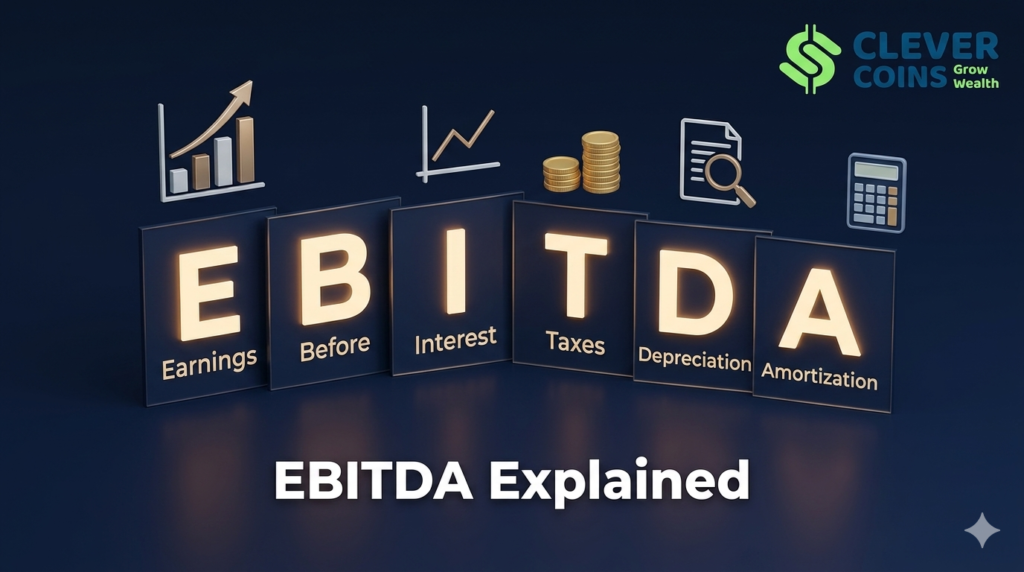
EBITDA is an acronym that stands for:
- E — Earnings
- B — Before
- I — Interest
- T — Taxes
- D — Depreciation
- A — Amortization
In plain English, EBITDA measures a company’s core profitability from its operations before the effects of financing decisions (interest), government obligations (taxes), and accounting conventions for long-lived assets (depreciation and amortization) are applied.
Think of EBITDA as a rough proxy for the cash a business generates from simply running its day-to-day operations — stripped of factors that vary widely from company to company and country to country.
A Brief History of EBITDA
EBITDA rose to prominence in the 1980s leveraged-buyout (LBO) boom. Private equity firms needed a quick metric to determine whether an acquisition target generated enough cash flow to service the heavy debt loads typical of LBO structures. Since interest was the largest cost in a leveraged deal, stripping it out of the profit figure allowed buyers to compare targets on an apples-to-apples basis regardless of how each company was financed.
Telecoms and cable companies popularised EBITDA further in the 1990s because their business models required enormous capital expenditure that generated massive depreciation charges, making reported net income look deceptively negative or tiny. EBITDA helped management communicate the underlying cash-generating power of the business to investors.
Today, EBITDA is ubiquitous across virtually every industry and is referenced in credit agreements, merger valuations, executive compensation targets, and equity research reports worldwide.
How to Calculate EBITDA: The Formula
There are two common ways to arrive at EBITDA:
Method 1: Starting from Net Income
EBITDA = Net Income + Interest Expense + Tax Expense + Depreciation & Amortization
Method 2: Starting from Operating Income (EBIT)
EBITDA = Operating Income (EBIT) + Depreciation & Amortization
Both methods yield the same result when applied correctly. The second method is faster if you already have the operating income line from the income statement; the first is useful when you want to trace all the way back from the bottom of the income statement.
A Step-by-Step Worked Example
Suppose a hypothetical company, TechCo Ltd., reports the following figures for its fiscal year:
- Revenue: $10,000,000
- Cost of Goods Sold: $4,000,000
- Gross Profit: $6,000,000
- Operating Expenses (SG&A): $2,500,000
- Operating Income (EBIT): $3,500,000
- Interest Expense: $400,000
- Tax Expense: $620,000
- Net Income: $2,480,000
- Depreciation: $700,000
- Amortization: $150,000
Using Method 1:
EBITDA = $2,480,000 + $400,000 + $620,000 + $700,000 + $150,000 = $4,350,000
TechCo’s EBITDA margin (EBITDA / Revenue) is 43.5%, indicating strong operational profitability. An investor comparing TechCo against peers can use this figure regardless of each company’s debt structure or the country where they pay taxes.
Understanding Each Component
1. Earnings (Net Income)
This is the starting point — the bottom-line profit after all expenses, interest, taxes, depreciation, and amortization have been subtracted from revenue. It is the most commonly quoted profit figure but also the most influenced by accounting choices.
2. Interest
Interest expense reflects the cost of a company’s debt. Adding it back to net income removes the impact of capital structure — how a business is financed. Two identical businesses, one debt-free and one highly leveraged, will show the same EBITDA but wildly different net income. This is why lenders and private equity investors prefer EBITDA: it shows operational performance independent of financing choices.
3. Taxes
Tax rates differ dramatically by country, by industry, and even by year (due to legislation changes or tax-loss carryforwards). Adding taxes back allows cross-border comparisons and removes the effect of tax planning strategies from the profitability analysis.
4. Depreciation
Depreciation is a non-cash expense that allocates the cost of physical (tangible) assets — machinery, buildings, vehicles — over their useful lives. A manufacturer that bought a $10 million factory 5 years ago still shows depreciation charges today, even though the cash left the bank years ago. Adding depreciation back reveals true cash generation.
5. Amortization
Amortization is the non-cash allocation of the cost of intangible assets — patents, trademarks, customer lists, software — over their estimated useful lives. It behaves exactly like depreciation but applies to intangibles. For companies that have made acquisitions, amortization of acquired intangibles can be substantial and masks true ongoing profitability.
Why Investors Use EBITDA
1. Apples-to-Apples Comparison Across Companies
Net income is affected by how a company is financed and where it is incorporated. EBITDA cuts through these differences. An investor comparing a US-listed company to a European counterpart can use EBITDA multiples without worrying about different tax regimes or debt levels distorting the comparison.
2. Proxy for Operating Cash Flow
EBITDA approximates the cash a business generates from operations before capital allocation decisions. For lenders assessing debt repayment capacity or for investors in mature, stable businesses with modest working-capital swings, EBITDA is a useful — if imperfect — stand-in for free cash flow.
3. Valuation via EV/EBITDA Multiples
The Enterprise Value-to-EBITDA (EV/EBITDA) ratio is the most widely used valuation multiple in mergers and acquisitions. It answers the question: how many years of EBITDA would it take to pay off the entire enterprise value of the company?
EV/EBITDA = Enterprise Value / EBITDA
Typical EV/EBITDA multiples range from 6x to 15x for most industries, though high-growth technology companies routinely trade at 20x or higher. Private equity buyers often set maximum bid prices based on target EBITDA multiples, making this metric central to deal pricing.
4. Covenant Compliance in Debt Agreements
Banks and bondholders embed EBITDA-based covenants into loan agreements. A company might be required to maintain a Net Debt/EBITDA ratio below 3.5x or an Interest Coverage Ratio (EBITDA/Interest) above 3.0x. Breaching these covenants can trigger default provisions, so management watches EBITDA obsessively.
5. Benchmarking Operational Efficiency
The EBITDA margin (EBITDA as a percentage of revenue) is a powerful indicator of how efficiently management converts sales into pre-financing, pre-tax cash profits. A rising EBITDA margin signals improving operational leverage; a falling margin may warn of cost pressures or pricing challenges.
6. Foundation for LBO Analysis
In a leveraged buyout, a private equity firm finances a large portion of the acquisition price with debt. The target company’s EBITDA must be sufficient to service this debt. PE analysts build LBO models centered on EBITDA to determine how much leverage is supportable and what returns are achievable at exit.
Key Variations: Adjusted EBITDA, EBITDAR, and EBITDAX
Adjusted EBITDA
Companies frequently report Adjusted EBITDA, which further removes one-time or non-recurring items such as restructuring charges, litigation settlements, stock-based compensation, and acquisition costs. The idea is to present the recurring, normalised earning power of the business. However, because management decides what counts as non-recurring, Adjusted EBITDA is highly subjective and prone to optimism. Always read the footnotes.
EBITDAR
EBITDAR adds Rent and lease costs back to EBITDA. It is commonly used in airlines, restaurants, and retail businesses where rent is a major operating cost that varies widely based on whether properties are owned or leased. The R stands for Rent (or Restructuring in some contexts).
EBITDAX
EBITDAX is used in the oil and gas sector, adding Exploration costs back to EBITDA. Since exploration spending is discretionary and its treatment under accounting standards varies, removing it gives a better picture of production-level profitability.
EBITDA vs. Other Profit Metrics
It helps to place EBITDA alongside other metrics on the income statement:
- Gross Profit: Revenue minus Cost of Goods Sold. Measures production efficiency.
- EBIT (Operating Income): Earnings before interest and taxes. Includes D&A. Used for operating efficiency analysis.
- EBITDA: Operating income before non-cash charges. Best for cross-company and cross-border comparison.
- Net Income: The bottom line. Incorporates all costs but most susceptible to accounting and capital structure distortions.
- Free Cash Flow (FCF): EBITDA minus capex, working capital changes, and taxes actually paid. The truest measure of cash generation but requires more data.
Limitations and Criticisms of EBITDA
EBITDA has attracted fierce criticism from legendary investors including Warren Buffett and Charlie Munger. Understanding the limitations is as important as knowing the benefits.
1. Ignores Capital Expenditure Requirements
Depreciation and amortization represent the gradual consumption of past capital investment. If a company needs heavy ongoing reinvestment (capex) just to maintain its existing assets, EBITDA grossly overstates true cash earnings. A steel mill with aging furnaces that require constant replacement is not as profitable as its EBITDA suggests.
2. Ignores Working Capital Changes
A growing company may have rising EBITDA while consuming cash through increasing receivables and inventory. EBITDA does not capture these cash dynamics, which is why free cash flow is ultimately the superior metric for cash-conscious investors.
3. Taxes Are Real Cash Costs
Unlike depreciation, taxes are a genuine cash outflow. By adding taxes back, EBITDA can mislead investors about actual cash available to debt holders and equity owners.
4. Susceptible to Manipulation via Adjusted EBITDA
Management teams can inflate Adjusted EBITDA by classifying recurring costs as one-time items. Academic research has shown that companies under pressure to meet earnings targets disproportionately use EBITDA add-backs. Investors should scrutinise every adjustment and consider whether truly non-recurring items keep recurring year after year.
5. Not a GAAP Measure
EBITDA is not defined under Generally Accepted Accounting Principles (GAAP) or International Financial Reporting Standards (IFRS). Every company calculates it slightly differently. The SEC requires US-listed companies to reconcile non-GAAP measures like EBITDA to their closest GAAP equivalent, but definitions still vary materially across companies.
6. Irrelevant for Financial Companies
For banks, insurance companies, and other financial institutions, interest income and expense are central to the business model, not peripheral financing costs. Using EBITDA for financials strips out the core earnings mechanism and makes no analytical sense.
EBITDA Margins by Industry: What Is Normal?
EBITDA margins vary widely. Here are approximate benchmarks across sectors:
- Software / SaaS: 25% – 40%+ (high margins, low capex)
- Healthcare / Pharma: 20% – 35%
- Oil & Gas Exploration: 30% – 50% (cyclical)
- Telecom: 30% – 45%
- Manufacturing: 10% – 20%
- Retail: 5% – 15%
- Airlines / Restaurants: 5% – 20% (highly variable)
Always compare a company’s EBITDA margin to its direct competitors and to its own historical trend. A 15% EBITDA margin could be excellent in grocery retail but alarming in software.
How to Use EBITDA in Investment Analysis
Step 1: Calculate EBITDA from the Financial Statements
Pull the income statement and cash flow statement from the company’s annual report. Locate net income, interest expense, tax expense (from income statement), and depreciation plus amortization (often on the cash flow statement under non-cash items).
Step 2: Calculate the EBITDA Margin
Divide EBITDA by total revenue. Compare to the same company over 3–5 years to detect trends and to at least 3 direct competitors to assess competitive positioning.
Step 3: Calculate the EV/EBITDA Multiple
Enterprise Value = Market Cap + Total Debt – Cash & Cash Equivalents. Divide EV by EBITDA. A lower multiple relative to peers may indicate undervaluation; a higher multiple suggests the market is pricing in strong growth.
Step 4: Assess Leverage
Calculate Net Debt/EBITDA (Net Debt = Total Debt – Cash). Below 2x is generally conservative; 3x–4x is moderate; above 5x is aggressive. Context matters: utilities can sustain higher leverage than cyclical industrials.
Step 5: Bridge to Free Cash Flow
Always follow EBITDA analysis with a free cash flow check. Calculate FCF = EBITDA – Capex – Changes in Working Capital – Cash Taxes. If FCF consistently falls well below EBITDA, dig deeper into capex requirements and working capital dynamics before drawing conclusions.
Real-World Examples: EBITDA in Action
Example 1: Private Equity Acquisition
A private equity firm is evaluating a mid-market distribution company with EBITDA of $25 million. The firm’s acquisition model targets a 7x entry multiple, implying a maximum enterprise value of $175 million. After subtracting net debt of $30 million, equity value is $145 million. The EBITDA figure is the anchor of the entire deal structure.
Example 2: Credit Analysis
A bank reviewing a loan application calculates the borrower’s Net Debt/EBITDA at 4.2x. The bank’s credit policy sets a maximum of 4.0x, so either the loan is declined or the borrower must reduce the requested amount. EBITDA directly determines borrowing capacity.
Example 3: Startup Valuation
A fast-growing SaaS startup has negative net income (it is investing heavily in growth) but positive EBITDA of $5 million on $20 million revenue — a 25% margin. A strategic buyer uses a 20x EBITDA multiple common in SaaS to arrive at a $100 million enterprise value. Without EBITDA, the negative net income would make valuation very difficult.
Warren Buffett’s Famous Criticism of EBITDA
Warren Buffett and his late partner Charlie Munger have been vocal critics of EBITDA. Buffett’s core argument is straightforward: depreciation is not a fictitious expense — it represents the real economic cost of asset wear that will require real cash to replace. In his 2000 Berkshire Hathaway shareholder letter, he asked rhetorically whether management would suggest that the tooth fairy pays for capital expenditures.
The lesson is not to avoid EBITDA but to use it as a starting point, not an endpoint. Always interrogate the gap between EBITDA and true free cash flow. If the gap is large and persistent, the business may be far less valuable than its EBITDA suggests.
Conclusion: EBITDA as a Tool, Not a Truth
EBITDA is one of the most powerful and most misused metrics in finance. When applied correctly, it enables cross-company comparisons, anchors M&A valuations, underpins lending decisions, and reveals operational profitability stripped of financing noise.
When applied carelessly — or manipulated via aggressive Adjusted EBITDA add-backs — it can paint a dangerously rosy picture of a company’s financial health.
The sophisticated investor uses EBITDA as a first filter and a comparative tool, then digs deeper into free cash flow, capital intensity, and balance sheet quality before making a final judgment. Armed with that nuanced understanding, EBITDA becomes an indispensable part of your analytical toolkit.