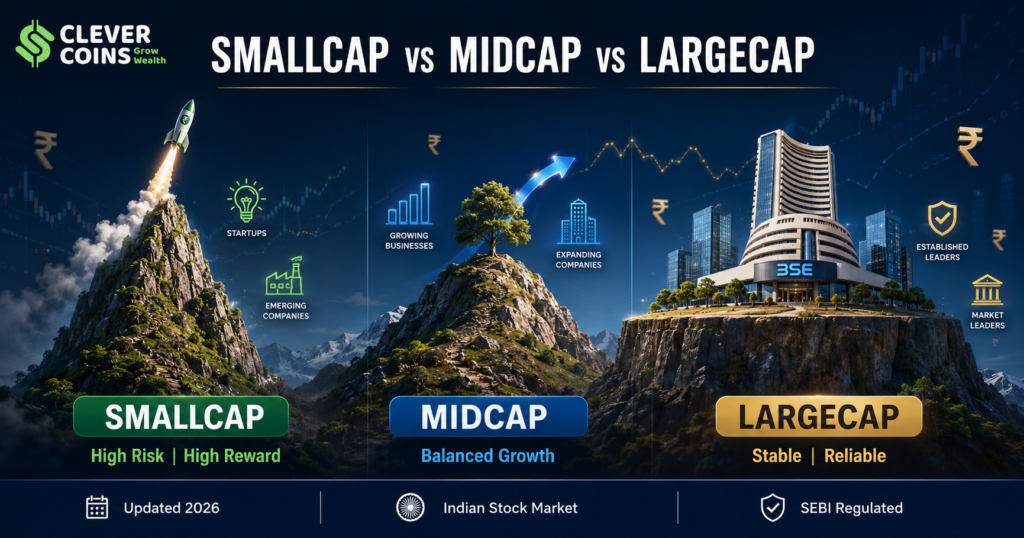
Why This Distinction Matters in 2026
The Indian stock market in 2026 is more dynamic and accessible than ever before. With over 9 crore registered investors on NSE and BSE combined, retail participation has reached an all-time high. Yet one of the most fundamental concepts — the difference between Smallcap, Midcap, and Largecap stocks — continues to baffle millions of investors.
Whether you are a first-time investor with Rs. 5,000 or a seasoned professional managing a corpus of Rs. 50 lakhs, understanding market capitalisation categories is the bedrock of smart investing. This comprehensive guide, updated as per SEBI’s latest regulations and AMFI guidelines for 2026, will break down everything you need to know.
What Is Market Capitalisation?
Market Capitalisation (Market Cap) is the total current market value of a company’s outstanding shares. It is calculated using a simple formula:
Market Cap = Current Share Price x Total Number of Outstanding Shares
For example, if a company has 10 crore outstanding shares and the current share price is Rs. 500, its Market Cap = Rs. 5,000 crore.
SEBI (Securities and Exchange Board of India), through its LODR (Listing Obligations and Disclosure Requirements) Regulations and AMFI’s bi-annual stock categorisation list (updated January 2026), classifies all listed stocks into three main categories based on their market cap rank.
SEBI’s Official Stock Classification (2026)
As per SEBI’s LODR Regulations and AMFI’s January 2026 categorisation list, companies are classified as follows:
Category | Rank by Market Cap | Indicative Market Cap (2026) | Key Index |
Largecap | 1st to 100th | Above Rs. 20,000 Crore (approx.) | Nifty 50, BSE Sensex |
Midcap | 101st to 250th | Rs. 5,000 to Rs. 20,000 Crore (approx.) | Nifty Midcap 150 |
Smallcap | 251st and below | Below Rs. 5,000 Crore (approx.) | Nifty Smallcap 250 |
Note: Exact thresholds are updated by AMFI every six months (January and July). The figures above are indicative for 2026.
Largecap Stocks — The Blue Chip Giants
Largecap stocks are the pillars of the Indian equity market. These are the top 100 companies by market capitalisation. Companies like Reliance Industries, Tata Consultancy Services (TCS), HDFC Bank, Infosys, ICICI Bank, Hindustan Unilever, and Bajaj Finance fall in this category.
Key Characteristics of Largecap Stocks
- Market Cap: Typically above Rs. 20,000 crore as per 2026 AMFI list
- Stability: High — these companies have proven business models and decades of operational history
- Liquidity: Very high — easy to buy and sell in large quantities without impacting price
- Volatility: Relatively low compared to mid and smallcaps
- Dividend: Most largecaps pay regular dividends (e.g., Coal India, ITC, ONGC)
- Analyst Coverage: Extensively tracked by domestic and foreign institutional investors
- Regulatory Scrutiny: Very high — quarterly earnings, board governance, ESG compliance
- Foreign Portfolio Investment (FPI): FPIs are allowed and heavily invested in largecaps
Returns — Historical Perspective
Nifty 50 (the benchmark for largecaps) has delivered an average CAGR (Compound Annual Growth Rate) of approximately 12-13% over the last 20 years. In CY2025, the Nifty 50 delivered around 9-11% returns (subject to final year data).
Who Should Invest in Largecap Stocks?
- Conservative investors with low-to-moderate risk appetite
- Retirees or near-retirement investors seeking capital preservation
- First-time investors who want stable, less volatile returns
- Investors with a time horizon of 3-5+ years
- Those wanting to park funds via Largecap Mutual Funds (SEBI mandate: min. 80% in top 100 stocks)
Midcap Stocks — The Sweet Spot
Midcap stocks occupy the 101st to 250th position in India’s listed companies by market cap. These are companies that have graduated from being small but have not yet reached the scale of largecaps. Examples in 2026 include companies like Persistent Systems, Oberoi Realty, Voltas, Coforge, and BSE Ltd.
Key Characteristics of Midcap Stocks
- Market Cap: Typically between Rs. 5,000 crore and Rs. 20,000 crore (indicative, 2026)
- Growth Potential: High — these companies are in an active growth phase
- Risk: Moderate to high — more volatile than largecaps but less than smallcaps
- Liquidity: Moderate — decent trading volumes but not as liquid as largecaps
- Dividend: Inconsistent — many focus on reinvesting profits for growth
- Analyst Coverage: Good, but less comprehensive than largecaps
- Management Quality: Usually strong entrepreneurial management
- Opportunity for Multibagger Returns: High — many of today’s largecaps were midcaps 5-10 years ago
Returns — Historical Perspective
The Nifty Midcap 150 index has historically outperformed the Nifty 50 over long periods. The 10-year CAGR of Nifty Midcap 150 is approximately 17-19%, though with higher volatility. In CY2024, the index delivered over 26% returns, significantly outpacing largecaps.
Who Should Invest in Midcap Stocks?
- Moderate risk-takers with an investment horizon of 5-7 years
- Investors looking to balance growth and stability in their portfolio
- Those who understand business cycles and can hold through corrections
- SIP investors in Midcap Mutual Funds (SEBI mandate: min. 65% in 101-250 ranked stocks)
Smallcap Stocks — High Risk, High Reward
Smallcap stocks are companies ranked 251st and below by market capitalisation. This is the most diverse and exciting segment of the Indian market, comprising thousands of companies across industries ranging from niche manufacturing to emerging technology. However, they also carry the highest risk.
Key Characteristics of Smallcap Stocks
- Market Cap: Typically below Rs. 5,000 crore (indicative, 2026)
- Growth Potential: Very high — early-stage companies with massive upside potential
- Risk: Very high — subject to high volatility, liquidity risk, and business risk
- Liquidity: Low — bid-ask spreads can be wide; large orders may move the price
- Dividend: Rare — most reinvest all profits into the business
- Analyst Coverage: Limited — creating opportunities for informed investors
- Promoter Holding: Often high promoter holding (can be both positive and negative)
- SEBI Surveillance: Subject to ASM (Additional Surveillance Measure) and GSM (Graded Surveillance Measure) frameworks
Returns — Historical Perspective
The Nifty Smallcap 250 index has delivered the highest long-term CAGR of approximately 18-22% over 10-year periods, but with periods of extreme drawdown (e.g., 60-70% fall in 2018 bear market). This highlights the need for a longer investment horizon of 7-10+ years and strong stomach for volatility.
Who Should Invest in Smallcap Stocks?
- Aggressive investors with high risk tolerance
- Young investors (20s-30s) with a long time horizon of 7-10+ years
- Investors who do thorough fundamental research
- Those investing through SEBI-registered Smallcap Mutual Funds (min. 65% in 251+ ranked stocks)
- Investors who understand they may face years of underperformance before rewards
Comprehensive Comparison: Smallcap vs Midcap vs Largecap (2026)
Parameter | Largecap | Midcap | Smallcap |
SEBI Rank | Top 100 | 101 to 250 | 251 and below |
Market Cap (Indicative) | > Rs. 20,000 Cr | Rs. 5,000-20,000 Cr | < Rs. 5,000 Cr |
Risk Level | Low to Moderate | Moderate to High | Very High |
Return Potential | Moderate (12-13% CAGR) | High (17-19% CAGR) | Very High (18-22% CAGR) |
Liquidity | Very High | Moderate | Low |
Volatility | Low | Moderate | High |
Dividend | Regular | Inconsistent | Rare |
Investor Type | Conservative | Moderate | Aggressive |
Ideal Horizon | 3-5 Years | 5-7 Years | 7-10+ Years |
Mutual Fund Mandate | Min. 80% in Top 100 | Min. 65% in 101-250 | Min. 65% in 251+ |
Key Index | Nifty 50 / Sensex | Nifty Midcap 150 | Nifty Smallcap 250 |
Analyst Coverage | Extensive | Good | Limited |
FPI Investment | Very High | Moderate | Low |
Governance Quality | Very High | High | Varies |
Tax Implications on Stock Gains — India 2026
Understanding tax treatment is critical for net returns. As per the Union Budget 2024-25 (effective from July 23, 2024, and continuing in 2026):
Gain Type | Holding Period | Tax Rate (2026) | Applicable Stocks |
Short-Term Capital Gain (STCG) | Less than 12 months | 20% (up from 15%) | All equity stocks |
Long-Term Capital Gain (LTCG) | 12 months or more | 12.5% above Rs. 1.25 lakh/year | All equity stocks |
Dividend Income | Any | Added to income, taxed at slab rate | All dividend-paying stocks |
STT (Securities Transaction Tax) | At transaction | 0.1% on delivery equity | All listed stocks |
Key Note: LTCG exemption of Rs. 1.25 lakh per year — gains up to this amount are completely tax-free. This was revised from Rs. 1 lakh as per Budget 2024-25.
Ideal Portfolio Allocation by Investor Profile (2026)
Financial planners and SEBI-registered investment advisers (RIA) in India generally recommend the following allocation based on risk profile:
Investor Profile | Age Group | Largecap % | Midcap % | Smallcap % |
Conservative | 50+ years | 70-80% | 15-20% | 0-10% |
Moderate | 35-50 years | 50-60% | 25-30% | 10-20% |
Aggressive | 25-35 years | 30-40% | 30-35% | 25-35% |
Very Aggressive | Under 25 years | 20-30% | 25-35% | 35-50% |
Key Indian Indices to Track (2026)
Index Name | Category | No. of Stocks | Managed By |
Nifty 50 | Largecap | 50 | NSE Indices Ltd. |
BSE Sensex | Largecap | 30 | Asia Index Pvt. Ltd. |
Nifty Next 50 | Largecap-Midcap Bridge | 50 | NSE Indices Ltd. |
Nifty Midcap 150 | Midcap | 150 | NSE Indices Ltd. |
Nifty Midcap 50 | Midcap | 50 | NSE Indices Ltd. |
Nifty Smallcap 250 | Smallcap | 250 | NSE Indices Ltd. |
Nifty Smallcap 50 | Smallcap | 50 | NSE Indices Ltd. |
BSE Midcap | Midcap | ~150 | Asia Index Pvt. Ltd. |
BSE Smallcap | Smallcap | ~700+ | Asia Index Pvt. Ltd. |
Mutual Fund Categories as per SEBI Categorisation (2026)
SEBI’s October 2017 circular on mutual fund categorisation (still in force in 2026 with amendments) mandates strict category definitions. Here is how your favourite mutual funds map to stock categories:
- Largecap Funds: Minimum 80% investment in top 100 stocks. Examples: Mirae Asset Largecap, Axis Bluechip, Canara Robeco Bluechip
- Midcap Funds: Minimum 65% in 101st-250th stocks. Examples: Kotak Emerging Equity, HDFC Midcap Opportunities, Nippon India Growth
- Smallcap Funds: Minimum 65% in 251st and beyond stocks. Examples: Quant Smallcap, Nippon India Smallcap, SBI Smallcap
- Large & Midcap Funds: Minimum 35% each in largecap and midcap. Examples: Mirae Asset Emerging Bluechip, Canara Robeco Emerging Equities
- Flexi Cap Funds: Minimum 65% in equity across all caps with flexibility. Examples: Parag Parikh Flexi Cap, Quant Flexi Cap
- Multi Cap Funds: Minimum 25% each in largecap, midcap, and smallcap. Examples: HDFC Multi Cap, Nippon India Multi Cap
Common Investor Mistakes to Avoid
1. Chasing Recent Performance
Many investors pour money into smallcap funds after a bull run (e.g., CY2023-24 when Nifty Smallcap 250 delivered 57%+ returns). This is called recency bias and often leads to investing at the peak, resulting in significant losses when the market corrects.
2. Ignoring Liquidity Risk in Smallcaps
Small and micro-cap stocks can become illiquid in a bear market. Selling a large position can drive the price down further, locking investors into losses. Always check the average daily trading volume before investing.
3. Not Aligning Investments with Goals
Investing your child’s education fund (needed in 3 years) in smallcap stocks is a classic mistake. Always match the investment horizon with the asset category risk profile.
4. Over-Diversification or Under-Diversification
Owning 50 smallcap stocks does not necessarily reduce risk if they are all correlated to the same sector. Focus on quality over quantity.
5. Ignoring SEBI Warnings
SEBI’s ASM (Additional Surveillance Measure) and GSM (Graded Surveillance Measure) lists are red flags. Stocks on these lists are under surveillance for unusual price or volume activity. Always check before investing.
Practical Tips for Indian Investors in 2026
- Use the AMFI website (amfiindia.com) to check the latest list of largecap, midcap, and smallcap stocks updated every January and July
- Always check a company’s SEBI filings on BSE (bseindia.com) and NSE (nseindia.com) before investing
- Use a SEBI-registered investment adviser (RIA) or research analyst (RA) for stock-specific advice — check their registration on sebi.gov.in
- Start SIPs in mutual funds before attempting direct stock picking in midcap and smallcap segments
- Maintain an emergency fund of 6-12 months’ expenses in liquid instruments before allocating to equities
- Use the ‘Core and Satellite’ strategy — build a large core of largecap/index funds and use a smaller satellite portion for midcap/smallcap alpha generation
- Review your portfolio allocation at least once a year, especially after AMFI’s bi-annual reclassification
- Keep tax implications in mind — avoid unnecessary churning in smallcap funds to prevent short-term capital gains tax of 20%