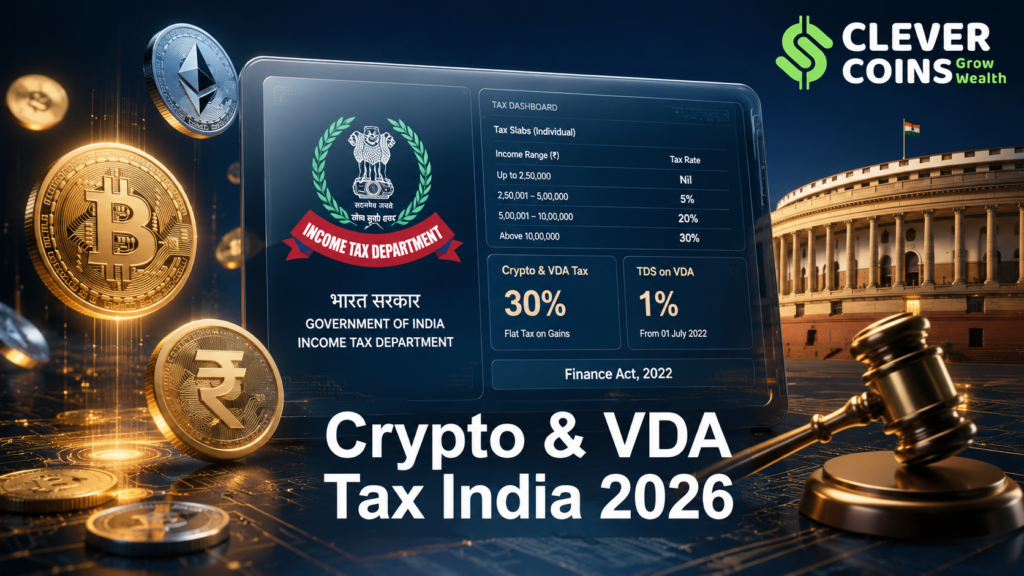
Why Crypto Tax Matters More Than Ever in 2026
The cryptocurrency and Virtual Digital Assets (VDA) landscape in India has witnessed an extraordinary transformation since the government introduced a dedicated tax regime in the Union Budget 2022. As we step into Financial Year 2025-26 (Assessment Year 2026-27), understanding the tax obligations on crypto earnings, NFT profits, DeFi yields, and other digital asset transactions is not just a legal necessity — it is a financial imperative.
India has firmly established itself as one of the world’s most active cryptocurrency markets, with millions of investors and traders engaged in digital asset transactions. Despite regulatory uncertainty, the Income Tax Department has been increasingly vigilant, with data obtained via exchanges such as CoinDCX, WazirX, and ZebPay being cross-referenced with ITR filings.
This comprehensive guide covers every aspect of crypto taxation in India for 2026 — from the basic tax structure to advanced scenarios involving staking rewards, DeFi protocols, airdrops, NFTs, foreign exchanges, and more.
What Are Virtual Digital Assets (VDAs)?
Under Section 2(47A) of the Income Tax Act, 1961 (inserted via Finance Act 2022 and amended subsequently), a Virtual Digital Asset is defined to include:
- Any information, code, number, or token generated through cryptographic means or otherwise
- A non-fungible token (NFT) or any other token of a similar nature
- Any other digital asset as notified by the Central Government
- Cryptocurrency including Bitcoin (BTC), Ethereum (ETH), Binance Coin (BNB), Solana (SOL), Tether (USDT), and thousands of altcoins
Importantly, the government has specifically excluded from this definition: gift cards, mileage points, airline reward points, and any other asset which may be notified by the Central Government.
Assets Covered Under VDA Taxation
Digital Asset Type | Examples |
Cryptocurrencies | Bitcoin (BTC), Ethereum (ETH), Ripple (XRP), Dogecoin (DOGE), Solana (SOL), Polygon (MATIC) |
Stablecoins | USDT, USDC, DAI, BUSD, INR-pegged tokens |
Non-Fungible Tokens | Art NFTs, Gaming NFTs, Domain NFTs, Music NFTs, Metaverse land |
DeFi Tokens | Uniswap (UNI), Aave (AAVE), Compound (COMP), Curve (CRV) |
Exchange Tokens | BNB, KCS, FTT, HT, OKB |
Gaming & Metaverse | SAND, MANA, AXS, GALA, ENJ |
Layer 2 & Scalability | Arbitrum (ARB), Optimism (OP), Polygon (MATIC) |
The Core Tax Framework: Section 115BBH Explained
Section 115BBH, introduced in the Income Tax Act via Finance Act 2022 and operative since April 1, 2022, lays down the following core provisions that continue to apply in FY 2025-26:
Key Provisions at a Glance
★ KEY TAX PROVISIONS FOR VDA / CRYPTO ★
Flat Tax Rate: 30% flat rate on all gains from VDA transfer (plus applicable surcharge and cess)
Effective Rate: 30% + 4% Health & Education Cess = 31.2% (for income below ₹50 lakh)
No Deduction: No deductions allowed except cost of acquisition
No Set-Off: Losses from VDA CANNOT be set off against any other income or any other VDA profit
No Loss Carry Forward: VDA losses cannot be carried forward to subsequent years
TDS @ 1%: 1% TDS deducted by crypto exchanges on sale/transfer of VDA above threshold |
Tax Rate with Surcharge (AY 2026-27)
Total Income Slab | Surcharge % | Effective Tax on VDA |
Up to ₹50 Lakh | Nil | 31.2% (30% + 4% Cess) |
₹50 Lakh – ₹1 Crore | 10% | 34.32% |
₹1 Crore – ₹2 Crore | 15% | 35.88% |
₹2 Crore – ₹5 Crore | 25% | 39% |
Above ₹5 Crore | 37% | 42.744% |
TDS on Crypto Transactions: Section 194S
Section 194S mandates TDS (Tax Deducted at Source) on payment for transfer of Virtual Digital Assets. This is a critical provision that crypto investors must understand thoroughly.
TDS Rate and Applicability
Parameter | Details |
TDS Rate | 1% of the consideration paid/credited |
Threshold – Specified Persons (Business) | ₹10,000 per financial year |
Threshold – Others (Individuals/HUF) | ₹50,000 per financial year |
Responsible to Deduct | Exchange/Buyer (whoever makes the payment) |
Due Date for Deposit | 7th of the following month (30th April for March) |
Form for Return | Form 26QE (quarterly) |
Certificate of Deduction | Form 16E issued to seller |
Adjustment in Final Tax | Yes – TDS credited against final tax liability |
Who Deducts TDS?
- Indian Crypto Exchanges (CoinDCX, WazirX, Giottus, Zebpay, CoinSwitch): Automatically deduct TDS on every qualifying transaction
- Peer-to-Peer (P2P) Transactions: The buyer is responsible for deducting and depositing TDS
- Foreign Exchange Users: The individual taxpayer must self-deposit TDS via Form 26QE
- OTC (Over-the-Counter) Trades: Buyer must deduct and deposit TDS
Important Note: If TDS is deducted in excess of actual tax liability, you can claim a refund while filing your ITR.
Calculating Crypto Tax: Step-by-Step Guide
Understanding how to calculate your crypto tax liability accurately is essential to avoid penalties and interest. Below is a comprehensive step-by-step methodology:
Step 1: Identify Your Cost of Acquisition
The cost of acquisition is the only permissible deduction under Section 115BBH. This includes:
- Purchase price paid in INR or its equivalent
- Transaction fees/gas fees paid at the time of purchase (directly related to acquisition)
- Import duty, if any, on hardware wallets used exclusively for the asset (highly debated – consult CA)
What is NOT included in cost of acquisition: Exchange fees on sale, withdrawal fees, network fees on transfer between wallets, storage costs, subscription charges.
Step 2: Calculate Net Gain
Net Gain = Sale Consideration − Cost of Acquisition
Important: Even if you make a loss, you CANNOT reduce it from gains on other VDA transactions or any other income. Each profitable transaction is taxed independently at 30%.
Step 3: Practical Tax Calculation Example
💰 EXAMPLE 1: Bitcoin Trade
Purchased 0.5 BTC at ₹40,00,000 (total cost: ₹20,00,000) in March 2025 Sold 0.5 BTC at ₹52,00,000 (total sale: ₹26,00,000) in January 2026
Gain = ₹26,00,000 − ₹20,00,000 = ₹6,00,000 Tax @ 30% = ₹1,80,000 Health & Education Cess @ 4% = ₹7,200 Total Tax Payable = ₹1,87,200
💰 EXAMPLE 2: Mixed Gains & Losses Scenario
Gain on Ethereum trade: ₹5,00,000 Loss on Solana trade: ₹2,00,000 (CANNOT be set off) Taxable Gain = ₹5,00,000 (Loss is NOT deductible) Tax @ 31.2% = ₹1,56,000 |
Taxation of Specific VDA Activities in 2026
1. Mining Income
Cryptocurrency obtained through mining is taxed at the point of receipt as Income from Other Sources under Section 56(2). The fair market value (FMV) on the date of receipt is treated as taxable income. When the mined crypto is later sold, the FMV on the date of receipt becomes the cost of acquisition, and the profit is again subject to 30% tax under Section 115BBH.
- Electricity costs and depreciation on mining equipment: Generally NOT deductible against VDA income
- Practical approach: Many CAs argue mining expenses may be claimed as business expenses if mining constitutes a business
- The CBDT has not issued specific guidance on mining expenses as of 2026 — consult a qualified tax advisor
2. Staking Rewards
Staking rewards received from Proof-of-Stake (PoS) networks are taxable as Income from Other Sources at the FMV on the date they are credited to your wallet. This includes:
- ETH 2.0 staking rewards
- ADA, SOL, DOT staking income
- Liquid staking rewards (stETH, rETH, bETH)
- DeFi yield farming returns (treated similar to staking)
3. NFT Transactions
NFTs are explicitly covered under the VDA definition. The following NFT-related transactions attract tax:
NFT Activity | Tax Treatment |
Creating and selling an NFT | 30% on profit (Sale price − Gas fees/minting cost) |
Buying and reselling NFT | 30% on gain (Sale price − Purchase price) |
Receiving NFT as a gift | Taxable as gift income if FMV exceeds ₹50,000 |
NFT airdrop to creator | FMV on receipt taxable as other income |
Royalty income from NFT | Taxed as Income from Other Sources at slab rate |
NFT used in gaming (play-to-earn) | Tokens earned: 30% VDA tax; Royalties: slab rate |
4. DeFi (Decentralised Finance) Transactions
DeFi activities present complex tax scenarios. Here is how major DeFi activities are treated:
- Liquidity Pool Contribution: Contribution itself not a taxable event; LP tokens received may be treated as exchange (taxable swap)
- Liquidity Pool Withdrawal: Profit over contribution is taxable at 30%
- Flash Loans: The net profit after repayment is taxable
- Yield Farming: Rewards received are taxable as other income at FMV on receipt
- Token Swaps (e.g., ETH to USDC): Treated as transfer of VDA; profit taxable at 30%
- Wrapped Tokens (e.g., WBTC): Wrapping/unwrapping may constitute a transfer — tax implications uncertain, CBDT guidance awaited
5. Airdrops and Hard Fork Tokens
Tokens received through airdrops or hard forks are taxable as Income from Other Sources at their FMV on the date of receipt. The FMV then becomes the cost of acquisition for future sale. If the airdrop tokens have no established market price on the date of receipt, the cost basis is zero and the entire sale proceeds become taxable income.
6. Crypto-to-Crypto Swaps
Every crypto-to-crypto exchange (e.g., BTC to ETH) is treated as a taxable event in India. You are deemed to have ‘sold’ the first cryptocurrency and ‘purchased’ the second. The gain on the deemed sale of the first crypto is taxable at 30%. This significantly increases the tax compliance burden for active DeFi and arbitrage traders.
7. Crypto Received as Salary or Professional Fees
If an employer pays salary in cryptocurrency, the FMV of the crypto on the date of payment is taxable as salary income at slab rates. Professional fees received in crypto by freelancers are taxable as professional income. The subsequent sale of such crypto will again attract 30% VDA tax on the gain over FMV at the time of receipt.
8. Crypto Gifts
Gift Scenario | Tax Treatment |
Gift from relative (as defined in IT Act) | Exempt from tax |
Gift received on marriage | Exempt from tax (no limit) |
Gift received from non-relative | Taxable if aggregate FMV exceeds ₹50,000 in FY |
Gift received under will/inheritance | Exempt from tax |
Crypto gifted to charity/trust | No tax on giftor; trust may seek exemption |
ITR Filing for Crypto Income: Which Form to Use?
Selecting the correct ITR form is critical. Filing an incorrect form can render the return defective and attract notice from the Income Tax Department.
ITR Form Selection Guide for AY 2026-27
Taxpayer Profile | Applicable ITR Form | Schedule |
Individual/HUF with salary + crypto gains | ITR-2 | Schedule VDA |
Individual with business income + crypto | ITR-3 | Schedule VDA + Business Schedule |
Professional with crypto income | ITR-3 | Schedule VDA |
Company/Firm with crypto trading | ITR-6/ITR-5 | Schedule VDA |
Individual with only crypto income (no other income) | ITR-2 | Schedule VDA |
Key Schedules in ITR Relevant to Crypto
- Schedule VDA: Specific schedule introduced for reporting Virtual Digital Assets income
- Schedule OS: For staking rewards, mining income, airdrops (Income from Other Sources)
- Schedule CG: If CBDT clarifies capital gain treatment in future revisions
- Schedule AL: Asset and Liability schedule — crypto holdings above ₹50 lakh must be disclosed
- Schedule FA: Foreign Assets — crypto held on foreign exchanges must be disclosed here
Information Required While Filing
- Name and type of each VDA transacted
- Date of acquisition and sale for each transaction
- Cost of acquisition in INR
- Sale consideration in INR
- Amount of TDS deducted (verify in Form 26AS and AIS)
- Head of income under which each type of VDA income is reported
- Total gain/income from VDA transactions
Annual Information Statement (AIS) and Crypto
The Annual Information Statement (AIS), accessible on the income tax portal (incometax.gov.in), now incorporates data from cryptocurrency exchanges operating in India. This is a significant development because:
- CBDT has mandated crypto exchanges to report transactions to the Income Tax Department
- All transactions above threshold limits appear in your AIS
- Mismatch between AIS data and ITR can trigger automated scrutiny notices
- Even foreign exchange transactions may appear in AIS through FEMA/RBI reporting
Best Practice: Download your AIS before filing ITR, reconcile all reported transactions, and ensure your ITR matches the AIS data completely. Any discrepancy should be addressed proactively.
Foreign Crypto Exchange Users: Special Compliance
FEMA Regulations and Reporting
Indians using foreign cryptocurrency exchanges such as Binance, Kraken, Coinbase, OKX, or Bybit must comply with both Income Tax laws and FEMA (Foreign Exchange Management Act) regulations. Key points:
- Holding crypto on a foreign exchange is treated as a foreign asset under Schedule FA of ITR
- The Liberalised Remittance Scheme (LRS) limit of USD 250,000 (approx. ₹2.08 crore) per FY applies when remitting INR to foreign exchanges
- TCS (Tax Collected at Source) @ 20% applies on LRS remittances for investment purposes above ₹7 lakh
- Non-disclosure of foreign crypto assets can attract penalties under the Black Money (Undisclosed Foreign Income and Assets) Act, 2015
- FATF guidance and international information exchange agreements (AEOI/CRS) increasingly bring foreign crypto holdings to Indian tax authorities’ attention
Self-Deposit of TDS for Foreign Exchange Users
If you trade on a foreign exchange, there is no exchange to deduct TDS on your behalf. You must:
- Log on to the income tax e-filing portal (incometax.gov.in)
- Use Form 26QE to compute and deposit TDS on each qualifying transaction
- Deposit TDS by 30th day from the end of the month of transaction
- Maintain detailed records of all transactions for 6 years (IT Act requirement)
Advance Tax on Crypto Income
Since VDA income often generates significant gains, taxpayers may be required to pay Advance Tax in instalments. Failure to pay Advance Tax leads to interest under Sections 234B and 234C.
Advance Tax Instalment | Due Date |
1st Instalment (15% of estimated tax) | 15th June 2025 |
2nd Instalment (45% cumulative) | 15th September 2025 |
3rd Instalment (75% cumulative) | 15th December 2025 |
4th Instalment (100% cumulative) | 15th March 2026 |
Note: For those opting for presumptive taxation (Section 44AD/44ADA), only one instalment of 100% is due by 15th March 2026. However, VDA income must be separately accounted for and included in advance tax calculations.
Penalties, Prosecution & Enforcement in 2026
The Income Tax Department has significantly increased scrutiny of cryptocurrency transactions. Understanding the penal provisions is essential to avoid severe consequences.
Penalty Structure
Offence | Section | Penalty |
Failure to file ITR | 234F | ₹1,000 to ₹5,000 |
Concealment of income/assets | 270A | 50% to 200% of tax |
Under-reporting of income | 270A | 50% of tax payable |
Failure to deduct TDS (P2P buyers) | 271C | Amount of TDS not deducted |
Non-disclosure of foreign assets | Black Money Act | Up to 3x FMV of asset |
Wilful tax evasion | 276C | Imprisonment up to 7 years |
Failure to maintain books | 271A | ₹25,000 |
CBDT Enforcement Actions in 2025-26
- Search and seizure operations on crypto traders with large undisclosed gains
- Survey operations at offices of crypto exchanges and OTC desks
- Mass notices under Section 143(1) to investors whose AIS/ITR shows discrepancies
- International cooperation through FATCA and CRS to trace offshore crypto holdings
Record Keeping & Compliance Best Practices
What Records Must You Maintain?
- Complete transaction history from all exchanges (Indian and foreign) — minimum 6 years
- Wallet-to-wallet transfer records with explanations for each transfer
- On-chain transaction hashes for all significant transactions
- FMV documentation for every airdrop, staking reward, and gift received
- Cost of acquisition records including original purchase invoices/receipts
- TDS certificates (Form 16E) from each exchange
- Bank statements showing INR in and out related to crypto transactions
- Smart contract interaction records for DeFi transactions
Recommended Compliance Tools
Tool / Service | Purpose |
Koinly | Crypto tax calculation, ITR-compatible reports for India |
CoinTracker | Portfolio tracking and tax report generation |
ZenLedger | Tax loss harvesting and gain/loss reports |
ClearTax (now Clear) | Full ITR filing with crypto schedule support |
Taxnodes | India-specific crypto tax filing platform |
CA with Crypto Expertise | Complex DeFi, mining, NFT, and foreign exchange scenarios |
Budget 2025-26 & Expected Regulatory Developments
Key Developments from Finance Act 2025
- The 30% flat tax and 1% TDS regime under Sections 115BBH and 194S continue unchanged
- CBDT issued updated FAQs clarifying that crypto-to-crypto swaps remain taxable events
- Enhanced reporting obligations placed on Virtual Asset Service Providers (VASPs)
- India’s compliance with FATF’s Travel Rule for VASPs mandated from April 2025
- Crypto exchanges required to register with Financial Intelligence Unit India (FIU-IND)
Expected Future Regulatory Changes
- Comprehensive Virtual Digital Asset Regulation Bill expected to be tabled in Parliament in late 2026
- Possibility of reduced TDS rates (from 1% to 0.1%) being lobbied by the crypto industry
- Potential introduction of specific crypto loss set-off provisions if regulatory clarity improves
- RBI’s Central Bank Digital Currency (e-RUPI/CBDC) — Digital Rupee expanding to wholesale and retail use cases
- SEBI exploring framework for regulated crypto trading platforms with investor protection norms
Frequently Asked Questions (FAQs)
Q1: Is crypto taxed as capital gains or income in India?
Crypto gains are taxed under a special provision (Section 115BBH) and NOT under capital gains or business income heads. The flat 30% rate applies irrespective of the holding period — whether held for 1 day or 10 years.
Q2: Can I set off crypto losses against stock market gains?
No. Losses from VDA transactions CANNOT be set off against any other income including equity gains, business income, or salary. This is an absolute restriction under Section 115BBH(2)(b).
Q3: Is transferring crypto between my own wallets taxable?
Transferring crypto between wallets that you own (e.g., from exchange to hardware wallet) is NOT a taxable event. However, you must maintain records to prove both wallets belong to you.
Q4: Are USDT and stablecoin transactions taxable?
Yes. Stablecoins like USDT, USDC, and DAI are considered VDAs. Any gain from buying and selling stablecoins is taxable at 30%. Converting crypto to stablecoins is also a taxable swap.
Q5: What happens if I don’t file crypto income in ITR?
Non-disclosure of crypto income is treated as concealment of income. Penalties range from 50% to 200% of tax evaded, and in serious cases, prosecution under Section 276C can lead to imprisonment of up to 7 years.
Q6: Is crypto inherited from a deceased family member taxable?
Crypto received through inheritance (will or intestate succession) is exempt from tax in the hands of the recipient. However, any subsequent sale of such crypto will attract 30% VDA tax. The cost of acquisition in such cases is the FMV on the date of the deceased’s purchase (or the date of inheritance, as per legal opinion).
Q7: Can NRIs invest in Indian crypto exchanges?
NRIs can invest in Indian crypto exchanges subject to FEMA regulations. Their crypto income from Indian sources is taxable in India. NRIs must also report Indian crypto holdings in their country of residence as per applicable foreign laws.