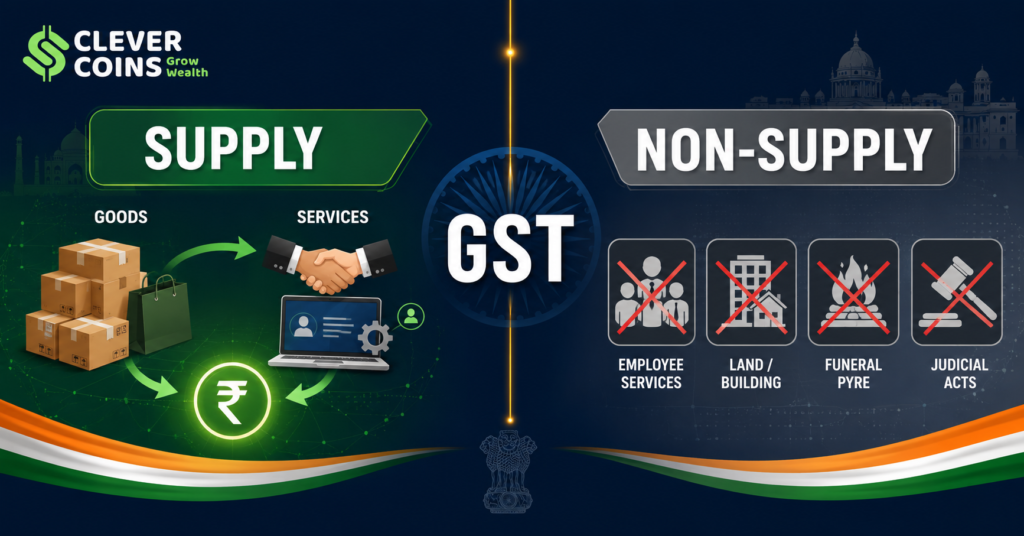
Why the Supply vs Non-Supply Distinction Is the Backbone of GST
Goods and Services Tax (GST), introduced in India on 1st July 2017, is built on one foundational concept: the taxability of a ‘supply’. Unlike the old indirect tax regime — where different taxes like VAT, Service Tax, Excise Duty, and CST applied based on the nature of the activity — GST follows a unified principle. If a transaction qualifies as a ‘supply’, it is potentially taxable under GST. If it does not qualify as a supply, GST simply does not apply, irrespective of any consideration involved.
This makes the determination of whether a transaction is a ‘supply’ or a ‘non-supply’ the single most critical step in any GST analysis. Getting this wrong can result in either paying GST where none is due (leading to cash flow losses) or not paying GST where it is applicable (inviting penalties, interest, and audit scrutiny). In 2026, with the GST Council having completed several rounds of amendments and the CBIC issuing numerous clarificatory circulars, the legal framework around supply and non-supply has become significantly more refined — but also more nuanced.
This detailed guide covers every dimension of the Supply vs Non-Supply distinction under the GST Act: the statutory definition, the scope of supply, the essential ingredients, the deemed supply provisions, and — critically — what falls outside the scope of GST (non-supply) under Schedule III of the CGST Act, 2017. We also cover practical examples with Indian Rupee calculations, recent judicial decisions, and compliance insights for 2026.
What is ‘Supply’ Under GST? The Statutory Definition
The term ‘supply’ is defined under Section 7 of the Central Goods and Services Tax (CGST) Act, 2017. This section is the cornerstone of the entire GST framework. Section 7(1) defines supply as including:
- All forms of supply of goods or services or both such as sale, transfer, barter, exchange, licence, rental, lease or disposal made or agreed to be made for a consideration by a person in the course or furtherance of business.
- Import of services for a consideration, whether or not in the course or furtherance of business.
- Activities specified in Schedule I, made or agreed to be made without a consideration (deemed supplies).
- Activities referred to in Schedule II, which shall be treated as either supply of goods or supply of services.
|
Section 7(2) of the CGST Act further specifies that activities or transactions listed in Schedule III shall be treated as neither a supply of goods nor a supply of services — these are the ‘Non-Supplies’ or ‘negative list’ of GST. Additionally, the government may notify certain activities as non-taxable supply by way of an official notification under Section 7(2)(b). |
The Five Essential Ingredients of a GST Supply
|
Ingredient |
What It Means |
Example |
|
Supply of Goods or Services |
The subject matter must be goods or services (or both) |
Selling a laptop (goods); providing accounting services (services) |
|
Made by a Taxable Person |
The supplier must be a registered or liable-to-register person |
A GST-registered firm selling products |
|
In Course or Furtherance of Business |
The transaction must be in the context of a business activity |
A manufacturer selling finished goods |
|
For a Consideration |
Generally, there must be some payment or benefit involved (except Schedule I supplies) |
Cash, credit, barter, or any other form of payment |
|
Within Taxable Territory |
The supply must be in the taxable territory of India (J&K included post-2019) |
Supply from Delhi to Mumbai, or from India to an SEZ |
Scope of Supply: Breaking Down Section 7 in Detail
Supply for Consideration in Course of Business
The most common form of supply under GST is a transaction for consideration in the course or furtherance of business. ‘Consideration’ under Section 2(31) includes any payment made or to be made in money or otherwise, or any act or forbearance, in respect of, in response to, or for the inducement of, the supply of goods or services. The consideration need not be in money — it can be in kind (barter), in the form of services, or any other benefit.
‘In course or furtherance of business’ means the activity must have a business nexus. A one-time personal transaction generally does not qualify as supply under GST. For example, if an individual sells their personal car, it is not a GST supply. But if a car dealer sells a car from their inventory, it is very much a supply.
Supply Without Consideration: Schedule I Deemed Supplies
Schedule I of the CGST Act lists activities that are treated as supplies even when made without any consideration. These are anti-avoidance provisions to prevent related-party transactions from escaping the GST net. As of 2026, Schedule I includes:
|
Schedule I Entry |
Description |
GST Implication |
|
Entry 1 |
Permanent transfer or disposal of business assets on which ITC has been availed |
Taxable even if no consideration |
|
Entry 2 |
Supply between related persons or distinct persons (different GST registrations of the same company) in course of business |
Taxable; value determined as per Rule 28 (open market value or similar) |
|
Entry 3 |
Supply of goods by a principal to his agent where the agent undertakes to supply goods on behalf of the principal (or vice versa) |
Treated as supply; e.g., consignment arrangements |
|
Entry 4 |
Import of services by a taxable person from a related person or from any of his establishments outside India in the course of or furtherance of business |
Taxable even if no payment between the entities |
Practical Example: Distinct Person Supply (Schedule I, Entry 2)
|
ABC Ltd. has two GST registrations — one in Maharashtra (GSTIN-MH) and one in Karnataka (GSTIN-KA). The Maharashtra unit transfers goods worth Rs. 10,00,000 to the Karnataka unit for further processing, free of charge. Despite no monetary consideration, this is a deemed supply under Schedule I. ABC Ltd. must raise a tax invoice from GSTIN-MH to GSTIN-KA, charge applicable GST (say 18% = Rs. 1,80,000), and GSTIN-KA can claim ITC on this GST. Value to be used: Open Market Value as per Rule 28. |
Schedule II: Transactions Classified as Goods or Services
Schedule II of the CGST Act, 2017, resolves the ambiguity of whether certain activities should be classified as a ‘supply of goods’ or a ‘supply of services’. This classification matters because different rates, exemptions, and place-of-supply rules may apply. As of 2026, Schedule II includes:
|
Entry |
Activity |
Treated As |
|
1(a) |
Transfer of title in goods |
Supply of Goods |
|
1(b) |
Transfer of title in goods under an agreement stipulating that property passes at a future date |
Supply of Goods |
|
2(a) |
Transfer of goods on hire-purchase / instalment basis where property passes at a later date |
Supply of Goods |
|
2(b) |
Transfer of right to use goods for any purpose for a period of time (Leasing/Hiring) |
Supply of Services |
|
3 |
Works Contract Services (construction of immovable property) |
Supply of Services |
|
4 |
Transfer of business assets (business to personal use / private use of business goods) |
Supply of Goods |
|
5(a) |
Renting of immovable property |
Supply of Services |
|
5(b) |
Construction of a complex / building / civil structure for sale (before completion) |
Supply of Services |
|
5(c) |
Temporary transfer / permitting use of intellectual property |
Supply of Services |
|
5(d) |
Development, design, programming of IT software |
Supply of Services |
|
5(e) |
Agreeing to do an act (agreeing not to compete, agreeing to tolerate a situation) |
Supply of Services |
|
5(f) |
Transfer of the right to use any goods for any purpose for any period |
Supply of Services |
|
6(a) |
Composite supply: works contract & supply of food/beverages (restaurant, catering) |
Supply of Services |
|
6(b) |
Supply of goods by unincorporated association or body to its members |
Supply of Goods |
What is Non-Supply Under GST? Schedule III Explained
Schedule III of the CGST Act, 2017, is often called the ‘negative list’ of GST — it specifies activities or transactions that shall be treated as NEITHER a supply of goods NOR a supply of services. Even if consideration is involved, these activities do not attract GST. Understanding Schedule III is crucial for businesses and individuals who want to correctly determine their GST obligations.
As of 2026, Schedule III contains the following entries:
Schedule III Entry 1: Services by an Employee to Employer
Services provided by an employee to their employer in the course of or in relation to his employment are specifically excluded from the definition of supply. This means:
- Salaries, wages, perquisites, and other employment remuneration paid by an employer to an employee are NOT subject to GST.
- The employer does not pay GST on salaries paid. The employee does not charge GST on work done for the employer.
- However, if an employee moonlights or provides services to a third party, that is a separate supply and may attract GST.
|
Example: Riya works as a Software Engineer for TechCorp Pvt. Ltd. and draws a salary of Rs. 1,20,000 per month. TechCorp does NOT pay GST on this Rs. 1,20,000. If, however, Riya independently provides freelance coding services to a startup and charges Rs. 2,00,000, she may need to register for GST (if annual income > Rs. 20 lakh) and pay GST on that freelance income. |
Schedule III Entry 2: Services by Courts / Tribunals
Services by any Court or Tribunal established under any law for the time being in force are not supplies under GST. This covers:
- Services of High Courts, Supreme Court of India, District Courts, Family Courts
- Services of quasi-judicial bodies like Consumer Forums, Income Tax Appellate Tribunal (ITAT), GST Appellate Authority
- Filing fees, court fees paid to government courts are NOT subject to GST
Note: Services provided by private arbitrators and private mediation centres are taxable as services under GST.
Schedule III Entry 3: MPs, MLAs, Members of Local Authorities
Functions performed by the Members of Parliament (MPs), Members of State Legislature (MLAs), and Members of Panchayats, Municipalities, and other local authorities — in their capacity as such — are treated as non-supply. Their allowances, salaries, and perquisites received from the government in this capacity are outside the GST net.
Schedule III Entry 4: Services by Constitutional Body
Services by any person as a Chairman, Member, or Director of a Constitutional body (e.g., Election Commission, UPSC, Finance Commission, National Human Rights Commission) in their capacity as such — including any allowances received from the government — are not subject to GST.
Schedule III Entry 5: Services of Funeral, Burial, Cremation or Mortuary
Services by way of funeral, burial, cremation, or mortuary services, including transportation of the deceased, are specifically excluded from the definition of supply. This is a humanitarian exclusion — no GST applies to funeral services, crematorium services, or hearse vehicles.
|
Example: A crematorium in Pune charges Rs. 5,000 for cremation services. No GST is applicable on this charge, as it falls squarely under Schedule III Entry 5. Similarly, a hearse vehicle operator charging Rs. 2,000 for transporting the deceased does not need to charge GST. |
Schedule III Entry 6: Sale of Land and Completed Buildings
This is one of the most commercially significant entries in Schedule III. The sale of land, and the sale of a building or apartment after the issuance of the completion certificate (or after its first occupation, whichever is earlier), is NOT a supply under GST.
- Sale of Agricultural Land: NOT a GST supply (Schedule III)
- Sale of Residential Plot: NOT a GST supply (Schedule III)
- Sale of Completed Flat (after Completion Certificate): NOT a GST supply (Schedule III)
- Sale of Under-Construction Flat: IS a GST supply — taxable at 5% (affordable housing) or 12% (other residential, without ITC benefit) — as it is treated as a supply of service under Schedule II
|
Property Type |
GST Applicability |
Rate (2026) |
Notes |
|
Sale of Land (any type) |
NOT a Supply — No GST |
NIL |
Schedule III, Entry 6 |
|
Sale of Completed Building (after OC/CC) |
NOT a Supply — No GST |
NIL |
Schedule III, Entry 6 |
|
Under-Construction Residential Flat |
IS a Supply — GST Applicable |
5% (no ITC) |
Schedule II — Supply of Service |
|
Affordable Housing (under PMAY criteria) |
IS a Supply — GST Applicable |
1% (no ITC) |
GST Council notification |
|
Commercial Under-Construction Property |
IS a Supply — GST Applicable |
12% (no ITC) |
Schedule II — Supply of Service |
|
Rental of Residential Property to Individual |
NOT a Supply (exempt) |
NIL |
GST Exemption Notification |
|
Rental of Commercial Property |
IS a Supply — GST Applicable |
18% |
Schedule II Entry 5(a) |
Schedule III Entry 7: Actionable Claims (Other Than Lottery, Betting, Gambling)
An actionable claim (as defined under the Transfer of Property Act, 1882) is a claim to any debt or a beneficial interest in movable property not in the possession of the claimant. Examples include book debts, receivables, and insurance claims. The transfer of most actionable claims is NOT a supply under GST. However, the following actionable claims ARE specifically included as supply of goods under Schedule III, Para 6:
- Lottery — Taxable at 28% GST
- Betting — Taxable at 28% GST
- Gambling — Taxable at 28% GST
- Online Gaming — Taxable at 28% GST (from October 1, 2023, confirmed in 2026)
Schedule III Entry 8: Services of Employees to Foreign Diplomatic Missions
Supply of goods or services by an employee to his employer in the course of or in relation to his employment, where the employer is a foreign diplomatic mission in India, is a non-supply. This aligns with India’s diplomatic obligations under the Vienna Convention.
Deemed Supplies Without Consideration: A Deep Dive into Schedule I
Why Deemed Supply Provisions Exist
The drafters of the GST law recognised that related parties and entities under common control could easily structure transactions to avoid GST by not charging any consideration. Schedule I was therefore introduced to bring such transactions into the GST net even in the absence of monetary consideration. It applies the ‘arms-length principle’ to GST.
Branch Transfers Between Different GSTINs
When a company operates in multiple states and has separate GST registrations for each state (as required under GST law), any transfer of goods between these branches is treated as a supply under Schedule I, Entry 2 — even if no money changes hands. The value for such transactions is determined as per Rule 28 of the CGST Rules:
- Open Market Value of such supply, OR
- If open market value is not available: 90% of the price charged to an unrelated customer for the same goods, OR
- If the above is not determinable: Cost of goods + 10% markup, OR
- By application of Rule 31 (best judgment)
|
Practical Example: XYZ Electronics Ltd. (GSTIN-Delhi) transfers 100 laptops to XYZ Electronics Ltd. (GSTIN-Gujarat) worth Rs. 50,000 each (market value). Total = Rs. 50,00,000. GST @ 18% on this inter-state supply = Rs. 9,00,000 IGST. XYZ Gujarat can claim this Rs. 9,00,000 as ITC, making it cash-neutral for the group — but the compliance obligation of raising an invoice and filing it in GSTR-1 exists and cannot be ignored. |
Supply of Goods vs Supply of Services: Why the Distinction Matters
Different Tax Rates
The classification between goods and services determines the applicable GST rate. Goods are generally taxed at 0%, 5%, 12%, 18%, or 28% based on their HSN code classification. Services are generally taxed at 0%, 5%, 12%, 18%, or 28% based on their SAC code, with most professional services falling at 18%. Getting the classification wrong can mean paying too much or too little GST.
Different Place of Supply Rules
The Place of Supply (PoS) determines whether a transaction is intra-state (CGST + SGST) or inter-state (IGST). The PoS rules for goods (Sections 10–12) and services (Sections 12–13) differ significantly. For instance:
- Supply of goods: PoS is generally where the goods are delivered.
- Supply of services: PoS can be the location of the service recipient, or the location where the service is performed, depending on the type of service.
Composite and Mixed Supplies
When a transaction involves both goods and services, it is classified as either a composite supply or a mixed supply:
|
Type |
Definition |
GST Treatment |
Example |
|
Composite Supply |
Two or more supplies naturally bundled, where one is the principal supply |
Tax rate of the principal supply applies to the entire bundle |
Laptop sold with a bag and charger — principal supply is laptop (18% GST) |
|
Mixed Supply |
Two or more independent supplies combined artificially for a single price |
Tax rate of the highest-taxed component applies |
Box containing chocolates (18%) + dry fruits (12%) = 18% on entire box |
Exempt Supply vs Non-Supply vs Zero-Rated Supply: Critical Differences
Many taxpayers confuse ‘exempt supply’, ‘non-supply’, and ‘zero-rated supply’. These three categories are fundamentally different in their legal effect and ITC implications:
|
Category |
Definition |
ITC on Inputs |
Example |
|
Non-Supply (Schedule III) |
Not a supply at all under GST — outside the scope of GST completely |
Not applicable — no GST framework applies |
Employee services to employer, sale of land, funeral services |
|
Exempt Supply |
Is a supply under GST but specifically exempted from tax by notification |
NOT available (ITC must be reversed under Rule 42/43) |
Healthcare services, educational services, fresh unprocessed food |
|
Zero-Rated Supply |
Supply taxable at 0% GST — exports and SEZ supplies |
FULLY AVAILABLE and refundable |
Export of software, export of goods, supply to SEZ |
|
Nil-Rated Supply |
Supply where the GST rate is 0% in the rate schedule |
NOT available |
Salt, fresh milk, books, newspapers |
|
Key Practical Insight: For a business making both taxable and exempt supplies, ITC must be proportionately reversed on inputs attributable to exempt supplies (Rule 42 — goods and services used commonly). Non-supplies being entirely outside GST do not affect ITC calculations in the same way, but careful tracking is still needed. This is a common area of GST audit scrutiny. |
Import of Goods and Services: Special Supply Rules
Import of Goods
The import of goods into India is treated as a supply under GST. Integrated GST (IGST) is levied on imports under the Customs Tariff Act (as amended), in addition to Basic Customs Duty (BCD). IGST on imports is credited to the Central Government. The importer can claim ITC on IGST paid at the time of import, provided the goods are used in the course of business.
|
Example: PQR Pvt. Ltd. imports raw materials worth USD 10,000 (approx. Rs. 8,35,000 at Rs. 83.5/USD). Basic Customs Duty (BCD) @ 10% = Rs. 83,500. Assessable Value for IGST = Rs. 8,35,000 + Rs. 83,500 = Rs. 9,18,500. IGST @ 18% = Rs. 1,65,330. Total outgo at port = Rs. 8,35,000 + Rs. 83,500 + Rs. 1,65,330 = Rs. 10,83,830. PQR can claim ITC of Rs. 1,65,330 in GSTR-3B. |
Import of Services
Import of services is specifically included in the scope of supply under Section 7(1)(b) — even if not in the course of business, if consideration is involved. This means that even a personal import of a service from abroad can attract GST (Reverse Charge Mechanism — RCM).
- Business imports of services: Always taxable under RCM — the recipient pays GST directly to the government and can claim ITC.
- Personal imports of services (non-business): Taxable under Section 7(1)(b) but practically difficult to enforce for individuals.
- Import of services from related party: Taxable even without consideration under Schedule I, Entry 4.
Reverse Charge Mechanism (RCM): Special Deemed Supply Rules
What is RCM?
Under the Reverse Charge Mechanism (RCM), the liability to pay GST shifts from the supplier to the recipient of goods or services. This applies in specific situations notified by the government under Sections 9(3) and 9(4) of the CGST Act. RCM transactions are still ‘supplies’ under GST — the tax responsibility simply moves to the buyer.
Key RCM Supplies (2026)
|
Supply Type |
Supplier |
Recipient |
GST Rate |
|
Legal Services by Advocate / Firm |
Advocate / Law Firm |
Business Entity |
18% |
|
Goods Transport Agency (GTA) Services |
GTA |
Registered Person / Corporate |
5% or 12% |
|
Services by Director to Company |
Director (non-employee) |
Company |
18% |
|
Import of Services |
Foreign Service Provider |
Indian Recipient |
Applicable rate |
|
Services by Sponsorship |
Sponsor |
Body Corporate / Partnership |
18% |
|
Renting of Motor Vehicle (certain cases) |
Unregistered person |
Registered person |
5% |
|
Security Services |
Unregistered individual |
Registered person |
18% |
|
Services by Author to Publisher |
Author |
Publisher (registered) |
5% or 12% |
|
Insurance Agent Commission |
Insurance Agent |
Insurance Company |
18% |
Specific Industry Analysis: Supply vs Non-Supply
Real Estate Sector
- Selling completed flat after OC = Non-Supply (Schedule III). No GST.
- Selling under-construction flat = Supply of Service. GST @ 1%/5%/12%.
- Renting commercial office = Supply of Service. GST @ 18%.
- Renting residential property to individual for personal use = Exempt Supply. No GST.
- Renting residential property to a GST-registered business for commercial use = Supply of Service. GST @ 18% (post Notification No. 05/2022-CT(R) w.e.f. 18.07.2022).
Healthcare Sector
- Clinical establishment services (diagnosis, treatment, hospitalization) = Exempt Supply. No GST.
- Cosmetic surgery (not medically necessary) = Taxable Supply. GST @ 18%.
- Supply of medicines, drugs within hospital as part of treatment = Composite Supply (principal: healthcare = exempt). No GST on bundled medicines.
- Sale of medicines at hospital pharmacy for outpatient use = Taxable Supply of Goods. GST @ applicable rate (5%/12%/18%).
Education Sector
- Educational services by a recognized institution (school, college, university) = Exempt Supply. No GST.
- Private coaching/tuition = Taxable Supply. GST @ 18%.
- Online educational services from foreign platform to Indian student = RCM on import of services.
- Sale of textbooks prescribed by government/NCERT = Exempt Supply (books @ 0%).
Financial Services Sector
- Interest on loans by scheduled banks to borrowers = Exempt Supply. No GST.
- Banking charges, processing fees = Taxable Supply of Service. GST @ 18%.
- Life insurance premium for term plans = Exempt Supply (pure risk cover).
- Health insurance premium = Taxable Supply @ 18%. (Ongoing demand for exemption as of 2026.)
- Trading in securities on stock exchange = NOT a Supply (actionable claim exclusion).
Agriculture and Food Sector
- Sale of raw agricultural produce by farmer = Exempt Supply. No GST.
- Processed food items (branded, packaged) = Taxable Supply. GST @ 5%/12%/18%.
- Renting of agricultural land = Exempt Supply. No GST.
- Sale of agricultural land = Non-Supply (Schedule III). No GST.
- Warehousing/cold storage of agricultural produce = Exempt Supply. No GST.
Valuation of Supply Under GST: How GST is Calculated
Transaction Value — Section 15 of CGST Act
The value of supply for GST purposes is determined under Section 15 of the CGST Act. The primary basis is the ‘transaction value’ — the price actually paid or payable for the supply, where the supplier and recipient are not related, and the price is the sole consideration.
Inclusions in Transaction Value
- Any taxes, duties, cesses, fees, and charges levied under any law other than GST (e.g., road tax, municipal charges)
- Any amount the supplier is liable to pay but incurred by the recipient (e.g., freight borne by buyer under FOB terms)
- Incidental expenses: packaging, commission, and all charges at the time or before delivery
- Interest, late fee, or penalty for delayed payment (if stipulated in the contract)
- Subsidies directly linked to price (other than government subsidies)
Exclusions from Transaction Value
- Discounts given before or at the time of supply, if shown on the tax invoice
- Post-supply discounts, if established prior to supply and ITC reversal is ensured by the recipient
- GST itself (CGST, SGST, IGST, UTGST, Compensation Cess)
Valuation Under Special Circumstances
|
Situation |
Valuation Method |
Rule Reference |
|
Related party transactions |
Open Market Value; 90% of price to unrelated buyer; or Cost + 10% |
Rule 28 |
|
Agent-Principal transactions |
Open Market Value of goods; or 90% of price charged by agent |
Rule 29 |
|
Foreign currency transactions |
Exchange rate notified by CBEC on the date of PoT |
Rule 34 |
|
Supply of software/IP rights |
Transaction value or determined by CBEC rules |
Rule 27 |
|
Transfer of business assets (self-supply) |
Open Market Value |
Rule 30/31 |
Recent Judicial Decisions and CBIC Circulars (2023–2026)
Key AAR and AAAR Rulings
- Employee Benefits (Canteen, Bus): Multiple AARs (2023–2025) have held that canteen services and employee bus transportation provided by employers are NOT services by the employee to the employer. They are services received by the employer for employees and attract ITC restrictions under Section 17(5). The employer cannot claim ITC on these.
- Club Membership to Members: The Supreme Court upheld that clubs providing services to their members are engaged in supply — the mutuality principle was rejected for GST purposes (Karnataka Golf Association case principle extended in 2024).
- Transfer of Going Concern: The CBIC clarified via Circular No. 196/08/2023-GST that the transfer of a business as a going concern (slump sale) is exempt from GST, as it qualifies as a supply of services that is exempt under Notification No. 12/2017-CT(R).
- Online Gaming (28% GST): Following the GST Council’s 50th meeting (2023) and subsequent constitutional amendments, online gaming is taxed at 28% on the full face value of bets. This position was reaffirmed in 2024 and remains the law in 2026.
- Liquidated Damages / Penalties: CBIC Circular No. 178/10/2022-GST clarified that liquidated damages (LD) and penalties for breach of contract are NOT consideration for a supply of service — they are treated as non-supply. Hence, no GST on LD received.
|
CBIC Master Circular 2025: The CBIC issued a comprehensive Master Circular on GST on Real Estate in 2025, consolidating all positions on under-construction vs completed properties, joint development agreements, TDR (Transfer of Development Rights), and area-sharing arrangements. This Master Circular is the definitive guide for the real estate sector as of 2026. |
GST Compliance Obligations Based on Supply Classification
|
Compliance Activity |
Applicable To |
Due Date (2026) |
Form / Reference |
|
GST Registration |
Persons making taxable supply > Rs. 20 lakh/year (Rs. 10 lakh in special states) |
Before commencing supply |
REG-01 on GST Portal |
|
Tax Invoice |
All taxable supplies |
Within 30 days from supply (services); at time of removal (goods) |
Rule 46 of CGST Rules |
|
GSTR-1 (Outward Supplies) |
All registered taxpayers |
11th of following month (monthly) |
GSTN Portal |
|
GSTR-3B (Summary) |
All registered taxpayers |
20th of following month |
GSTN Portal |
|
E-Way Bill |
Movement of goods > Rs. 50,000 (inter/intra-state) |
Before movement of goods |
EWB portal |
|
E-Invoice |
Businesses with turnover > Rs. 5 crore (2026) |
At time of invoice generation |
IRP (Invoice Registration Portal) |
|
GSTR-9 (Annual Return) |
Registered taxpayers (optional < Rs. 2 crore) |
31st December of following FY |
GSTN Portal |
|
ITC Reconciliation (GSTR-2B vs Books) |
All registered taxpayers claiming ITC |
Monthly, before filing GSTR-3B |
GSTN Portal |
|
RCM Payment |
Recipients liable under RCM |
20th of following month |
Challan on GST Portal |
|
LUT Filing (for exporters) |
Exporters making zero-rated supply without payment of IGST |
Beginning of every financial year |
Form RFD-11 |
Common Mistakes Businesses Make in Supply Classification
Mistake 1: Treating All Employee Perquisites as Non-Supply
While services by an employee to employer are non-supply (Schedule III), employer-provided perquisites (like cars, housing, club memberships) involve the employer paying for services received from third parties. ITC on such services is blocked under Section 17(5). Many businesses incorrectly claim ITC on these — a common GST audit finding.
Mistake 2: Not Raising Invoices for Branch Transfers
Companies with multiple GST registrations frequently fail to raise tax invoices for inter-branch stock transfers. Since this is a deemed supply under Schedule I, failure to invoice is a violation. This leads to penalties and ITC denial at the receiving branch.
Mistake 3: Treating Discounts as Reductions Without Documentation
Post-supply discounts are allowed as deductions from the transaction value only if they are pre-agreed and ITC reversal is done by the recipient. Many businesses give ad hoc discounts without proper documentation or ensuring recipient-side ITC reversal, leading to GST demands.
Mistake 4: Misclassifying Exempt and Non-Supply Transactions
Many taxpayers believe that exempt supplies and non-supplies are the same. As explained earlier, they are fundamentally different in terms of ITC reversal requirements. Treating an exempt supply as a non-supply to avoid ITC reversal under Rule 42 is a serious compliance risk.
Mistake 5: Ignoring RCM Obligations
Small and medium businesses often overlook RCM obligations — particularly for legal services from advocates, GTA services, and security services. Failure to pay GST under RCM attracts the full tax amount as a demand plus 18% annual interest plus penalties up to 100% of tax.
Practical INR Examples: Supply vs Non-Supply in Action
Case 1: Construction Company
|
BuildRight Constructions Pvt. Ltd. (Mumbai) has the following transactions in FY 2025-26: 1. Sale of 10 completed flats (OC received): Rs. 5 crore total → NON-SUPPLY (Schedule III) — GST: NIL 2. Sale of 5 under-construction flats: Rs. 2 crore total → SUPPLY OF SERVICE — GST @ 5% = Rs. 10,00,000 3. Rental income from commercial office leased to a company: Rs. 12,00,000/year → SUPPLY OF SERVICE — GST @ 18% = Rs. 2,16,000 4. Employee salaries paid: Rs. 80,00,000/year → NON-SUPPLY (Schedule III, Entry 1) — GST: NIL 5. Contract labour charges: Rs. 15,00,000 → SUPPLY received by company — GST @ 18% = Rs. 2,70,000 (ITC available for business use) |
Case 2: IT Company with Branch Transfer
|
TechSol Pvt. Ltd. has offices in Bengaluru (GSTIN-KA) and Hyderabad (GSTIN-TS). The Bengaluru office provides software development support worth Rs. 25,00,000 to the Hyderabad office at cost (no profit markup). Value: Rs. 25,00,000 (at cost; per Rule 28 — between distinct persons, open market value or cost + 10% if OM value unavailable) IGST @ 18% = Rs. 4,50,000 Bengaluru GSTIN: Must raise a tax invoice and report in GSTR-1. Hyderabad GSTIN: Can claim ITC of Rs. 4,50,000 in GSTR-2B/3B. NET GST IMPACT ON GROUP: Zero (tax credit offsets tax paid) — but non-compliance means Rs. 4,50,000 demand + 18% interest + penalties for Bengaluru. |
Quick Reference: Supply vs Non-Supply Master Table
|
Transaction |
Category |
GST Applicable? |
Rate |
|
Salary paid to employee |
Non-Supply (Sch. III) |
NO |
NIL |
|
Sale of completed flat (after OC) |
Non-Supply (Sch. III) |
NO |
NIL |
|
Sale of land |
Non-Supply (Sch. III) |
NO |
NIL |
|
Funeral / cremation services |
Non-Supply (Sch. III) |
NO |
NIL |
|
Services by Court / Tribunal |
Non-Supply (Sch. III) |
NO |
NIL |
|
Transfer of actionable claim (book debt) |
Non-Supply (Sch. III) |
NO |
NIL |
|
Lottery / Betting / Gambling / Online Gaming |
Supply of Goods (Sch. III Para 6) |
YES |
28% |
|
Branch Transfer (different GSTINs) |
Deemed Supply (Sch. I) |
YES |
Applicable rate |
|
Sale of under-construction flat |
Supply of Service (Sch. II) |
YES |
1%/5%/12% |
|
Renting commercial property |
Supply of Service (Sch. II) |
YES |
18% |
|
Export of goods/services |
Zero-Rated Supply |
YES (at 0%) |
0% + refund of ITC |
|
Healthcare in hospital |
Exempt Supply |
NO |
NIL |
|
Import of services (business) |
Supply (RCM) |
YES |
Applicable rate |
|
Transfer of going concern (slump sale) |
Exempt Supply of Service |
NO |
NIL |
|
Works contract services |
Supply of Service (Sch. II) |
YES |
12% or 18% |
|
Freelance services by individual |
Supply of Service |
YES (if > Rs. 20L) |
18% |
|
Liquidated damages received |
Non-Supply (CBIC Circular) |
NO |
NIL |
|
Renting residential property to individual |
Exempt Supply |
NO |
NIL |
|
Security services (unregistered to registered) |
Supply (RCM) |
YES |
18% |
|
GTA services to registered person |
Supply (RCM) |
YES |
5% or 12% |
Conclusion: Mastering the Supply vs Non-Supply Distinction in GST
The distinction between supply and non-supply under GST is not merely an academic exercise — it has profound real-world implications for every business, professional, and individual in India. Correctly classifying your transactions as taxable supply, exempt supply, zero-rated supply, or non-supply determines your GST liability, your ITC eligibility, your invoicing obligations, and your filing requirements.
As we have seen through this comprehensive guide, the GST law’s approach to ‘supply’ is extremely broad — it covers sales, transfers, barters, exchanges, leases, licences, deemed supplies, and even imports — but also carves out specific non-supply categories through Schedule III that represent activities the government has consciously excluded from the GST net: employee services, sale of land and completed buildings, funeral services, court services, and transfer of most actionable claims.
In 2026, with enhanced technology-driven GST enforcement (e-invoicing, e-way bill analytics, GSTR-2B auto-matching, and AI-based risk flagging by CBIC), the cost of getting supply classification wrong has never been higher. Businesses are strongly advised to conduct periodic GST health checks, train their finance teams on supply classification, and engage qualified GST practitioners for complex transactions.
|
Disclaimer: This blog is for informational and educational purposes only. It does not constitute legal, financial, or tax advice. GST law is subject to frequent amendments, notifications, and circulars. Always consult a qualified Chartered Accountant (CA) or GST Practitioner for advice specific to your business situation. All provisions are based on the CGST Act, 2017, and amendments thereto as understood as of 2026. |