-
-
-
-
-
GST on Rent in India — Why It Matters in 2026
The Goods and Services Tax (GST) regime, introduced in India on 1st July 2017, brought a sweeping change to the indirect tax landscape, including the taxation of rental income. Under the pre-GST era, service tax was applicable only on commercial property rentals. With GST, the ambit expanded significantly — encompassing commercial, industrial, and even certain residential property rentals.
In 2026, with several amendments, CBIC circulars, and judicial clarifications having shaped the framework, understanding GST on rent has become critical for landlords (lessors), tenants (lessees), Chartered Accountants, and business owners alike. The fundamental question that arises is: Who pays the GST — the landlord or the tenant? This is precisely where the distinction between Reverse Charge Mechanism (RCM) and Forward Charge comes into play.
This comprehensive guide covers everything you need to know about GST on rent in 2026 — the applicable rates, RCM vs Forward Charge rules, ITC eligibility, exemptions, invoice requirements, compliance obligations, and real-life examples with Indian Rupee calculations.
📚 What Is GST on Rent? — Legal Framework
Under the CGST Act, 2017, ‘renting of immovable property’ is classified as a supply of services and is taxable under GST. The legal provisions governing GST on rent include:
Key Legal Provisions
➡️ What Is Forward Charge in GST on Rent?
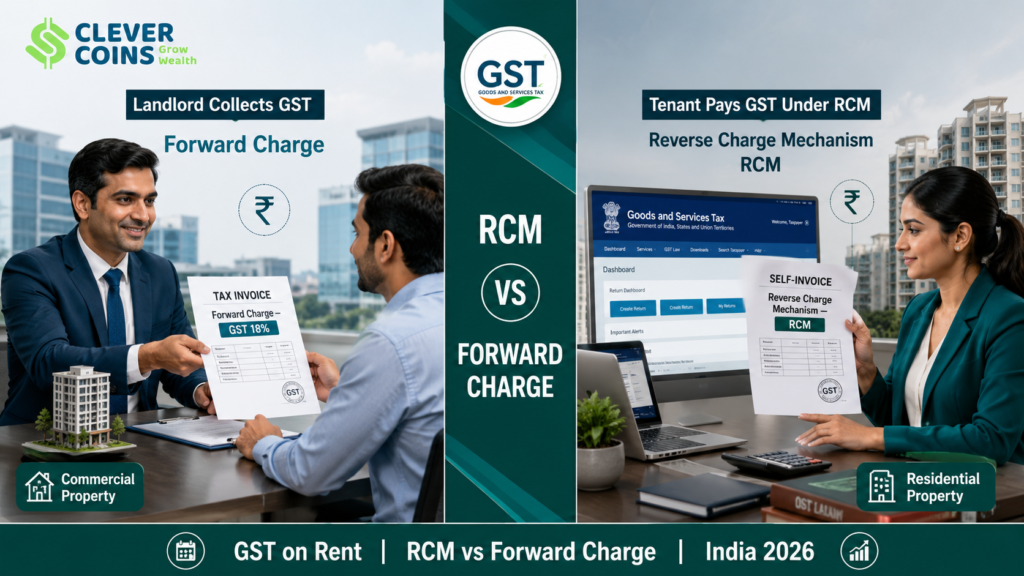
Under the Forward Charge Mechanism (also called the Normal Charge), the supplier of the service — i.e., the landlord (lessor) — is responsible for collecting GST from the tenant and depositing it with the Government.
How Forward Charge Works
- The landlord rents out property (commercial, industrial, or residential) to a tenant
- The landlord charges GST @ 18% on the rent amount in the invoice
- The tenant pays rent + GST to the landlord
- The landlord files GST returns (GSTR-1 and GSTR-3B) and remits GST to the government
- The tenant can claim Input Tax Credit (ITC) on the GST paid, subject to eligibility conditions
When Does Forward Charge Apply?
-
Forward Charge — Quick Summary:
• Who pays GST: Landlord (Supplier / Lessor)
• GST Rate: 18% (9% CGST + 9% SGST for intra-state; 18% IGST for inter-state)
• Invoice: Raised by Landlord
• Return Filing: GSTR-1 & GSTR-3B by Landlord
• ITC: Available to Tenant (if GST registered and property used for business)
↩️ What Is Reverse Charge Mechanism (RCM) in GST on Rent?
Under the Reverse Charge Mechanism (RCM), the liability to pay GST shifts from the supplier (landlord) to the recipient (tenant). The tenant is required to self-assess, pay the GST, and file the necessary returns — even if the landlord is not registered under GST.
The Core Logic of RCM
RCM was introduced to bring unregistered suppliers into the GST compliance net indirectly and to ensure that GST is not lost on transactions where the supplier (landlord) may be exempt or unregistered. The tenant — who is typically a registered GST entity — becomes the deemed taxpayer for that supply.
When Does RCM Apply on Rent?
- Landlord is NOT registered under GST
- Tenant IS registered under GST
- The property is ANY type — commercial, industrial, or residential (post-2022 amendment)
- Specifically applicable when a registered person takes a residential dwelling on rent for use as residence (18th July 2022 onward — later modified, see below)
RCM on Rent — Quick Summary:
• Who pays GST: Tenant (Recipient / Lessee)
• GST Rate: 18% (self-assessed by Tenant)
• Invoice: Self-Invoice raised by Tenant
• Return Filing: GSTR-3B by Tenant (declare and pay RCM liability)
• ITC: Available to Tenant on the RCM paid (subject to conditions)
• Landlord: No GST obligation; does not need to register solely for this rental
🔄 The Critical 2022 Amendment — Residential Property Under RCM
One of the most significant and widely discussed changes in GST on rent came into effect on 18th July 2022 via Notification No. 05/2022 – Central Tax (Rate). Prior to this amendment, residential property rented to individuals for use as a residence was fully exempt from GST.
What Changed on 18th July 2022?
- Pre-18th July 2022: Renting of a residential dwelling for use as a residence was EXEMPT from GST — regardless of the registration status of landlord or tenant
- Post-18th July 2022: The exemption was WITHDRAWN if the tenant is a registered person under GST. In such cases, RCM applies — the registered tenant must pay GST @ 18% on rent for residential property
Further Clarification — CBIC Circular 2022
- If the tenant is an individual who rents a residential dwelling for personal use (not for business), GST is still EXEMPT even if the tenant is GST registered
- If the tenant is a company, firm, or other GST-registered entity that provides the accommodation to its employees, RCM applies
- The property must be used as a ‘residence’ — hotels, guest houses, and commercial accommodations are covered under different entries
2024 CBIC Clarification (Circular No. 228/22/2024-GST)
CBIC clarified in 2024 that the intent of the 2022 notification was to tax situations where businesses use residential properties as offices or employee accommodation while being GST registered. A salaried employee who is GST-registered (e.g., for rental income) and rents a home for personal use is NOT liable for RCM on such rent.
📊 RCM vs Forward Charge — Comprehensive Comparison Table (2026)
Parameter
Forward Charge
Reverse Charge (RCM)
Definition
Supplier (Landlord) collects & pays GST
Recipient (Tenant) pays GST directly to govt.
Landlord’s GST Registration
Required
Not required
Tenant’s GST Registration
Not mandatory
Required (trigger for RCM)
Who Raises Invoice
Landlord raises Tax Invoice
Tenant raises Self-Invoice
GST Rate
18% (CGST 9% + SGST 9%)
18% (CGST 9% + SGST 9%)
ITC for Tenant
Yes — if property used for business
Yes — on RCM paid (except residential for personal use)
GSTR-1 Filing
Landlord reports in GSTR-1
Tenant declares in GSTR-3B
Applicable Property
Commercial / Industrial / Residential (if tenant is registered business)
All property types where conditions met
Cash Flow Impact
Tenant pays higher monthly amount
Tenant pays RCM separately from rent
Risk of Non-Compliance
Landlord’s risk
Tenant’s risk (penalty + interest)
💰 GST Rates on Rent — Property Type Wise (2026)
Type of Property
Tenant Type
Charge Mechanism
GST Rate
Remarks
Commercial (Office/Shop/Warehouse)
Any GST Registered Entity
Forward Charge (if LL registered)
18%
Standard business rent
Commercial (Office/Shop/Warehouse)
Registered Tenant, Unregistered LL
RCM
18%
Self-invoice by tenant
Industrial (Factory/Plant)
Registered Business
Forward / RCM
18%
Same rules as commercial
Residential Dwelling
Individual — personal use
Exempt
NIL
Exempt regardless of reg. status
Residential Dwelling
GST Reg. Company/Firm — employee housing
RCM
18%
Post 18 Jul 2022 amendment
Residential Dwelling
Unregistered Individual — personal use
Exempt
NIL
Always exempt
Agricultural Land
Any
Exempt
NIL
Explicitly exempt under Notif 12/2017
Hotel/Guest House
Tariff < ₹7,500/day per room
Forward Charge
12%
Different entry — not plain rent
Hotel/Guest House
Tariff > ₹7,500/day per room
Forward Charge
18%
Luxury accommodation
Co-working Space
GST Registered User
Forward Charge
18%
Treated as commercial
🧮 Practical Examples with INR Calculations (2026)
Example 1: Commercial Property — Forward Charge
Scenario A — Forward Charge (Commercial Office Space):
• Landlord: Mr. Ramesh Sharma (GST Registered, Mumbai)
• Tenant: ABC Pvt. Ltd. (GST Registered, Mumbai — intra-state)
• Monthly Rent: ₹1,00,000
• GST Rate: 18% (CGST 9% + SGST 9%)
• GST Amount: ₹1,00,000 × 18% = ₹18,000
• CGST: ₹9,000 | SGST: ₹9,000
• Total Invoice Amount: ₹1,18,000
• Who pays GST to Govt: Mr. Ramesh Sharma (Landlord)
• ITC Available to ABC Pvt. Ltd.: ₹18,000 per month (can offset against output GST liability)
• Annual Rent: ₹12,00,000 | Annual GST: ₹2,16,000
Example 2: Commercial Property — RCM (Unregistered Landlord)
Scenario B — RCM (Commercial Shop — Unregistered Landlord):
• Landlord: Mrs. Sunita Agarwal (NOT GST Registered — annual rent income ₹15 lakh, below threshold)
• Tenant: XYZ Trading Co. (GST Registered, Delhi — intra-state)
• Monthly Rent: ₹60,000
• Trigger: Landlord unregistered + Tenant registered → RCM applies
• GST Rate: 18% (CGST 9% + SGST 9%)
• GST Amount: ₹60,000 × 18% = ₹10,800
• Who pays GST: XYZ Trading Co. raises a Self-Invoice and pays ₹10,800 directly to Govt.
• XYZ pays Mrs. Sunita: ₹60,000 (rent only — no GST to landlord)
• XYZ pays Govt. (RCM): ₹10,800 separately via GST portal
• ITC: XYZ can claim ₹10,800 as ITC in the same month (subject to conditions)
• Net Cash Impact on XYZ: Nil (pay & claim back) — only compliance obligation
Example 3: Residential Property — RCM (Post-2022 Amendment)
Scenario C — Residential Property RCM:
• Landlord: Mr. Patel (Individual, NOT GST Registered)
• Tenant: PQR Consulting Pvt. Ltd. (GST Registered Company, Bengaluru)
• Purpose: Used as guest house / employee accommodation
• Monthly Rent: ₹40,000
• Status Post 18 Jul 2022: RCM applies (registered company using residential property)
• GST: ₹40,000 × 18% = ₹7,200
• PQR pays Mr. Patel: ₹40,000 (no GST to landlord)
• PQR pays Govt. via RCM: ₹7,200
• ITC Eligibility: Generally BLOCKED under Section 17(5)(g) — accommodation for personal use of employees
• Important: PQR cannot claim ITC on ₹7,200 — it is a final cost to the company
• Annual Additional Cost to PQR: ₹7,200 × 12 = ₹86,400 — non-recoverable
Example 4: Residential Property — EXEMPT (Individual Tenant)
Scenario D — Exempt (Individual Renting Home for Personal Use):
• Landlord: Mr. Verma (GST Registered — has other business income)
• Tenant: Ms. Priya Singh (Salaried Individual, GST Registered for her freelance business)
• Purpose: Residential use — personal accommodation
• Monthly Rent: ₹25,000
• GST Status: EXEMPT — residential dwelling for personal use
• GST Applicable: NIL — Ms. Priya need not pay RCM
• Mr. Verma need not charge GST on this rent
• Conclusion: Despite both parties being GST registered, personal residential use = Exempt
📋 Input Tax Credit (ITC) on Rent — Detailed Rules 2026
ITC is the backbone of the GST system and understanding ITC eligibility on rent paid is crucial for businesses to manage working capital effectively.
When ITC IS Available on GST Paid as Rent
- Commercial property (office, shop, warehouse, factory) taken on rent for business purposes — ITC fully available
- RCM paid on rent from unregistered landlord for commercial property — ITC available in the same tax period
- GST paid under Forward Charge on commercial rent — eligible ITC if used in the course or furtherance of business
- Co-working space membership fees — ITC available if used for business
When ITC is BLOCKED on Rent
- Section 17(5)(b): Food and beverages, outdoor catering — ITC blocked even if property is rented for such purposes
- Section 17(5)(g): Rent for accommodation services used for employees’ personal benefit — ITC BLOCKED
- Residential property rented by a registered company for employee accommodation — RCM paid but ITC BLOCKED
- Property used partly for business and partly for personal use — proportionate ITC only under Section 17(1) & 17(2)
- Registered person opts for Composition Scheme — ITC on rent NOT available
ITC on RCM — Special Conditions
-
🗂️ Self-Invoice Under RCM — What It Must Contain
When a GST-registered tenant pays GST under RCM on rent received from an unregistered landlord, the tenant is required under Section 31(3)(f) of the CGST Act to issue a self-invoice (also called a payment voucher or self-billing invoice). This document is crucial for ITC claims and audit trails.
Mandatory Details in a Self-Invoice for RCM on Rent
S.No.
Field
Details Required
1
Document Type
‘Self-Invoice’ or ‘Tax Invoice (RCM)’
2
Invoice Date
Date of payment of rent
3
Tenant’s Name & Address
Name, address, and GSTIN of tenant (recipient)
4
Landlord’s Name & Address
Name and address of landlord (supplier — unregistered)
5
Nature of Supply
‘Renting of Immovable Property — Reverse Charge’
6
Property Description
Address and type of property rented
7
Rental Period
Month / Period for which rent is paid
8
Taxable Value
Monthly rent amount (e.g., ₹60,000)
9
CGST / SGST / IGST
Rate and amount (e.g., CGST 9% = ₹5,400; SGST 9% = ₹5,400)
10
Total Invoice Value
Taxable value (Note: RCM tax is NOT added to rent — paid separately)
11
Whether RCM Applicable
‘Yes — Section 9(3) of CGST Act 2017’
📅 GST Compliance Calendar for Rent — 2026
Compliance
Who
Frequency
Due Date
Form
Report taxable rent (Forward Charge)
Registered Landlord
Monthly
11th of next month
GSTR-1
Pay GST on rental income
Registered Landlord
Monthly
20th of next month
GSTR-3B
Declare & Pay RCM on rent
Registered Tenant
Monthly
20th of next month
GSTR-3B
Raise Self-Invoice for RCM
Registered Tenant
Each rental payment
Date of payment
Self-Invoice
Claim ITC on RCM paid
Registered Tenant
Monthly
In the same month as RCM payment
GSTR-3B
Annual return
Landlord & Tenant
Annual
31st December of next FY
GSTR-9
Reconciliation of ITC
Tenant
Annual
With GSTR-9C filing
GSTR-2B vs Books
✅ GST Exemptions on Rent — Complete List (2026)
Not all rent transactions attract GST. Notification No. 12/2017 – Central Tax (Rate) provides a comprehensive list of exempt services. The following rental transactions are fully exempt from GST in 2026:
Fully GST-Exempt Rental Transactions:
• Renting of residential dwelling for use as a residence by an individual (personal, non-business use) — Entry 12 of Notif. 12/2017
• Renting of agricultural land — Entry 54
• Renting of land or building by a Religious Trust or Temple to a business up to ₹10,000 per day — Entry 13
• Services by Government/local body by way of renting of immovable property to a person registered under GST — EXEMPT (specific entries)
• Renting of precincts of a religious place meant for general public (to a registered charitable trust) — Conditional exemption
• Accommodation services by hotel/lodge/guest house with tariff below ₹1,000 per day — Entry 14
• Services by RWA (Resident Welfare Association) to its members for housing society maintenance up to ₹7,500 per month — Entry 77A
💳 GST Registration Threshold for Landlords — 2026
A landlord whose aggregate annual turnover (including all taxable supplies — rental and otherwise) exceeds the prescribed threshold is mandatorily required to obtain GST registration.
Registration Thresholds (2026)
Category
Annual Turnover Threshold
Mandatory GST Registration?
Most States (regular states)
Above ₹20 lakh
Yes — mandatory
Special Category States (NE, Uttarakhand, etc.)
Above ₹10 lakh
Yes — mandatory
Exclusively Exempt Supplies (e.g., only residential rent)
Any amount
No — but can voluntarily register
Landlord supplying only to unregistered persons
Below ₹20 lakh
No — tenant pays under RCM if applicable
Casual Taxable Person
Any amount
Compulsory regardless of turnover
Important Note on Voluntary Registration:
• Even if a landlord’s rental income is below the ₹20 lakh threshold, they can voluntarily register under GST.
• Voluntary registration allows the landlord to collect and remit GST (Forward Charge), shifting the compliance burden from the tenant.
• This may be commercially beneficial in B2B transactions where the tenant wants ITC on rent paid.
• Once voluntarily registered, all provisions of the CGST Act apply — including return filing, annual audit (if applicable), and anti-profiteering.
💵 GST on Advance Rent, Security Deposit & Lease Premium — 2026
Advance Rent / Rent in Advance
- Advance rent is taxable at the time of receipt or issuance of invoice, whichever is earlier
- If a tenant pays 3 months’ advance rent of ₹3,00,000, GST of ₹54,000 (18%) is payable at the time of receipt
- The landlord must issue a receipt voucher and the advance is adjusted against future invoices
Security Deposit
- Refundable security deposit: NOT subject to GST — it is a financial transaction and not a consideration for supply
- Non-refundable security deposit: Taxable as GST — it is treated as part of the consideration for the supply of services
- Example: If a tenant pays ₹5,00,000 as refundable deposit and ₹50,000 as non-refundable upfront fee, GST applies only on ₹50,000
Lease Premium / One-Time Lease Charges
- One-time premium paid at the time of executing a long-term lease is taxable under GST @ 18%
- Example: A 99-year lease with a premium of ₹1,00,00,000 attracts GST of ₹18,00,000
- The GST is applicable irrespective of the duration of the lease or whether a recurring rent is also payable
Maintenance Charges in Rent
- If maintenance charges are bundled with rent in a composite supply, GST applies on the total (principal supply rules)
- If maintenance charges are separately contracted, they may attract GST @ 18% independently
- RWA maintenance up to ₹7,500 per member per month is exempt — does not apply to commercial complexes
⚠️ Penalties and Interest for Non-Compliance — GST on Rent (2026)
Non-Compliance
Applicable Section
Penalty / Interest
Failure to pay RCM on rent
Section 9(3) + Section 74
18% interest p.a. on unpaid GST + penalty up to 100% of tax
Non-issuance of Self-Invoice
Section 31(3)(f) + Section 122
Penalty ₹10,000 or tax amount — whichever is higher
Failure to register (if threshold crossed)
Section 22 + Section 122
Penalty 10% of tax or ₹10,000 — whichever is higher
Wrong ITC claim on blocked credits
Section 17(5) + Section 73/74
Reversal of ITC + 18% interest + penalty
Late filing of GSTR-3B (with RCM liability)
Section 47
₹50/day (CGST ₹25 + SGST ₹25) or ₹20/day for nil return
Fraudulent ITC claim
Section 74
Penalty up to 100% of wrongful ITC + tax + interest
⚖️ Key Judicial Decisions and CBIC Clarifications (2022–2026)
1. CBIC Circular No. 228/22/2024-GST — Residential Property RCM Clarification
CBIC clarified the scope of GST on residential dwelling under RCM. A GST-registered individual renting a residential property for personal residential use — even if incidentally registered for another business — is not liable to pay RCM. The RCM applies only when the residential property is used for business/commercial purposes by the registered entity.
2. AAR Maharashtra — M/s. Atharv Enterprises (2023)
The Authority for Advance Ruling (AAR) held that where a company leases residential flats for its employees, the GST under RCM is payable by the company. However, ITC on such GST is blocked under Section 17(5)(g) as it constitutes an accommodation service for personal use of employees.
3. AAAR West Bengal — Residential Property as Corporate Office (2024)
The Appellate AAR ruled that if a registered company takes a residential property on rent and uses it exclusively as its registered office (for business purposes, not employee residence), the RCM GST paid thereon is eligible for ITC, overturning the lower AAR ruling.
4. Rajasthan High Court — Union of India v. XYZ Developers (2025)
The Rajasthan HC upheld the validity of the 2022 amendment making RCM applicable on residential property taken by registered persons. The Court held that the legislative intent was clear and the distinction between personal and commercial use of residential property is the relevant test for exemption.
5. CBIC FAQ on RCM — January 2026
CBIC released a comprehensive FAQ document in January 2026 addressing common issues on RCM on rent. Key clarifications: (a) RCM is triggered by registration status of tenant, not purpose; (b) self-invoice must be issued even if rent is paid via NEFT/IMPS; (c) co-tenants must each assess their own RCM liability proportionately.
🗺️ Decision Flowchart — RCM or Forward Charge?
Step-by-Step Decision Guide for GST on Rent (2026):
• STEP 1: Is the property a residential dwelling used for personal residence by an individual? → YES = EXEMPT (No GST). STOP.
• STEP 2: Is it agricultural land? → YES = EXEMPT. STOP.
• STEP 3: Is the property commercial/industrial? → Proceed to Step 4.
• STEP 4: Is the Landlord registered under GST? → YES = Forward Charge applies. Landlord raises invoice @ 18% GST. STOP.
• STEP 5: Landlord is NOT registered. Is the Tenant registered under GST? → YES = RCM applies. Tenant raises self-invoice & pays 18% GST. STOP.
• STEP 6: Both Landlord and Tenant are unregistered → If rent < ₹20L p.a., no GST applicable. If rent crosses threshold, registration triggered.
• STEP 7 (Residential — Post 2022): Tenant is a registered company/firm using residential property for business → RCM applies @ 18%. ITC likely blocked.
🏭 GST on Rent — Industry-Specific Scenarios (2026)
1. IT Companies / Startups — Co-working and Office Spaces
- Monthly co-working space rental: ₹15,000–₹1,00,000 per seat — GST 18% via Forward Charge
- If co-working space provider is GST registered, they collect and remit GST
- IT company (registered) can claim full ITC on such rent — effectively no GST cost
2. Retail Businesses — Shop / Showroom Rent
- Retail shop rent from GST-registered landlord: Forward Charge — tenant claims ITC
- Shop in a mall: Maintenance + Rent often bundled — composite supply at 18%
- Revenue-sharing rent (percentage of sales): GST applies on actual consideration paid each month
3. Manufacturing / Warehousing
- Factory/warehouse on rent from registered lessor: 18% GST via Forward Charge — ITC available
- Cold storage facilities leased: 18% GST (cold storage is not agricultural produce storage for GST purposes)
- Godown rental for goods storage: 18% — eligible ITC for registered manufacturing entities
4. Healthcare / Educational Institutions
- Hospital building leased from a trust: Depends on trust’s GST status and hospital’s exemption status
- Educational institution renting school building: Check if institution is exempt under Section 9(1) read with Schedule III
- Private hospital (registered): Commercial rent applicable — 18% GST via Forward/RCM
5. Freelancers and Self-Employed Professionals
-
✅ Compliance Checklist — GST on Rent for Businesses (2026)
Tenant’s Compliance Checklist:
• Verify landlord’s GST registration status — GSTIN lookup on gst.gov.in
• If landlord is unregistered — prepare to pay RCM and raise self-invoice
• Raise self-invoice on or before the date of rent payment
• Declare RCM liability in GSTR-3B Table 3.1(d) — every month
• Pay RCM tax in cash (cannot use ITC to pay RCM liability directly)
• Claim ITC on RCM paid in Table 4(A)(3) of GSTR-3B in the same period
• Verify ITC eligibility — check if property is used for business (not blocked under Section 17(5))
• Ensure rent agreement clearly specifies GST obligation between parties
• Maintain rent invoices/self-invoices for at least 6 years (records retention requirement)
• Reconcile ITC claimed with GSTR-2B monthly
Landlord’s Compliance Checklist:
• Determine if aggregate turnover (all supplies) exceeds ₹20 lakh — if yes, register for GST
• If registered, issue Tax Invoice with 18% GST for all taxable rents
• Report rental income in GSTR-1 under HSN Code 997212 (Commercial) or 997211 (Residential)
• File GSTR-3B monthly and remit GST collected to the Government
• Maintain proper books — rent register, GST invoices, payment records
• If below threshold but supplying to registered businesses, consider voluntary GST registration
• Issue receipt voucher for advance rent received
• File annual GSTR-9 if turnover exceeds ₹2 crore
🔢 HSN / SAC Codes for Renting of Immovable Property (2026)
SAC Code
Description
GST Rate
997211
Renting or leasing services involving residential property
18% (if taxable) / Exempt
997212
Renting or leasing services involving commercial/industrial property
18%
997213
Renting or leasing services involving vacant land
18% (if commercial)
997214
Renting or leasing services involving other immovable property
18%
997221
Licensing services for use of intangible assets (not immovable property)
18%
996311
Hotel and similar accommodation services (tariff > ₹7,500/day)
18%
996312
Hotel accommodation (tariff ₹1,000–₹7,500/day)
12%
❓ Frequently Asked Questions — GST on Rent (2026)
Q1. If I am a freelancer registered under GST and I pay rent for my home office, do I need to pay RCM?
It depends. If your residential property is genuinely used as a home office for your freelance business (and you are a GST-registered person), RCM technically applies post-2022 amendment. However, CBIC circular 228/22/2024 clarifies that if the primary use is residential, exemption continues. For dual-use properties, proportionate RCM may be required. Consult a GST professional for your specific situation.
Q2. Can a landlord voluntarily charge GST even if his rental income is below ₹20 lakh?
Yes. Voluntary GST registration is permitted. Once registered, the landlord collects and pays GST under Forward Charge. This is commercially beneficial for tenants who are GST-registered businesses since they can claim ITC on the rent paid.
Q3. My company has rented a residential flat as a guest house for visiting clients. Is RCM applicable?
Yes. Since your company is GST-registered and the residential property is used for business purposes (guest house, client accommodation), RCM @ 18% applies. However, ITC on this RCM is blocked under Section 17(5)(g) — accommodation for employees/clients — and is a sunk cost to the company.
Q4. Our landlord is an NRI (Non-Resident Indian). What is the GST treatment on rent paid to an NRI?
If an NRI landlord is not registered under GST in India, the Indian registered tenant must pay GST under RCM. The NRI landlord is not required to register for GST solely on account of renting property in India — this is an area of active litigation and professional advice is strongly recommended.
Q5. Is GST applicable on rent paid to a co-operative housing society for commercial use of flat?
If the housing society is GST-registered and provides the flat for commercial use, GST @ 18% applies under Forward Charge. If the society is not registered, the tenant (if registered) must pay RCM.
Q6. What is the time of supply for GST on rent?
Under Section 13(2) of the CGST Act, the time of supply for rent services is the earliest of: (a) date of invoice issuance (by landlord or self-invoice by tenant for RCM); (b) due date of payment as per the contract; or (c) date of payment.
Q7. Can a composition dealer landlord charge GST on rent?
No. A landlord registered under the Composition Scheme cannot collect GST from tenants. They pay a flat composition levy on their total turnover and cannot issue a Tax Invoice with GST. Tenants of composition dealers cannot claim ITC on such rent.
-