Pradhan Mantri Jan Dhan Yojana Features: The Ultimate Guide to India’s Financial Inclusion Revolution
Financial inclusion is the bedrock of any thriving modern economy. For decades, a massive chunk of India’s population remained unbanked, operating completely outside the formal financial ecosystem. Lacking access to safe savings accounts, institutional credit, or formal insurance products, millions of marginalized households fell prey to informal, high-interest moneylenders.Everything changed on August 28, 2014, when the Government of India launched the Pradhan Mantri Jan Dhan Yojana (PMJDY). Hailed as the world’s largest financial inclusion initiative, PMJDY aimed to bridge the massive gap between the unbanked masses and formal banking infrastructure.PIB+ 1
PIB
1. What is Pradhan Mantri Jan Dhan Yojana (PMJDY)?
Pradhan Mantri Jan Dhan Yojana is a National Mission for Financial Inclusion designed to integrate marginalized communities into the mainstream banking grid. Its core motto reads: “Banking the Unbanked, Securing the Unsecured, Funding the Unfunded”.Pradhan Mantri Jan-Dhan Yojana | Department of Financial Services | Ministry of Finance+ 1
IBEF
PM India
- Phase I (2014–2018): Focused on universal access to banking facilities, ensuring every household had at least one basic bank account, expanding rural banking infrastructure via Bank Mitras (Business Correspondents), and introducing basic insurance.Department of Financial Services
- Phase II (2018 Onwards): Shifted focus from “every household” to “every unbanked adult”. It enhanced overdraft limits, doubled accident insurance covers, and integrated advanced micro-insurance and pension schemes.Department of Financial Services+ 1
2. Core Pradhan Mantri Jan Dhan Yojana Features at a Glance
To fully appreciate the scope of the scheme, let us examine its primary structural features:Feature Category | Specific Provision / Benefit |
|---|---|
Account Type | Basic Savings Bank Deposit (BSBD) Account |
Minimum Balance | Nil (Zero Balance Account) |
Interest Rate | Standard savings account interest rates applicable on deposits |
Debit Card | Free RuPay Debit Card provided to all eligible holders |
Accidental Insurance | ₹2 Lakh cover linked with the RuPay card (for accounts opened post-August 2018) |
Life Insurance Cover | ₹30,000 life cover (subject to specific legacy eligibility terms) |
Overdraft (OD) Facility | Up to ₹10,000 for compliant account operators |
Direct Benefit Transfer | Seamless routing for government subsidies, pensions, and welfare funds |
3. Deep-Dive Analysis of Key PMJDY Features
A. Zero-Balance Savings Account Structure
One of the greatest deterrents keeping lower-income groups away from traditional banks was the mandate to maintain a minimum average monthly balance (AMB). Failure to maintain this threshold often resulted in punitive non-maintenance penalties, wiping out small savings.PMJDY eliminated this hurdle entirely. A Jan Dhan account is a Basic Savings Bank Deposit (BSBD) account requiring zero balance. Account holders are not penalized if their balance drops to zero, making it completely risk-free for daily-wage earners, laborers, and rural artisans to park their hard-earned money safely.Department of Financial Services
B. Free RuPay Debit Card & Cash Withdrawals
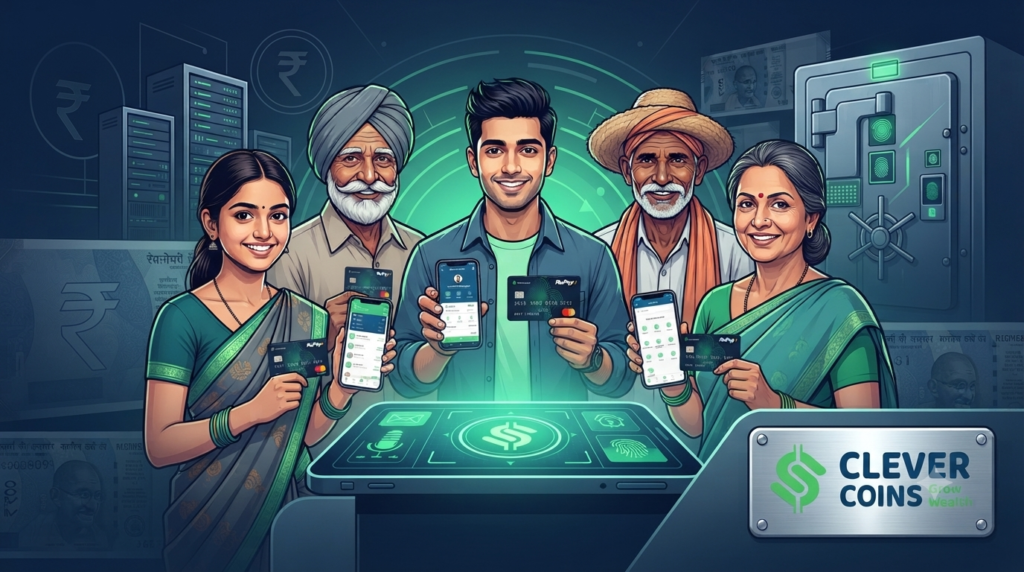
Every PMJDY account holder receives a specialized RuPay debit card. Unlike international card networks that attract heavy processing fees, RuPay is India’s indigenous domestic card network.pradhanmantri-jan-dhan-yojana.com
- The card comes with zero annual maintenance fees initially.
- It allows account holders to withdraw cash freely from ATMs and make point-of-sale (PoS) purchases or digital merchant payments.
- It serves as a primary gateway for rural and semi-urban populations to enter the digital economy, supporting UPI (Unified Payments Interface) transactions seamlessly.
C. In-Built Accidental Insurance Cover of ₹2 Lakh
Security is an essential pillar of financial inclusion. Every RuPay debit card issued under PMJDY comes with an integrated Accidental Insurance Cover of ₹2 Lakh (applicable to accounts opened after August 28, 2018; earlier accounts carried a ₹1 lakh cover).IBEF
- Condition: To keep this insurance active, the cardholder must perform at least one successful financial or non-financial transaction (ATM withdrawal, swipe, or online purchase) within 90 days prior to the date of the accident.
D. Substantial Overdraft (OD) Facility up to ₹10,000
To protect vulnerable families from predatory local moneylenders during medical emergencies or sudden financial crunches, PMJDY features an Overdraft (OD) facility of up to ₹10,000.IBEF
- Eligibility for OD: An overdraft of up to ₹2,000 can be accessed without rigid prior conditions. For the full limit of ₹10,000, the account must have been operated satisfactorily for at least 6 months.pradhanmantri-jan-dhan-yojana.com
- Household Cap: This facility is typically restricted to one member per household, preferably the woman of the house, promoting financial governance within the family unit.pradhanmantri-jan-dhan-yojana.com
E. Direct Benefit Transfer (DBT) Integration
Before Jan Dhan, a massive percentage of government welfare funds, LPG subsidies, and scholarships leaked through intermediary channels or failed to reach intended beneficiaries directly.PMJDY acts as the fundamental anchor for the Direct Benefit Transfer (DBT) architecture. Because Jan Dhan accounts are systematically mapped with Aadhaar numbers and mobile linkages, government subsidies land directly into the beneficiary’s bank account with zero leakage, ensuring absolute transparency and speed.pradhanmantri-jan-dhan-yojana.com
4. Eligibility Criteria: Who Can Open a Jan Dhan Account?
The framework of PMJDY is designed to be maximally inclusive while maintaining compliance with regulatory protocols:pradhanmantri-jan-dhan-yojana.com
- General Nationality: The applicant must be a citizen of India.pradhanmantri-jan-dhan-yojana.com
- Unbanked Status: Primarily targeted at individuals who do not possess any other formal savings bank account.pradhanmantri-jan-dhan-yojana.com
- Age Guidelines:
- Any individual above the age of 18 years can independently open an account.pradhanmantri-jan-dhan-yojana.com
- Minors above the age of 10 years are also permitted to open a Jan Dhan savings account, which can be operated under the supervision of a legal guardian.pradhanmantri-jan-dhan-yojana.com
- Any individual above the age of 18 years can independently open an account.
What About Individuals Without Standard KYC Documents?
Recognizing that many marginalized citizens lack standard documents like passports, pan cards, or formal utility bills, the Reserve Bank of India (RBI) introduced provisions for “Small Accounts”:- If an individual cannot provide officially valid KYC documents, they can open a Small Account by submitting a self-attested photograph and signing or thumb-printing in the presence of a bank official.pradhanmantri-jan-dhan-yojana.com
- Limitations: These accounts have caps (e.g., total deposits cannot exceed ₹50,000 in a year, total withdrawals capped at ₹10,000 a month, and balances cannot cross ₹50,000). However, they can be fully regularized later once standard KYC documents are submitted.
5. Documents Required to Open a PMJDY Account
Opening a Jan Dhan account requires minimal paperwork. Applicants can present any Officially Valid Document (OVD) from the following list:IBEF
- Aadhaar Card (most preferred and recommended for seamless DBT mapping)
- PAN Card
- Voter Identity Card
- Driving Licence
- Passport
- NREGA Job Card signed by a state government officer
- ID card issued by Central/State government departments or public sector undertakings (if applicable)
6. Expanding the Safety Net: Integration with Jan Suraksha Schemes
Jan Dhan is not just about holding money; it acts as a launchpad for broader national social security structures. Account holders can effortlessly bundle their accounts with three major social security frameworks:Department of Financial Services
- Pradhan Mantri Jeevan Jyoti Bima Yojana (PMJJBY): Offers life insurance coverage of ₹2 Lakh for death due to any cause, available at a highly subsidized annual premium.PIB
- Pradhan Mantri Suraksha Bima Yojana (PMSBY): Provides accidental death and disability cover of ₹2 Lakh (and ₹1 lakh for partial permanent disability) at an extremely nominal annual cost.PIB
- Atal Pension Yojana (APY): Empowers unorganized sector workers to secure a guaranteed monthly pension ranging from ₹1,000 to ₹5,000 post the age of 60, depending on their contribution tier.PIB
7. The Transformational Impact on India’s Economy
The multi-fold benefits of PMJDY extend far past individual account holders, reshaping macro-level economic indicators:- Eradication of Financial Exclusion: Bringing hundreds of millions of people into the formal financial mainstream has drastically reduced reliance on informal, exploitative moneylenders.
- Empowerment of Women: With over 32.6 crore female account holders, women have gained direct control over household savings, driving independent financial decision-making in rural households.PIB
- Digital Penetration: The widespread distribution of RuPay cards alongside expanding smartphone penetration has laid down the pipeline for rural India to adopt UPI, mobile banking, and micro-credit systems.
8. Conclusion
The Pradhan Mantri Jan Dhan Yojana has proven that visionary public policy coupled with robust execution can scale financial inclusion to unprecedented heights. By removing minimum balance barriers, offering insurance cushions, and streamlining welfare delivery, PMJDY has transformed basic bank accounts into powerful instruments of social dignity and economic mobility.pradhanmantri-jan-dhan-yojana.com+ 1
Frequently Asked Questions (FAQs)
Q1: Is there any penalty for not maintaining a balance in a Jan Dhan account?No. One of the core features of PMJDY is that it is a zero-balance account. You will never be charged any penalty if your account balance falls to zero.Q2: Who is eligible for the ₹10,000 overdraft facility?pradhanmantri-jan-dhan-yojana.com
The overdraft facility of up to ₹10,000 is available to eligible account holders who have maintained and operated their accounts satisfactorily for at least 6 months. It is typically restricted to one member per household.Q3: How can I check if my Jan Dhan account is linked with Aadhaar for DBT?pradhanmantri-jan-dhan-yojana.com
You can verify your Aadhaar-to-bank seeding status directly through the official UIDAI portal or by visiting your nearest bank branch or Bank Mitra.pradhanmantri-jan-dhan-yojana.com
- Phone: +91 77389 59862
- Email: client@clevercoins.org
- Address: Ideal Market, Mumbra, Thane-400612
- Website: https://clevercoins.org/
Days
Hours
Minutes
Seconds
Related posts:
GST Registration Cancellation: The Complete 2026 Process & Impact Guide
GST
RBI Floating Rate Bonds – Should You Invest? (Comprehensive Guide)
GST
GST on Agricultural Produce: The Ultimate Tax, Exemption, and Compliance Guide
GST
GST on Agricultural Produce: The Ultimate 2026 Compliance Guide
GST
CIBIL Rank for MSMEs – How to Improve, Maintain, and Leverage It for Ultimate Business Growth
GST
Comprehensive Master Guide to Nil GST Return Filing: GSTR-1 & GSTR-3B
GST
Complete Guide to SEBI Registration for Investment Advisors
GST
DIGITAL BANKING FRAUDS
GST
Export of Services Under GST: Letter of Undertaking (LUT) vs. IGST Payment with Refund
GST
GST PORTAL NEW FEATURES 2025-26
GST