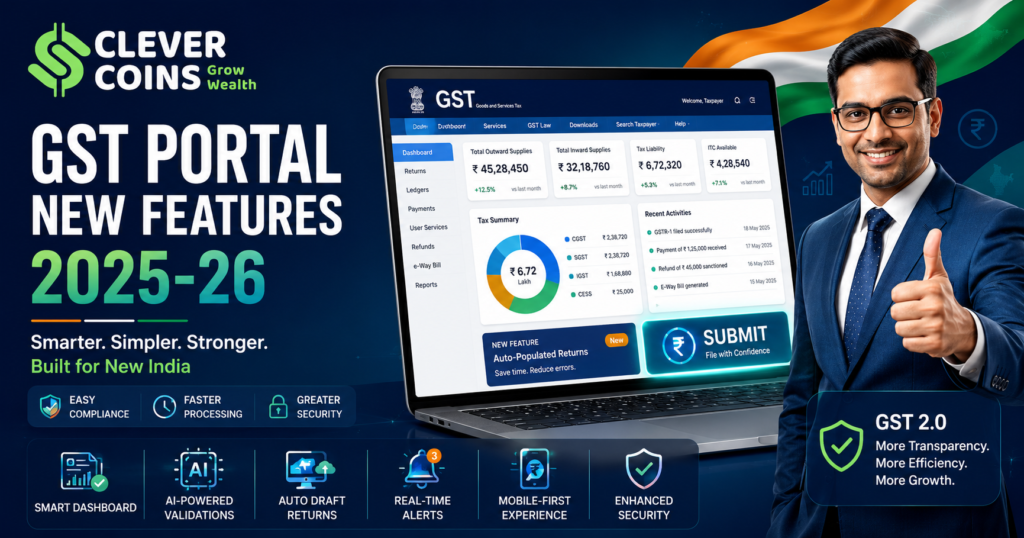
Why GST Portal Updates Matter in 2025-26
The Goods and Services Tax (GST) system in India has been continuously evolving since its landmark rollout on July 1, 2017. In the financial year 2025-26, the GST Network (GSTN) and the Central Board of Indirect Taxes and Customs (CBIC) have introduced a sweeping range of new features, tools, and compliance enhancements on the GST Portal (www.gst.gov.in). These upgrades are specifically designed to reduce compliance burden, improve transparency, minimise tax evasion, and make the overall filing experience smoother for over 1.5 crore registered taxpayers across India.
Whether you are a small business owner in Surat, a CA managing 200+ GST clients in Mumbai, an exporter in Chennai, or a startup CFO in Bengaluru — understanding these new features is not optional. Non-compliance or missed deadlines now attract steeper scrutiny thanks to AI-powered tools embedded in the portal.
This comprehensive blog covers every significant update introduced on the GST portal for FY 2025-26, from revamped return filing to e-invoicing expansion, ITC intelligence, the new GST Sahay portal, and much more.
|
📌 Key Fact India’s GST collection crossed ₹2.10 lakh crore in a single month for the first time in April 2025 — a record high, partly driven by increased compliance enabled by the new portal features. |
1. Overview of GST Portal Changes in FY 2025-26
The GSTN has undertaken its most comprehensive technology overhaul since 2020. The upgrades span the following key domains:
- Return Filing Simplification & Auto-Population
- Expanded e-Invoicing Applicability
- Enhanced Input Tax Credit (ITC) Management
- New Compliance & Risk Management Tools
- Revamped Registration & Amendment Processes
- AI-Driven Scrutiny & Mismatch Detection
- New API-Based Integration for ERP Systems
- GST Sahay — MSME Credit Facilitation
- Improved Refund Processing System
- Upgraded Mobile App & e-Services
1.1 Technology Backbone of the New GST Portal
The GST portal has migrated to a cloud-native architecture in 2025, significantly improving uptime and page-load performance. GSTN has partnered with multiple cloud providers to ensure 99.9% availability, especially during peak filing dates (10th, 11th, 13th, 20th, and last day of every month). The new infrastructure can now handle over 50 lakh concurrent user sessions — a 5x improvement over the earlier system.
2. Revamped GST Return Filing System for 2025-26
Return filing is the backbone of GST compliance. In FY 2025-26, GSTN has overhauled the entire return ecosystem to make it intuitive, automated, and error-resistant.
2.1 Full Auto-Population of GSTR-3B from GSTR-1 and GSTR-2B
Previously, taxpayers had to manually enter outward supply data in GSTR-3B. From April 2025, GSTR-3B is now fully auto-populated based on:
- GSTR-1 filed by the taxpayer (outward supply details)
- GSTR-2B generated from supplier filings (ITC eligibility)
- GSTR-1A amendments reconciled in real-time
This eliminates dual data entry and significantly reduces mismatches. Taxpayers only need to review and submit — with an option to override specific fields with a documented reason.
2.2 GSTR-1A — The New Amendment Return
A new return called GSTR-1A has been operationalised in FY 2025-26. This allows taxpayers to amend their GSTR-1 data after filing but before the due date of GSTR-3B. Key benefits:
- Correct invoice-level errors without impacting the buyer’s ITC
- Add missed B2B invoices before the GSTR-3B deadline
- Revise e-invoice amendments in a structured manner
2.3 Quarterly Return Monthly Payment (QRMP) Scheme Enhancements
Taxpayers with an annual aggregate turnover up to ₹5 crore who opted for QRMP now enjoy the following new features:
- IFF (Invoice Furnishing Facility) now includes credit/debit note amendments
- Auto-computed Fixed Sum Method (FSM) payment challan
- SMS-based filing confirmation for QRMP taxpayers
- Turnover threshold re-validation auto-alert system
2.4 GSTR-9 and GSTR-9C Enhancements
Annual return filing for FY 2024-25 (filed in 2025-26) now comes with:
- Pre-filled GSTR-9 with comparative data from all monthly returns
- Automated reconciliation tool highlighting ± ₹1,000 discrepancies
- GSTR-9C self-certification now includes a digital audit trail
- Turnover threshold for mandatory GSTR-9C filing remains ₹5 crore
3. E-Invoicing Expansion and New Applicability Rules
E-Invoicing (electronic invoicing) was a game-changer introduced in 2020 for large businesses. In 2025-26, it has been expanded further:
3.1 New Turnover Threshold
From August 1, 2025, e-invoicing is mandatory for all registered taxpayers with aggregate annual turnover exceeding ₹5 crore (previously ₹10 crore). This brings an estimated 15-20 lakh additional businesses under the e-invoicing umbrella.
|
⚠️ Important Update From FY 2025-26, taxpayers between ₹5 crore and ₹10 crore turnover must generate IRN (Invoice Reference Number) for every B2B transaction. Failure to do so may result in the buyer being unable to claim ITC. |
3.2 E-Invoicing for SEZ & Government Supplies
Special Economic Zone (SEZ) units and supplies to government departments now mandatorily require e-invoicing where the supplier’s turnover exceeds the threshold. The earlier exemption for these categories has been withdrawn effective April 1, 2025.
3.3 Dynamic QR Code Enhancements
For B2C transactions, the existing requirement of a Dynamic QR Code on invoices above ₹5 lakh has been extended. The QR code now also captures:
- State-wise place of supply data
- HSN-level breakup for compliance verification
- UPI payment deep link embedded in the QR
3.4 E-Invoicing Sandbox Environment
GSTN has launched a live Sandbox environment where businesses can test their e-invoicing integration before going live. This is especially beneficial for MSMEs newly brought under the threshold, allowing them to test their billing software integration with no risk to live data.
4. Input Tax Credit (ITC) Management — New Intelligence Layer
ITC management has historically been the most contentious area of GST. FY 2025-26 introduces a dedicated ITC Intelligence module on the GST portal.
4.1 GSTR-2B Enhancements
GSTR-2B, the auto-drafted ITC statement, now features:
- Real-time ITC ledger showing eligible, ineligible, and blocked credit
- Rule 86B compliance auto-check (restricts use of ITC exceeding 99% of tax liability where cash turnover exceeds ₹50 lakh)
- ITC reversal on non-payment to supplier beyond 180 days — auto-computed and reflected in GSTR-3B
- MSME supplier flag — highlights ITC from suppliers registered under MSME Act for priority tracking
4.2 ITC Reconciliation Tool
A brand-new ITC Reconciliation Tool has been introduced within the portal. Features include:
- Match GSTR-2A vs GSTR-2B vs Purchase Register (upload in CSV/Excel format)
- Identify mismatches with supplier GSTIN, invoice number, date, and amount
- Generate reconciliation report in PDF/Excel format
- Auto-draft ITC reversal amounts to be populated in GSTR-3B Table 4(B)
4.3 Blocked Credit Alerts
The portal now proactively alerts taxpayers when they are about to claim ITC on:
- Section 17(5) blocked categories (motor vehicles, food, club memberships, etc.)
- Invoices from suppliers whose registration has been cancelled or suspended
- Invoices where e-way bill has not been generated (where applicable)
5. GST Registration — Streamlined & Biometric-Enabled
GST registration and amendments have historically been plagued by delays and rejection. FY 2025-26 introduces significant improvements.
5.1 Aadhaar-Based Biometric Authentication
Following a pilot in Rajasthan and Gujarat, biometric-based Aadhaar authentication for new GST registration is now rolled out across all states. This feature:
- Eliminates identity fraud in new registrations
- Requires applicants to visit designated GST Suvidha Kendra for biometric capture
- Reduces registration approval time from 7 working days to 3 working days for verified applicants
5.2 Risk-Based Registration Classification
GSTN now classifies new registration applications into three risk categories automatically:
- Low Risk: Approved within 1 working day — existing businesses with clean history
- Medium Risk: Approved in 3-5 working days — new businesses with standard documents
- High Risk: Referred for physical verification — flagged by AI for potential fraud patterns
5.3 Registration Amendment Simplification
Core amendments such as change of principal place of business, addition of partners, and change of authorised signatory now feature:
- Parallel online and offline document submission
- Real-time status tracking with reason for any objection
- Deemed approval within 15 days if no action taken by officer
6. AI-Powered Compliance & Risk Management Tools
The 2025-26 upgrades have placed Artificial Intelligence at the heart of GST compliance enforcement. These tools are designed to be proactive rather than reactive.
6.1 ADVAIT — Advanced Analytics for GST Vigilance & Tax Intelligence
CBIC’s ADVAIT system has been fully integrated with the GST portal in 2025-26. It provides:
- Circular trading detection — identifies networks of businesses claiming fake ITC
- Turnover mismatch flags — cross-checks GST turnover with Income Tax and TDS data
- High-risk supplier list — updated weekly and visible to buyers in GSTR-2B
- Sector-specific compliance benchmarking
6.2 System-Generated Notices (SGN)
A new category of notices called System-Generated Notices (SGN) have been introduced. These are auto-generated without officer intervention for:
- GSTR-1 vs GSTR-3B mismatch exceeding ₹25,000
- ITC claimed in excess of GSTR-2B auto-draft
- Non-filing of returns for more than 2 consecutive months
Taxpayers can respond to SGNs directly through the portal’s Notice & Order Management section within 30 days.
6.3 Compliance Rating Score (Pilot)
GSTN has launched a pilot Compliance Rating Score (CRS) for registered taxpayers in select states. The score (0-100) is calculated based on:
- Return filing timeliness
- Accuracy of tax payment
- ITC reversal compliance
- Response to notices
A good CRS score is expected to become a prerequisite for availing certain government tenders and subsidies by FY 2026-27.
7. Refund Processing — Faster & Transparent
GST refunds have been a major pain point for exporters and inverted duty structure cases. FY 2025-26 introduces a revamped refund workflow.
7.1 Automated Refund for Zero-Rated Supplies
Exporters filing GSTR-1 with IGST payment data on zero-rated supplies now receive automated refund processing within 7 working days — down from the earlier 30-60 days. The system:
- Auto-validates shipping bill data from ICEGATE (Customs portal)
- Cross-checks GSTR-1 with IGST paid in GSTR-3B
- Generates bank transfer directly to the registered bank account
7.2 Refund Application Tracker
A new centralised Refund Application Tracker on the portal shows:
- Stage-wise status: Submitted → Under Processing → Approved → Disbursed
- Officer remarks at each stage
- Expected disbursement date based on category and amount
- Escalation option if refund is delayed beyond 60 days
7.3 Inverted Duty Structure Refunds
For businesses claiming refunds under inverted duty structure (where tax rate on inputs is higher than on output), a new formula-based calculator has been added to the portal to compute the maximum eligible refund amount before application. This prevents excess claims and associated deficiency memos.
8. E-Way Bill System — Upgrades for 2025-26
The E-Way Bill (EWB) system, though a separate portal, is deeply integrated with the GST portal in 2025-26.
8.1 E-Way Bill 2.0 Portal
The upgraded E-Way Bill 2.0 portal launched in December 2024 has now been fully stabilised. New features include:
- Real-time GPS tracking integration with vehicle movement for high-value consignments
- Automatic EWB extension based on NHAI highway data for route delays
- Consolidated EWB for multi-consignment vehicles
- Integration with FASTag data for transit verification
8.2 HSN-Level E-Way Bill Validation
From June 2025, the e-way bill system validates HSN codes against the e-invoice data in real-time. Any mismatch between the e-invoice HSN and the EWB HSN blocks generation until corrected. This closes a major leakage point in the system.
8.3 Time-Limit Alerts
Transporters and consignors now receive automated SMS/WhatsApp alerts at:
- 4 hours before EWB expiry
- 1 hour before EWB expiry
- Upon successful extension of EWB
9. GST Sahay — MSME Invoice Financing Portal
One of the most impactful new launches under the GST ecosystem in 2025-26 is GST Sahay — a dedicated platform for MSMEs to access invoice-based credit.
9.1 What is GST Sahay?
GST Sahay is a digital lending marketplace launched by GSTN in collaboration with the Reserve Bank of India (RBI) and select public and private sector lenders. It allows:
- MSMEs to apply for short-term working capital loans against outstanding GST invoices
- Lenders to access GST return data with consent for creditworthiness assessment
- Instant in-principle loan approval for amounts up to ₹10 lakh
- Interest rates starting at 8.5% per annum for eligible borrowers
9.2 Eligibility
To use GST Sahay, a business must:
- Be registered on GST portal for at least 12 months
- Have filed GSTR-3B for at least 6 consecutive months without default
- Have an annual aggregate turnover below ₹5 crore
- Provide Aadhaar-linked digital consent for GST data sharing with lender
10. GST Appellate Tribunal (GSTAT) — Portal Integration
The long-awaited GST Appellate Tribunal (GSTAT) has been established and its digital interface integrated with the GST portal in 2025-26.
10.1 Online Appeal Filing
Taxpayers can now file GST appeals directly through the portal:
- GST APL-01: Appeal to Appellate Authority
- GST APL-05: Appeal to GSTAT
- All documents submitted digitally — no physical filing required
- Hearing dates and orders communicated via portal notifications and email
10.2 Pre-Deposit Payment
The mandatory pre-deposit of 10% of the disputed tax demand (for first appeal) and 20% (for GSTAT appeal) can now be paid directly through the portal using the electronic cash ledger. The system automatically blocks the deposited amount until the appeal is disposed of.
11. Key Compliance Calendar for FY 2025-26
|
Return / Form |
Due Date |
Applicable Taxpayers |
|
GSTR-1 |
11th of next month |
Monthly filers — Turnover > ₹5 Cr |
|
GSTR-1 (QRMP) |
13th of month after quarter |
Quarterly filers — Turnover ≤ ₹5 Cr |
|
GSTR-3B |
20th of next month |
Monthly filers |
|
GSTR-3B (QRMP) |
22nd/24th after quarter |
Quarterly filers (Category-wise) |
|
GSTR-9 |
31st December |
All regular taxpayers |
|
GSTR-9C |
31st December |
Taxpayers with turnover > ₹5 Cr |
|
GSTR-7 (TDS) |
10th of next month |
TDS deductors under GST |
|
GSTR-8 (TCS) |
10th of next month |
E-commerce operators |
12. Late Fees & Penalties Update for 2025-26
The late fee structure has been revised in the Union Budget 2025 and subsequent GST Council notifications:
12.1 Late Fee for GSTR-3B
- ₹50 per day (₹25 CGST + ₹25 SGST) for returns with tax liability
- ₹20 per day (₹10 CGST + ₹10 SGST) for NIL returns
- Maximum cap of ₹10,000 per return reinstated for MSMEs
12.2 Late Fee for GSTR-9
- ₹200 per day (₹100 CGST + ₹100 SGST)
- Cap at 0.5% of aggregate turnover in the state
12.3 Interest on Delayed Tax Payment
- 18% per annum on shortfall in tax payment
- 24% per annum on excess ITC wrongly availed and utilised
- Portal now auto-computes and shows interest liability before GSTR-3B submission
Conclusion: Stay Ahead of GST Compliance in 2025-26
The GST portal’s new features for FY 2025-26 represent a decisive shift towards a technology-first, AI-powered compliance ecosystem. For taxpayers and businesses across India, this means both opportunity and accountability. The era of manual errors and delayed filings is being replaced by automated validation, real-time data cross-checks, and proactive compliance monitoring.
The key takeaways for FY 2025-26 are:
- E-invoicing now covers businesses with turnover above ₹5 crore — act now if you are in the ₹5-10 crore bracket
- GSTR-3B is now fully auto-populated — review carefully before submission
- Use the new ITC Reconciliation Tool to avoid notices and penalties
- MSMEs should explore GST Sahay for working capital needs
- Respond promptly to System-Generated Notices to avoid escalation
Bookmark the official GST portal (www.gst.gov.in) and the CBIC notification page for real-time updates throughout the year. If you found this guide helpful, share it with your CA, accountant, or fellow business owner — because in GST compliance, knowledge shared is penalty saved.