Complete Guide to GST on Export of Services: Rules, LUT, and Refunds
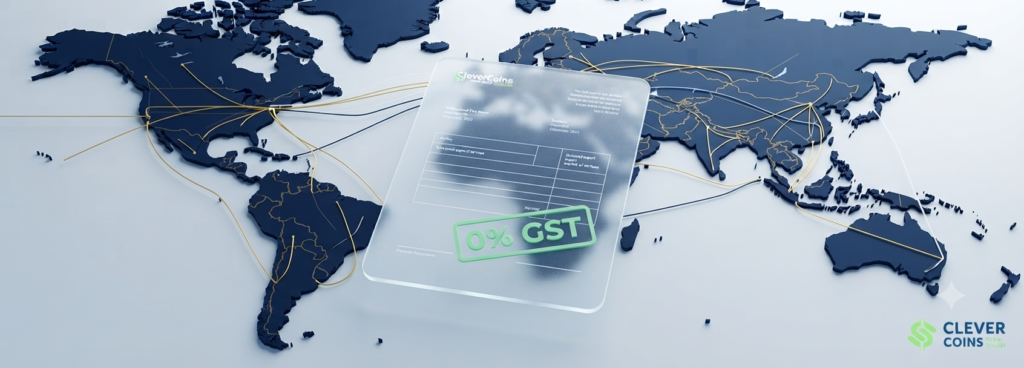
India has rapidly evolved into a global powerhouse for service exports, ranging from IT and software development to consulting, legal advisory, and BPO operations. For businesses expanding globally, navigating the taxation framework is critical. Under the Goods and Services Tax (GST) regime, exports are treated as zero-rated supplies. This means the service itself is tax-free, allowing exporters to either claim refunds on input taxes or supply without paying tax under a Letter of Undertaking (LUT).
In this comprehensive guide, brought to you by CleverCoins, we break down every nuance of GST on the export of services, statutory conditions, documentation requirements, and step-by-step refund mechanisms.
1. What Constitutes an “Export of Services” Under GST?
To claim the benefits of zero-rated supplies, your transaction must strictly fit the legal definition outlined under Section 2(6) of the Integrated Goods and Services Tax (IGST) Act, 2017. If even one condition fails, the transaction will be treated as a domestic supply, attracting local GST rates.
The five mandatory conditions are:
The supplier of service is located in India.
The recipient of service is located outside India.
The place of provision (pop) of service is outside India.
The payment for such service has been received by the supplier in convertible foreign exchange (or in Indian rupees wherever permitted by the RBI).
The supplier of service and the recipient of service are not merely establishments of a distinct person (i.e., they cannot be mere branches of the same legal entity across borders under specific explanations).
2. Determining the “Place of Provision” (PoP)
The cornerstone of international service taxation is figuring out where the service is legally consumed. Governed by Section 13 of the IGST Act, the default rule and exceptions dictate export status:
Default Rule: The place of supply of services shall be the location of the recipient of services. If the recipient’s location is outside India, it clears the export test.
Performance-Based Services: Services like restaurant services, personal grooming, or events physically carried out require the recipient to be present. However, if business-to-business (B2B) services are performed across borders, specific sub-sections apply.
Intermediary Services: Caution: Services rendered by an agent, broker, or intermediary who facilitates the supply of goods or services are not considered exports if the location of the principal or actual service occurs domestically. The PoP for intermediaries is explicitly India.
3. Zero-Rated Supplies: LUT vs. IGST Payment
Exporters have two legal pathways to handle GST compliance on cross-border transactions:
Option A: Export Under Letter of Undertaking (LUT) — Recommended
How it works: You export services without paying IGST by furnishing an LUT electronically on the GST portal (Form GST RFD-11) prior to exporting.
Advantage: Capital is not blocked. You do not pay tax upfront and chase refunds later.
Condition: Valid for one financial year. Must be renewed annually before April 1st.
Option B: Export on Payment of IGST and Claiming Refund
How it works: You raise an invoice charging IGST, pay the tax to the government, and subsequently file a refund claim for the IGST paid on export.
Advantage: Rarely chosen for services unless accumulated input tax credits (ITC) cannot be cleared otherwise. It usually leads to working capital lock-in.
4. Essential Documentation Checklist
Clean documentation protects businesses during audits and accelerates refund approvals. Ensure your billing records feature:
Tax Invoice: Must explicitly state “SUPPLY MEANT FOR EXPORT ON PAYMENT OF IGST” or “SUPPLY MEANT FOR EXPORT UNDER LETTER OF UNDERTAKING (LUT)”.
Client Details: Name, overseas address, and country of the recipient.
Bank Realisation Certificate (BRC) / Foreign Inward Remittance Certificate (FIRC): Proof that foreign currency has landed in your designated authorized dealer (AD) bank account.
Contract/Agreement: Master Services Agreement (MSA) or statement of work defining the scope of international work.
5. Step-by-Step Procedure to Claim GST Refunds on Service Exports
If you have accumulated Input Tax Credit (ITC) because your inputs (software licenses, rent, professional fees) bear GST while your outputs are zero-rated, you are eligible for a refund.
File GSTR-3B and GSTR-1: Ensure matching turnover details are declared accurately in Table 6A of GSTR-1 and GSTR-3B.
Access the GST Portal: Navigate to Services > Refunds > Application for Refund.
Select Refund Type: Choose “Refund of ITC on export of services without payment of tax”.
Compute Maximum Refund Amount: The portal auto-calculates based on the formula:
Maximum Refund=Adjusted Total TurnoverTurnover of Export of Services×Net ITC
Upload Supporting Documents: Attach FIRC/BRC statements, invoices, and self-certified declarations in Form GST RFD-01.
Acknowledgment (RFD-02): Once submitted via DSC or EVC, an ARN is generated.
6. Common Pitfalls and Litigation Traps
Many businesses run into notices from tax authorities due to avoidable errors:
Delayed Realization of Foreign Exchange: The RBI mandates realization within a specific timeframe. Failing to bring funds into India within the stipulated window can convert a zero-rated export into a taxable domestic supply with retrospective interest and penalties.
Mismatch in Turnover: Discrepancies between figures reported in GSTR-1, GSTR-3B, and Income Tax Returns (Form 26AS / P&L foreign receipts) trigger automated scrutiny notices (ASMT-10).
Intermediary Confusion: IT-enabled services (ITeS) providers often mistake back-office support for export, whereas if they act on behalf of an overseas entity to contract third parties, they risk classification as intermediaries.
Conclusion
Managing GST on the export of services does not have to be a bottleneck for your global expansion. By keeping your LUT active, ensuring airtight contracts, maintaining clear FIRC trails, and filing returns meticulously, you can protect your cash flow and stay fully compliant.
Need expert intervention to audit your export structures or clear stuck refunds? Connect with the strategic team at CleverCoins today to turn complex tax codes into your competitive advantage.
- Phone: +91 77389 59862
- Email: client@clevercoins.org
- Address: Ideal Market, Mumbra, Thane-400612.