What Is a Bad Bank?
|
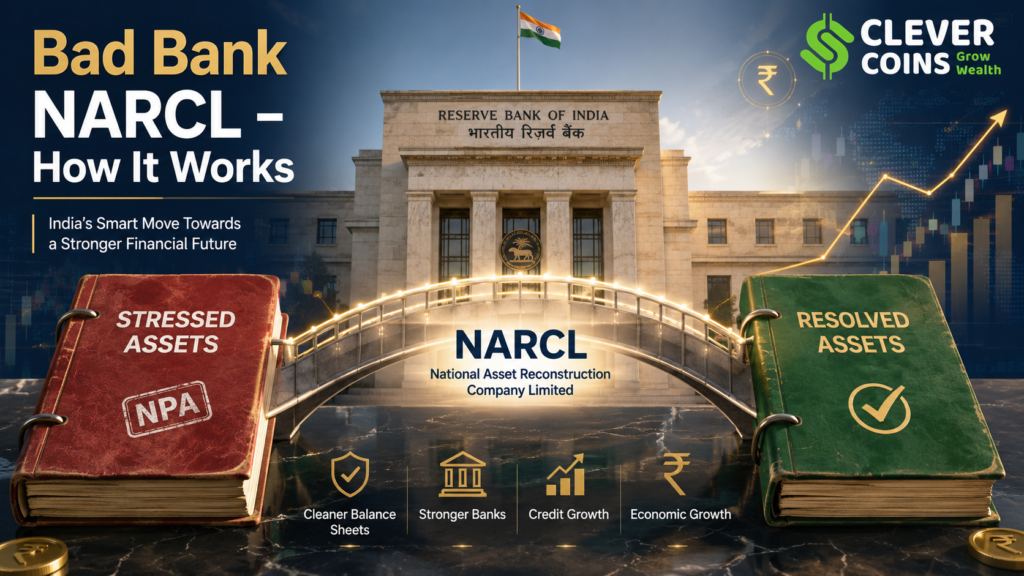
India’s banking sector has long struggled with the burden of Non-Performing Assets (NPAs). To address this, the Government of India established the National Asset Reconstruction Company Limited (NARCL) – popularly known as the Bad Bank – in 2021. By 2026, this institution has become a cornerstone of India’s financial sector reform strategy. |
A Bad Bank is a specialised financial institution created to buy and manage distressed or non-performing loans from commercial banks. The primary goal is to clean up the balance sheets of regular banks so they can focus on fresh lending and economic growth.
In India, the concept was first recommended by the Indian Banks’ Association (IBA) and was formally approved by the Union Cabinet. The Reserve Bank of India (RBI) granted the required licence, and NARCL began operations under the Companies Act, 2013, the SARFAESI Act, 2002, and related banking regulations.
🏛️ What Is NARCL – National Asset Reconstruction Company Limited?
Formation & Legal Structure
NARCL was incorporated as a company under the Companies Act, 2013, and registered as an Asset Reconstruction Company (ARC) under Section 3 of the SARFAESI Act, 2002. It operates under the regulatory oversight of the Reserve Bank of India (RBI).
|
Feature |
Details |
|
Full Name |
National Asset Reconstruction Company Limited (NARCL) |
|
Incorporated |
2021 (operations scaling up through 2026) |
|
Type |
Asset Reconstruction Company (ARC) |
|
Registered Under |
Companies Act, 2013 | SARFAESI Act, 2002 |
|
Regulator |
Reserve Bank of India (RBI) |
|
Shareholding |
Public Sector Banks hold >51% stake |
|
Headquarters |
Mumbai, Maharashtra, India |
|
Partner Entity |
IDRCL (India Debt Resolution Company Limited) |
|
Mandate |
Acquire & resolve NPA accounts above ₹500 crore |
The Two-Entity Model: NARCL + IDRCL
The Indian Bad Bank operates through a unique twin-entity model:
- NARCL (National Asset Reconstruction Company Limited) – acquires the stressed assets from banks.
- IDRCL (India Debt Resolution Company Limited) – manages and resolves the acquired assets for value maximisation.
This dual-structure ensures specialisation: NARCL focuses on acquisition, while IDRCL brings professional management expertise to recover maximum value from distressed assets
⚙️ How Does the Bad Bank (NARCL) Work?
Step-by-Step Working Mechanism
- Banks identify large Non-Performing Assets (NPAs) with outstanding dues of ₹500 crore or more.
- The lending banks agree to transfer these stressed accounts to NARCL by way of a consortium decision.
- NARCL pays 15% of the agreed value in cash to the transferring banks.
- The remaining 85% is paid in the form of Security Receipts (SRs) backed by a Government of India guarantee.
- IDRCL takes over the management of the acquired assets and works towards resolution, restructuring, or recovery.
- Upon successful resolution, the Security Receipts are honoured and the government guarantee, if invoked, is settled.
- Banks receive final payment and their balance sheets get cleaned.
|
Key Principle: NARCL pays 15% cash + 85% in Government-Guaranteed Security Receipts, reducing immediate cash burden while providing strong assurance to the transferring banks. |
The Government Guarantee Mechanism
One of the most significant features of NARCL is the Central Government’s guarantee of ₹30,600 crore (approximately ₹30,600 Crore INR) on the Security Receipts issued by NARCL. This guarantee was extended and remains active as of 2026, giving confidence to banks accepting the Security Receipts.
The guarantee kicks in when:
- NARCL is unable to recover the full value of the stressed asset.
- The Security Receipts mature and the redemption amount falls short of the face value.
The guarantee is valid for 5 years from the date of issuance of Security Receipts, ensuring medium-term certainty for the banking system.
📊 The NPA Problem in India – Why Was NARCL Needed?
Scale of the NPA Crisis
India’s banking system has faced a persistent NPA problem. While the overall Gross NPA (GNPA) ratio has improved from its peak of around 11.5% in FY2018 to approximately 2.8%–3.2% in FY2025-26 (as per latest RBI Financial Stability Reports), the absolute quantum of stressed assets remains massive in value terms.
|
Year / Period |
GNPA Ratio (Approx.) |
|
FY 2017-18 (Peak) |
~11.5% |
|
FY 2020-21 |
~7.5% |
|
FY 2022-23 |
~3.9% |
|
FY 2024-25 |
~2.8% |
|
FY 2025-26 (Projected) |
~2.5%–3.0% |
Source: RBI Financial Stability Reports & Annual Reports (2025-26). Figures are approximate and indicative.
Why Existing Mechanisms Were Not Enough
Before NARCL, India relied on multiple channels to resolve NPAs:
- SARFAESI Act, 2002 – Security enforcement by banks.
- Insolvency and Bankruptcy Code (IBC), 2016 – Corporate insolvency resolution.
- Debt Recovery Tribunals (DRTs) – Recovery through courts.
- Private ARCs (Asset Reconstruction Companies) – Market-based acquisition.
However, these mechanisms faced challenges: long resolution timelines, haircuts exceeding 60–70%, consortium coordination issues, and inadequate capital with private ARCs. NARCL was designed to overcome these bottlenecks with government backing and a streamlined process
⚖️ Legal Framework Governing NARCL in 2026
Key Laws and Regulations
|
Law / Regulation |
Role in NARCL Operations |
|
SARFAESI Act, 2002 |
Provides the legal basis for asset reconstruction companies including NARCL. |
|
Companies Act, 2013 |
Governs NARCL as a corporate entity. |
|
Insolvency & Bankruptcy Code (IBC), 2016 |
Provides an alternative resolution pathway for acquired assets. |
|
RBI Master Directions on ARCs (Updated 2024-25) |
Regulates capital, governance, and operations of NARCL. |
|
SEBI Regulations |
Govern the Security Receipts issued by NARCL. |
|
Prevention of Money Laundering Act (PMLA) |
Compliance requirements for asset transactions. |
|
Central Government Guarantee Notification |
Formalises the ₹30,600 crore Government guarantee. |
RBI Master Directions on ARCs (2024 Amendment)
The RBI updated its Master Directions on Asset Reconstruction Companies in 2024, which NARCL must comply with. Key provisions include:
- Minimum Net Owned Fund (NOF) of ₹300 crore for ARCs.
- Mandatory appointment of a Resolution Manager (RM) for acquired assets.
- Time-bound resolution: assets must be resolved within 8 years (extendable in special cases).
- Enhanced disclosure norms for Security Receipt holders.
- Strict fit-and-proper criteria for directors and key management.
📈 NARCL’s Progress and Performance (2021–2026)
Accounts Acquired and Under Resolution
Since its inception in 2021, NARCL has progressively acquired large NPA accounts from public sector and private sector banks. The focus has been on accounts above ₹500 crore where consortium resolution was complex.
|
Metric |
Status as of 2025-26 (Approx.) |
|
Target NPA Pool (Initial) |
~₹2,00,000 crore (₹2 Lakh Crore) |
|
Accounts Targeted (Phase 1) |
~38 accounts worth ₹82,845 crore |
|
Accounts Transferred (Cumulative) |
Multiple tranches across 2022–2026 |
|
Government Guarantee Utilised |
Partial utilisation; guarantee active |
|
Resolution Mechanism Used |
IBC, SARFAESI, One-Time Settlement (OTS) |
|
IDRCL Management Portfolio |
Actively managed through professional teams |
Note: Exact figures are updated periodically by NARCL. Readers are advised to check the official NARCL website and RBI publications for the most current data.
Sectors with Highest NPA Transfers
- Infrastructure & Power Sector
- Steel & Metals
- Real Estate
- Textiles & Garments
- Telecom
- Engineering & Capital Goods
✅ Advantages of the Bad Bank (NARCL) Model
Benefits for the Banking System
- Balance Sheet Cleansing: Banks can offload stressed assets and improve Capital Adequacy Ratios (CAR).
- Improved Credit Rating: Cleaner balance sheets lead to better credit ratings and lower borrowing costs for banks.
- Fresh Lending Capacity: With NPAs off the books, banks can deploy capital for new productive loans.
- Reduced Provisioning Burden: Banks no longer need to set aside large provisions for transferred NPAs.
- Consolidated Resolution: Instead of each bank handling NPAs individually, NARCL provides a unified, professional approach.
Benefits for the Economy
- Revival of Stressed Companies: Professional resolution can save viable companies and preserve employment.
- Asset Value Recovery: Specialised management by IDRCL can extract higher value than traditional recovery.
- Credit Cycle Improvement: A healthier banking system supports India’s credit growth and GDP expansion.
- Investor Confidence: Government backing of NARCL increases confidence among domestic and foreign investors.
⚠️ Challenges and Criticisms of NARCL
Operational Challenges
- Valuation Disputes: Agreeing on a fair value for distressed assets between NARCL and transferring banks is complex.
- Resolution Timelines: Despite the mandate, resolutions under IBC and other frameworks can stretch beyond projected timelines.
- Haircut Concerns: Banks have resisted transferring assets where the expected haircut (loss on book value) is very high.
- Limited Private Sector Participation: IDRCL’s management capabilities face capacity constraints for a large portfolio.
- Market Perception: Security Receipts, despite government guarantee, are not always seen as liquid instruments.
Structural Concerns
- Moral Hazard Risk: Banks may become less diligent in lending knowing that the government will backstop bad loans.
- Government Fiscal Burden: If NARCL’s recoveries fall short, the ₹30,600 crore guarantee creates a fiscal liability.
- Competitiion with Private ARCs: NARCL’s government advantage may crowd out or discourage private ARC activity.
- Political Economy Issues: Large borrowers with political connections may receive preferential treatment in resolution.
🔄 NARCL vs Private ARCs – Key Differences
|
Parameter |
NARCL (Bad Bank) vs Private ARC |
|
Ownership |
NARCL: Majority PSU banks | Private ARC: Private promoters/investors |
|
Government Guarantee |
NARCL: Yes, ₹30,600 crore GoI guarantee | Private ARC: No government guarantee |
|
Focus |
NARCL: Large accounts ≥ ₹500 crore | Private ARC: Flexible, including smaller accounts |
|
Payment Structure |
NARCL: 15% cash + 85% SRs | Private ARC: Negotiated (typically 15–25% cash) |
|
Resolution Partner |
NARCL: IDRCL | Private ARC: In-house or third-party resolution teams |
|
Regulatory Oversight |
Both: RBI regulated under SARFAESI Act |
|
Scale |
NARCL: Systemic, large-scale | Private ARC: Individual, case-by-case |
|
Examples of Private ARCs |
Edelweiss ARC, JM Financial ARC, Arcil, Phoenix ARC |
📄 Security Receipts – Understanding the Key Instrument
What Are Security Receipts?
Security Receipts (SRs) are instruments issued by an ARC (like NARCL) when it acquires NPAs from banks. Under the SARFAESI Act, 2002, SRs represent the beneficial interest in the trust that holds the acquired assets.
Features of NARCL Security Receipts
- Denomination: SRs are issued for 85% of the agreed acquisition value.
- Government Guarantee: Backed by Central Government guarantee of ₹30,600 crore for 5 years.
- Regulated by SEBI: Secondary market trading of SRs is regulated by SEBI.
- Redemption: Redeemed upon successful resolution of the underlying assets.
- Accounting Treatment: Banks holding SRs must mark them to market (MTM) based on recovery prospects.
🇮🇳 Impact of NARCL on the Indian Economy in 2026
Macro-Economic Impact
The establishment and operation of NARCL has contributed to measurable improvements in India’s banking sector health:
- GNPA Ratio Improvement: India’s banking system GNPA ratio has declined significantly, from double digits at peak to below 3% by FY2025-26.
- PSU Bank Profitability: Public sector banks have recorded multi-year high profits in FY2024-25, partly due to reduced NPA burden.
- Credit Growth: Bank credit growth has been robust at 14–16% year-on-year in FY2025-26.
- Capital Adequacy: PSU banks’ Capital to Risk-weighted Assets Ratio (CRAR) improved significantly.
Impact on Key Stakeholders
|
Stakeholder |
Impact of NARCL |
|
Public Sector Banks |
Cleaner balance sheets, higher profits, improved ratings |
|
Government of India |
Reduced fiscal burden from bank recapitalisation; guarantee risk manageable |
|
Borrowers (Stressed Companies) |
Access to structured resolution without immediate liquidation |
|
Economy |
More credit available for productive sectors; revival of stressed assets |
|
Investors |
Greater confidence in Indian banking stocks and bonds |
|
RBI |
Improved systemic financial stability indicators |
🌍 Global Comparison – Bad Banks Around the World
India is not alone in creating a Bad Bank. Many countries have used similar mechanisms to resolve banking crises:
|
Country / Region |
Bad Bank Model |
|
USA |
TARP (Troubled Asset Relief Program) during 2008 financial crisis |
|
Sweden |
Securum – created during 1990s banking crisis; highly successful model |
|
Ireland |
NAMA (National Asset Management Agency) – post-2008 property crisis |
|
South Korea |
KAMCO – post-1997 Asian financial crisis |
|
Spain |
SAREB – post-2012 European debt crisis |
|
China |
AMCs (Asset Management Companies) – created in 1999 for state bank NPAs |
|
India |
NARCL (IDRCL) – 2021 onwards; specific to consortium large NPAs |
India’s model draws inspiration from global experience but is tailored to India’s unique legal and regulatory environment under SARFAESI, IBC, and RBI regulations.
🔭 Future Outlook of NARCL (2026 and Beyond)
Priorities for 2026–2028
- Accelerating resolution of already-acquired accounts through IBC and One-Time Settlements.
- Expanding the scope to include medium-sized NPA accounts (below ₹500 crore) if warranted.
- Strengthening IDRCL’s management capacity with industry expertise.
- Technology Integration: Using AI and data analytics for better asset valuation and recovery forecasting.
- Potential NARCL IPO: Discussions about eventual public listing to enhance transparency and capital.
- Coordination with SEBI for a more liquid Security Receipts market.
Expert Opinion & RBI Stance (2026)
The RBI’s Financial Stability Report (latest edition) acknowledges NARCL as a key institutional mechanism supporting the health of the Indian banking system. However, the RBI has also emphasised the importance of:
- Preventing moral hazard through strong credit underwriting standards.
- Ensuring that NARCL does not become a dumping ground for unresolvable assets.
- Maintaining transparency in Security Receipts valuation.
📝 Conclusion
|
The Bad Bank (NARCL) represents one of India’s most significant financial sector reforms of the decade. By providing a government-backed mechanism to resolve large, complex NPAs, NARCL has helped clean up the banking system, improved credit availability, and strengthened India’s financial stability. While challenges remain – particularly around resolution timelines and moral hazard – the institution has demonstrated its value in India’s journey toward becoming a ₹5 crore crore (₹500 Lakh Crore / $6 Trillion) economy. |
For individuals, businesses, and investors, understanding NARCL is crucial to grasping the dynamics of Indian banking, credit markets, and economic policy in 2026 and beyond.