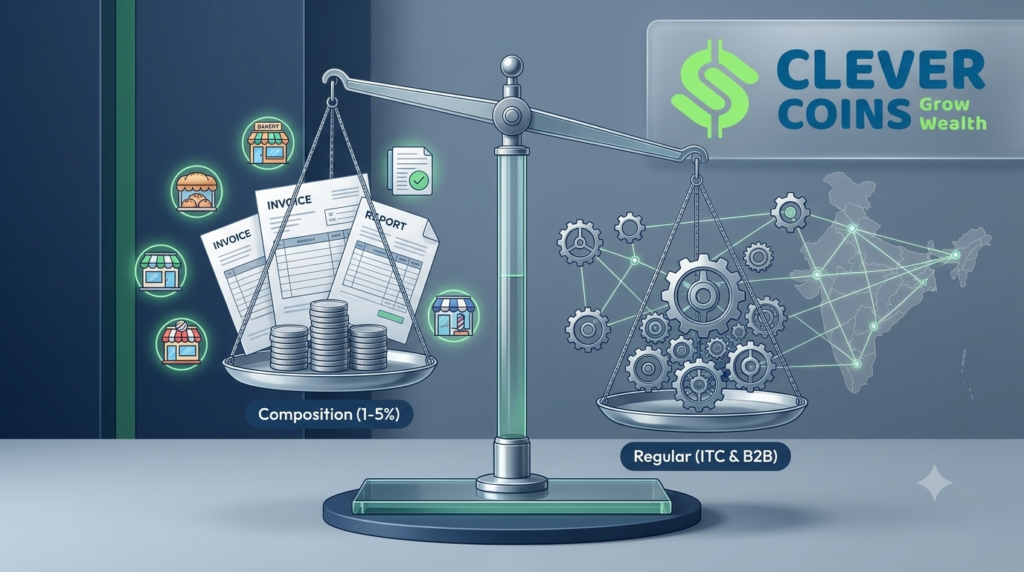
Composition Scheme vs Regular Scheme: Which GST Scheme is Better for MSMEs?
Micro, Small, and Medium Enterprises (MSMEs) form the backbone of the Indian economy, driving innovation, generating local employment, and contributing significantly to exports and the GDP. However, navigating India’s indirect tax regime can often feel like walking through a labyrinth. When registering under the Goods and Services Tax (GST) framework, one of the most critical decisions an entrepreneur faces is choosing between the Composition Scheme and the Regular Scheme.
Choosing the wrong track can suffocate cash flow, increase compliance overheads, or isolate you from lucrative B2B supply chains. This comprehensive guide breaks down every facet of the GST Composition Scheme versus the Regular Scheme, analyzing eligibility, tax rates, Input Tax Credit (ITC) dynamics, compliance burdens, and strategic suitability so you can make an informed choice for your enterprise.
1. Understanding the Fundamentals: What Are GST Schemes?
Before diving into a comparative analysis, let’s establish what each scheme represents in the eyes of the law.
The Regular Scheme: This is the default framework under the GST law. It is designed for businesses of all sizes, from scaling startups to large corporations. Under this scheme, businesses collect GST from their customers, claim Input Tax Credit (ITC) on their business purchases, and file regular monthly or quarterly returns. There is no turnover ceiling restricting entry.
The Composition Scheme: Introduced as a relief measure under Section 10 of the CGST Act, this scheme is tailor-made for small taxpayers, local retailers, and specific service providers. It allows eligible businesses to pay tax at a flat, nominal percentage of their aggregate turnover and shed the heavy burden of complex, recurring filings. However, it comes with strict operational guardrails.
2. Core Comparison Parameters: Head-to-Head
To understand which scheme serves your business model better, let’s evaluate them across six critical operational metrics:
A. Turnover Thresholds and Eligibility
Regular Scheme: There is no upper limit on turnover. Any business can—and once crossing the statutory threshold (₹40 lakhs for goods, ₹20 lakhs for services in most states) must—register under this scheme.
Composition Scheme: Strictly limited to small taxpayers. For manufacturers and traders, the aggregate annual turnover threshold is ₹1.5 Crores (reduced to ₹75 Lakhs for special category states like Himachal Pradesh and northeastern states). For eligible service providers or mixed suppliers under Section 10(2A), the threshold is ₹50 Lakhs.
B. Tax Rates and Calculation Methodology
Regular Scheme: Tax rates vary according to the classification of goods and services, spanning multiple tax slabs (0%, 5%, 12%, 18%, and 28%). Tax is applied to the value of the outward supply.
Composition Scheme: Tax is calculated as a flat percentage of the aggregate turnover, not on individual transaction profits or item slabs:
Manufacturers and Traders: 1% (0.5% CGST + 0.5% SGST)
Restaurants (not serving alcohol): 5% (2.5% CGST + 2.5% SGST)
Eligible Service Providers: 6% (3% CGST + 3% SGST)
C. The Deciding Factor: Input Tax Credit (ITC)
Regular Scheme: Full ITC Availability. You can offset the GST paid on your raw materials, capital goods, and business services against the GST collected from your customers. This eliminates the cascading effect of taxes (“tax on tax”).
Composition Scheme: Zero ITC. Composition dealers cannot claim any Input Tax Credit on their purchases. Furthermore, the GST paid on purchases becomes a direct business expense, increasing the cost base of goods or services.
D. Invoicing and Tax Collection Rights
Regular Scheme: Taxpayers issue a Tax Invoice. They are legally authorized to collect GST explicitly from their customers.
Composition Scheme: Taxpayers cannot collect GST from customers. They must pay the tax out of their own pocket and issue a Bill of Supply instead of a tax invoice. The bill must prominently display the words: “Composition taxable person, not eligible to collect tax on supplies.”
E. Geographic and Inter-State Boundaries
Regular Scheme: Full freedom to conduct inter-state sales, branch transfers, and exports without territorial restrictions.
Composition Scheme: Strictly intra-state. Composition dealers cannot make outward inter-state supplies of goods or services. Procuring goods from other states is allowed, but selling across state borders disqualifies the business from the scheme. Additionally, selling through e-commerce aggregators who collect TCS (Tax Collected at Source) is generally prohibited.
F. Compliance Burden and Return Filing
Regular Scheme: High compliance frequency. Requires filing monthly outward supplies (GSTR-1), inward matching, and monthly summary returns (GSTR-3B), alongside annual returns (GSTR-9).
Composition Scheme: Simplified compliance. Requires filing a simple quarterly tax payment statement (CMP-08) and a comprehensive annual return (GSTR-4).
3. Detailed Comparison Matrix
| Parameter | Regular GST Scheme | Composition GST Scheme |
| Eligibility Turnover | No limit (mandatory above ₹20L/₹40L) | Up to ₹1.5 Crore (goods) / ₹50 Lakh (services) |
| Tax Collection | Can collect GST from buyers | Cannot collect GST from buyers |
| Input Tax Credit (ITC) | Available to pass on and claim | Not available under any circumstance |
| Invoice Type | Tax Invoice | Bill of Supply |
| Geographic Scope | Inter-state and international trade allowed | Restricted to intra-state (within state) sales only |
| Return Filing Frequency | Monthly (GSTR-1, GSTR-3B) + Annual | Quarterly (CMP-08) + Annual (GSTR-4) |
| E-commerce Sales | Allowed without restrictions | Restricted (cannot sell via TCS-collecting e-commerce portals) |
4. Deep-Dive Scenarios: When to Choose Which?
Choosing the right scheme is a mathematical and strategic exercise. Let’s analyze real-world scenarios to see which path triumphs.
Scenario A: The Local Retail Kirana Store or Neighborhood Cafe
Profile: Annual turnover of ₹60 Lakhs. Customer base consists entirely of B2C retail consumers (end-users). Purchases local goods with minimal input tax embedded.
The Verdict: Composition Scheme Wins. Since end-consumers do not care about ITC, paying a flat 1% or 5% tax without maintaining complex monthly invoices saves immense accounting overhead and preserves working capital.
Scenario B: The B2B Manufacturing Startup Supplying Large Corporations
Profile: Annual turnover of ₹90 Lakhs. Supplies sub-components to large automotive and tech assemblers. Purchases heavy raw materials attracting 18% GST.
The Verdict: Regular Scheme Wins hands down. If this startup chooses the composition scheme, it cannot pass on ITC. Its B2B corporate clients will refuse to buy from it because they cannot claim tax credits on their purchases. Furthermore, the 18% tax paid on raw materials would become a dead cost, crushing profit margins.
5. Strategic Pitfalls and Hidden Traps to Avoid
The Illusion of the Low Tax Rate: A 1% rate sounds attractive, but if your business has high input costs bearing 12% or 18% GST, losing ITC can cost you more than saving on output tax.
Accidental Inter-state Breaches: Many small business owners execute a single online or out-of-state transaction without realizing it immediately disqualifies them from the composition scheme, attracting heavy penalties and retrospective regular taxation demands.
PENALTY on Wrong Invoicing: Issuing a tax invoice or collecting explicit tax while registered under the composition scheme is a punishable offense under GST law.
6. Conclusion and Expert Recommendation
There is no universal “better” scheme; there is only the scheme that fits your business architecture. If your venture is small-scale, localized, hyper-focused on retail B2C consumers, and burdened by compliance costs, the Composition Scheme offers a peaceful and economical runway. However, if you plan to scale across state borders, deal with corporate B2B clients, or tap into heavy input tax chains, the Regular Scheme is your essential highway to growth.
Need help analyzing your turnover figures, calculating ITC trade-offs, or executing smooth scheme transitions? Consult the experts at CleverCoins to optimize your tax framework today.
Lorem ipsum dolor sit amet, consectetur adipiscing elit. Ut elit tellus, luctus nec ullamcorper mattis, pulvinar dapibus leo.