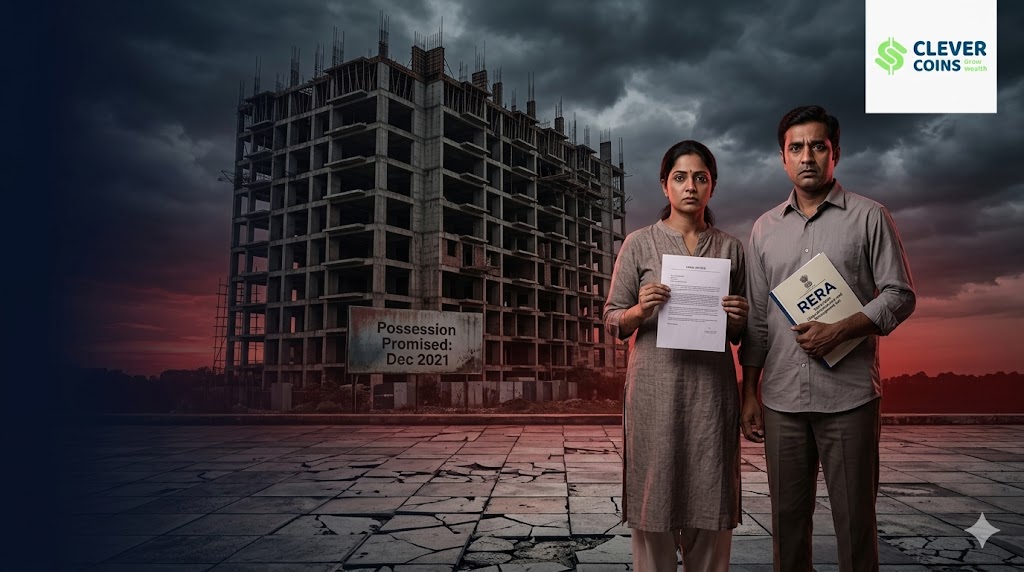
Buying a home in India is often the single largest financial decision of a person’s life. Dreams of a new home — carefully planned, earnestly saved for, and patiently awaited — are shattered when builders fail to deliver possession on time. Delayed possession is one of the most rampant and distressing problems faced by Indian homebuyers, especially in the residential under-construction segment.
If your builder has missed the promised possession date, know this: you are not powerless. Indian law — through multiple statutes and judicial forums — provides homebuyers with powerful, time-tested legal remedies to seek compensation, refunds, and accountability from errant developers.
This comprehensive guide covers every legal remedy available to homebuyers suffering from delayed possession in India — from RERA complaints and consumer courts to NCLT insolvency proceedings and civil suits. Whether your project is delayed by 6 months or 6 years, this guide will tell you exactly what you can do, where to go, and what to expect.
Important: Delayed possession is not just a contractual inconvenience — it is a legal wrong for which builders are liable to pay interest, compensation, and even face criminal consequences under Indian law.
1. Understanding Delayed Possession: The Scale of the Problem
1.1 How Serious is the Problem?
India’s real estate sector has historically been plagued by project delays. According to industry data, as of 2024, over 4.5 lakh residential units across India’s top 7 cities are delayed by more than 3 years. Cities like NCR (Delhi-Gurgaon-Noida), Mumbai Metropolitan Region, Pune, and Bengaluru account for the lion’s share of these delays.
Homebuyers who have paid 80–100% of the property price often wait years in rented accommodation, paying EMIs on home loans while the builder’s project remains stalled. The financial, emotional, and physical toll is immense.
1.2 What Constitutes ‘Delayed Possession’?
Delayed possession occurs when a builder/developer fails to hand over possession of a property (flat, villa, commercial unit) to the buyer on or before the date specified in the:
- Sale Agreement / Agreement for Sale
- Builder-Buyer Agreement (BBA)
- RERA-registered project details
- Allotment Letter issued by the developer
Even if the agreement contains a ‘force majeure’ or ‘grace period’ clause (typically 6 to 12 months), delays beyond the grace period give the buyer a right to claim remedies.
1.3 Common Reasons Builders Cite for Delay
- Lack of construction finance / fund diversion
- Government approvals and clearance delays
- Labour shortage (especially post-pandemic)
- Legal disputes over land title
- Market slowdown and unsold inventory
- Change in project design or scope
- Force majeure events (floods, COVID, etc.)
While some causes may be genuine, RERA and courts have consistently held that delays — regardless of reason — entitle buyers to compensation.
2. Your Rights as a Homebuyer: Legal Framework
Indian homebuyers have rights under multiple laws. Understanding the legal framework helps you choose the right remedy:
|
Law / Forum |
Key Right |
Best For |
|
RERA, 2016 |
Interest on delay, refund, compensation |
Ongoing or stalled under-construction projects |
|
Consumer Protection Act, 2019 |
Compensation for deficiency of service, mental agony |
All property buyers; quicker for smaller amounts |
|
IBC / NCLT, 2016 |
Refund as financial creditor during insolvency |
Builder declared insolvent or on verge of bankruptcy |
|
Civil Courts |
Specific performance, damages, injunction |
Complex disputes; breach of contract claims |
|
Section 420 IPC / BNS |
Criminal complaint for fraud and cheating |
Clear cases of misrepresentation and fraud by builder |
|
Writ Petition (HC/SC) |
Systemic relief, project stalled due to govt. issues |
Mass buyer cases; policy-level intervention needed |
3. Remedy 1: RERA Complaint — The Fastest & Most Effective Route
The Real Estate (Regulation and Development) Act, 2016 (RERA) is the most powerful and most accessible remedy for delayed possession in India. It is specifically designed for real estate disputes and provides a time-bound, online grievance mechanism.
3.1 What RERA Guarantees on Possession
Under Section 18 of RERA, if a developer fails to hand over possession on the date specified in the agreement, the buyer is entitled to:
- Option A — FULL REFUND: A full refund of all amounts paid along with interest at the rate prescribed by the state (typically SBI MCLR + 2%), calculated from the date of investment to the date of actual refund.
- Option B — STAY WITH PROJECT + COMPENSATION: The buyer may choose to stay in the project and receive monthly interest compensation for every month of delay until possession is given.
3.2 Which RERA Authority to Approach?
File your complaint with the RERA authority of the state where the project is located — NOT your home state. For example, if the project is in Pune, file with MahaRERA even if you live in Bangalore.
3.3 How to File a RERA Complaint — Step-by-Step
- Visit the official state RERA portal (e.g., maharera.mahaonline.gov.in, up-rera.in)
- Register as a complainant (buyer) on the portal
- Search and verify the project’s RERA registration number
- Click ‘File Complaint’ and fill in the complaint form
- Upload supporting documents (agreement, payment receipts, possession letter, email correspondence)
- Pay the prescribed complaint fee (typically Rs. 1,000 to Rs. 5,000)
- Submit the complaint — you will receive a complaint number for tracking
- Attend hearings (in person or via video conferencing) before the RERA adjudicating officer
3.4 Documents Required for RERA Complaint
- Registered Sale Agreement / Builder-Buyer Agreement
- All payment receipts and bank statements showing amounts paid
- Demand letters and builder’s communications
- Allotment letter / possession letter (if issued)
- Home loan sanction letter and EMI statements (if applicable)
- Builder’s promotional materials / brochures showing possession date
- Proof of KYC (Aadhaar, PAN, passport)
- Any correspondence showing delay — emails, WhatsApp messages, legal notices
3.5 Timelines & Compensation Under RERA
The RERA authority must adjudicate and pass an order within 60 days of filing the complaint (extendable with recorded reasons). Interest rates typically range from 9% to 11.5% per annum on the amount paid, compounded monthly — making RERA compensation extremely meaningful for buyers who have invested large sums.
3.6 RERA Limitation Period
There is no specific limitation period prescribed under RERA for filing complaints. However, courts have held that complaints should be filed within a reasonable time. As a best practice, file within 3 years of the cause of action (date of default).
Pro Tip: Even if the possession has been partially given or an OC has been received, you can still file a RERA complaint for the delay period. RERA remedies are not extinguished merely by taking possession.
4. Remedy 2: Consumer Forum / National Consumer Disputes Redressal Commission (NCDRC)
Long before RERA, the Consumer Protection Act was the primary recourse for delayed possession victims. Even after RERA, consumer forums remain a valid and effective alternative — especially for projects not covered under RERA (pre-2016 projects) or for seeking higher compensation for mental agony and harassment.
4.1 Is a Homebuyer a ‘Consumer’ Under the Act?
Yes. The Supreme Court of India has repeatedly held that a homebuyer who purchases a flat for residential purposes qualifies as a ‘consumer’ under the Consumer Protection Act, and a builder/developer providing construction services is a ‘service provider.’ Deficiency in service — including delayed possession — is actionable under the Act.
4.2 Which Consumer Forum to Approach?
|
Forum |
Pecuniary Jurisdiction |
Level |
|
District Consumer Commission |
Up to Rs. 50 Lakh |
District Level |
|
State Consumer Commission |
Rs. 50 Lakh to Rs. 2 Crore |
State Level |
|
National Consumer Commission (NCDRC) |
Above Rs. 2 Crore |
National Level (New Delhi) |
4.3 What Relief Can You Claim?
- Refund of entire amount paid with interest
- Compensation for mental agony and harassment (Rs. 50,000 to Rs. 5 lakh or more based on facts)
- Compensation for rent paid during delay period
- Cost of litigation
- Specific direction to the builder to complete the project and handover possession
4.4 Consumer Court vs. RERA — Key Differences
A buyer can choose either forum, or in certain cases both (for different reliefs). RERA is faster and more specialised for real estate; consumer courts allow higher compensation for mental agony. Supreme Court and NCDRC have held that RERA and consumer forums are concurrent and non-exclusive.
4.5 Limitation Period
A consumer complaint must be filed within 2 years from the date of the cause of action (i.e., the date possession was due). Courts have condoned delay in genuine cases, but it is best to file promptly.
5. Remedy 3: Insolvency Proceedings Under IBC (NCLT)
The Insolvency and Bankruptcy Code, 2016 (IBC) introduced a game-changing provision for homebuyers: the right to be treated as ‘Financial Creditors’ of a real estate developer. This was inserted by the Insolvency and Bankruptcy Code (Second Amendment) Act, 2018, after the landmark Chitra Sharma vs. Union of India judgment by the Supreme Court.
5.1 When Does This Apply?
If a real estate developer is financially distressed, unable to pay its debts, or has completely abandoned your project, you can initiate or join an insolvency proceeding under the IBC before the National Company Law Tribunal (NCLT).
5.2 Who Can File?
Under Section 7 of the IBC, a single financial creditor (including a homebuyer) or a group of at least 100 allottees (or 10% of total allottees, whichever is lower) can file an application before NCLT to initiate Corporate Insolvency Resolution Process (CIRP) against the developer.
5.3 What Happens After Filing?
- NCLT admits the application and declares a moratorium on all legal proceedings against the builder
- An Interim Resolution Professional (IRP) is appointed to manage the developer company
- A Committee of Creditors (CoC) is formed — homebuyers are part of this committee
- A resolution plan is invited from potential investors to take over and complete the project
- If no viable plan is found within 330 days, the company may be liquidated
5.4 Homebuyer Protections Under IBC
- Homebuyers have voting rights in the Committee of Creditors proportional to their claims
- Homebuyers can vote to approve or reject resolution plans
- Under Section 29A, promoters/directors with default history are barred from submitting resolution plans
- Supreme Court in Pioneer Urban Land & Infrastructure case confirmed homebuyers’ financial creditor status
5.5 Pros and Cons of IBC Route
- Pros: Strongest legal pressure on developers; can result in project completion under new management
- Pros: Provides financial creditor status with priority in distribution
- Cons: Lengthy process (can take 2–5 years); uncertain outcome for individual buyers
- Cons: Buyer may receive only partial amount after liquidation waterfall
- Cons: Not ideal if you want possession of your specific unit quickly
6. Remedy 4: Civil Suit for Specific Performance or Damages
A civil suit under the Specific Relief Act, 1963 and the Contract Act, 1872 is the traditional legal remedy and remains available — though it is slower and more expensive compared to RERA or consumer courts.
6.1 Specific Performance Suit
Under Section 10 of the Specific Relief Act (amended in 2018, making specific performance ordinarily available), a buyer can sue the builder for specific performance — i.e., for a court order directing the builder to complete construction and hand over possession of the specific flat booked by the buyer.
The 2018 amendment removed the court’s discretion to refuse specific performance, making it a right of the buyer in most cases. This is particularly useful when buyers don’t want a refund — they want their flat.
6.2 Suit for Damages
A buyer can also file a civil suit claiming:
- Liquidated damages as per the Builder-Buyer Agreement
- General damages for breach of contract
- Consequential damages — rent paid during delay, interest on home loan during delay, loss of rental income
- Special damages in cases of proven fraud or misrepresentation
6.3 Injunction Relief
If the builder is about to sell the same flat to a third party, transfer assets, or divert funds, a buyer can seek an interim injunction from the civil court to freeze those transactions while the main suit is pending.
6.4 Drawbacks of Civil Suits
- Extremely slow — civil suits in India can take 5–15 years for final disposal
- High litigation costs — advocate fees, court fees, process fees
- Requires physical presence in court or continuous attorney engagement
- Not recommended as the primary remedy when RERA or consumer forums are available
- Best used concurrently with RERA for specific performance or injunctions not available under RERA
7. Remedy 5: Criminal Complaint — Cheating and Fraud
In cases where the builder’s conduct amounts to criminal fraud, cheating, or misappropriation of buyer funds, a criminal complaint is a powerful additional weapon.
7.1 Applicable Provisions
- Section 420 IPC (now Section 318 BNS) — Cheating: If the builder made false promises about possession date, amenities, or approvals with dishonest intent
- Section 406 IPC (now Section 316 BNS) — Criminal Breach of Trust: If the builder was entrusted with buyer’s funds and misappropriated them
- Section 415 IPC (now Section 319 BNS) — Cheating by personation or misrepresentation
- RERA Section 59 — Making false statements in advertisements
7.2 Where to File
- Local Police Station (FIR): File an FIR at the police station having jurisdiction over the project location
- Economic Offences Wing (EOW): For large-scale fraud involving multiple buyers — the EOW of the state police is better equipped
- CBI: In rare cases of national-level real estate fraud
- Court Complaint under Section 200 CrPC (now Section 223 BNSS) if police refuses to register FIR
7.3 Effect of Criminal Complaint
Filing a criminal complaint creates significant pressure on developers and their promoters — as criminal liability is personal and cannot be insured against. Many builders settle civil dues and provide possession upon receipt of a well-founded criminal notice or FIR. Criminal proceedings also run concurrently with civil and RERA proceedings.
Note: Criminal complaints should only be filed when there is clear evidence of fraudulent intent or misappropriation. Consult a criminal lawyer before filing an FIR.
8. Remedy 6: Writ Petition Before High Court / Supreme Court
In cases involving systemic project stalling — often due to government inaction, regulatory failures, or issues with multiple projects of the same developer — homebuyers can approach the High Court or the Supreme Court by way of a Writ Petition under Articles 226 and 32 of the Constitution of India.
8.1 When Are Writ Petitions Effective?
- Government authorities (RERA, municipal bodies, housing boards) are not acting on complaints
- The delay is partly due to government approvals, NOCs, or policy failures
- Multiple buyers in the same project want collective, enforceable relief
- The developer is politically connected and local forums are ineffective
- Environmental or forest clearance disputes are causing delays
8.2 Notable Precedents
The Supreme Court of India has suo moto taken cognisance of mass homebuyer distress in cases like Jaypee Infratech, Amrapali Group, and Unitech — directing refunds, project takeovers by NBCC (National Buildings Construction Corporation), and criminal investigations. These cases established that homebuyers’ fundamental rights to housing can be enforced through constitutional courts.
9. Choosing the Right Forum: A Decision Guide
|
Your Situation |
Best Primary Remedy |
Secondary Remedy |
Speed |
Cost |
|
RERA project, delay < 3 yrs, want possession |
RERA Complaint |
Consumer Forum |
Fast (3–12 mo) |
Low |
|
Want refund with interest |
RERA Section 18 |
NCDRC |
Fast |
Low |
|
Builder bankrupt/insolvent |
NCLT under IBC |
RERA + Consumer |
Medium |
Medium |
|
Pre-2016 project, no RERA |
Consumer Forum |
Civil Suit |
Medium |
Medium |
|
Mass fraud, 100+ buyers |
NCLT / HC Writ |
EOW Criminal |
Variable |
Low-Med |
|
Want flat, not refund |
Specific Performance |
RERA + Consumer |
Slow |
High |
|
Clear fraud/cheating |
RERA + Criminal FIR |
Consumer Court |
Variable |
Low |
10. Pre-Legal Steps: What to Do Before Filing a Case
Before you approach any legal forum, ensure you have taken the following steps. They strengthen your case and often lead to settlement without litigation:
10.1 Send a Legal Notice
A formal legal notice sent via registered post (AD) or email by a lawyer puts the builder on notice and creates a legal record. It must:
- Specify the possession date as per agreement
- State the period of delay clearly
- Demand possession within 30 days or refund with interest
- Reserve the right to initiate all legal proceedings
Many developers, especially listed companies, settle upon receipt of a strong legal notice to avoid public litigation and reputational damage.
10.2 Collect and Preserve Evidence
- Take screenshots of all WhatsApp messages and email correspondence with the builder
- Download your payment receipts and preserve originals
- Save the original Sale Agreement and any addendums
- Preserve any builder emails promising revised possession dates
- Keep records of rent paid and home loan EMI payment during delay
- Save the builder’s website, advertisements, and brochures
10.3 Join a Buyer’s Association
Most large stalled projects have organised buyer associations — on WhatsApp, RWA platforms, or dedicated forums. Joining these groups provides:
- Shared legal strategy and cost splitting
- Collective complaint filing (stronger position before RERA/NCLT)
- Access to project information and documents
- Media and political pressure mechanism
10.4 Check for Bank Linkage
If your home loan was disbursed by a bank to the developer under a Tripartite Agreement, you can involve your bank — banks are co-signatories to the project and have a duty to ensure construction progress. Report the delay to your lending bank and ask them to invoke their security interest.
11. Calculating Your Compensation — What You Are Entitled To
11.1 Under RERA
Interest rate: SBI’s Marginal Cost of Lending Rate (MCLR) + 2% (varies by state). Calculated on the total amount paid, from the date of each payment to the date of actual refund/possession. On an investment of Rs. 50 lakh with a 3-year delay, RERA compensation can easily exceed Rs. 12–18 lakh.
11.2 Under Consumer Protection Act
No fixed rate — the forum awards compensation based on:
- Interest on amount paid (at 9–12% p.a. typically)
- Rent paid during the delay period
- Mental agony: Rs. 50,000 to Rs. 5,00,000 or more
- Litigation costs: Rs. 25,000 to Rs. 1,00,000
11.3 Sample Calculation (Illustrative)
|
Parameter |
Value |
|
Total Amount Paid |
Rs. 60,00,000 |
|
Agreed Possession Date |
December 2021 |
|
Actual / Expected Possession |
December 2024 |
|
Delay |
36 months (3 years) |
|
RERA Interest Rate (assumed) |
10.5% p.a. |
|
Interest on Rs. 60 lakh for 3 years |
~Rs. 18,90,000 |
|
Rent paid during delay (Rs. 25,000/mo) |
Rs. 9,00,000 |
|
Mental Agony (Consumer Forum) |
Rs. 2,00,000 |
|
Total Potential Compensation |
~Rs. 29,90,000+ |
Disclaimer: The above is illustrative only and actual compensation depends on the specific facts, forum, and applicable interest rates.
12. Key Supreme Court & NCDRC Judgments on Delayed Possession
Indian courts have consistently ruled in favour of homebuyers in delayed possession cases. Here are landmark judgments that establish clear legal principles:
12.1 Lucknow Development Authority v. M.K. Gupta (1994) — SC
The Supreme Court held that housing construction and sale by public/private bodies is a ‘service’ under the Consumer Protection Act, paving the way for consumer complaints against builders.
12.2 DLF Home Developers v. Capital Greens Flat Buyers (2020) — SC
The Supreme Court upheld NCDRC’s order awarding compensation for delayed possession, holding that developers cannot hide behind one-sided clauses in builder-buyer agreements. Unfair contract terms are not binding on buyers.
12.3 Pioneer Urban Land & Infrastructure Ltd. v. Union of India (2019) — SC
A 9-judge Constitutional Bench held that homebuyers are ‘financial creditors’ under IBC Section 5(8)(f), allowing them to initiate CIRP against insolvent developers. This judgment transformed buyer rights in insolvency scenarios.
12.4 Kolkata West International City v. Devasis Rudra (2019) — SC
The Supreme Court held that where possession has not been offered on time and the buyer opts for a refund, the builder must pay interest from the date of payment — not just from the date of the complaint.
12.5 Wg. Cdr. Arifur Rahman v. DLF Southern Homes (2020) — SC
The court held that a buyer cannot be compelled to take possession without Occupancy Certificate. Handing over possession without OC is itself a deficiency in service entitling the buyer to compensation.
12.6 Amrapali Group Case — In Re: Housing & Urban Development (2019) — SC
In this landmark suo moto case, the Supreme Court cancelled the registration of Amrapali Group’s companies, directed NBCC to complete stalled projects, and referred promoters for criminal investigation — setting a precedent for handling large-scale builder fraud.
13. What If the Builder Offers a Revised Possession Date?
Builders frequently send ‘revised possession date letters’ extending the timeline by 6, 12, or 24 months. Here is how to handle this situation:
- Do NOT sign any revised agreement or addendum without legal advice — signing can be interpreted as waiving your right to claim interest for the original delay period
- You can accept the revised possession date while explicitly reserving your right to compensation for the delay — state this in writing
- Use the revised date as a trigger to file your RERA complaint if already past
- A revised possession date letter is admissible evidence in RERA/consumer forum proceedings — it amounts to a builder admission of delay
- Do not cancel your booking under builder pressure without taking legal advice on refund entitlement
Important: Receiving a revised possession date letter does NOT mean you have accepted the delay. You retain full rights to claim compensation for the original delay period.
14. What If the Builder Has Obtained Occupancy Certificate (OC)?
Obtaining an OC does not extinguish your right to compensation for the delay that already occurred. Key points:
- If the OC is obtained years after the promised possession date, you are entitled to interest for the delay period regardless
- Possession offered without OC is legally deficient — you are not obligated to take possession without OC
- Acceptance of possession under protest (stating you are not waiving compensation rights) is a valid legal strategy
- Always get OC copy before taking possession — do not accept ‘OC will come soon’ promises
- Fire NOC, water connection certificate, electricity connection — these must accompany OC for valid possession
15. Practical Tips: Maximising Your Chances of Success
- File as early as possible — delay in filing weakens your case and reduces recoverable compensation
- Hire a lawyer specialised in real estate / RERA — a general practice lawyer may not know RERA procedures
- File both RERA and consumer forum complaints simultaneously for different reliefs — they are concurrent
- Calculate and document your full loss — interest, rent, loan EMI, mental suffering — before filing
- Preserve digital evidence meticulously — WhatsApp, emails, builder portal login screenshots
- Join the project’s buyer association — collective action has historically achieved faster results
- Do not engage in verbal negotiations without written records — always follow up oral discussions with email
- If you have a home loan, inform your lender about the delay — some banks have dedicated resolution cells
- Check if the developer is listed (stock exchange) — SEBI complaints and stock exchange grievances add pressure
- Keep monitoring the RERA portal for your project — complaints filed by other buyers are visible and useful evidence
16. Conclusion: You Have More Power Than You Think
Delayed possession is not a dead end — it is a trigger for comprehensive legal action. India’s legal framework, particularly after RERA and the IBC amendments, has tilted significantly in favour of homebuyers. The days when builders could delay indefinitely with impunity are over.
Whether you choose to file a RERA complaint, approach the consumer forum, or join an insolvency proceeding before NCLT, you have meaningful legal options — each with real financial outcomes. The key is to act promptly, document thoroughly, and engage qualified legal professionals.
Your dream home deserves to be delivered on time. And if it isn’t — the law is on your side.
Final Reminder: Always consult a RERA-qualified lawyer before taking any legal step. This blog is for informational purposes only and does not constitute legal advice.