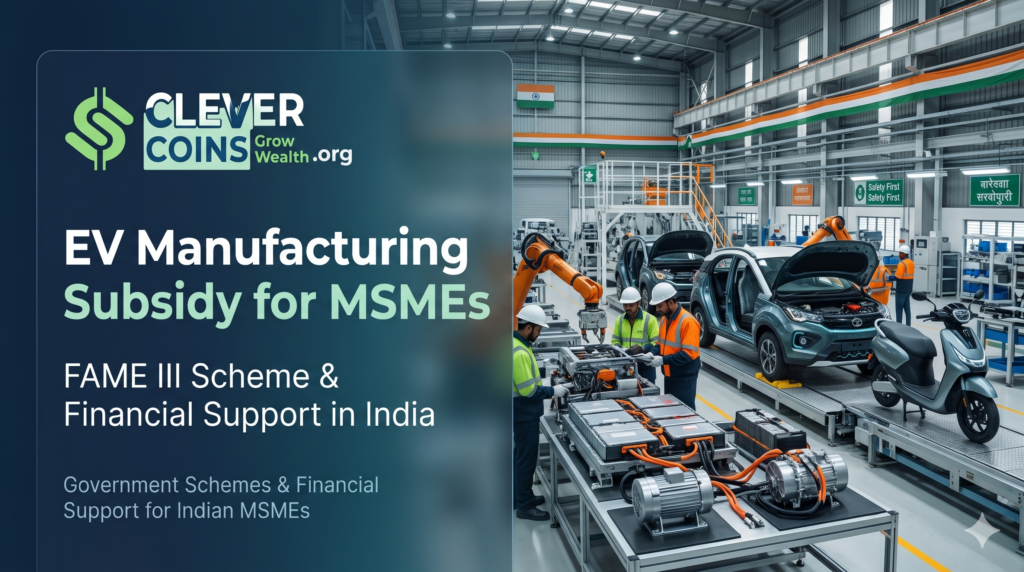
FAME III Scheme 2025: Subsidy for EV Manufacturing MSMEs in India – Eligibility, Benefits, Government Schemes and Application Process
India is rapidly transforming its automobile industry through electric mobility. With increasing environmental awareness, rising fuel prices, technological advancements and government initiatives, electric vehicles (EVs) are becoming an important part of India’s transportation ecosystem.
This transformation is creating significant business opportunities for Micro, Small and Medium Enterprises (MSMEs). From manufacturing electric vehicle batteries and motors to producing controllers, chargers, wiring harnesses and other EV components, small and medium-sized businesses can participate in India’s growing electric vehicle industry.
However, establishing an EV manufacturing business requires substantial investment in machinery, technology, research, skilled manpower, infrastructure and regulatory compliance. Financial assistance and government incentives can play an important role in reducing these challenges.
This is where the discussion around the FAME III Scheme 2025 and EV manufacturing subsidies for MSMEs becomes important.
Many entrepreneurs are searching for information about FAME III, including its eligibility criteria, subsidy amount, application procedure and benefits for EV manufacturers. However, understanding the actual government policies is essential before making any financial or investment decision.
India introduced the PM Electric Drive Revolution in Innovative Vehicle Enhancement (PM E-DRIVE) Scheme in September 2024 after the completion of FAME II. In addition, the government has introduced manufacturing-oriented initiatives such as the Production Linked Incentive (PLI) Scheme for Automobile and Auto Components and the PLI Scheme for Advanced Chemistry Cell (ACC) Battery Storage.
These programmes have different objectives. Some encourage EV purchases, while others support domestic manufacturing and technological development.
In this comprehensive guide, we will explain the FAME III Scheme 2025 search topic, the actual government initiatives available to EV manufacturers, potential benefits for MSMEs, eligibility considerations, application procedures and important financial support options.
1. What Is the FAME III Scheme 2025?
FAME stands for Faster Adoption and Manufacturing of (Hybrid &) Electric Vehicles in India.
The FAME programme was introduced to encourage electric mobility, reduce dependence on fossil fuels, promote cleaner transportation and develop India’s domestic electric vehicle ecosystem.
The programme initially operated through two phases:
- FAME I: Introduced in 2015 to promote hybrid and electric vehicles.
- FAME II: Implemented from 1 April 2019 to 31 March 2024, with a total budgetary support of ₹11,500 crore.
After FAME II, the Government of India introduced the PM E-DRIVE Scheme on 29 September 2024.
Important clarification: FAME III should not be treated as an officially notified government subsidy programme without a corresponding government notification. The relevant successor initiative is PM E-DRIVE. Therefore, businesses searching for FAME III Scheme 2025 should also examine PM E-DRIVE and the separate manufacturing incentive programmes.
The PM E-DRIVE Scheme was originally notified with a financial outlay of ₹10,900 crore and a two-year implementation period. Its duration was subsequently extended in August 2025 until 31 March 2028, subject to the scheme’s funding limits and segment-specific conditions.
The scheme aims to:
- Accelerate the adoption of electric vehicles.
- Promote cleaner transportation.
- Develop public EV charging infrastructure.
- Support electric buses and other eligible EV categories.
- Strengthen India’s electric mobility ecosystem.
- Encourage domestic manufacturing through phased manufacturing requirements.
For EV entrepreneurs, understanding the distinction between consumer subsidies and manufacturing incentives is particularly important.
2. Why Is the Government Promoting EV Manufacturing in India?
Electric mobility is not simply about replacing petrol and diesel vehicles with electric alternatives. It involves developing an entire industrial ecosystem.
An electric vehicle requires several specialised components, including batteries, electric motors, controllers, power electronics, charging systems and battery management systems.
India has an opportunity to manufacture these components domestically rather than depending heavily on imported products.
Government support for EV manufacturing is intended to achieve several objectives.
A. Reduce dependence on imported EV components
Many advanced EV components and battery technologies have historically depended on international supply chains.
Developing domestic manufacturing capabilities can reduce import dependence, improve supply-chain security and strengthen India’s industrial ecosystem.
B. Generate employment opportunities
EV manufacturing creates employment across multiple activities, including:
- Battery assembly and manufacturing.
- Electric motor production.
- Electrical component manufacturing.
- Research and development.
- Electronics assembly.
- Software and embedded systems.
- Quality testing.
- Charging infrastructure development.
- Maintenance and after-sales services.
MSMEs can participate in these activities as manufacturers, suppliers, distributors and technology partners.
C. Encourage technological innovation
The EV sector requires continuous technological development.
Businesses working on battery efficiency, thermal management, power electronics, lightweight materials, charging technology and vehicle safety can contribute to India’s innovation ecosystem.
D. Support Make in India
Domestic manufacturing can strengthen India’s position as an automotive production hub.
By encouraging local value addition and technology development, government initiatives can create opportunities for Indian manufacturers to serve both domestic and international markets.
E. Promote environmentally responsible transportation
Electric vehicles have the potential to reduce tailpipe emissions and improve urban air quality.
The environmental benefits depend on electricity generation, battery manufacturing, battery life-cycle management and recycling practices. Nevertheless, electric mobility is an important component of India’s broader clean transportation transition.
3. What Is the PM E-DRIVE Scheme?
The PM Electric Drive Revolution in Innovative Vehicle Enhancement (PM E-DRIVE) Scheme is one of the most important government initiatives for promoting electric mobility in India.
It was launched by the Ministry of Heavy Industries on 29 September 2024.
The original scheme had an outlay of ₹10,900 crore and was designed to operate until 31 March 2026. In August 2025, the government extended its implementation period until 31 March 2028.
However, the terminal date for certain vehicle segments, including registered electric two-wheelers, e-rickshaws, e-carts and L5 electric three-wheelers, remained 31 March 2026 under the extension announcement. Businesses must therefore verify the latest segment-specific provisions rather than assuming that every incentive remains available until 2028.
Key objectives of PM E-DRIVE
- Encourage the adoption of electric vehicles.
- Reduce the initial purchase cost of eligible electric vehicles.
- Promote electric public transportation.
- Develop EV charging infrastructure.
- Encourage domestic manufacturing.
- Improve the availability of advanced electric mobility technologies.
EV categories covered
The scheme covers eligible categories such as:
- Electric two-wheelers.
- Electric three-wheelers.
- Electric rickshaws and electric carts.
- Electric ambulances.
- Electric trucks.
- Electric buses.
- Public charging infrastructure.
- Upgradation of testing agencies.
Does PM E-DRIVE provide a direct manufacturing subsidy to every MSME?
No.
This is one of the most important distinctions for EV entrepreneurs.
PM E-DRIVE primarily provides demand-side incentives for eligible vehicles. These incentives reduce the purchase price for eligible customers and are reimbursed to the manufacturers or original equipment manufacturers according to the scheme’s procedures.
It does not mean that every MSME manufacturing EV components automatically receives a fixed capital subsidy.
Manufacturers must comply with the relevant vehicle eligibility requirements, certification procedures, phased manufacturing programme and other applicable conditions.
For businesses looking for manufacturing-oriented incentives, the PLI-Auto and PLI-ACC programmes deserve particular attention.
4. Understanding EV Manufacturing Subsidies for MSMEs
When entrepreneurs search for EV manufacturing subsidies, they often expect a single government scheme that provides financial assistance for purchasing machinery, establishing factories and manufacturing electric vehicles.
In reality, support is distributed across different programmes.
Some programmes support manufacturing investments, some provide credit assistance, some promote new enterprise establishment, while others encourage quality certification and technological development.
An EV manufacturing MSME should evaluate multiple support options rather than relying on one programme.
The following initiatives are particularly relevant.
A. PLI Scheme for Automobile and Auto Component Industry
The Production Linked Incentive Scheme for Automobile and Auto Component Industry is an important manufacturing-oriented initiative administered by the Ministry of Heavy Industries.
The government approved the scheme in September 2021 with a budgetary outlay of ₹25,938 crore.
Its objective is to encourage manufacturing of Advanced Automotive Technology (AAT) products in India.
These include technologies associated with zero-emission vehicles, including battery electric vehicles and hydrogen fuel cell vehicles.
The incentive period covers FY 2022-23 to FY 2026-27, with disbursement linked to subsequent financial years under the scheme framework.
How can EV manufacturers benefit?
The programme encourages eligible companies to invest in advanced automotive technologies, improve domestic manufacturing capabilities and develop local supply chains.
Potential areas of relevance include:
- Advanced battery technology.
- Electric vehicle powertrain systems.
- Electric motors.
- Advanced automotive electronics.
- Vehicle control systems.
- Other eligible advanced automotive technology products.
However, the PLI-Auto Scheme is not a universal MSME subsidy.
The scheme has specific applicant, investment, sales, product and domestic value addition requirements.
The official scheme FAQ identifies eligible applicants as qualifying companies incorporated or registered in India. A proprietorship, partnership or LLP cannot simply assume that it qualifies as an applicant under the PLI-Auto framework.
Therefore, MSMEs should review the official guidelines before restructuring their business or making investments based on anticipated PLI benefits.
B. PLI Scheme for Advanced Chemistry Cell Battery Storage
Battery technology is one of the most important parts of the EV industry.
Advanced Chemistry Cells (ACC) are used in modern energy storage applications and are important for developing advanced electric vehicle batteries.
The Government of India approved the PLI Scheme for Advanced Chemistry Cell Battery Storage with a budgetary outlay of ₹18,100 crore.
The programme aims to establish a domestic manufacturing ecosystem with a cumulative capacity of 50 GWh.
It is intended to encourage domestic battery manufacturing, improve technological capabilities and reduce dependence on imported battery technology.
Potential business opportunities exist in:
- Advanced battery manufacturing.
- Battery cell production.
- Battery technology development.
- Battery pack integration.
- Battery management technology.
- Energy storage solutions.
- Supporting manufacturing activities.
However, the ACC PLI programme is a targeted manufacturing incentive and should not be confused with an automatic subsidy for every battery assembly MSME.
An entrepreneur planning to manufacture battery packs, accessories or related components should carefully examine the product-specific eligibility and current programme status.
C. PMEGP – Prime Minister’s Employment Generation Programme
The Prime Minister’s Employment Generation Programme (PMEGP) is an important credit-linked subsidy programme administered through the Ministry of MSME and implementing agencies.
It aims to encourage the establishment of new micro-enterprises in the non-farm sector.
For eligible manufacturing projects, the maximum admissible project cost under the programme is ₹50 lakh.
The margin money subsidy depends on the beneficiary category and project location.
For new eligible manufacturing units, the indicative subsidy structure is:
| Beneficiary category | Urban subsidy | Rural subsidy |
|---|---|---|
| General category | 15% | 25% |
| Special category | 25% | 35% |
The beneficiary contribution is generally 10% for the general category and 5% for eligible special-category beneficiaries.
Special categories include specified groups such as SC, ST, OBC, minorities, women, ex-servicemen, transgender persons, persons with disabilities and other categories identified under the programme guidelines.
Can an EV manufacturing business apply under PMEGP?
A proposed EV-related manufacturing activity may be considered where it satisfies the programme’s eligibility and permitted-activity requirements.
The applicant must establish a viable new micro-enterprise and meet the relevant educational, contribution, project-cost and other conditions.
PMEGP is not intended to provide a blanket subsidy to every existing EV manufacturing company.
Applications are processed through the designated implementing agencies and financial institutions.
Official portal: https://pmegp.msme.gov.in/
D. CGTMSE – Credit Guarantee Scheme
Access to finance is one of the biggest challenges faced by small EV manufacturers.
Banks may request collateral or additional security when an entrepreneur applies for a business loan.
The Credit Guarantee Scheme for Micro and Small Enterprises, implemented through the Credit Guarantee Fund Trust for Micro and Small Enterprises (CGTMSE), helps eligible lenders provide credit support to micro and small enterprises.
The programme provides guarantee coverage according to the applicable scheme rules.
This can help eligible businesses access credit without depending entirely on traditional collateral arrangements.
Potential uses of business finance include:
- Machinery purchases.
- Factory establishment.
- Working capital.
- Production equipment.
- Business expansion.
- Technology upgrades.
Important: CGTMSE provides a guarantee to the lending institution. It is not a direct cash subsidy paid to the entrepreneur, and the lender must independently assess the loan application.
Official website: https://www.cgtmse.in/
E. MSME Sustainable (ZED) Certification Scheme
Quality, reliability and environmental responsibility are important for businesses supplying components to automobile manufacturers.
The Zero Defect Zero Effect (ZED) Certification Scheme encourages MSMEs to improve product quality, manufacturing efficiency and environmental performance.
It offers financial assistance towards eligible certification costs.
The published certification subsidy rates include:
- Micro enterprises: 80%.
- Small enterprises: 60%.
- Medium enterprises: 50%.
Additional concessions may be available for specified beneficiary categories and locations under the applicable guidelines.
An EV component manufacturing MSME can consider ZED certification to strengthen its quality management practices and supplier credibility.
Official website: https://zed.msme.gov.in/
5. Who Can Benefit from EV Manufacturing Support?
The EV manufacturing ecosystem consists of several different business categories.
An entrepreneur does not necessarily need to manufacture a complete electric vehicle to participate in the industry.
Many opportunities exist in specialised components and supporting technologies.
A. Electric battery manufacturers
Battery manufacturing and battery technology are important parts of the EV supply chain.
Businesses can explore battery-related manufacturing opportunities, subject to the required safety, technical and regulatory standards.
B. Electric motor manufacturers
Electric motors convert electrical energy into mechanical power.
Manufacturers can explore production of motors, motor components, assemblies and associated technologies.
C. EV controller manufacturers
Electronic controllers regulate the operation of electric motors and other vehicle systems.
Businesses with electrical engineering and electronics manufacturing capabilities can explore this segment.
D. Battery Management System manufacturers
A Battery Management System (BMS) monitors battery performance and helps manage charging, discharging, temperature and safety.
This is an important technology area for EV manufacturers.
E. EV charging equipment manufacturers
Charging infrastructure is essential for widespread EV adoption.
Businesses can explore manufacturing charging equipment, connectors, power electronics and related infrastructure components.
F. Wiring harness and electrical component manufacturers
EVs require specialised electrical systems, connectors, cables and wiring harnesses.
Traditional automobile component manufacturers may be able to diversify into this segment after meeting relevant technical requirements.
G. Lightweight component manufacturers
Reducing vehicle weight can improve efficiency and driving range.
Manufacturers of aluminium components, specialised plastics, composite materials and other lightweight products may find opportunities in the EV supply chain.
H. Battery recycling and related businesses
Battery recycling and responsible end-of-life management are important for developing a sustainable EV industry.
Businesses can explore eligible recycling and material recovery activities subject to environmental permissions and applicable battery waste management regulations.
6. MSME Classification for EV Manufacturing Businesses in 2025
Before applying for MSME-related benefits, an entrepreneur should understand the revised MSME classification criteria.
The government revised the investment and turnover limits with effect from 1 April 2025.
The revised classification is:
| Enterprise category | Investment limit | Annual turnover limit |
|---|---|---|
| Micro | ₹2.5 crore | ₹10 crore |
| Small | ₹25 crore | ₹100 crore |
| Medium | ₹125 crore | ₹500 crore |
Both investment and turnover conditions must be satisfied for the relevant category.
For example, an EV component manufacturing business with investment in eligible plant and machinery of ₹1.5 crore and turnover of ₹6 crore may fall within the micro-enterprise classification, subject to the applicable rules and calculation methodology.
Similarly, a business with investment of ₹12 crore and turnover of ₹65 crore may fall within the small-enterprise category.
The classification is relevant because several MSME schemes offer benefits according to the enterprise category.
Why is Udyam Registration important?
Udyam Registration is the official MSME registration system operated by the Ministry of MSME.
It helps identify an enterprise as a registered MSME and can be relevant when accessing eligible government schemes, credit facilities and other benefits.
Registration is free through the official government portal.
Official website: https://udyamregistration.gov.in/
Entrepreneurs should avoid unofficial websites charging unnecessary fees for government MSME registration.
7. Eligibility Criteria for EV Manufacturing MSMEs
Eligibility depends on the specific government programme being considered.
There is no single eligibility checklist applicable to every EV subsidy or manufacturing incentive.
Nevertheless, the following requirements are important for many MSME-related programmes.
1. Valid business registration
The applicant should have a legally recognised business structure appropriate for the selected programme.
Depending on the scheme, acceptable structures may include proprietorships, partnerships, LLPs or companies.
However, some manufacturing incentive programmes have narrower applicant requirements.
2. Udyam Registration
For MSME-specific benefits, the enterprise should obtain Udyam Registration where required.
The enterprise must satisfy the applicable MSME classification criteria.
3. Manufacturing activity
The business should undertake an eligible manufacturing activity or another activity specifically permitted by the scheme.
For example, an enterprise manufacturing EV battery components may need to demonstrate its actual manufacturing operations rather than merely purchasing finished products for resale.
4. Investment in plant and machinery
Some programmes consider the applicant’s investment in machinery, equipment, production facilities and other eligible assets.
Proper documentation of capital expenditure is important.
5. Financial eligibility
Banks and government implementing agencies may evaluate:
- Business turnover.
- Financial statements.
- Existing liabilities.
- Credit history.
- Promoter contribution.
- Project viability.
- Repayment capacity.
6. Technical compliance
EV manufacturers may need to comply with applicable automotive safety, quality, testing and certification requirements.
The relevant standards depend on the product being manufactured.
7. Environmental compliance
Manufacturing facilities may require approvals and permissions under applicable pollution control, factory, waste management and environmental regulations.
Battery manufacturing and recycling activities require particular attention to environmental and safety requirements.
8. Scheme-specific requirements
The applicant must satisfy the particular conditions of the selected scheme, including application deadlines, eligible products, investment thresholds and other requirements.
8. Documents Required for EV Manufacturing Subsidy Applications
Documentation requirements differ between programmes, banks and government departments.
However, an EV manufacturing business should generally prepare the following documents.
Business and registration documents
- PAN card of the business.
- Aadhaar and KYC documents of promoters, where required.
- Certificate of Incorporation, if applicable.
- Partnership deed or LLP agreement, where applicable.
- Udyam Registration Certificate.
- GST Registration Certificate, where applicable.
- Business address proof.
Financial documents
- Bank account details.
- Bank statements.
- Income tax returns, where applicable.
- Audited financial statements, where applicable.
- Existing loan details.
- Promoter contribution details.
- Projected cash flow statements.
Manufacturing and project documents
- Detailed Project Report (DPR).
- Machinery quotations.
- Factory ownership or lease documents.
- Production capacity details.
- Manufacturing process description.
- Raw material requirements.
- Technical specifications.
- Product details and proposed customer segments.
Regulatory and technical documents
- Applicable factory licences.
- Pollution control approvals, where required.
- Fire safety approvals, where required.
- Product testing certificates, where applicable.
- Quality certifications.
- Relevant automotive approvals.
- Battery and waste management compliance documents, where applicable.
Preparing a complete project file before approaching a bank or government department can improve the efficiency of the application process.
9. How to Apply for Government Support for EV Manufacturing MSMEs
There is no single application portal for every EV manufacturing incentive.
The process depends on the particular programme.
The following approach can help entrepreneurs identify and pursue appropriate support.
Step 1: Decide the manufacturing activity
First, identify the specific EV product you intend to manufacture.
Examples include:
- EV batteries or battery packs.
- Electric motors.
- Battery management systems.
- EV controllers.
- Charging equipment.
- Electrical components.
- Wiring harnesses.
- Other automotive components.
The proposed product determines which government programme may be relevant.
Step 2: Establish the business legally
Choose an appropriate business structure.
Options may include:
- Proprietorship.
- Partnership firm.
- Limited Liability Partnership.
- Private Limited Company.
The decision should consider ownership, investment, taxation, liability, future fundraising and the eligibility conditions of the proposed scheme.
Step 3: Obtain Udyam Registration
If the business qualifies as an MSME, complete the registration process through the official Udyam portal.
Ensure that business and investment information is accurate.
Step 4: Prepare a Detailed Project Report
A Detailed Project Report should explain the proposed manufacturing business.
It should cover:
- Business overview.
- Product description.
- Market demand.
- Manufacturing process.
- Machinery requirements.
- Factory infrastructure.
- Project cost.
- Promoter contribution.
- Loan requirements.
- Working capital requirements.
- Estimated revenue.
- Profitability projections.
- Employment generation.
- Environmental considerations.
A realistic DPR helps banks and other institutions assess project viability.
Step 5: Identify the appropriate scheme
Evaluate whether the project may qualify for:
- PMEGP.
- CGTMSE-backed credit.
- PLI-Auto, where the applicant and product qualify.
- PLI-ACC, where the project meets the applicable requirements.
- ZED certification assistance.
- State-level EV manufacturing incentives.
- Other applicable MSME programmes.
Do not apply for a scheme merely because it contains the words electric vehicle or manufacturing.
Check the current operational guidelines first.
Step 6: Arrange project financing
Identify the total project cost and the amount required from promoters, banks and other funding sources.
The financing plan should include both capital expenditure and working capital.
Step 7: Submit the application
Use the designated official portal, implementing agency or participating bank.
Submit accurate information and all supporting documents.
Step 8: Respond to verification and assessment
The relevant authority may examine the business structure, manufacturing facility, financial records, product specifications and eligibility requirements.
Some schemes also require inspections, testing or independent verification.
Step 9: Track approval and compliance
After receiving approval or financial assistance, maintain records of eligible expenditure, production, invoices and other scheme-related requirements.
Timely reporting and compliance are important for receiving or retaining benefits.
10. State Government Incentives for EV Manufacturing MSMEs
Apart from central government initiatives, several Indian states have introduced electric vehicle policies to encourage investment in EV manufacturing and supporting infrastructure.
Depending on the state policy and the applicant’s eligibility, incentives may include:
- Capital investment subsidies.
- Interest subsidies.
- Stamp duty concessions.
- Electricity duty exemptions.
- Land-related concessions.
- SGST reimbursement.
- Employment-linked incentives.
- Support for research and development.
- Infrastructure development assistance.
States such as Maharashtra, Tamil Nadu, Karnataka, Gujarat, Telangana and Uttar Pradesh have developed policies or investment initiatives relating to electric mobility and manufacturing.
However, incentives differ significantly between states.
For example, a business setting up an EV component manufacturing facility in Maharashtra should examine the applicable Maharashtra industrial and EV policy provisions, including the location of the project, investment category, employment commitments and application deadlines.
Entrepreneurs should obtain written clarification from the relevant state department or investment promotion agency before including any proposed incentive in their project financing calculations.
11. Benefits of Government Support for EV Manufacturing MSMEs
Government support can provide several advantages to eligible manufacturing businesses.
Reduced initial financial burden
Capital-intensive manufacturing projects require investment in equipment, production lines, infrastructure and technology.
Eligible capital subsidies or credit-linked support can help reduce the financial burden.
Better access to business finance
Credit guarantee mechanisms may improve access to loans for eligible micro and small enterprises.
This can be particularly helpful for businesses that have limited collateral.
Improved manufacturing quality
Certification programmes such as ZED encourage better production processes, quality management and environmental performance.
Increased competitiveness
Manufacturers with reliable quality systems, competitive pricing and domestic supply capabilities may become more attractive to established automotive companies.
Employment generation
Expanding manufacturing activities can create skilled and semi-skilled employment opportunities.
Technology development
Government initiatives supporting advanced automotive technologies can encourage research, innovation and technological advancement.
Stronger domestic supply chains
MSMEs can become suppliers to larger EV manufacturers and automotive companies.
This creates opportunities for long-term business relationships and industrial growth.
12. Challenges Faced by EV Manufacturing MSMEs
Despite the opportunities, starting an EV manufacturing business comes with several challenges.
Understanding these challenges before investing is essential.
High capital expenditure
Manufacturing batteries, motors, power electronics and other specialised components requires significant investment.
Entrepreneurs must carefully evaluate machinery costs, factory infrastructure and production capacity.
Technology dependency
Advanced EV technologies continue to evolve.
Manufacturers must invest in research, testing and technological upgrades to remain competitive.
Quality and safety requirements
EV components, particularly batteries and electrical systems, must meet relevant safety and performance requirements.
Failure to maintain quality can create serious financial and operational risks.
Competition
The EV manufacturing industry includes established automotive companies, technology businesses and emerging startups.
Small manufacturers need to identify specialised product segments where they can compete effectively.
Working capital management
Manufacturing businesses often need to purchase raw materials, maintain inventory and provide credit to customers.
Insufficient working capital can affect production and delivery schedules.
Regulatory compliance
Businesses must manage GST, income tax, factory-related requirements, environmental permissions, labour compliance and product-specific regulations.
A strong compliance system is essential for long-term sustainability.
13. Business Opportunities for New EV Manufacturing MSMEs
The EV sector offers opportunities beyond manufacturing complete vehicles.
Entrepreneurs can explore specialised manufacturing segments based on their technical knowledge, investment capacity and market demand.
Some promising areas include:
| Business opportunity | Potential customers |
|---|---|
| EV battery pack assembly | EV manufacturers |
| Electric motor components | Vehicle manufacturers |
| Battery management systems | Battery and vehicle companies |
| EV charging equipment | Charging infrastructure operators |
| Wiring harness manufacturing | Automotive OEMs |
| Power electronics | EV manufacturers |
| Lightweight vehicle components | Automobile companies |
| Battery recycling | Battery manufacturers and recyclers |
| EV testing equipment | Testing facilities |
| Thermal management components | Battery and vehicle manufacturers |
Before starting any activity, conduct market research and identify potential buyers.
A manufacturing business should not depend entirely on the possibility of receiving government assistance.
It must have a sustainable commercial model.
14. Is an EV Manufacturing MSME Automatically Eligible for Subsidy?
No.
Obtaining Udyam Registration does not automatically qualify a business for every central or state government subsidy.
Each programme has its own requirements.
For example:
- PMEGP is a credit-linked subsidy programme for eligible new micro-enterprises.
- CGTMSE provides credit guarantee support to eligible lenders.
- PLI-Auto has specific applicant, product and investment requirements.
- PLI-ACC focuses on eligible advanced chemistry cell battery manufacturing.
- ZED provides assistance for eligible certification costs.
- PM E-DRIVE primarily supports eligible EV deployment and related ecosystem development.
Therefore, an entrepreneur should first identify the exact type of financial assistance required.
A capital subsidy, machinery loan, working capital facility, production-linked incentive and certification subsidy are different forms of support.
Understanding these differences can prevent incorrect applications and unrealistic financial projections.
15. Important Tax and Compliance Considerations for EV Manufacturing Businesses
Financial assistance is only one part of establishing an EV manufacturing business.
Entrepreneurs must also consider legal, taxation and regulatory requirements.
Business registration
Choose an appropriate business structure based on the nature and scale of operations.
GST registration
Manufacturers should evaluate GST registration requirements and applicable rates for their products and transactions.
Income tax compliance
Maintain proper books of accounts, file income tax returns and evaluate the tax treatment of business expenditure and depreciation.
Factory and labour compliance
Depending on the manufacturing facility and workforce, applicable factory, labour, employee welfare and workplace safety requirements must be followed.
Environmental compliance
Manufacturing and battery-related operations may require permissions from the relevant pollution control authorities.
Product certification
Vehicle components and complete vehicles may require testing and approvals under applicable automotive regulations.
Intellectual property protection
Businesses developing unique EV technologies, software, product designs or brand identities should evaluate patent, copyright and trademark protection.
16. Why Professional Business and Financial Consultancy Matters
Starting an EV manufacturing business involves multiple legal, financial and operational decisions.
An entrepreneur may have a promising manufacturing idea but still face difficulties in choosing the right business structure, obtaining registrations, preparing financial projections and understanding government scheme requirements.
Professional consultancy can help businesses approach these activities systematically.
CleverCoins provides business-oriented consultancy and compliance services that may be relevant to entrepreneurs entering the manufacturing sector.
These include:
- Company incorporation.
- LLP registration.
- Proprietorship and partnership-related services.
- Udyam Registration assistance.
- GST registration.
- GST return filing.
- Income tax return filing.
- Accounting and compliance support.
- Trademark registration.
- Business documentation assistance.
For an EV manufacturing entrepreneur, these services can help establish a compliant business foundation.
However, scheme eligibility, subsidy approval and loan sanction remain subject to the relevant government authority, financial institution and applicable guidelines.
Before making a major manufacturing investment, businesses should obtain professional advice and independently verify the latest scheme conditions.
17. Frequently Asked Questions (FAQs)
Q1. Is FAME III Scheme 2025 officially launched in India?
FAME III should not be treated as an officially notified government scheme without a corresponding government notification. The Government of India introduced PM E-DRIVE in September 2024 following FAME II. Entrepreneurs searching for FAME III should examine PM E-DRIVE and the applicable manufacturing incentive programmes.
Q2. Does the FAME III Scheme provide subsidies to EV manufacturing MSMEs?
There is no basis to assume that a separate FAME III manufacturing subsidy is available. Manufacturing businesses should explore applicable programmes such as PLI-Auto, PLI-ACC, PMEGP, CGTMSE and state industrial incentives.
Q3. What is the PM E-DRIVE Scheme?
PM E-DRIVE is a government initiative designed to accelerate electric vehicle adoption, develop charging infrastructure and strengthen India’s electric mobility ecosystem. It was notified on 29 September 2024.
Q4. Can an MSME manufacture EV batteries and apply for government support?
Yes, an eligible MSME can explore applicable business finance, MSME support and other relevant manufacturing initiatives. However, eligibility for battery manufacturing incentives depends on the particular scheme, product and applicant requirements.
Q5. What is the maximum PMEGP subsidy for EV manufacturing?
For eligible new manufacturing micro-enterprises, PMEGP offers margin money subsidy at rates of 15% or 25% for general-category beneficiaries in urban and rural areas, respectively. For eligible special-category beneficiaries, the rates are 25% and 35%, respectively. The manufacturing project cost ceiling is ₹50 lakh, subject to programme conditions.
Q6. Can an EV manufacturing startup apply for a government business loan?
Yes. Eligible startups and MSMEs can approach banks and other financial institutions for suitable business financing. Depending on the applicant and project, credit guarantee support through CGTMSE may also be relevant.
Q7. Is Udyam Registration mandatory for all EV manufacturing subsidies?
Not necessarily for every programme. However, Udyam Registration is important for accessing many MSME-specific benefits. Individual schemes may have different registration requirements.
Q8. What is the revised MSME investment limit in 2025?
From 1 April 2025, the investment limits are ₹2.5 crore for micro enterprises, ₹25 crore for small enterprises and ₹125 crore for medium enterprises, subject to the corresponding turnover limits.
Q9. Which government scheme supports EV battery manufacturing?
The PLI Scheme for Advanced Chemistry Cell Battery Storage is an important manufacturing initiative. It has a budgetary outlay of ₹18,100 crore and aims to establish a 50 GWh domestic ACC manufacturing ecosystem. It is not an automatic subsidy for every battery-related MSME.
Q10. Does PM E-DRIVE provide direct machinery subsidies?
PM E-DRIVE should not be interpreted as a universal machinery subsidy for EV manufacturers. Its primary support is directed towards eligible electric vehicle deployment and other notified components of the programme.
Q11. Can a proprietorship apply for PLI-Auto?
The official PLI-Auto FAQ identifies qualifying companies incorporated or registered in India as eligible applicant types. Proprietorships, partnerships and LLPs should not assume that they can apply directly under this programme.
Q12. Can Maharashtra-based MSMEs obtain EV manufacturing incentives?
Maharashtra-based businesses can examine applicable state industrial and EV policy incentives along with central government schemes. Eligibility depends on the project’s location, investment, activity, registration and applicable policy conditions.
Q13. Can an existing automobile component manufacturer enter the EV sector?
Yes. Existing automotive suppliers can explore manufacturing opportunities in electric motors, battery systems, controllers, power electronics and other EV components. They should evaluate the technical and regulatory requirements of their intended products.
Q14. How can an entrepreneur apply for EV manufacturing financial assistance?
The entrepreneur should identify the appropriate scheme, establish the business, obtain relevant registrations, prepare a Detailed Project Report, arrange promoter contribution and submit the application through the designated government portal, implementing agency or bank.
Q15. Is government subsidy guaranteed after MSME registration?
No. MSME registration does not guarantee a subsidy or loan. Every programme has specific eligibility requirements, funding availability and approval procedures.
18. Conclusion: Is EV Manufacturing a Good Opportunity for MSMEs in India?
India’s electric mobility transition is creating opportunities for entrepreneurs, startups, manufacturers and established automotive suppliers.
The growing demand for electric vehicles is creating business opportunities in battery technology, electric motors, charging equipment, controllers, electrical components, power electronics and other specialised products.
Government initiatives such as PM E-DRIVE, PLI-Auto, PLI-ACC, PMEGP, CGTMSE and ZED certification assistance can support different aspects of this emerging industrial ecosystem.
However, businesses must understand that these schemes serve different purposes.
PM E-DRIVE primarily encourages EV adoption, while PLI-Auto and PLI-ACC are manufacturing-oriented programmes with specific eligibility conditions. PMEGP supports eligible new micro-enterprises, CGTMSE facilitates credit access and ZED encourages manufacturing quality and environmental performance.
There is no automatic subsidy available to every EV manufacturing MSME simply because it has obtained Udyam Registration.
Entrepreneurs should identify their manufacturing activity, evaluate the investment requirement, prepare a strong project report, examine applicable government policies and verify eligibility before making financial commitments.
With proper planning, technical expertise, financial discipline and regulatory compliance, EV manufacturing can become a promising business opportunity for India’s MSME sector.
Planning to establish an EV manufacturing business? CleverCoins can assist entrepreneurs with business registration, Udyam-related assistance, GST, taxation and business compliance requirements.
Visit https://clevercoins.org/ to explore relevant business and financial consultancy services.
Related posts:
GST Invoice Management System (IMS) from October 2024: New Rules for MSMEs to Accept or Reject ITC
PMEGP Loan Scheme 2026: How to Get 35% Subsidy for New Business
MSME Competitive (LEAN) Scheme: How Indian Enterprises Can Claim 90% Government Support for Lean Cer...
PM Kaushal Vikas Yojana 4.0 for MSME Employees: The Complete Guide to Free Skill Training, RPL Certi...
CGTMSE Revised 2025: Collateral-Free Loan Limit Increased to ₹10 Crore for MSMEs
PMEGP Urban vs Rural Subsidy 2025: The Ultimate Guide to Funding, Eligibility, and Location Strategy...
SRIJAN Scheme for SC/ST Entrepreneurs Under NSIC: Benefits & Eligibility
Agri Infra Fund for Food Processing MSMEs: Complete Guide to 3% Interest Subvention, Eligibility, Be...
ECLGS Extension 2025: Is Emergency Credit Line Still Available for MSMEs?
Self Reliant India (SRI) Fund: Rs 50,000 Cr Equity Infusion for MSMEs Explained
Related posts:
 Self Reliant India (SRI) Fund: Rs 50,000 Cr Equity Infusion for MSMEs Explained
 ONDC Seller Incentive Scheme 2025: How Small Sellers Get Free Delivery Support
 Procurement and Marketing Support Scheme: Reimbursement for MSME Trade Fairs – Complete Guide
 Credit Guarantee Scheme for Exporters (CGSE): New 2025 Scheme for MSME Exporters