Why GST Annual Return Reconciliation Is Critical
Every GST-registered taxpayer in India who crosses the prescribed turnover threshold is required to file a GST Annual Return — GSTR-9 — for each financial year. This is not merely another compliance checkbox. The annual return is the single most comprehensive financial summary a business submits to the GST department, and it must perfectly reconcile with all the monthly/quarterly returns filed throughout the year.
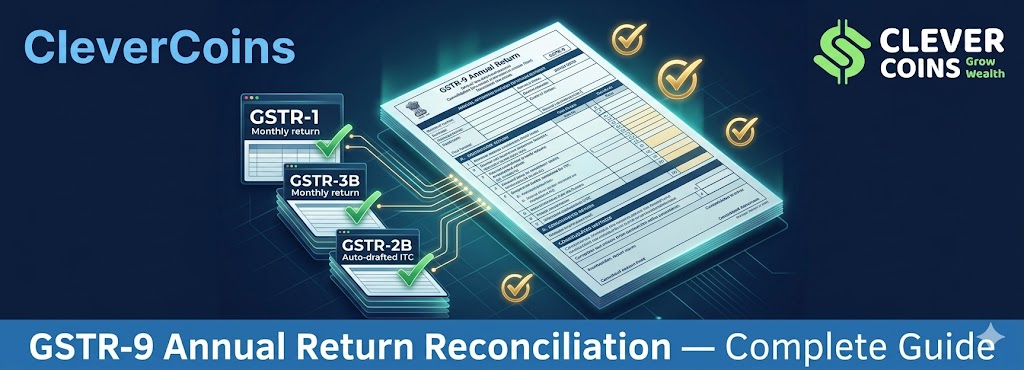
GST Annual Return Reconciliation is the process of ensuring that your GSTR-9 data is in complete alignment with:
- Your GSTR-1 (outward supplies filed monthly/quarterly)
- Your GSTR-3B (summary return filed monthly/quarterly)
- Your GSTR-2B (auto-drafted ITC from supplier filings)
- Your books of accounts (financial statements, ledgers, purchase/sales registers)
Any mismatch between these data sets can lead to notices, demands, penalties, and even cancellation of GST registration. This guide from CleverCoins walks you through everything — from understanding GSTR-9 and GSTR-9C, to executing a flawless reconciliation, fixing mismatches, and filing error-free annual returns.
What Is GSTR-9 — GST Annual Return?
GSTR-9 is the annual return form that consolidates all transactions reported in the monthly/quarterly returns (GSTR-1 and GSTR-3B) of a financial year. It is filed once a year and covers the full financial year period (April to March).
Key Facts About GSTR-9: Frequency: Once a year (per financial year) Applicability: All regular GST taxpayers with turnover > Rs. 2 crore (Optional for turnover up to Rs. 2 crore from FY 2022-23) Due Date: 31st December of the following financial year Form: GSTR-9 (Annual Return) Audit Form: GSTR-9C (Reconciliation Statement — for turnover > Rs. 5 crore) |
GSTR-9 is NOT a replacement of GSTR-1 or GSTR-3B. It is an annual consolidation that gives the department a bird’s-eye view of your business transactions over the entire year.
Who Must File GSTR-9? Applicability and Exemptions
Taxpayer Category | GSTR-9 Applicability |
Regular taxpayer, turnover > Rs. 2 crore | MANDATORY — must file |
Regular taxpayer, turnover up to Rs. 2 crore | OPTIONAL (from FY 2022-23 onwards as per notification) |
Composition scheme taxpayer | Files GSTR-9A (separate form — currently suspended) |
Input Service Distributor (ISD) | NOT required to file GSTR-9 |
Casual taxable person | NOT required to file GSTR-9 |
Non-resident taxable person | NOT required to file GSTR-9 |
Person deducting TDS under Sec 51 | NOT required to file GSTR-9 |
Person collecting TCS under Sec 52 | NOT required to file GSTR-9 |
Turnover > Rs. 5 crore | GSTR-9 MANDATORY + GSTR-9C mandatory |
Turnover Rs. 2–5 crore | GSTR-9 MANDATORY + GSTR-9C optional (self-certified) |
GSTR-9 Form Structure — All Parts & Tables Explained
GSTR-9 is divided into 6 parts and 19 tables. Understanding each part is essential for accurate reconciliation.
PART I — Basic Details (Tables 1–3)
Contains GSTIN, legal name, trade name, and the financial year for which the return is being filed. This is auto-populated from your GST registration data.
PART II — Details of Outward and Inward Supplies (Tables 4–5)
This is the most important part of GSTR-9 and covers the full year’s supply details:
- Table 4: Details of advances, inward and outward supplies on which tax is payable — this should match the sum of all GSTR-1 and GSTR-3B filed for the year.
- Table 5: Details of outward supplies on which tax is NOT payable — includes nil-rated, exempt, non-GST, zero-rated (with LUT), and exports.
PART III — Details of ITC (Tables 6–8)
This part consolidates all ITC claims for the year:
- Table 6: ITC availed during the year — bifurcated by IGST, CGST, SGST and by type (inputs, capital goods, input services).
- Table 7: ITC Reversed during the year — includes reversals under Rule 42, Rule 43, Section 17(5), and others.
- Table 8: Other ITC-related information — reconciliation between GSTR-2A/2B and ITC actually claimed in GSTR-3B.
PART IV — Details of Tax Paid (Tables 9)
Table 9 captures the actual tax paid (IGST, CGST, SGST, cess) during the year — split between tax paid through cash ledger and through ITC utilisation. This must match the total tax declared across all GSTR-3B filings for the year.
PART V — Particulars of Transactions for Previous Financial Year (Tables 10–14)
This covers amendments or adjustments related to the previous financial year that were reported in the current year’s GSTR-1 or GSTR-3B. For example, if a debit note for FY 2023-24 was issued and reported in October 2024, it appears here in the FY 2024-25 GSTR-9.
PART VI — Other Information (Tables 15–19)
Includes details of:
- Demands and refunds during the year
- Supplies received from composition taxpayers, deemed supply under Section 143
- HSN-wise summary of outward and inward supplies
- Late fees payable and paid
What Is GSTR-9C — GST Reconciliation Statement?
GSTR-9C is a reconciliation statement that compares the figures in GSTR-9 with the audited financial statements. It is required for taxpayers with aggregate annual turnover exceeding Rs. 5 crore in a financial year.
GSTR-9C has two parts: PART A — Reconciliation Statement: Reconciles the turnover, tax paid, and ITC as per books of accounts with the figures declared in GSTR-9. PART B — Certification: For FY 2020-21 onwards, GSTR-9C is self-certified by the taxpayer. (Previously required CA/CMA certification — removed w.e.f. FY 2021-22) |
Feature | GSTR-9 vs GSTR-9C |
Full Name | GSTR-9: Annual Return | GSTR-9C: Reconciliation Statement |
Who Files | All regular taxpayers above threshold | Turnover > Rs. 5 crore |
Purpose | Consolidate annual transactions | Reconcile books vs GSTR-9 |
Data Source | GSTR-1 + GSTR-3B summary | Audited financial statements |
Certification | Self-filing by taxpayer | Self-certified by taxpayer (post FY21) |
Due Date | 31st December (following FY) | Same as GSTR-9 |
The GST Annual Return Reconciliation Process — Step by Step
Reconciliation is the backbone of accurate GSTR-9 filing. Here is the step-by-step process followed by CleverCoins for every client:
STEP 1: Gather All Data Sources
Compile the following for the full financial year:
- All filed GSTR-1 returns (April to March)
- All filed GSTR-3B returns (April to March)
- GSTR-2A / GSTR-2B auto-drafted statements
- Purchase register / purchase invoices
- Sales register / sales invoices
- Books of accounts (Tally/SAP/zoho ledgers)
- E-way bills generated for the year
- Debit notes and credit notes issued/received
STEP 2: Reconcile Outward Supplies (Sales Turnover)
Compare three data points for sales:
Data Point | What to Check | Acceptable Variance |
GSTR-1 vs Books | Total taxable value + tax reported in GSTR-1 vs Sales ledger in books | Zero — must match exactly |
GSTR-3B vs GSTR-1 | Tax declared in GSTR-3B vs tax reported in GSTR-1 | Zero — else liability difference |
GSTR-9 vs Sum of GSTR-1 | Annual total in GSTR-9 vs sum of monthly GSTR-1 data | Zero — GSTR-9 should match aggregate |
Common Sales Mismatches: -> Credit notes not reported in GSTR-1 on time -> Advances received reported in GSTR-3B but missed in GSTR-1 -> Rate-wise classification errors (e.g., 12% reported instead of 18%) -> B2B vs B2C categorisation errors -> Export transactions without LUT reported as taxable supply |
STEP 3: Reconcile Input Tax Credit (ITC)
ITC reconciliation is the most complex and high-risk component of GSTR-9. There are THREE layers of ITC reconciliation:
Layer A: GSTR-2B vs Purchase Register
Every invoice in your purchase register should have a corresponding entry in GSTR-2B (auto-drafted from supplier’s GSTR-1). Mismatches arise when:
- Supplier has not filed their GSTR-1 (your ITC not reflected in 2B)
- Supplier filed but with wrong GSTIN or wrong tax period
- You have invoices but supplier has not uploaded them
Layer B: GSTR-2B vs GSTR-3B (ITC Claimed)
Compare the ITC available in GSTR-2B vs. the ITC actually claimed in GSTR-3B Table 4(A). GSTR-3B ITC should never EXCEED GSTR-2B ITC.
Rule 36(4) Restriction: Provisional ITC (not in GSTR-2B) is now ZERO. Effective FY 2021-22 onwards, you can only claim ITC that is reflected in GSTR-2B. Excess ITC claimed must be reversed with interest. |
Layer C: Books of Accounts vs GSTR-9 (ITC in Annual Return)
The ITC figures in Table 6 of GSTR-9 must match the ITC booked in your purchase ledger/accounts. Any ITC in books not reflected in GSTR-9 (or vice versa) must be explained and corrected.
STEP 4: Reconcile Tax Paid (Table 9)
Add up the tax paid (IGST + CGST + SGST + Cess) across all 12 months of GSTR-3B. This sum must match Table 9 of GSTR-9. Common issues:
- Interest and late fees paid in cash ledger need to be separately identified
- ITC utilisation entries must match the credit ledger data
- Tax paid through DRC-03 (voluntary payment) must be separately noted
STEP 5: HSN-Wise Summary Reconciliation (Table 17 & 18)
Table 17 (outward supply HSN summary) and Table 18 (inward supply HSN summary) must be filled accurately:
- Total quantity and taxable value per HSN code must match the aggregate of all GSTR-1 line items for that HSN
- For inward supplies: match purchase register HSN-wise with GSTR-2B data
- Errors in HSN classification can trigger notices asking for rate reconciliation
STEP 6: Previous Year Adjustments (Tables 10–14)
Record all FY adjustments that were made in the current year’s monthly returns:
- Amendments to B2B invoices of previous FY reported in current year’s GSTR-1
- ITC claims for previous year invoices made in the current year’s GSTR-3B
- Credit notes for previous year issued/reported in current year
Master Reconciliation Checklist — GSTR-9 Filing
GSTR-9 Table | Data to Reconcile | Source Document | Status Check |
Table 4 | Total outward taxable supplies + tax | Sum of GSTR-1 (B2B + B2C) | Match to books |
Table 5 | Nil/exempt/zero-rated/export supplies | GSTR-1 nil/exempt rows + LUT exports | Match to export invoices |
Table 6 | ITC availed (inputs, capital, services) | GSTR-3B Table 4(A) aggregate | Match to purchase ledger |
Table 7 | ITC reversed | GSTR-3B Table 4(B) aggregate | Match to reversal entries |
Table 8 | ITC reconciliation (2B vs claimed) | GSTR-2B vs GSTR-3B comparison | Identify excess/short ITC |
Table 9 | Total tax paid (cash + ITC) | Sum of all GSTR-3B tax paid rows | Match to cash + credit ledger |
Table 10 | Supplies of previous FY amended now | GSTR-1 amendments for prev FY | Match to CDN/amendments |
Table 11 | ITC availed for previous FY in current year | GSTR-3B prev FY ITC claimed now | Check eligibility |
Table 17 | HSN summary (outward) | GSTR-1 HSN rows aggregated | Match to sales register HSN |
Table 18 | HSN summary (inward) | Purchase register HSN-wise | Match to GSTR-2B HSN data |
Top 15 Common Errors in GSTR-9 Reconciliation — And How to Fix Them
Common Error | How to Fix / Precaution |
1. Turnover mismatch between GSTR-1 and GSTR-9 | Prepare month-wise GSTR-1 summary; cross-check each month’s total with books before entering in GSTR-9 |
2. ITC in GSTR-3B > ITC in GSTR-2B | Identify excess ITC in GSTR-3B; reverse the excess via GSTR-3B Table 4(B)(2) with interest at 18% p.a. |
3. Blocked credits (Sec 17(5)) claimed in GSTR-3B | Identify all blocked credit invoices; reverse in GSTR-3B and record in Table 7 of GSTR-9 |
4. Credit notes not reflected in GSTR-1 | Issue all pending credit notes before the due date; report in GSTR-1 of correct month |
5. ITC on RCM not paid and claimed simultaneously | Pay RCM liability in GSTR-3B; ITC can only be claimed in the SAME or subsequent month after payment |
6. Export supplies shown as taxable in GSTR-3B | Correct with amendment in subsequent GSTR-1; show in Table 5 of GSTR-9 as zero-rated |
7. Advances received not adjusted properly | Adjust advances against final invoice in GSTR-1 Table 11A; ensure no double counting in GSTR-9 |
8. E-commerce supplies reported incorrectly | Verify TCS credit received from e-commerce operators; match with GSTR-8 data available on portal |
9. HSN code mismatch between GSTR-1 and books | Standardise HSN master in billing software; verify top 20 HSN codes represent correct rates |
10. Previous year ITC/supply amendments missed | Run report on all GSTR-1/3B amendments; capture in GSTR-9 Tables 10-14 |
11. GSTR-3B filed with wrong tax rate | Note the variance; for significant errors consider DRC-03 voluntary payment to avoid demand |
12. ISD credits not tracked properly | ISD recipients to verify ISD credits in GSTR-2B; reconcile with GSTR-6 data |
13. Tax paid on exempt supplies by mistake | File refund claim under Section 77/Section 54; mention in GSTR-9C reconciliation statement |
14. Late fee not accounted for | Check GST portal for late fee demand; include in Table 9 (late fee paid) |
15. GSTR-9C turnover not matching GSTR-9 | Reconcile Notes to Accounts with GSTR-9 figures; prepare turnover reconciliation statement |
GSTR-9C Reconciliation Statement — Detailed Walkthrough
For taxpayers with turnover above Rs. 5 crore, GSTR-9C must also be filed. Here is what each reconciliation part covers:
Part A: Section I — Reconciliation of Turnover
Start with the turnover as per audited financial statements (profit & loss account). Make adjustments for:
- Unbilled revenue (recognised in books but not invoiced)
- Unadjusted advances received
- Trade discounts not reflected in invoices
- Other adjustments (deemed supplies, branch transfers, etc.)
The final reconciled turnover must match the taxable turnover declared in GSTR-9.
Part A: Section II — Reconciliation of ITC
Compare ITC as per books of accounts with ITC claimed in GSTR-9:
- ITC as per profit & loss/balance sheet should match Table 6 of GSTR-9
- Reasons for differences must be explained (e.g., blocked credits, ineligible ITC, timing differences)
- ITC reversed must be reconciled with actual reversal entries in books
Part A: Section III — Reconciliation of Tax Paid
Compare tax payable as per GSTR-9C computation with tax actually paid via GSTR-3B:
- If tax paid > tax payable: eligible for refund
- If tax payable > tax paid: additional liability must be discharged via DRC-03
GSTR-9 Due Dates, Late Fees & Penalties
Financial Year | Normal Due Date | Extended Date (if any) |
FY 2022-23 | 31 December 2023 | Extended to 31 March 2024 for some states |
FY 2023-24 | 31 December 2024 | Per official CBIC notification |
FY 2024-25 | 31 December 2025 | Watch for CBIC notifications |
Penalty / Late Fee | Applicable Rate / Amount |
Late Fee for GSTR-9 | Rs. 200 per day (Rs. 100 CGST + Rs. 100 SGST) of delay |
Maximum Late Fee Cap | 0.25% of annual turnover in the State/UT |
Interest on short-paid tax | 18% per annum from due date of GSTR-3B |
Penalty for non-filing | General penalty under Section 122 — up to Rs. 10,000 or tax evaded x 10%, whichever is higher |
Penalty for wrong ITC claim | 100% of tax involved under Section 74 if fraud/misstatement established |
Penalty under GSTR-9C (wrong certification) | Fine under Section 125 — up to Rs. 25,000 |
CleverCoins Pro Tips for Error-Free GSTR-9 Reconciliation
PRO TIP 1: Start Early — Don’t Wait Until December Begin your GSTR-9 reconciliation exercise in July/August itself. This gives you time to push suppliers to file their GSTR-1 so your GSTR-2B reflects all eligible ITC. PRO TIP 2: Use the Official Comparison Tool on the GST Portal Go to: GST Portal > Services > Returns > Annual Return. The portal auto-populates GSTR-9 from your monthly returns. Download the pre-filled form and compare with your books. PRO TIP 3: Create a Month-Wise Summary File Build an Excel tracker with columns: Month | GSTR-1 Taxable | GSTR-3B Taxable | Books Sales | GSTR-3B ITC | GSTR-2B ITC | Books ITC. Review this monthly — do not leave it to year-end. PRO TIP 4: Reconcile GSTR-2B Every Month Do not accumulate 12 months of ITC mismatch. Reconcile GSTR-2B vs purchase register every month before filing GSTR-3B. PRO TIP 5: Maintain a CDN (Credit/Debit Note) Register All credit notes and debit notes issued/received must be tracked separately. These are the most common source of GSTR-9 mismatches. PRO TIP 6: Identify Blocked Credits Before Year End Run a Section 17(5) filter on your purchase register every quarter. Reverse blocked credits proactively rather than discovering them during GSTR-9 preparation. |
Real-World Case Studies: GSTR-9 Reconciliation Challenges Solved
Case Study 1: E-Commerce Seller — Rs. 4.2 Lakh ITC Mismatch
A garment seller on Flipkart and Amazon (Mumbai, turnover Rs. 3.8 crore) found that their GSTR-3B ITC exceeded GSTR-2B by Rs. 4.2 lakhs during GSTR-9 preparation.
Root Cause: 23 suppliers had filed their GSTR-1 with wrong HSN codes. Their invoices appeared in GSTR-2B but under different GSTINs, causing the system to not link them to the buyer.
Resolution: Contacted all 23 suppliers; 18 filed amendments. Remaining Rs. 68,000 ITC was reversed in GSTR-3B with interest. GSTR-9 filed accurately. No notice received.
Lesson: Supplier reconciliation must be done BEFORE claiming ITC in GSTR-3B. Do not wait for year-end to find and resolve GSTR-2B mismatches. |
Case Study 2: Services Company — Turnover Mismatch Rs. 11 Lakhs
An IT services firm in Pune (turnover Rs. 6.2 crore) found that their GSTR-9 turnover was Rs. 11 lakhs higher than their audited financial statements.
Root Cause: GST on advance receipts was declared in GSTR-1 but the corresponding invoices were issued in the next financial year. This created a timing difference.
Resolution: The difference was explained in GSTR-9C Part A Section I through a specific adjustment row for ‘advances received adjusted in subsequent year.’ No additional tax was payable since tax had already been paid on the advance.
Case Study 3: Manufacturer — Section 17(5) Reversal Missed for 3 Years
A mid-size manufacturer in Gujarat discovered during GSTR-9 preparation that ITC on construction materials (office renovation) worth Rs. 9.8 lakhs had been incorrectly claimed over 3 years.
Action: Voluntary disclosure via DRC-03. Paid Rs. 9.8 lakhs + interest of ~Rs. 2.3 lakhs. Since disclosure was voluntary, penalty was waived under Section 73(5).
Lesson: Voluntary disclosure before the department detects the error ALWAYS results in significantly lower financial impact — penalty is waived under Sec 73(5). |
Technology Tools for GST Annual Return Reconciliation
Tool / Platform | How It Helps in GSTR-9 Reconciliation |
GST Portal (gstin.gov.in) | Auto-populated GSTR-9 draft, GSTR-2B download, comparison reports, filing portal |
Tally Prime (with GST module) | Exports GSTR-1, GSTR-3B data; built-in reconciliation reports; HSN reports |
ClearTax GST | Automated reconciliation of GSTR-2B vs purchase register; mismatch alerts; GSTR-9 filing |
Zoho Books GST | GSTR-2B reconciliation, ITC tracking, GSTR-9 preparation wizard |
GSTN Offline Utility | Excel-based tool for GSTR-9 / GSTR-9C preparation before online filing |
Excel / Google Sheets | Manual reconciliation for small businesses; pivot tables for HSN-wise analysis |
CleverCoins Advisory | End-to-end reconciliation service: data collection, reconciliation, error correction, filing |
Frequently Asked Questions on GST Annual Return Reconciliation
Q1. Is it mandatory to file GSTR-9 if my turnover is below Rs. 2 crore?
As per recent CBIC notifications (effective FY 2022-23), filing GSTR-9 is optional for taxpayers with aggregate annual turnover up to Rs. 2 crore. However, it is advisable to file for record-keeping and to avoid any compliance risk if turnover subsequently crosses the threshold.
Q2. Can I make changes in GSTR-9 after filing?
No. Once GSTR-9 is filed, it cannot be revised or amended. This is why thorough reconciliation before filing is non-negotiable. Any subsequent corrections must be made in the current year’s monthly returns or via DRC-03 voluntary payment.
Q3. My supplier has not filed GSTR-1. Can I still claim ITC in GSTR-9?
You can only claim ITC that reflects in GSTR-2B. If your supplier has not filed GSTR-1, their invoices will not appear in GSTR-2B, and hence you cannot claim that ITC. You should follow up with the supplier and claim ITC in the month when it appears in GSTR-2B, but not beyond the deadline of the annual return filing date or November return of the next FY, whichever is earlier.
Q4. What happens if there is a difference between GSTR-9 and GSTR-9C?
GSTR-9C is a reconciliation statement — differences between GSTR-9 and books are expected and must be explained in GSTR-9C. If there is unreconciled tax liability (i.e., tax payable as per books > tax declared in GSTR-9), the taxpayer must discharge the differential via DRC-03 before filing GSTR-9C.
Q5. How far back can the department raise a demand based on GSTR-9?
The GST department can raise a demand within 3 years from the due date of annual return for non-fraudulent cases, and within 5 years for cases involving fraud, willful misstatement, or suppression of facts. This makes accurate GSTR-9 filing crucial for long-term peace of mind.
Q6. Is GSTR-9C self-certification sufficient, or do I need a CA?
From FY 2021-22 onwards, GSTR-9C can be self-certified by the taxpayer — CA/CMA certification is no longer mandatory. However, for complex businesses or high-value transactions, engaging a qualified CA or GST consultant like CleverCoins is strongly recommended to ensure accuracy and avoid liability.
Need Help Filing Your GSTR-9 & GSTR-9C? CleverCoins specialises in end-to-end GST Annual Return Reconciliation for Indian MSMEs, startups, traders, and service providers. Our services include: -> Full GSTR-9 / GSTR-9C reconciliation & preparation -> Month-wise GSTR-1 vs GSTR-3B vs Books reconciliation -> ITC mismatch identification and correction -> DRC-03 voluntary payment support -> GST Notice response and audit representation -> Ongoing monthly GST return filing to ensure error-free annual returns Visit: clevercoins.org | DM @clevercoins on Instagram Free GST Registration Currently Available — Limited Slots! |
Conclusion
GST Annual Return Reconciliation is not just a compliance exercise — it is an annual audit of your business’s GST health. A business that reconciles accurately every month will find GSTR-9 filing to be a smooth, stress-free process. One that ignores monthly reconciliation will face a year-end scramble with potentially serious financial and legal consequences.
The key takeaways from this guide:
- Reconcile GSTR-1, GSTR-3B, GSTR-2B, and books of accounts every month — not just at year end.
- ITC beyond GSTR-2B is strictly disallowed from FY 2021-22 onwards.
- GSTR-9 cannot be revised after filing — accuracy at the time of filing is paramount.
- Voluntary disclosure of errors attracts no penalty under Section 73(5).
- Engage a GST professional like CleverCoins for complex reconciliation challenges.
At CleverCoins, we believe that great tax compliance is built month by month, return by return. Our team of GST experts ensures that your annual return is not a last-minute panic but a seamless reflection of a year of disciplined compliance. Visit clevercoins.org to get started today.