GST Composition Scheme: Who Can Opt in 2026? A Plain-English Guide for Small Businesses
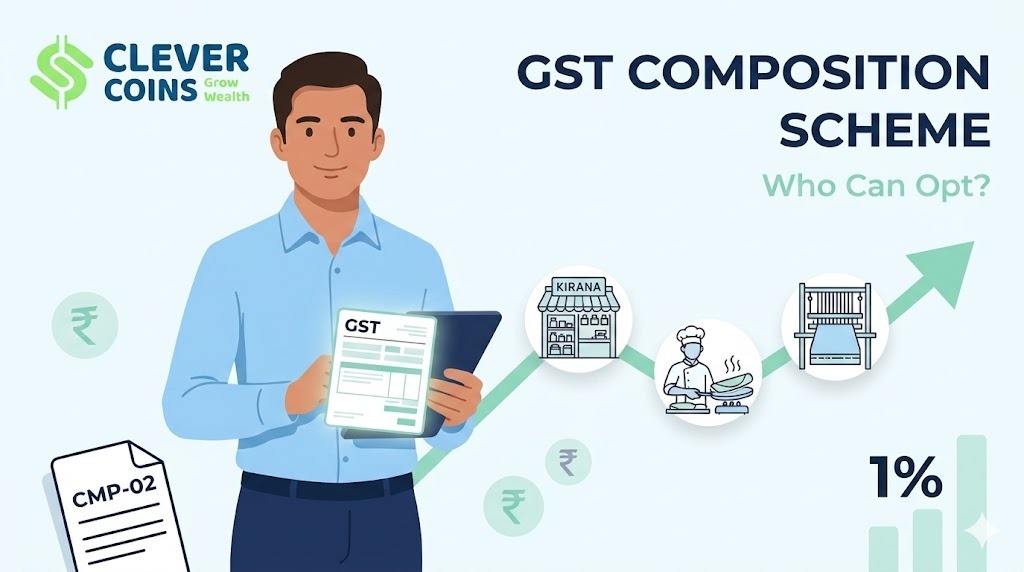
If you run a kirana store in Mumbra, a small textile unit in Bhiwandi, or a family restaurant anywhere in India, you have almost certainly heard the words “GST Composition Scheme” thrown around. And you have probably also heard conflicting answers about whether you qualify for it.
Here is the honest truth: the Composition Scheme can save a small business thousands of rupees in tax and dozens of hours in paperwork every year. But it is not for everyone. One wrong tick on Form CMP-02 and you could end up paying penalties, losing input tax credit, or getting your GSTIN flagged.
In this guide, we break down exactly who can opt for the GST Composition Scheme in 2026, who cannot, how much tax you actually pay, and when it makes sense to skip it entirely. No jargon. No confusing CA-speak. Just the facts, the way we explain them to our clients at CleverCoins every day.
What Is the GST Composition Scheme?
The GST Composition Scheme, introduced under Section 10 of the CGST Act, 2017, is a simplified tax route designed specifically for small taxpayers. Instead of calculating tax on every invoice, claiming input tax credit, and filing monthly returns, a composition dealer pays a fixed low percentage of turnover as tax and files just one quarterly payment plus one annual return.
Think of it like this: a regular GST taxpayer is a salaried employee filing ITR-2 with every capital gain and deduction itemised. A composition dealer is a freelancer under presumptive taxation — less control, less paperwork, predictable liability.
At a Glance — Why People Choose It • Tax rate drops to 1%, 5%, or 6% of turnover (vs 5% – 28% in regular GST) • Only one quarterly payment (CMP-08) and one annual return (GSTR-4) — not 12 monthly GSTR-1s and GSTR-3Bs • No input tax credit tracking, no e-invoice pressure, no monthly reconciliation stress |
Who Can Opt for the GST Composition Scheme?
Eligibility is decided by two things — your turnover and your business type. If both match, you are in.
Turnover Limits in 2026
Your aggregate turnover in the previous financial year must be below a specified threshold. This is computed on an all-India basis across every business under the same PAN — so if you have two shops under one PAN, their combined turnover is what counts.
Category of Business | Turnover Limit | Applies To |
Manufacturers & Traders of Goods | ₹ 1.5 Crore | Most Indian states including Maharashtra |
Goods Suppliers in Special Category States | ₹ 75 Lakh | Arunachal, Manipur, Meghalaya, Mizoram, Nagaland, Sikkim, Tripura, Uttarakhand |
Restaurants (not serving alcohol) | ₹ 1.5 Crore | Treated as goods suppliers under the scheme |
Pure Service Providers (Section 10(2A)) | ₹ 50 Lakh | Freelancers, consultants, salons, etc. |
Important nuance: manufacturers and traders are allowed to provide some services on the side (up to 10% of turnover in the preceding FY, or ₹5 lakh — whichever is higher) without losing their composition status. So a sweet shop that also delivers catering for small events doesn’t automatically get disqualified.
Eligible Business Types
- Small manufacturers — textile units, food processing, plastic goods, furniture, handicrafts, printing presses
- Traders & wholesalers — kirana stores, general stores, stationery, hardware shops, garment retailers
- Restaurants & dhabas — any food service not serving alcoholic beverages
- Service providers under 10(2A) — independent consultants, beauty parlours, laundromats, coaching classes, tailors, caterers (within the ₹50 lakh limit)
- Brick & mortar retailers — anyone whose customers are primarily end-consumers (B2C) within their own state
Who CANNOT Opt for the Composition Scheme?
Even if your turnover is below the limit, these exclusions apply — and they are strict. Missing even one of them invalidates your composition registration and attracts penalties.
✗ Inter-State Suppliers — If you sell goods or services outside your own state — even once — you are out. The scheme is intra-state only.
✗ Manufacturers of Notified Goods — Ice cream and other edible ice (with or without cocoa), pan masala, tobacco and tobacco substitutes, aerated waters, fly ash bricks, building bricks, earthen or roofing tiles.
✗ E-commerce Sellers via TCS Operators — If you sell through Amazon, Flipkart, Meesho, or any operator that collects TCS under Section 52 — you cannot opt in. The marketplace itself disqualifies you.
✗ Casual & Non-Resident Taxable Persons — Exhibition sellers, occasional traders, and any supplier registered as a non-resident cannot use the scheme.
✗ Suppliers of Non-Taxable Goods — If any part of your supply is goods that are not taxable under GST (e.g. petroleum, alcohol for human consumption), the scheme is off limits.
✗ Multiple GSTINs Under One PAN — Split Opt-In — All businesses under a single PAN must be on the scheme together. You cannot put one GSTIN under composition and keep another regular.
Composition Scheme Tax Rates
Here is where the scheme earns its reputation. Compare these against the 5% – 28% you would otherwise pay under regular GST slabs.
Type of Business | CGST | SGST | Total Tax |
Manufacturer | 0.5% | 0.5% | 1% of turnover |
Trader (Goods) | 0.5% | 0.5% | 1% of taxable turnover |
Restaurant (no alcohol) | 2.5% | 2.5% | 5% of turnover |
Service Provider (10(2A)) | 3% | 3% | 6% of turnover |
A quick worked example. A garment trader in Mumbra with ₹80 lakh turnover pays roughly ₹80,000 as GST for the entire year under the Composition Scheme. Under regular GST at 5%, the same business would pay ₹4 lakh — minus input tax credit, of course, but that ITC rarely closes a gap this wide for a small retailer whose customers are individual buyers.
Conditions You Must Follow
Opting in comes with a set of non-negotiable rules. Break any of these and your composition status can be cancelled retroactively.
- Cannot collect tax from customers. You pay the 1% / 5% / 6% from your own margin. That is why you issue a Bill of Supply, never a tax invoice.
- Cannot claim input tax credit. The GST you pay on purchases becomes a cost, not a credit.
- Must display “Composition Taxable Person” prominently at your place of business — shop signboard, office entrance, and on every Bill of Supply.
- Pay tax on reverse charge at normal rates. If you buy from unregistered suppliers where RCM applies, you pay full GST — not the composition rate.
- Cannot supply through e-commerce operators who collect TCS. Keep your sales offline or through non-TCS channels.
- Intra-state supply only. Cross a state border with your goods and you lose the scheme.
How to Opt In — The Actual Process
If You Are Already GST-Registered
File Form GST CMP-02 on the GST Portal before the start of the financial year. For FY 2026-27, the window closed on 31st March 2026 — but if you missed it, mark your calendar for 31st March 2027 for the following year. The path: Login → Services → Registration → Application to Opt for Composition Levy.
If You Are Registering for the First Time
Opt in directly on Form GST REG-01 at the time of registration. Tick the composition option and the portal will handle the rest.
After Opting In
Within 60 days of opting in, file Form GST ITC-03 to reverse any input tax credit lying in your electronic credit ledger. You are leaving the credit chain — that unused ITC has to be paid back.
Returns Under the Composition Scheme
Form | Purpose | Frequency | Due Date |
CMP-08 | Self-assessment tax payment | Quarterly | 18th of month after quarter end |
GSTR-4 | Annual consolidated return | Yearly | 30th April after FY end |
CMP-04 | Withdrawal from the scheme | On-event | Within 7 days of crossing limit |
Late filing of GSTR-4 attracts ₹50 per day (₹25 CGST + ₹25 SGST), capped at ₹2,000. Missing returns for three consecutive tax periods can lead to GSTIN cancellation — so don’t sleep on the dates.
Pros and Cons — The Honest Scorecard
✓ Where the Composition Scheme Wins • Dramatically lower tax outflow — 1% instead of 5% – 28% • Quarterly tax payment eases working capital pressure • One annual return instead of 24 – 36 monthly filings • No e-invoicing requirement regardless of turnover • No ITC reconciliation headache with vendor mismatches • Simpler accounting — saves CA and software fees |
✗ Where It Hurts • B2B customers cannot claim ITC from you — you become less competitive in wholesale supply • Zero inter-state sales — blocks e-commerce, export, SEZ supply • Tax comes out of your margin, not the customer’s wallet • Crossing the turnover limit mid-year forces an immediate painful shift to regular GST • Cannot sell through Amazon, Flipkart, Meesho, Myntra, or similar marketplaces |
When You Must Exit the Scheme
The day your aggregate turnover in the current financial year crosses the threshold (₹1.5 crore for goods, ₹50 lakh for services), your composition status lapses automatically. You must file Form GST CMP-04 within seven days and transition to regular GST from that date forward.
Good news at transition: you can claim ITC on the stock of inputs, semi-finished goods, and finished goods held on the day of withdrawal — provided you file Form GST ITC-01 within 30 days. Don’t leave money on the table.
A Real CleverCoins Client Example
Case Study — The Mumbra Hardware Store Client: A hardware trader in Mumbra with ₹92 lakh FY turnover and around 70% B2C (end-customer) sales. Before: Regular GST. Paying ~₹3.6 lakh annually in net GST after ITC, plus ₹18,000 yearly in compliance software and CA fees. Monthly GSTR-1 and GSTR-3B filing pressure. After opting in via CMP-02: Flat ₹92,000 tax on turnover. Only CMP-08 every quarter, GSTR-4 once a year. Annual saving: roughly ₹2.5 lakh plus around 50 hours of owner’s time. Caveat: We reviewed their customer mix first. Because only 30% were B2B and those buyers were mostly unregistered contractors, ITC pass-through was not a deal-breaker. For a business with mostly registered B2B buyers, the math would have gone the other way. |
Frequently Asked Questions
- Can I sell on Amazon or Flipkart under the Composition Scheme?
- No. Any supplier whose goods are sold through an e-commerce operator that collects TCS under Section 52 is specifically excluded from the scheme. You would need to shift to regular GST to sell on these marketplaces.
- What if my turnover crosses ₹1.5 crore in the middle of the year?
- Your composition status lapses from the day you cross the limit. File CMP-04 within seven days and start issuing tax invoices under regular GST from that date. Stock already held qualifies for ITC if you file ITC-01 within 30 days.
- Can I claim input tax credit on my old stock when switching to composition?
- No — the opposite. When you opt in, you must reverse any ITC lying in your credit ledger and on stock-in-hand by filing Form GST ITC-03 within 60 days.
- Is a freelance graphic designer eligible for the Composition Scheme?
- Yes, under Section 10(2A) for pure service providers, if their aggregate turnover is below ₹50 lakh and they do not make inter-state outward supplies. They would pay 6% of turnover as GST.
- Do I need to file monthly GSTR-1 or GSTR-3B under composition?
- No. You only file CMP-08 quarterly (for tax payment) and GSTR-4 annually (for the consolidated return). That is a massive reduction from the 24 monthly returns a regular taxpayer files.
- Can one GSTIN under a PAN be on composition while another stays regular?
- No. All GSTINs registered under the same PAN must be on the scheme together, or none of them. This is one of the most commonly missed rules.
Still Confused? Let Us Run the Numbers for You. At CleverCoins, we have helped 200+ small businesses across Mumbra, Thane and MMR evaluate whether the Composition Scheme actually saves them money — or costs them more in lost ITC. One 30-minute call. We pull your past 12 months of purchase & sales data, run both tax scenarios, and tell you straight: opt in, stay regular, or wait. 📞 Book a free consultation at clevercoins.org • Follow us on Instagram @clevercoins_official for daily GST tips in Hinglish. |
Disclaimer: This blog is for informational purposes only and reflects GST rules as of April 2026. Tax laws change through periodic CBIC notifications. Consult a qualified tax professional before making any registration decision.