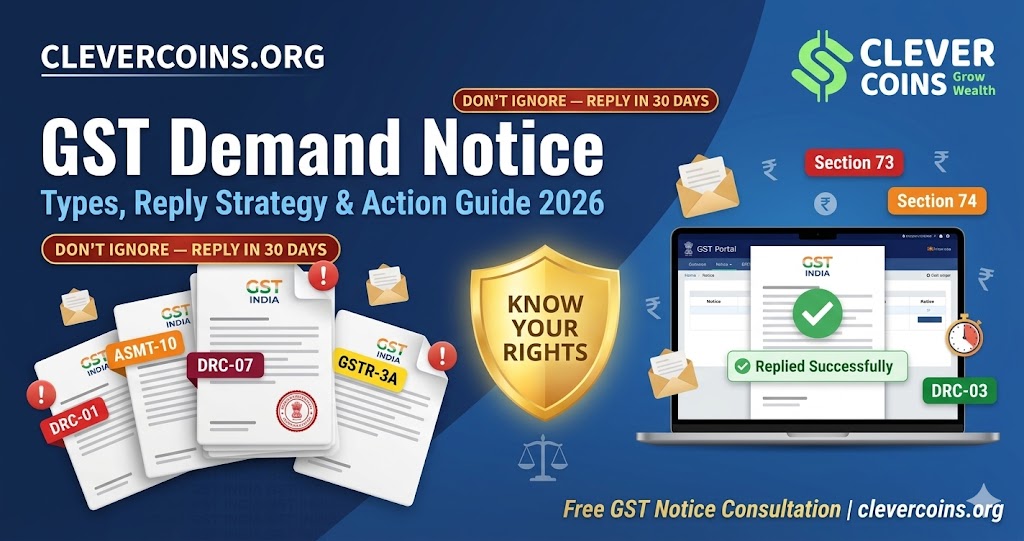
A GST Notice is Not the End — It’s a Beginning
Your heart skips a beat when you see an official GST department email or a message on the GST portal. ‘GST Demand Notice Issued.’ For most business owners, this is a moment of panic. Questions flood the mind: What did I do wrong? How much do I owe? Will my registration be cancelled? Can I go to jail?
The truth is — a GST demand notice is NOT the end of the world. It is the government’s way of initiating a dialogue. Most notices arise from data mismatches, reconciliation gaps, ITC discrepancies, or filing errors — issues that can be resolved with the right response, documentation, and professional guidance.
What you must NOT do is ignore a GST demand notice. Ignoring a notice escalates it from a communication to a demand order, and then to recovery proceedings — including attachment of bank accounts, property, and cancellation of GST registration.
In this comprehensive guide by CleverCoins, we explain every type of GST demand notice under the Indian GST law, why they are issued, what each notice means, the exact steps to reply, and how to protect your business from escalating consequences.
💡 CleverCoins Insight: Over 80% of GST demand notices issued to MSMEs and small traders are for issues that can be resolved without any actual additional tax payment — if responded to correctly and on time. The key is professional, timely, and well-documented reply. |
Overview: The GST Demand & Recovery Framework
The GST demand and notice framework is governed primarily by Sections 73, 74, and 75 of the Central Goods and Services Tax (CGST) Act, 2017, along with associated Rules under the CGST Rules, 2017. The framework creates a structured, time-bound process for issuing notices, allowing replies, conducting adjudication, and passing demand orders.
The Demand Lifecycle — From Notice to Recovery
Stage | Action / Document | Key Detail |
1 | Pre-Show Cause Letter (DRC-01A) | Informal communication inviting voluntary payment before formal notice — introduced in Rule 142(1A) |
2 | Show Cause Notice — SCN (DRC-01) | Formal legal notice demanding explanation — mandatory before any demand order |
3 | Reply to SCN (DRC-06) | Taxpayer submits written reply with evidence and documents |
4 | Personal Hearing | Officer grants hearing — taxpayer/representative presents case |
5 | Demand Order (DRC-07) | Final adjudication order confirming or modifying tax demand + interest + penalty |
6 | Payment / Appeal | Taxpayer pays DRC-07 amount OR files Appeal (APL-01) to Appellate Authority |
7 | Recovery Proceedings | If unpaid — bank account attachment, asset seizure, GSTIN cancellation |
⚠️ Critical Rule: A demand order (DRC-07) CANNOT be passed without first issuing a Show Cause Notice (DRC-01) and giving the taxpayer a reasonable opportunity to be heard. Any demand order passed without due process is invalid and can be challenged in appeal. |
The Two Master Sections: Section 73 vs Section 74 — Know the Difference
All GST demand notices stem from either Section 73 or Section 74 of the CGST Act. Understanding the distinction is critical because it determines the penalty exposure, interest rates, and safe harbour benefits available to you.
Parameter | Section 73 — Non-Fraud | Section 74 — Fraud / Wilful Misstatement |
Applicable When | Tax not paid / short paid due to genuine error, oversight or misinterpretation | Tax not paid due to fraud, suppression of facts, wilful misstatement or deliberate evasion |
Time Limit to Issue SCN | Within 3 years from the due date of annual return for the relevant FY | Within 5 years from the due date of annual return for the relevant FY |
Penalty — If paid before SCN | Nil (no penalty — just tax + interest) | 15% of tax due |
Penalty — If paid within 30 days of SCN | Nil (no penalty) | 25% of tax due |
Penalty — If paid within 30 days of DRC-07 Order | 10% of tax due (min ₹10,000) | 50% of tax due |
Penalty — If not paid / litigated | 10% of tax (min ₹10,000) | 100% of tax due |
Interest Rate | 18% per annum (Section 50) | 18% (but 24% for ITC overclaim under Sec 50(3)) |
Can It Be Reduced? | Yes — pay quickly; penalty reduced to nil/10% | Limited reduction — only via early payment stages |
⚡ Strategy Alert: If you receive a Section 74 notice but believe the non-payment was due to genuine error (not fraud), you can contest the classification and request the notice be treated under Section 73 instead. This can drastically reduce your penalty exposure from 100% to nil/10%. |
All Types of GST Demand Notices — Explained in Full
Type 1: ASMT-10 — Notice for Scrutiny of Returns
ASMT-10 is issued by the GST officer when discrepancies or inconsistencies are found during scrutiny of a filed GST return (GSTR-1, GSTR-3B, GSTR-9). This is NOT yet a demand notice — it is an inquiry notice.
Parameter | Detail |
Issued Under | Section 61 of CGST Act read with Rule 99 |
Common Reasons | GSTR-1 vs GSTR-3B mismatch, ITC claimed vs 2B mismatch, turnover difference with 26AS/AIS |
Reply Form | ASMT-11 (online on GST portal) |
Reply Deadline | Within 30 days of receipt of ASMT-10 (or extended period if granted) |
If No Reply | Officer may initiate assessment proceedings under Section 63 or issue SCN under Sec 73/74 |
Best Response Strategy | Explain each discrepancy with supporting documents; file ASMT-11 clearly and completely |
Type 2: DRC-01A — Pre-Show Cause Notice (Voluntary Payment Intimation)
DRC-01A is the government’s way of giving you an early warning — an opportunity to pay voluntarily before the formal legal process begins. It is an informal intimation, not yet an SCN.
Parameter | Detail |
Issued Under | Rule 142(1A) of CGST Rules |
Purpose | Invite taxpayer to pay tax + interest voluntarily before SCN is issued |
Benefit of Paying at DRC-01A Stage | Under Section 73: ZERO penalty payable. Under Section 74: Only 15% penalty. |
Response | Pay via DRC-03 (voluntary payment) within the time mentioned in DRC-01A |
If Disputed | File DRC-01A reply explaining why demand is incorrect — prevents issuance of SCN |
✅ Pro Tip: DRC-01A is the most favourable stage to resolve a demand. Under Section 73 cases, paying at the DRC-01A stage means ZERO penalty — you only pay the tax amount + 18% interest. Do not delay if the demand is genuine. |
Type 3: DRC-01 — Show Cause Notice (The Formal Notice)
DRC-01 is the formal Show Cause Notice (SCN) under Sections 73 or 74. This is the official commencement of the adjudication process. It must be taken very seriously.
Parameter | Detail |
Issued Under | Section 73(1) or Section 74(1) of CGST Act, Rule 142(1) |
Contents | Alleged grounds, tax demand amount, tax period, and request to show cause why demand should not be confirmed |
Reply Form | DRC-06 (online on GST portal) — formal reply to SCN |
Reply Deadline | Typically 30 days from receipt of SCN (extension possible on request) |
Hearing | After reply, officer grants a personal hearing via notice in DRC-01 itself or separate notice |
Penalty if paid within 30 days of SCN | Sec 73: Nil penalty | Sec 74: 25% of tax demand |
Outcome | If reply is satisfactory — SCN dropped. If not — DRC-07 (Demand Order) is passed. |
🚨 NEVER IGNORE DRC-01 (SCN): Failure to reply to an SCN within the stipulated time is treated as admission of the demand. The officer may then pass an ex-parte demand order (DRC-07) for the FULL amount demanded — without considering your side. This can be catastrophic for your business. |
Type 4: DRC-07 — Summary of Demand / Demand Order
DRC-07 is the Summary of Order — the final demand order passed by the GST officer after adjudication. It is not a notice but an order — the final word on the demand (subject to appeal).
Parameter | Detail |
Issued Under | Section 73(9) or 74(9) of CGST Act, Rule 142(5) |
Content | Final tax demand + interest + penalty as determined by the adjudicating authority |
Payment Window | Pay within 3 months of DRC-07 to get reduced penalty (Sec 73: 10%; Sec 74: 50%) |
Appeal Option | File Appeal (APL-01) before Appellate Authority within 3 months of DRC-07 |
Pre-deposit for Appeal | 10% of disputed tax amount must be deposited before appeal is admitted |
If Not Paid & No Appeal | Recovery proceedings initiated — bank attachment, asset seizure, GSTIN cancellation |
Type 5: GSTR-3A — Notice for Non-Filing of Returns
GSTR-3A is a notice issued to taxpayers who have not filed their mandatory GST returns (GSTR-1, GSTR-3B, GSTR-4, GSTR-7, GSTR-8) within the prescribed due dates.
Parameter | Detail |
Issued Under | Section 46 of CGST Act read with Rule 68 |
Common Reasons | Missed GSTR-3B / GSTR-1 filing for one or more months |
Time to Respond | 15 days from receipt of notice |
Required Action | File the pending return immediately + pay all taxes, interest, and late fees |
Consequence if Ignored | Best assessment under Section 62 — officer estimates your tax and passes an order |
Section 62 Assessment | Best judgement assessment — officer can estimate turnover and demand tax based on comparable businesses |
Type 6: MOV-09 / MOV-10 — E-Way Bill and Transit-Related Notices
These notices are issued during physical verification of goods in transit or at the taxpayer’s premises related to e-way bill violations.
Notice | Purpose |
MOV-07 | Show Cause Notice issued on the spot during goods interception for e-way bill violation |
MOV-09 | Demand order for tax and penalty after MOV-07 proceedings |
MOV-10 | Notice for confiscation of goods and/or conveyance |
Common Reasons | Expired e-way bill, mismatch in goods description/value, wrong GSTIN on e-way bill, no e-way bill for notified goods |
Type 7: ADT-02 — GST Audit Notice
ADT-02 is issued by the GST department when it initiates a departmental audit of a taxpayer’s records, books, and returns.
Parameter | Detail |
Issued Under | Section 65 of CGST Act read with Rule 101 |
Who Conducts | Commissioner or officer authorised by Commissioner |
Duration | Audit to be completed within 3 months (extendable by 6 months by Commissioner) |
Taxpayer Obligations | Provide books, records, returns, invoices, bank statements as requested |
Post-Audit | If discrepancy found — formal SCN under Section 73/74 issued. If no discrepancy — audit closure communicated. |
Type 8: REG-17 — Notice for Cancellation of GST Registration
REG-17 is a notice proposing cancellation of GST registration — either suo motu by the officer or on application by the taxpayer.
Common Grounds for REG-17 | Details |
Non-filing of returns | Consecutive non-filing of 6 or more returns (monthly) or 2 returns (quarterly) |
Business discontinued | Business has ceased operations |
Fraudulent registration | GSTIN obtained using fake documents or non-existent business address |
Violation of GST provisions | Repeated non-compliance, fake ITC, circular trading |
Reply Required | REG-18 — reply within 7 working days of REG-17 to prevent cancellation |
Master Reference Table — All GST Notices at a Glance
Notice Form | Section/Rule | Purpose | Reply Form | Deadline |
ASMT-10 | Sec 61 / Rule 99 | Scrutiny of returns — clarification sought | ASMT-11 | 30 days |
DRC-01A | Rule 142(1A) | Pre-SCN voluntary payment intimation | DRC-01A reply / DRC-03 | As per notice |
DRC-01 | Sec 73 / 74 | Formal Show Cause Notice for tax demand | DRC-06 | 30 days |
DRC-07 | Sec 73(9)/74(9) | Final Demand Order (adjudication) | APL-01 (Appeal) | 3 months (pay/appeal) |
GSTR-3A | Sec 46 / Rule 68 | Non-filing of returns notice | File pending returns | 15 days |
MOV-07 | Sec 129 | E-Way Bill violation on-spot SCN | MOV-08 (spot reply) | On-spot |
MOV-09/10 | Sec 129/130 | Demand order / confiscation for transit violations | Appeal / DRC-03 | 7 days |
ADT-02 | Sec 65 / Rule 101 | Departmental audit initiation notice | Cooperate with audit | Within 15 days of notice |
REG-17 | Sec 29 / Rule 22 | Notice for GST registration cancellation | REG-18 | 7 working days |
CMP-05 | Rule 6(4) | Show Cause for cancellation of Composition Scheme | CMP-06 | 15 days |
Top Reasons Why GST Demand Notices Are Issued
Understanding why notices are issued helps you avoid them proactively. Here are the most frequent triggers:
1. ITC Mismatch — GSTR-2B vs GSTR-3B
The most common trigger. If you claimed more ITC in GSTR-3B than what appears in your GSTR-2B (auto-populated from supplier returns), the system flags it and the officer issues ASMT-10 or DRC-01A.
- Cause: Supplier filed GSTR-1 late or incorrectly, creating a 2B vs 3B gap
- Cause: You claimed ITC on ineligible invoices (blocked under Section 17(5))
- Cause: You claimed ITC on RCM purchases without actually paying RCM tax
2. GSTR-1 vs GSTR-3B Mismatch — Turnover Difference
If the outward supply data in GSTR-1 shows higher turnover than what was reported (and tax paid) in GSTR-3B, the system identifies the gap and triggers a demand.
- Cause: Invoice deleted from GSTR-1 after 3B was filed
- Cause: B2C turnover understated in GSTR-3B
- Cause: Amendments in GSTR-1 not reflected in 3B payment
3. Non-Payment / Short Payment of GST
Direct trigger for Sections 73/74. Tax collected from customers but not deposited with the government is the most serious form of GST default.
4. Non-Filing or Late Filing of Returns
Consecutive non-filing triggers GSTR-3A followed by best assessment under Section 62 and ultimately registration cancellation.
5. E-Way Bill Violations
Goods moved without a valid e-way bill, or with an expired one, or with wrong vehicle/route details are intercepted — leading to MOV-07 and MOV-09 notices.
6. Excess ITC or Fake ITC Claims
Circular trading, fake invoicing, or inflated purchases lead to Section 74 notices (fraud) with 100% penalty exposure.
7. Turnover Underreporting or Cash Economy Detection
GSTN’s AI and analytics cross-match your GST turnover with data from Income Tax (26AS/AIS), customs data, banking data, and e-way bill data. Any unexplained differences trigger notices.
8. Reversal Not Done for Exempt / Non-Business Use
If you have mixed supplies (exempt + taxable) and have not done the Rule 42/43 ITC reversal, it triggers a notice for wrongful ITC retention.
How to Reply to a GST Demand Notice — Step-by-Step Action Plan
Step 1: Don’t Panic — Read the Notice Carefully
The first step is to carefully read the entire notice. Note the following key elements:
- Type of notice (ASMT-10, DRC-01A, DRC-01, etc.) and the specific form number
- Tax period under consideration (FY / month)
- Specific allegations — what discrepancy or non-compliance is alleged
- Tax demand amount (tax, interest, penalty — separately mentioned)
- Reply due date — this is the most critical piece of information
- Name and designation of the issuing officer
Step 2: Preserve All Evidence and Documents
Immediately gather and secure all documents related to the period and issue mentioned in the notice:
- GSTR-1, GSTR-3B, GSTR-2A, GSTR-2B for relevant period
- Purchase invoices, sales invoices, credit/debit notes
- Payment challans (GSTR-3B payments)
- Books of accounts — ledgers, purchase register, sales register
- Bank statements (for reconciling payments)
- E-way bills (for transit-related notices)
- Any previous correspondence with the department on the same matter
Step 3: Analyse the Demand — Agree, Disagree, or Partially Agree
After reviewing your records, classify the demand into one of three categories:
Classification | Meaning | Recommended Action |
Fully Agree | Department’s demand is correct — tax was short paid or ITC overclaimed | Pay tax + interest via DRC-03 immediately to avail minimum penalty; reply confirming payment |
Partially Agree | Some part of demand is valid, rest is incorrect | Pay the agreed portion via DRC-03; contest the rest with detailed written reply and evidence |
Fully Disagree | Demand is baseless, incorrect, or based on wrong interpretation | File comprehensive written reply (DRC-06 for SCN) with full supporting documents and legal grounds |
Step 4: Draft the Reply (DRC-06 for SCN / ASMT-11 for ASMT-10)
The reply is your most important weapon. A well-drafted, professional, and legally supported reply can get the notice dropped entirely. Your reply must include:
- Reference to the notice number, date, and tax period
- A clear, point-by-point response to each allegation in the notice
- Legal grounds — cite relevant sections, rules, circulars, or court judgements that support your position
- Factual explanation with supporting evidence — invoices, ledgers, bank statements
- Reconciliation statements showing how the claimed difference has been explained
- Declaration that all taxes have been paid (attach challan proofs)
- Prayer / Conclusion — request to drop the notice / confirm reduced demand
💡 Professional Tip: The reply must be formal, factual, and legally referenced. Emotional language or aggressive tone can prejudice the officer. Stick to facts, legal citations, and documentary evidence. When in doubt, engage a GST professional like CleverCoins to draft the reply. |
Step 5: File the Reply on GST Portal Within Deadline
- Log in to GST portal → Services → User Services → My Applications
- For DRC-06 (reply to SCN): Go to ‘Notices/Orders’ — locate the specific DRC-01 notice — click ‘Reply’
- For ASMT-11 (reply to ASMT-10): Go to ‘Returns’ → ‘Notices’ → Locate ASMT-10 → ‘File Reply’
- Attach all supporting documents (PDF format, max file size as specified)
- Submit with DSC (Digital Signature Certificate) or EVC (Electronic Verification Code)
- Download and save the acknowledgement number and filed copy
🚨 DEADLINE IS EVERYTHING: Missing the reply deadline on a DRC-01 (SCN) means the officer can pass an ex-parte demand order confirming the entire demand without considering your reply. Once DRC-07 is passed without your reply, your only recourse is Appeal — which costs 10% pre-deposit and takes months. File on time, ALWAYS. |
Step 6: Attend the Personal Hearing
The officer must grant a personal hearing before passing any demand order. Attend the hearing prepared:
- Carry physical copies of all documents submitted online
- Prepare a brief verbal presentation supporting your written reply
- Bring a professional (CA, GST consultant) for representation if the demand is large
- Record the hearing date, officer’s observations, and any directions given
- If hearing is granted virtually (video conferencing), test the setup beforehand
Step 7: Post-Hearing — Await Order or Make Payment
After the hearing, the officer has two options:
- Drop the notice / SCN — if reply is satisfactory. You receive a closure order.
- Pass a demand order (DRC-07) — confirming tax + interest + penalty (possibly reduced based on your reply)
If DRC-07 is passed, review it carefully. If you agree with the order, pay within 3 months. If you disagree, file Appeal (APL-01) within 3 months with 10% pre-deposit.
Appealing a GST Demand Order — The APL-01 Process
Grounds for Filing Appeal
- The demand order is based on incorrect facts
- The officer misapplied the law or ignored binding circulars/court judgements
- Natural justice not followed — no proper hearing was granted
- The Section 74 (fraud) classification was unjustified — should be Section 73
- Penalty imposed is disproportionate to the alleged violation
Appeal Authorities Under GST
Level | Authority | Limitation Period |
First Appeal | Appellate Authority (Joint/Additional Commissioner) | 3 months from DRC-07 date |
Second Appeal | GST Appellate Tribunal (GSTAT) | 3 months from First Appellate Order |
High Court | High Court (on questions of law only) | As per HC rules |
Supreme Court | Supreme Court of India | As per SLP rules |
⚖️ Section 107 Pre-Deposit Rule: To file a first appeal, you must deposit 10% of the disputed tax amount (minimum ₹25,000). This is non-refundable if appeal is dismissed but is adjusted if appeal is allowed. Budget for this when planning your appeal strategy. |
DRC-03 — Voluntary Payment: Your Best Friend
DRC-03 is the form used to make voluntary payment of GST, interest, and/or penalty — either proactively (before notice) or in response to a notice at any stage. Using DRC-03 correctly can save you massive penalties.
Stage of Payment | Benefit Under Section 73 |
Before DRC-01A / SCN issued | Tax + interest only — ZERO penalty |
Within 30 days of DRC-01 (SCN) | Tax + interest only — ZERO penalty |
Within 30 days of DRC-07 (Order) | Tax + interest + 10% penalty (min ₹10,000) |
After 30 days of DRC-07 | Tax + interest + 10-100% penalty (officer’s discretion) |
Critical Mistakes to Avoid When Dealing With GST Notices
# | Mistake | Correct Approach |
1 | Ignoring the notice assuming it will go away | All GST notices have legal consequences. Reply immediately. |
2 | Filing a vague, one-line reply | File a detailed, document-supported reply addressing each allegation specifically |
3 | Missing the reply deadline | Set calendar reminders the day notice is received; engage CA/consultant immediately |
4 | Accepting Section 74 (fraud) classification without challenge | If you believe it’s a genuine error, contest the classification as Section 73 |
5 | Not making DRC-03 payment when demand is clearly correct | Early payment = zero penalty under Sec 73; delay = 10–100% penalty |
6 | Not attending the personal hearing | Absence is treated negatively by the officer; always attend or send a representative |
7 | Not keeping proof of reply submission | Always download and save the acknowledgement after filing reply online |
8 | Handling high-value notices (above ₹5 lakh) without a professional | Engage a GST professional — the cost of professional help is far less than penalty exposure |
9 | Filing Appeal without the 10% pre-deposit | Appeal is not admitted without pre-deposit — plan cash flow accordingly |
10 | Not tracking the appeal / notice status on GST portal | Regularly check portal for any updates, orders, or additional notices |
How to Prevent GST Demand Notices — 10 Proactive Measures
- File GSTR-1 and GSTR-3B on time every month — no exceptions
- Reconcile GSTR-2B with GSTR-3B every month before filing 3B
- Reconcile GSTR-1 with GSTR-3B output tax every month
- Never claim ITC on blocked credits (Section 17(5) list)
- Ensure all suppliers file their GSTR-1 on time — follow up regularly
- Reverse ITC for unpaid invoices before 180 days elapse
- File GSTR-9 and GSTR-9C accurately and on time every year
- Maintain valid e-way bills for all goods movements above threshold
- Keep all invoices, purchase orders, delivery challans, and payment records digitally organised
- Engage a professional GST compliance partner (like CleverCoins) for year-round monitoring
How CleverCoins Handles GST Demand Notices for You
At CleverCoins, we understand that receiving a GST demand notice is stressful. Our experienced GST professionals handle every type of GST notice with precision, strategy, and timely action:
- Immediate notice review and classification (Sec 73 vs 74, ASMT-10 vs DRC-01 vs REG-17)
- Root cause analysis — identifying the exact data or compliance issue that triggered the notice
- Comprehensive, legally referenced reply drafting (DRC-06, ASMT-11, REG-18)
- Evidence compilation and reconciliation statement preparation
- DRC-03 voluntary payment advisory — optimise penalty exposure at every stage
- Personal hearing attendance and officer representation
- Post-hearing follow-up and DRC-07 order analysis
- Appeal filing (APL-01) before Appellate Authority if demand order is unjust
- Preventive compliance monitoring — proactive 2B vs 3B reconciliation to stop notices before they start
🛡️ CleverCoins — Your GST Shield. From the first notice to the final resolution, we fight for your business. Visit www.clevercoins.org | Free GST Notice Consultation Available. |
Conclusion: React Fast, Reply Right, Resolve Completely
GST demand notices are an inherent part of the compliance landscape in India — especially for growing businesses with complex transactions. The GST department’s data analytics capabilities are becoming sharper every year, and notices will only become more frequent and targeted.
Your best defence is a two-pronged strategy: proactive month-on-month compliance (preventing notices) and swift, professional response when notices do arrive. A well-drafted reply, backed by strong documentation and submitted on time, resolves the vast majority of GST demand notices without any significant financial consequence.
Remember: a GST notice demands a response, not panic. With CleverCoins by your side, every notice becomes manageable.
Disclaimer: This blog is for educational purposes only, updated as of June 2026. GST laws, forms, and procedures are subject to amendment. Always consult a qualified GST practitioner for advice specific to your business and notice.