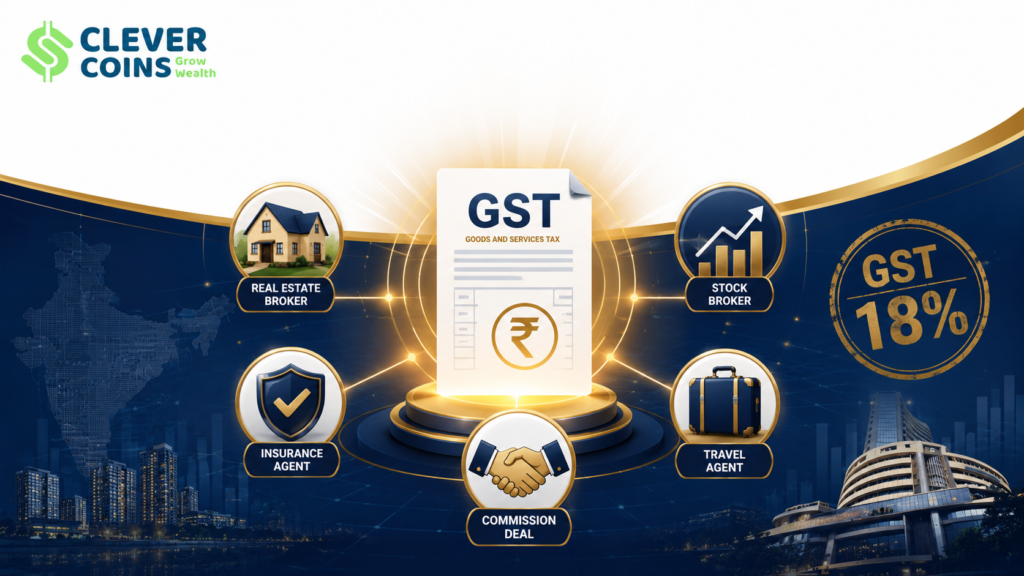
Why GST on Commission & Brokerage Matters in 2026
Commission and brokerage income is one of the most widespread forms of business earnings in India — from real estate agents and stock brokers to insurance agents, travel agents, commodity traders, and referral-fee earners. Yet, the GST treatment of commission and brokerage income remains one of the most frequently misunderstood areas of indirect taxation.
Whether you are a commission agent earning ₹5 lakh a year from property deals, a stock broker handling crores in daily turnover, an insurance agent earning renewals, or a company paying referral bonuses — GST on commission and brokerage applies differently in each scenario. The consequences of getting it wrong range from interest and penalties to denial of Input Tax Credit (ITC) and even prosecution under the GST Act.
This comprehensive guide — updated as per Finance Act 2026, CBIC Circulars, and GST Council decisions up to May 2026 — covers every aspect: applicable GST rates, SAC codes, registration thresholds, invoicing rules, ITC eligibility, TDS/TCS implications, sector-specific treatment, and compliance best practices.
What is Commission & Brokerage? — Legal Definitions Under GST
Commission: Legal Meaning
Commission is a fee paid to an agent or intermediary for performing a service on behalf of a principal — typically for facilitating a transaction, sale, or business deal. Examples:
- Real estate agent earning a percentage of property sale value
- Insurance agent earning commission from insurer for selling a policy
- Business development executive earning referral fee for leads
- Trade agent earning a cut for facilitating import/export transactions
- Mutual Fund distributor earning trail commission from AMC
Brokerage: Legal Meaning
Brokerage refers to a fee charged by a broker — an intermediary who arranges transactions between buyers and sellers — for executing trades or facilitating deals. Examples:
- Stock broker charging brokerage on equity trades on NSE/BSE
- Commodity broker charging fees on MCX/NCDEX trades
- Forex broker charging spread and commission on currency trades
- Ship broker earning brokerage on cargo/vessel charters
GST Perspective: Commission & Brokerage as a Supply of Service
Under the CGST Act 2017 (as amended), both commission and brokerage income are treated as a supply of services. The relevant category is ‘intermediary services’ or ‘agent services’ depending on the nature of engagement. This classification has significant implications for the place of supply, GST rate, and ITC eligibility.
Key Principle: Under GST, an agent acts on behalf of the principal. The commission/brokerage received by the agent IS the consideration for the agent’s service to the principal — and is fully taxable as a supply of services, unless specifically exempted.
GST Rate on Commission & Brokerage — 2026 Rates
Standard GST Rate: 18%
The standard GST rate applicable on commission and brokerage services in India is 18% (9% CGST + 9% SGST for intra-state, or 18% IGST for inter-state). This rate has been consistent since the GST rollout in July 2017 and remains unchanged as per GST Council decisions up to May 2026.
|
Service Type |
SAC Code |
GST Rate |
Applicable Tax |
|
General commission/brokerage services |
9961 / 9985 |
18% |
CGST 9% + SGST 9% / IGST 18% |
|
Stock & commodity brokerage |
99715 |
18% |
CGST 9% + SGST 9% / IGST 18% |
|
Real estate agent/broker services |
99721 |
18% |
CGST 9% + SGST 9% / IGST 18% |
|
Insurance agent commission |
99712 |
18% |
CGST 9% + SGST 9% / IGST 18% |
|
Travel agent commission |
99855 |
18% |
CGST 9% + SGST 9% / IGST 18% |
|
Mutual fund distribution commission |
99715 |
18% |
CGST 9% + SGST 9% / IGST 18% |
|
Ship/freight broker commission |
99655 |
18% |
CGST 9% + SGST 9% / IGST 18% |
|
Commission on agricultural produce (pure agents) |
Nil |
0% (Exempt) |
Exempt under Notfn 12/2017 |
|
Insurance commission to small agents (exempt) |
— |
0% (Exempt) |
Below threshold / specific exempt |
SAC Code Explained
SAC stands for Services Accounting Code — the classification system used under GST to categorise services, similar to HSN codes for goods. Correct SAC codes must be mentioned on GST invoices for commission/brokerage services. The primary SAC codes are:
- 99611 — Services of agents involved in the sale of agricultural raw material, livestock, textile fibres and agricultural inputs
- 99612 — Services of agents involved in the sale of food, beverages and tobacco
- 99715 — Financial and related services including brokerage services
- 99721 — Real estate services involving owned or leased property
- 99855 — Travel arrangement and tour operator services
GST Registration for Commission & Brokerage Agents
Threshold Limits (As per Finance Act 2026)
The GST registration thresholds applicable to commission and brokerage agents as of 2026 are:
|
Category |
Registration Threshold |
Notes |
|
Normal States & UTs (services) |
₹20 lakh aggregate turnover |
Standard threshold for service providers |
|
Special Category States (NE + Himachal, etc.) |
₹10 lakh aggregate turnover |
J&K included at ₹20 lakh from 2020 |
|
E-commerce operator / supply through ECO |
No threshold — mandatory |
Must register regardless of turnover |
|
Inter-state commission agent |
No threshold — mandatory |
Inter-state supply triggers mandatory registration |
|
Commission agent for agricultural produce |
No threshold — mandatory if agent |
Even if commission earned is below threshold |
|
Non-resident taxable person |
No threshold — mandatory |
Register before starting supply |
Important 2026 Update: CBIC Circular No. 220/34/2024-GST (issued January 2025) clarified that commission agents earning solely from agricultural commodity markets (APMC mandis) who act as pure agents are NOT required to register under GST if they do not collect GST from the farmer/buyer and the commission is embedded in the transaction price. This relief is applicable only to agents covered under APMC Acts.
Mandatory Registration Irrespective of Turnover — Commission Agents
The following types of commission agents MUST register under GST regardless of their annual turnover:
- Agents who supply goods or services on behalf of a registered principal (Section 24(vii) of CGST Act)
- Commission agents conducting inter-state business
- Commission agents who are input service distributors
- Commission agents supplying through e-commerce operators
- Commission agents who are required to pay GST under reverse charge mechanism
Place of Supply Rules for Commission & Brokerage
Why Place of Supply is Critical
The Place of Supply (PoS) determines whether CGST+SGST or IGST is levied on commission/brokerage income. Getting the PoS wrong leads to wrong tax payment — CGST+SGST paid instead of IGST or vice versa — which creates refund complexity and potential demands.
Place of Supply: General Rules for Intermediary Services
Under Section 13(8)(b) of the IGST Act (as interpreted by courts up to 2026), for intermediary services:
- Where the supplier (agent) is located in India and the transaction involves parties outside India — the Place of Supply is the location of the supplier (i.e., India). Therefore, CGST+SGST (or IGST if inter-state within India) applies — NOT zero-rated export.
- This has been a heavily litigated issue. The Supreme Court, in several cases up to 2025, upheld the view that intermediary services in India cannot be zero-rated merely because the principal is overseas.
- Commission earned by Indian agents from foreign principals IS taxable at 18% GST in India.
|
Scenario |
Agent Location |
Principal Location |
PoS |
Tax |
|
Intra-state commission |
Maharashtra |
Maharashtra |
Maharashtra |
CGST + SGST @ 18% |
|
Inter-state commission (domestic) |
Maharashtra |
Delhi |
Agent’s state |
IGST @ 18% |
|
Indian agent — foreign principal |
India |
Outside India |
India (Agent’s location) |
IGST @ 18% (NOT zero-rated) |
|
Foreign agent — Indian principal |
Outside India |
India |
Outside India |
No Indian GST (PoS outside India) |
|
Commission on import transactions |
India |
India/Foreign |
India |
IGST @ 18% |
Critical Alert: Many Indian agents earning from foreign companies wrongly treat their commission as an export of service (zero-rated). CBIC and GST authorities have issued notices in such cases. Ensure your tax consultant reviews the intermediary services PoS rules carefully.
Sector-Wise GST Treatment on Commission & Brokerage
1. Real Estate Commission & Brokerage
Real estate agents/brokers in India earning commission on property transactions are subject to 18% GST on their commission income. Key points:
- Commission earned by property brokers on sale/purchase of under-construction flats: 18% GST.
- Commission on resale of completed/ready-to-move properties (no GST on property itself): The broker’s commission is still subject to 18% GST.
- Commission on commercial property leases/rentals: 18% GST on commission income.
- Land sale transactions: No GST on land per se, but the agent’s commission is taxable at 18%.
Example: Mr. Arun Kumar, a Mumbai-based property broker, earns ₹5,00,000 as commission on sale of an apartment worth ₹1 crore. GST applicable on his commission income = ₹5,00,000 × 18% = ₹90,000. He must issue a GST invoice and file returns accordingly.
2. Stock Broking & Securities Brokerage
Stock brokers registered with SEBI earning brokerage on equity, derivatives, currency, and commodity trades are subject to 18% GST on their brokerage income. In addition to GST:
- Securities Transaction Tax (STT) is separately applicable on trades — STT is NOT part of GST.
- Stock brokers must file GSTR-1 (outward supplies) and GSTR-3B monthly.
- The GST base is the brokerage charged, NOT the transaction value. E.g., if a broker charges ₹100 brokerage on a ₹1,00,000 trade, GST applies on ₹100 → GST = ₹18.
- Discount brokers (Zerodha, Groww, Angel One) also charge 18% GST on their flat-fee brokerage.
- Depository participant (DP) charges are also subject to 18% GST.
2026 Clarification: SEBI & CBIC joint circular (March 2026) clarified that exchange transaction charges, SEBI turnover fees, and clearing charges are NOT brokerage and are not subject to 18% GST separately if already included in the brokerage amount reported.
3. Insurance Agent Commission
Insurance agent commission is one of the most nuanced areas under GST:
- Commission received by insurance agents (individual / corporate) from insurance companies is subject to 18% GST.
- GST is payable by the insurance agent on the commission received. The insurance company (insurer) pays GROSS commission; agent remits 18% GST to government.
- Under Reverse Charge Mechanism (RCM) — Section 9(3) of CGST Act: If the insurance company pays commission to an unregistered agent, the insurance company must pay GST under RCM on the commission paid.
- Post-2026, IRDAI’s revised commission structure and CBIC’s alignment circular mean agents earning above ₹20 lakh in commission MUST mandatorily register.
- Point-of-Sales (POS) agents and micro-insurance agents: May be covered under composition scheme if eligible.
Example: Ms. Priya Sharma is an LIC agent earning ₹8,00,000 in total commission in FY 2025–26. Her GST liability = ₹8,00,000 × 18% = ₹1,44,000. She must register, collect GST from LIC (or LIC deducts and pays under RCM), and file quarterly returns under QRMP scheme.
4. Mutual Fund Distribution Commission
Mutual Fund (MF) distributors/agents earning trail commission and upfront commission from Asset Management Companies (AMCs) are subject to 18% GST. Key developments in 2026:
- SEBI banned upfront commissions in October 2018; trail commissions continue. 18% GST applies on all trail commission received.
- AMFI (Association of Mutual Funds in India) registers distributors; GST registration is mandatory for distributors earning above ₹20 lakh.
- GST Invoice: AMC deducts TDS under Income Tax Act and pays GST on commission. Distributor must match the commission in GSTR-2B with GSTR-1 of AMC.
- RCM: If the distributor is unregistered, the AMC pays 18% GST under RCM.
5. Travel Agent Commission
Travel agents earning commission on airline tickets, hotel bookings, tour packages, and visa facilitation are subject to GST. The rate structure is:
- Commission from airlines on ticket sales: 18% GST on commission income.
- Tour package sales to customers: GST is on the value of the package supplied (not the commission embedded within it). Rates vary — 5% on tour packages without ITC for some categories.
- Hotel booking commissions: 18% GST on commission received from hotels.
- Outbound tour operator services: Treated as export of service if conditions met — zero-rated.
6. Commodity & Futures Broker Commission
- Commodity brokers on MCX (Multi Commodity Exchange) and NCDEX: 18% GST on brokerage income.
- Agricultural commodity futures: 18% GST on brokerage, NOT on the commodity value itself.
- Warehousing and storage charges by commodity brokers: Separate GST rate (5% or 18% depending on commodity).
7. Referral Fees & Marketing Commission
In the digital economy, referral fees and performance-based marketing commissions have emerged as major income streams. GST treatment:
- Referral fees paid by companies to individuals/entities for customer referrals: 18% GST.
- Affiliate marketing commissions earned through e-commerce platforms: 18% GST.
- Lead generation fees: 18% GST (treated as marketing/intermediary services).
- If the referral fee payer is registered and the recipient is unregistered: RCM applies — the payer pays 18% GST under RCM.
GST Exemptions on Commission & Brokerage — 2026 Status
Notification 12/2017-Central Tax (Rate) — Exempt Services
Certain commission/brokerage activities are exempt from GST under Notification 12/2017-CT(Rate), as amended up to 2026:
|
Exempt Category |
Relevant Entry |
Conditions |
|
Services by commission agent for agricultural produce |
Entry 54 |
Agent must be acting in APMC-regulated market; produce must be unprocessed agricultural produce |
|
Services by individual direct selling agents (DSA) of banks — loans/advances |
Entry 29A (amended 2021) |
DSA must be individual (not corporate); service to scheduled banks for extending deposits/loans |
|
Life insurance services — specified basic policies |
Entry 36 |
Only for specific government-scheme life insurance (e.g., Pradhan Mantri Jeevan Jyoti Bima) |
|
Commission on chit fund subscriptions — foreman’s fee above ₹12% |
Taxable at 12% |
Chit fund foreman’s commission taxable at 12% GST (reduced rate, not exempt) |
|
Services by SEBI-regulated intermediaries on sovereign debt instruments |
Specific CBIC circular |
Limited application — check latest CBIC circulars |
Important: Exemptions are very narrowly defined. If your commission activity does not precisely fit the exemption notification, it is taxable at 18%. When in doubt, assume taxability and consult a GST practitioner.
Composition Scheme — Is It Available for Commission Agents?
Commission agents generally CANNOT opt for the Composition Scheme under GST because:
- The Composition Scheme is not available to service providers with turnover exceeding ₹50 lakh (for service-only suppliers). However, from 2019, a limited composition scheme at 6% GST is available for service providers with aggregate turnover up to ₹50 lakh.
- Commission/brokerage agents who also deal in goods CAN opt for composition if their total turnover (goods + services) is below ₹1.5 crore AND services do not exceed 10% of turnover or ₹5 lakh, whichever is higher.
- Composition scheme registrants CANNOT issue a Tax Invoice — they issue a Bill of Supply — so the principal CANNOT take ITC on commissions paid.
Input Tax Credit (ITC) on Commission & Brokerage — Rules & Restrictions
ITC for the Commission Agent (Service Provider)
A registered commission agent can avail ITC on GST paid on inputs, input services, and capital goods used for providing taxable commission/brokerage services. Common ITC-eligible expenses for commission agents include:
- Office rent (18% GST) — eligible ITC
- Professional services (CA, legal fees) — 18% GST — eligible ITC
- Software subscriptions (CRM, trading platforms) — 18% GST — eligible ITC
- Mobile/internet services — 18% GST — eligible ITC
- Advertising and marketing services — 18% GST — eligible ITC
- Office supplies and equipment — GST paid — eligible ITC
ITC NOT Available on Certain Expenses
Under Section 17(5) of the CGST Act (blocked credits), commission agents CANNOT claim ITC on:
- Motor vehicles (cars) used by agents — ITC blocked unless used for further supply of vehicle transportation services
- Food and beverages — ITC blocked
- Membership of clubs, health and fitness centres — ITC blocked
- Life insurance and health insurance of employees — partially restricted
- Works contract services for construction of own office — ITC blocked
ITC for the Principal Paying Commission
The business entity (principal) paying commission/brokerage to a registered agent CAN claim ITC on the GST paid to the agent, provided:
- The principal receives a valid GST Tax Invoice from the agent with correct GSTIN, SAC code, and GST amount.
- The commission is used for taxable outward supplies (not for exempt or personal purposes).
- The GST paid by the agent is reflected in GSTR-2B of the principal (auto-populated from GSTR-1 of the agent).
- Payment has been made to the agent within 180 days of invoice date (failing which, ITC must be reversed per Rule 37 of CGST Rules).
2026 Update — Rule 37A: As per CGST Rules amendment effective April 2025, ITC will be automatically reversed from the recipient’s GSTR-3B if the supplier (commission agent) does not file their GSTR-3B for the period. Recipients must regularly reconcile GSTR-2B to ensure agent compliance.
Reverse Charge Mechanism (RCM) on Commission Payments
When Does RCM Apply on Commission/Brokerage?
Under Section 9(3) and 9(4) of the CGST Act, RCM applies in specific commission/brokerage scenarios:
|
Scenario |
RCM Trigger |
Who Pays GST |
Rate |
|
Commission paid to unregistered agent by registered principal |
Section 9(4) (if notified) |
Principal (recipient) |
18% |
|
Commission paid by insurance company to unregistered agent |
Section 9(3) Notfn 13/2017 |
Insurance company |
18% |
|
Commission paid to GTA (Goods Transport Agency) |
Section 9(3) |
Service recipient |
5% or 12% |
|
Commission paid to a director (whole-time/part-time) |
Section 9(3) Notfn 13/2017 |
Company |
18% |
|
Import of brokerage services from abroad |
Section 5(3) IGST Act |
Indian recipient |
18% IGST |
|
Commission paid to advocate / legal service provider |
Section 9(3) Notfn 13/2017 |
Business recipient |
18% |
RCM Compliance Steps for Principals Paying Commission:
- Determine if the commission agent is registered under GST. Ask for their GSTIN.
- If unregistered: Evaluate RCM applicability based on notification entries.
- Pay GST under RCM by raising a self-invoice (Rule 36 of CGST Rules).
- Report RCM liability in GSTR-3B Table 3.1(d) — Inward supplies liable to reverse charge.
- Claim ITC on RCM paid in the same return (eligible if used for business).
TDS/TCS Under GST for Commission & Brokerage
GST TDS (Section 51 of CGST Act)
Certain specified government entities, PSUs, and local bodies are required to deduct GST TDS at 2% (1% CGST + 1% SGST) on payments exceeding ₹2,50,000 to a supplier, including commission agents. As of 2026:
- GST TDS deductors: Central/State Government, Government Authorities, PSUs, local authorities, entities with Government equity > 51%.
- Threshold: Payment of ₹2,50,000 or more per contract for taxable supplies.
- Commission agents supplying to government entities face GST TDS deduction.
- The deducted TDS is credited to the agent’s Electronic Cash Ledger on GSTN portal.
- TDS certificate (Form GSTR-7A) must be issued by deductor within 5 days of deducting TDS.
GST TCS (Section 52 of CGST Act) — E-Commerce Operators
E-commerce operators (like Amazon, Flipkart, Meesho, Swiggy, Zomato) are required to collect TCS at 1% (0.5% CGST + 0.5% SGST / 1% IGST) on the net taxable supplies made by suppliers through their platform. This applies to commission-earning agents who are e-commerce sellers.
- Commission agents/sellers on e-commerce platforms: TCS is collected on the net value of taxable supplies. The TCS appears in the seller’s Electronic Cash Ledger.
- TCS reconciliation: Sellers must match TCS collected by ECO with GSTR-8 filed by the ECO, visible in the seller’s GSTR-2B.
Income Tax TDS on Commission — Interaction with GST
Income Tax TDS under Section 194H of Income Tax Act applies to commission/brokerage payments exceeding ₹15,000 per year (₹20,000 from April 2025 per Finance Act 2025) at the rate of 5%. This is separate from GST:
- TDS under 194H is on the GROSS amount including GST component. Deductor deducts 5% TDS on (Commission Amount + GST Amount).
- However, as per CBDT Circular 23/2017, TDS should be deducted on the commission EXCLUDING GST component, if GST is separately indicated in the invoice.
- Best practice: Issue invoices clearly showing commission amount and GST separately. Request deductor to apply TDS only on commission, not on GST.
Invoicing & Documentation Requirements for Commission Agents
GST Invoice Requirements
A commission/brokerage agent registered under GST must issue a Tax Invoice for every commission transaction exceeding ₹200 (as per Rule 46 of CGST Rules). The Tax Invoice must contain:
- Name, address, and GSTIN of the agent (supplier)
- Consecutive invoice number (not exceeding 16 characters) — unique per financial year
- Date of invoice
- Name, address, and GSTIN of the recipient (principal) if registered
- SAC code of the commission/brokerage service
- Description of the service (e.g., ‘Real estate brokerage services for XYZ property transaction’)
- Value of service (commission amount)
- Rate of GST (18%)
- Amount of CGST and SGST (for intra-state) or IGST (for inter-state)
- Place of supply
- Whether tax is payable on reverse charge (Yes/No)
- Signature or digital signature of authorised signatory
Time Limit for Issuing Invoice
For services (including commission/brokerage), the GST invoice must be issued:
- Before or after the provision of service BUT within 30 days from the date of supply of service.
- For banks and NBFCs: Within 45 days of supply.
- Continuous services (like trail commission): Periodic invoices can be issued based on agreed billing cycle (monthly, quarterly).
Record Keeping Requirements — 2026
Commission agents must maintain the following records for at least 72 months (6 years) from the last date of filing of Annual Return for that year (as per Section 35 of CGST Act):
- All Tax Invoices, Credit Notes, Debit Notes issued
- GSTR-1, GSTR-3B, GSTR-9 filed returns
- Bank statements showing commission receipts
- Agreements/contracts with principals
- Electronic records on GSTN portal (auto-preserved)
GST Return Filing for Commission & Brokerage Agents
Return Filing Schedule
|
Return Form |
Who Files |
Frequency |
Due Date |
Content |
|
GSTR-1 |
All registered taxable persons |
Monthly (turnover > ₹5 Cr) or Quarterly (QRMP) |
11th of next month / 13th of next month of quarter |
Outward supplies — commission invoices raised |
|
GSTR-3B |
All registered taxable persons |
Monthly (turnover > ₹5 Cr) or Quarterly (QRMP) |
20th of next month / 22nd or 24th of next month of quarter |
Summary of outward, inward, ITC, tax payment |
|
GSTR-9 |
Turnover > ₹2 crore |
Annual |
31st December of next FY |
Annual return reconciling all monthly data |
|
GSTR-9C |
Turnover > ₹5 crore |
Annual |
31st December of next FY |
Self-certified reconciliation statement |
|
GSTR-7 |
TDS deductors only |
Monthly |
10th of next month |
TDS deducted on commission payments |
|
GSTR-8 |
E-commerce operators only |
Monthly |
10th of next month |
TCS collected from commission agents/sellers |
QRMP Scheme for Small Commission Agents
Commission agents with aggregate turnover up to ₹5 crore can opt for the Quarterly Return Monthly Payment (QRMP) scheme:
- File GSTR-1 and GSTR-3B quarterly (instead of monthly).
- Pay tax monthly using PMT-06 challan (Fixed Sum Method or Self-Assessment Method).
- Reduces compliance burden significantly for small-scale commission agents.
Annual GST Compliance for Commission Agents — GSTR-9 & GSTR-9C
GSTR-9 — Annual Return
Commission agents with turnover exceeding ₹2 crore must file GSTR-9 by 31 December of the subsequent financial year. Key tables for commission agents:
- Table 4: Details of outward supplies (commission invoices) during the year — breakup by rate (18% for most commission).
- Table 6: ITC availed — reconcile with books.
- Table 8: ITC as per GSTR-2A/2B vs ITC claimed — common mismatch area for commission agents.
- Table 11: Any tax paid post-return on demand/suo-motu.
GSTR-9C — Reconciliation Statement
Agents with turnover exceeding ₹5 crore must file GSTR-9C, which is a self-certified reconciliation between:
- Audited Financial Statements (P&L, Balance Sheet) and
- GST Returns filed (GSTR-1, GSTR-3B)
Common reconciliation differences for commission agents: accrual-based commission recognition in books vs. invoice-based GST reporting; advance commissions received; RCM adjustments.
Agent vs. Principal: Understanding the GST Supply Chain
When Is the Agent’s Supply Separate from the Principal’s Supply?
Under Schedule I of the CGST Act, supply of goods by an agent to the principal, or by the principal to the agent, is treated as a supply even if made without consideration — for GST purposes. This is a critical provision:
- If an agent holds goods on behalf of the principal and delivers them to buyers: BOTH the agent’s supply to the buyer AND the principal’s supply to the agent (constructive) may be GST events.
- Pure service agent (no custody of goods — only facilitates): Only the commission earned is subject to GST; no separate GST on the underlying transaction value.
Example: A car dealer acting as agent of an automobile company (not taking ownership of cars) earns a booking commission per vehicle sold. GST applies ONLY on the dealer’s commission income at 18%. The car sale GST is the automobile company’s liability.
Del Credere Agent (DCA)
A Del Credere Agent (DCA) is an agent who guarantees payment by the buyer to the principal, taking on additional credit risk. Under GST:
- If the DCA guarantees payment and bears credit risk: The DCA may be treated as a principal in the transaction (not merely an agent), making the entire transaction value (not just commission) subject to GST in the DCA’s hands.
- CBIC Circular No. 73/47/2018-GST clarified DCA treatment — relevant for traders, commodity agents, and financial intermediaries.
Practical GST Calculation Examples for Commission Agents
Example 1: Real Estate Broker
Scenario: Mr. Ramesh Verma, a Delhi-based real estate broker, facilitates sale of a ₹80,00,000 flat. He charges 1% commission from the buyer and 1% from the seller.
- Commission from Buyer: ₹80,000. GST @ 18% = ₹14,400. Total invoice to buyer: ₹94,400.
- Commission from Seller: ₹80,000. GST @ 18% = ₹14,400. Total invoice to seller: ₹94,400.
- Total GST collected by Mr. Verma: ₹28,800.
- Less: ITC on office rent (₹30,000 rent × 18% GST = ₹5,400).
- Net GST payable to government: ₹28,800 − ₹5,400 = ₹23,400.
Example 2: Insurance Agent
Scenario: Mr. Suresh Nair earns ₹12,00,000 in annual commission from ICICI Prudential Life Insurance as a corporate agent.
- Annual commission income: ₹12,00,000.
- GST @ 18%: ₹2,16,000 (to be deposited with government).
- ICICI Prudential deducts TDS @ 5% under Section 194H on ₹12,00,000 = ₹60,000.
- Net commission received: ₹12,00,000 − ₹60,000 = ₹11,40,000 (TDS refunded/adjusted during ITR).
- Nair pays ₹2,16,000 GST out of pocket (or ICICI pays as RCM if Nair is unregistered).
Example 3: Stock Broker
Scenario: ABC Securities Ltd. charges ₹500 as brokerage on trades worth ₹5,00,000 from a client in a month.
- Brokerage: ₹500.
- GST @ 18%: ₹90.
- Total charged to client: ₹590.
- Separately: STT (Securities Transaction Tax) of ₹500 (0.1% on delivery trades) is charged — NOT subject to GST.
- ABC Securities claims ITC on office expenses, technology infrastructure, compliance services.
GST Penalties, Notices & Common Compliance Issues
Penalties Under CGST Act for Commission Agents
|
Violation |
Section |
Penalty |
|
Failure to register (when mandatory) |
Section 122(1) |
Higher of 10% of tax due or ₹10,000 |
|
Collecting GST but not depositing within 30 days |
Section 122(1)(ii) |
Equal to GST collected (100% penalty) |
|
Issuing invoice without supply (fake invoice) |
Section 122(1)(i) |
Equal to GST on invoice amount |
|
Non-filing of GST returns |
Section 47 |
₹50/day (₹20/day for nil returns) up to ₹10,000 max per return |
|
Short-payment / non-payment of GST (non-fraud) |
Section 73 |
10% of tax or ₹10,000, whichever is higher |
|
Short-payment / non-payment (fraud/willful) |
Section 74 |
Equal to tax evaded (100%) |
|
Failure to maintain records |
Section 122(3)(e) |
Up to ₹25,000 |
|
Late filing fee (GSTR-1, GSTR-3B) |
Section 47 |
₹50/day up to ₹10,000 (₹20/day for nil turnover) |
Common GST Notices Received by Commission Agents
- ASMT-10: Scrutiny of returns — mismatch between GSTR-1 and GSTR-3B.
- DRC-01: Demand notice for tax short-paid or ITC wrongly availed.
- GSTR-2B mismatch notice: Commission income declared in GSTR-1 doesn’t match GSTR-2B of the principal.
- RCM non-compliance notice: Principal paid commission to unregistered agent but did not pay RCM GST.
- Registration cancellation notice: Agent filed nil returns continuously for 6 months.
Key GST Updates for 2026 Affecting Commission & Brokerage
54th GST Council Meeting Decisions (2025) — Commission Impact
- Enhanced QRMP threshold raised to ₹5 crore (from ₹5 crore — no change but reaffirmed). Commission agents benefit from quarterly compliance.
- E-invoicing threshold reduced to ₹5 crore from April 2024; commission agents with turnover above ₹5 crore MUST generate e-invoices for every commission Tax Invoice.
- B2C QR Code mandate: Commission agents above ₹500 crore turnover must display QR codes on B2C invoices.
E-Invoicing for Commission Agents (2026 Mandatory)
E-invoicing under the GST system requires commission agents with aggregate annual turnover exceeding ₹5 crore to generate invoices through the Invoice Registration Portal (IRP). Key features:
- IRN (Invoice Reference Number) must be generated for every Tax Invoice, Credit Note, and Debit Note issued.
- e-Invoice auto-populates GSTR-1 — reduces manual data entry errors.
- Commission agents must integrate their billing software with IRP via API or use the Government’s offline tool.
- Failure to e-invoice (when mandated) attracts a penalty of ₹10,000 per instance of non-compliance.
Finance Act 2026 — Relevant Changes
- Section 17(5) amendment: ITC on outdoor catering services now disallowed categorically — commission agents hosting client events cannot claim ITC on catering.
- Section 75(12) amendment: Where a commission agent has been assessed under Section 73/74, the tax can be recovered directly from the bank account (bank attachment procedure simplified).
- GST Appellate Tribunal (GSTAT): Operational from January 2026. Commission agents receiving adverse orders can now approach GSTAT (principal bench in Delhi, with state benches).
GST Compliance Checklist for Commission & Brokerage Agents — 2026
Monthly Compliance
- Issue GST Tax Invoice for every commission earned (SAC code, 18% GST clearly stated).
- File GSTR-1 by 11th of every month (or quarterly under QRMP).
- File GSTR-3B by 20th of every month (or quarterly under QRMP).
- Reconcile GSTR-2B with purchase register — verify ITC eligibility.
- Pay GST liability through Electronic Cash Ledger before filing GSTR-3B.
- Generate e-invoices for all Tax Invoices if turnover > ₹5 crore.
Quarterly Compliance
- QRMP registrants: File GSTR-1 and GSTR-3B quarterly; pay tax monthly via PMT-06.
- Review ITC utilisation — ensure CGST ITC not set off against SGST liability.
- Reconcile commissions earned in books with GST returns.
Annual Compliance
- File GSTR-9 (Annual Return) by 31 December.
- File GSTR-9C (if turnover > ₹5 crore) with self-certification.
- Conduct internal GST audit — check all invoice series, ITC, RCM payments.
- Update GST registration details if business address, partners, or nature of service changes.
- Renew digital signature (DSC) used for GST portal filing.
Conclusion: Staying GST-Compliant as a Commission or Brokerage Agent in 2026
GST on commission and brokerage is a non-negotiable compliance requirement for every intermediary operating in India’s formal economy. With 18% GST applicable on most commission and brokerage income, mandatory registration for inter-state and e-commerce-linked agents, RCM provisions catching unregistered agents, and e-invoicing now mandatory for larger agents, the compliance framework is comprehensive and strictly enforced.
The good news: a well-structured GST compliance system not only keeps you penalty-free but also enables you to claim meaningful ITC on your business operating expenses — effectively reducing your net tax burden. An agent spending ₹3 lakh a year on office rent, software, and professional services can save approximately ₹54,000 in ITC — a significant benefit.
With GST Appellate Tribunals now operational from 2026 and the GSTN portal’s matching mechanism becoming more sophisticated, the era of undetected non-compliance is firmly over. Commission agents across all sectors — real estate, insurance, stocks, commodities, travel, and digital referral platforms — must invest in professional GST compliance assistance.
Action Steps for 2026: (1) Verify your GST registration status and update details. (2) Review all commission invoices for correct SAC codes and 18% GST. (3) Reconcile your GSTR-2B monthly. (4) Consult a GST practitioner for RCM and ITC eligibility. (5) If above ₹5 crore turnover — implement e-invoicing immediately.
Stay compliant, stay competitive. GST compliance is not a cost — it is the foundation of sustainable business growth in today’s formal Indian economy.