01 |
Introduction — Why the Balance Sheet Is the Mirror of a Business |
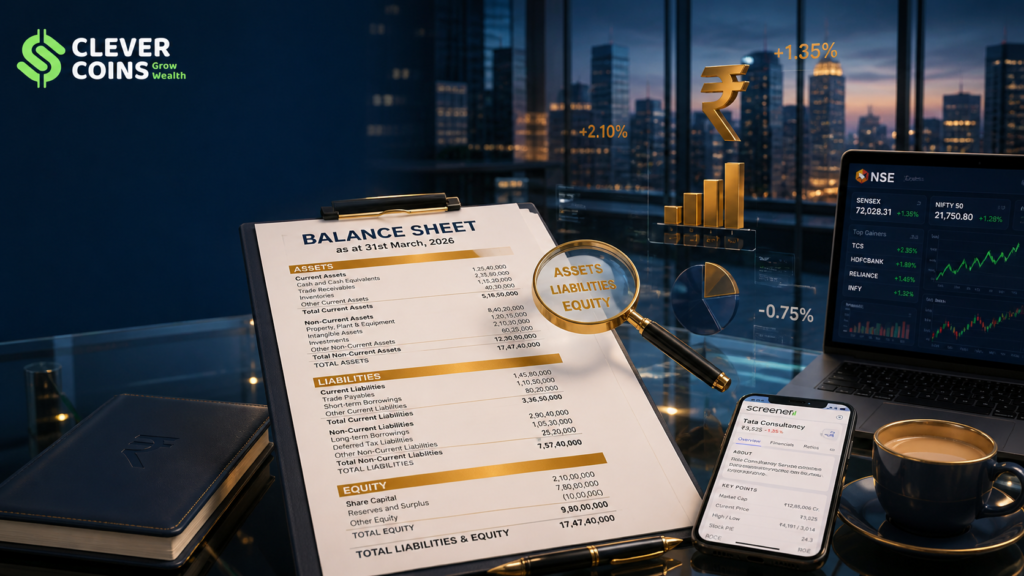
A balance sheet — formally known as the ‘Statement of Financial Position’ — is one of the three core financial statements (along with the Profit & Loss Account and the Cash Flow Statement) that every business is required to prepare. While the P&L tells you whether a company made money in a given period, and the cash flow statement tracks actual cash movements, the balance sheet is the single most comprehensive snapshot of a company’s financial health at any given moment in time.
Think of the balance sheet as a company’s medical report card. Just as a blood report reveals the internal health of a person, a balance sheet reveals what the company owns (assets), what it owes (liabilities), and what belongs to the owners (shareholders’ equity). Analysing a balance sheet is a skill that separates informed investors, savvy bankers, and sharp CFOs from those who make financial decisions in the dark.
In India, public companies listed on the BSE or NSE are required to publish audited balance sheets every quarter and annually, as per SEBI regulations and the Companies Act, 2013. Private companies must file with the Registrar of Companies (ROC) annually. The balance sheet follows the format prescribed under Schedule III of the Companies Act, 2013, and is prepared as per Indian Accounting Standards (Ind AS) or Indian GAAP, depending on the size and listing status of the company.
This guide is a complete, step-by-step tutorial on how to read, understand, and analyse a balance sheet — covering every component, every key ratio, every red flag, and real-world Indian examples using Indian Rupees (₹). Whether you are an investor screening stocks on NSE, a business owner trying to understand your financials, or a finance student preparing for CA or CFA exams, this guide will give you everything you need.
02 |
The Structure of a Balance Sheet — The Accounting Equation |
Every balance sheet is built on one fundamental equation that has governed accounting for over 500 years (since Luca Pacioli codified double-entry bookkeeping in 1494):
|
The Golden Accounting Equation |
|
ASSETS = LIABILITIES + SHAREHOLDERS’ EQUITY
In other words: Everything a company OWNS = Everything it OWES to outsiders + Everything it OWES to owners
Example: If a company has ₹50 crore in assets and ₹30 crore in liabilities, shareholders’ equity = ₹20 crore This equation MUST always balance — hence the term ‘balance sheet’ |
In Indian financial statements (Schedule III format under Companies Act 2013), the balance sheet is presented in a vertical format with two sides:
- LEFT SIDE (Sources of Funds): Shareholders’ Funds + Non-Current Liabilities + Current Liabilities
- RIGHT SIDE (Application of Funds): Non-Current Assets + Current Assets
Note: In older horizontal formats (pre-2013), assets were on the right and liabilities on the left. Modern Ind AS-compliant balance sheets use the vertical format exclusively.
03 |
Understanding Assets — What the Company Owns |
Assets represent all the economic resources owned or controlled by a company that are expected to generate future economic benefits. Under Schedule III (Companies Act 2013), assets are classified into two major categories:
3.1 Non-Current Assets (Long-Term Assets)
These are assets that are NOT expected to be converted into cash or consumed within 12 months from the balance sheet date. They represent the long-term investment backbone of the business.
3.1.1 Property, Plant & Equipment (PP&E) / Fixed Assets
- Land & Buildings (factories, offices, warehouses)
- Plant & Machinery (manufacturing equipment)
- Computers, Vehicles, Furniture & Fixtures
- Capital Work-in-Progress (CWIP) — assets under construction, not yet ready for use
- Shown at COST less accumulated DEPRECIATION = Net Book Value (NBV)
- Example: A manufacturing company bought machinery for ₹10 crore in 2020; accumulated depreciation ₹3 crore → NBV = ₹7 crore
3.1.2 Intangible Assets
- Goodwill (premium paid during acquisitions — e.g., Tata acquiring Jaguar Land Rover)
- Brands and Trademarks (e.g., ‘Amul’ brand on GCMMF’s books)
- Patents, Copyrights, Software Licences
- Customer Relationships, Non-Compete Agreements
- Amortised over their useful life (e.g., software over 3–5 years)
3.1.3 Long-Term Investments / Financial Assets
- Equity shares held in subsidiary companies, associates, and JVs
- Long-term bonds, debentures, government securities
- Security deposits (refundable deposits paid to landlords, utilities)
- Loans given to related parties or employees (repayable > 12 months)
3.1.4 Deferred Tax Assets (DTA)
DTAs arise when a company has paid more tax to the government than what is due based on its accounting profits. This excess can be recovered in future periods. Common causes include accelerated depreciation for tax purposes, provisions for bad debts not yet allowed by tax authorities, etc.
3.1.5 Other Non-Current Assets
- Capital advances (advances paid to suppliers for purchase of fixed assets)
- Prepaid expenses due after 12 months
- Non-current bank deposits (FDs maturing after 12 months)
3.2 Current Assets (Short-Term Assets)
These are assets expected to be converted into cash, sold, or consumed within 12 months. They represent the operational liquidity of the business.
|
Current Asset |
Description |
Indian Example |
|
Inventories |
Raw materials, work-in-progress, finished goods, stores & spares |
A textile company: Raw cotton ₹5 Cr, WIP ₹2 Cr, Finished fabric ₹8 Cr |
|
Trade Receivables |
Amounts due from customers (debtors) for goods/services already delivered |
IT company: Software services billed but unpaid: ₹50 Cr from TCS clients |
|
Cash & Cash Equivalents |
Cash in hand, bank balances, liquid FDs < 3 months, T-Bills |
Bank balance ₹10 Cr + Liquid mutual funds ₹5 Cr = ₹15 Cr |
|
Short-Term Investments |
Mutual funds, fixed deposits maturing within 12 months |
₹20 Cr FD with SBI maturing in 6 months |
|
Loans & Advances (current) |
Employee advances, advance tax paid, GST input tax credit (ITC) |
GST ITC receivable: ₹3 Cr | Advance tax: ₹8 Cr |
|
Other Current Assets |
Prepaid expenses, interest accrued, export incentive receivables |
Prepaid insurance ₹25 Lakh | Interest accrued ₹80 Lakh |
04 |
Understanding Liabilities — What the Company Owes |
Liabilities represent the financial obligations of a company — amounts it owes to external parties. They are the ‘claims’ of outsiders on the company’s assets. Like assets, liabilities are divided into Non-Current and Current.
4.1 Non-Current Liabilities (Long-Term Obligations)
4.1.1 Long-Term Borrowings
- Term loans from banks (SBI, HDFC Bank, Axis Bank, etc.) repayable after 12 months
- Debentures / Bonds issued to the public (NCDs — Non-Convertible Debentures)
- External Commercial Borrowings (ECB) from foreign banks
- Loans from financial institutions (SIDBI, NABARD, NaBFID)
- Finance lease obligations
4.1.2 Deferred Tax Liabilities (DTL)
DTLs arise when a company has PAID LESS tax currently than what accounting profits suggest it should, creating a future tax obligation. Common cause: Accelerated depreciation claimed for tax purposes means higher profit is shown in tax books later, creating a future liability.
4.1.3 Long-Term Provisions
- Provision for employee benefits: Gratuity (under Payment of Gratuity Act), Earned Leave
- Warranty provisions for products sold with multi-year guarantees
- Decommissioning obligations (for mining, oil & gas companies)
4.1.4 Other Non-Current Liabilities
- Advance received from customers for long-term contracts
- Lease liabilities (under Ind AS 116 — right-of-use assets)
- Security deposits received from dealers/distributors
4.2 Current Liabilities (Short-Term Obligations — due within 12 months)
|
Current Liability |
Description |
Watch Point |
|
Short-Term Borrowings |
Working capital loans (CC/OD), commercial paper, short-term NCDs |
High short-term borrowings vs cash = liquidity stress |
|
Trade Payables |
Amounts owed to suppliers/vendors for goods/services received |
Days Payable Outstanding (DPO) — how long company takes to pay suppliers |
|
Other Financial Liabilities |
Current portion of long-term debt, interest accrued but not paid |
Rising unpaid interest = warning sign of cash crunch |
|
Short-Term Provisions |
Provision for tax, dividend proposed, warranty (current portion) |
Unexplained large provisions may be used to hide profits |
|
Statutory Dues |
GST payable, TDS payable, PF/ESI payable, advance tax payable |
Overdue statutory dues = compliance & legal risk |
|
Advance from Customers |
Money received from customers before delivering goods/services |
High advances in manufacturing = healthy order book |
05 |
Shareholders’ Equity — What Belongs to the Owners |
Shareholders’ Equity (also called ‘Net Worth’ or ‘Book Value’) is the residual claim of the company’s owners after all liabilities have been paid. In the context of the accounting equation: Equity = Assets – Liabilities. A positive equity means the company has more assets than debts; a negative equity (called ‘capital erosion’) is a serious red flag.
5.1 Components of Shareholders’ Equity
5.1.1 Share Capital
- Authorised Capital: Maximum share capital a company is legally allowed to issue (ceiling)
- Issued Capital: Portion of authorised capital actually offered to public/investors
- Subscribed & Paid-Up Capital: Capital actually received from shareholders
- Each equity share has a Face Value (FV) — commonly ₹1, ₹2, or ₹10 in India
- Example: Reliance Industries — FV ₹10, 676.1 crore shares → Paid-up capital = ₹6,761 crore
5.1.2 Other Equity / Reserves & Surplus
- Capital Reserve: From capital profits (e.g., gains on revaluation of assets, capital subsidies)
- Securities Premium Reserve: Amount received over face value on issuance of shares
- General Reserve: Accumulated profits transferred from P&L for general business use
- Retained Earnings / P&L Balance: Net profits accumulated over years, not distributed as dividend
- Revaluation Reserve: Created when assets are revalued upward (e.g., land revaluation)
- ESOP Outstanding: Fair value of stock options granted but not yet exercised by employees
- Other Comprehensive Income (OCI): Gains/losses not in P&L — forex translation, actuarial gains
|
💡 Key Insight: Retained Earnings vs Reserves |
|
Retained Earnings = Net Profit after tax, MINUS Dividends paid to shareholders A company with large, growing retained earnings is generating profit and reinvesting it — generally a positive sign A company distributing ALL profit as dividends has zero retained earnings growth — may indicate limited growth opportunities Negative retained earnings (accumulated losses) in a growing startup is NORMAL in early stages (e.g., Zomato, Nykaa in initial years) Negative retained earnings in a mature company = serious concern about long-term viability |
06 |
Sample Balance Sheet — Hypothetical Indian Company (FY 2024–25) |
Below is a simplified but realistic balance sheet for ‘Bharat Manufacturing Ltd.’ — a hypothetical listed Indian company — to illustrate how a real balance sheet looks.
|
BHARAT MANUFACTURING LTD. | Balance Sheet as at 31 March 2025 (₹ in Lakhs) |
FY 2024-25 |
FY 2023-24 |
|
EQUITY & LIABILITIES |
|
|
|
A. Shareholders’ Funds |
|
|
|
Share Capital |
1,200 |
1,200 |
|
Reserves & Surplus |
8,740 |
7,420 |
|
Total Shareholders’ Funds |
9,940 |
8,620 |
|
B. Non-Current Liabilities |
|
|
|
Long-Term Borrowings |
4,500 |
5,200 |
|
Deferred Tax Liabilities (Net) |
380 |
320 |
|
Long-Term Provisions |
640 |
580 |
|
Total Non-Current Liabilities |
5,520 |
6,100 |
|
C. Current Liabilities |
|
|
|
Short-Term Borrowings |
1,800 |
2,100 |
|
Trade Payables |
3,200 |
2,900 |
|
Other Current Liabilities |
1,100 |
980 |
|
Short-Term Provisions |
460 |
390 |
|
Total Current Liabilities |
6,560 |
6,370 |
|
TOTAL (A+B+C) |
22,020 |
21,090 |
|
ASSETS |
|
|
|
D. Non-Current Assets |
|
|
|
Property, Plant & Equipment (Net) |
8,400 |
8,900 |
|
Capital Work-in-Progress |
1,200 |
600 |
|
Goodwill & Intangibles |
800 |
850 |
|
Long-Term Investments |
2,100 |
1,800 |
|
Deferred Tax Assets |
0 |
0 |
|
Other Non-Current Assets |
340 |
290 |
|
Total Non-Current Assets |
12,840 |
12,440 |
|
E. Current Assets |
|
|
|
Inventories |
4,200 |
3,800 |
|
Trade Receivables |
2,880 |
2,650 |
|
Cash & Cash Equivalents |
840 |
620 |
|
Short-Term Investments |
600 |
400 |
|
Other Current Assets |
660 |
1,180 |
|
Total Current Assets |
9,180 |
8,650 |
|
TOTAL (D+E) |
22,020 |
21,090 |
07 |
Key Financial Ratios Derived from the Balance Sheet |
The real power of balance sheet analysis lies in computing and interpreting financial ratios. Ratios give context — a company with ₹10 crore cash sounds great until you realise it has ₹100 crore in debt due next month. Using the ‘Bharat Manufacturing Ltd.’ numbers above (FY 2024-25 data), here are the most important ratios:
7.1 Liquidity Ratios — Can the Company Pay Its Short-Term Debts?
|
Liquidity Ratios — Bharat Manufacturing Ltd. |
|
1. CURRENT RATIO = Current Assets ÷ Current Liabilities = ₹9,180 ÷ ₹6,560 = 1.40 Interpretation: For every ₹1 of current liability, the company has ₹1.40 in current assets Benchmark: 1.5–2.0 is considered healthy. Below 1.0 = danger zone (more debt than liquid assets)
2. QUICK RATIO (Acid Test) = (Current Assets – Inventories) ÷ Current Liabilities = (₹9,180 – ₹4,200) ÷ ₹6,560 = ₹4,980 ÷ ₹6,560 = 0.76 Interpretation: Excluding slow-moving inventory, company can cover 76% of current liabilities Benchmark: Above 1.0 preferred; 0.76 suggests moderate liquidity pressure
3. CASH RATIO = (Cash + Short-Term Investments) ÷ Current Liabilities = (₹840 + ₹600) ÷ ₹6,560 = ₹1,440 ÷ ₹6,560 = 0.22 Interpretation: Only 22% of current liabilities can be immediately settled with cash Benchmark: 0.5–1.0 desired; 0.22 is low — company relies heavily on receivables/inventory |
7.2 Solvency / Leverage Ratios — Can the Company Survive Long-Term?
|
Ratio |
Formula |
Bharat Mfg. Result |
Benchmark / Interpretation |
|
Debt-to-Equity (D/E) |
Total Debt ÷ Total Equity |
(₹4,500+₹1,800) ÷ ₹9,940 = 0.63 |
< 1.0 is ideal; 0.63 is healthy |
|
Debt-to-Assets |
Total Debt ÷ Total Assets |
₹6,300 ÷ ₹22,020 = 0.29 |
< 0.5 = low leverage; 0.29 is excellent |
|
Interest Coverage |
EBIT ÷ Interest Expense |
Requires P&L; typically > 3x desired |
< 1.5x = high default risk |
|
Equity Multiplier |
Total Assets ÷ Total Equity |
₹22,020 ÷ ₹9,940 = 2.22 |
Higher = more debt-financed |
|
Net Debt |
Total Debt – Cash & Equivalents |
₹6,300 – ₹840 = ₹5,460 Lakhs |
Lower/negative net debt = very safe |
7.3 Efficiency Ratios — How Well Does the Company Use Its Assets?
|
Ratio |
Formula |
Calculation |
Interpretation |
|
Asset Turnover |
Revenue ÷ Total Assets |
Assumes Revenue ₹28,000L → 1.27x |
Higher = better asset utilisation |
|
Inventory Days (DIO) |
(Inventory ÷ COGS) × 365 |
Assumes COGS ₹18,000L → 85 days |
Lower days = faster inventory turnover |
|
Debtor Days (DSO) |
(Receivables ÷ Revenue) × 365 |
(₹2,880 ÷ ₹28,000) × 365 = 37.5 days |
< 30 days ideal for manufacturing |
|
Creditor Days (DPO) |
(Payables ÷ COGS) × 365 |
(₹3,200 ÷ ₹18,000) × 365 = 64.9 days |
Paying suppliers in ~65 days |
|
Cash Conversion Cycle |
DIO + DSO – DPO |
85 + 37.5 – 64.9 = 57.6 days |
Lower CCC = more efficient working capital |
|
Fixed Asset Turnover |
Revenue ÷ Net PP&E |
₹28,000 ÷ ₹8,400 = 3.33x |
High ratio = efficient use of fixed assets |
7.4 Valuation / Book Value Ratios — Is the Stock Cheap or Expensive?
|
Book Value Per Share & P/B Ratio |
|
Book Value Per Share (BVPS) = Shareholders’ Equity ÷ Total No. of Shares = ₹9,940 Lakhs ÷ 1,20,00,000 shares (12 crore shares at ₹10 FV) = ₹82.83 per share
Price-to-Book (P/B) Ratio = Market Price ÷ BVPS If market price = ₹250 per share → P/B = ₹250 ÷ ₹82.83 = 3.02x
Interpretation: P/B < 1 = Stock trades below book value (potential undervaluation OR distress) P/B 1–3 = Normal for most manufacturing/traditional businesses P/B > 5 = Common for technology, pharma, FMCG (intangible-heavy businesses like Infosys, Asian Paints) P/B > 10 = Premium franchise brands — e.g., Titan Company, Bajaj Finance |
08 |
Vertical & Horizontal Analysis — Spotting Trends |
8.1 Vertical Analysis (Common Size Analysis)
In vertical analysis, every line item is expressed as a percentage of Total Assets (for balance sheet items). This allows easy comparison across companies of different sizes.
|
Balance Sheet Item |
FY 2024-25 (₹L) |
% of Total Assets |
FY 2023-24 (₹L) |
% of Total Assets |
|
PP&E (Net) |
8,400 |
38.2% |
8,900 |
42.2% |
|
Total Non-Current Assets |
12,840 |
58.3% |
12,440 |
59.0% |
|
Inventories |
4,200 |
19.1% |
3,800 |
18.0% |
|
Trade Receivables |
2,880 |
13.1% |
2,650 |
12.6% |
|
Cash & Equivalents |
840 |
3.8% |
620 |
2.9% |
|
Total Current Assets |
9,180 |
41.7% |
8,650 |
41.0% |
|
Long-Term Borrowings |
4,500 |
20.4% |
5,200 |
24.6% |
|
Trade Payables |
3,200 |
14.5% |
2,900 |
13.8% |
|
Shareholders’ Equity |
9,940 |
45.1% |
8,620 |
40.9% |
Key Observation: Shareholders’ equity as % of total assets improved from 40.9% to 45.1% — company is delevering (reducing debt proportion). Long-term borrowings dropped from 24.6% to 20.4% — positive signal.
8.2 Horizontal Analysis (Year-on-Year Trend Analysis)
Horizontal analysis compares line items across multiple years to identify growth trends, deteriorating positions, and emerging risks.
|
Item |
FY 2024-25 |
FY 2023-24 |
Change (₹L) |
YoY Growth |
|
Shareholders’ Equity |
₹9,940L |
₹8,620L |
+₹1,320L |
+15.3% ✅ |
|
Long-Term Borrowings |
₹4,500L |
₹5,200L |
-₹700L |
-13.5% ✅ |
|
Short-Term Borrowings |
₹1,800L |
₹2,100L |
-₹300L |
-14.3% ✅ |
|
Inventories |
₹4,200L |
₹3,800L |
+₹400L |
+10.5% ⚠️ |
|
Trade Receivables |
₹2,880L |
₹2,650L |
+₹230L |
+8.7% ⚠️ |
|
Cash & Equivalents |
₹840L |
₹620L |
+₹220L |
+35.5% ✅ |
|
Trade Payables |
₹3,200L |
₹2,900L |
+₹300L |
+10.3% |
|
PP&E (Net) |
₹8,400L |
₹8,900L |
-₹500L |
-5.6% (depreciation) |
09 |
Red Flags in a Balance Sheet — Warning Signs for Investors |
Knowing what to look for in a balance sheet is only half the story. The other half is knowing what to AVOID. Here are the most critical red flags that should trigger further investigation before any investment or lending decision:
|
🚨 10 Major Balance Sheet Red Flags |
|
1. NEGATIVE NET WORTH: Total liabilities > Total assets. Company is technically insolvent. Common in NBFCs/banks under stress (e.g., pre-resolution IL&FS entities).
2. CONSISTENTLY RISING DEBT WITHOUT REVENUE GROWTH: Long-term borrowings growing every year while revenue stagnates = company borrowing to survive, not to grow.
3. BLOATED TRADE RECEIVABLES: If receivables grow faster than revenue (DSO keeps increasing), it may indicate forced credit sales, related-party manipulations, or uncollectable debts.
4. GOODWILL LARGER THAN EQUITY: Company may have overpaid for acquisitions. Any goodwill impairment directly reduces equity. Red flag in M&A-heavy companies.
5. LARGE CAPITAL WORK-IN-PROGRESS (CWIP) FOR YEARS: If CWIP never gets capitalised into PP&E over multiple years, it may indicate a stalled project or inflated asset values.
6. RELATED-PARTY LOANS & ADVANCES: Large loans to promoter-related entities or subsidiaries — common vehicle for fund diversion. Always check Note on Related Party Transactions.
7. SUDDEN SPIKE IN INVENTORY: Rising inventory without corresponding revenue increase = possible sales slowdown, channel stuffing, or inventory write-off risk.
8. LOW/NEGATIVE CASH DESPITE HIGH PROFITS: If P&L shows profit but cash is declining, it may indicate aggressive revenue recognition, non-cash income, or working capital mismanagement.
9. CONTINGENT LIABILITIES LARGER THAN EQUITY: These are off-balance-sheet obligations (tax disputes, pending litigation). If they materialise, they can wipe out equity. Always read the Notes to Accounts.
10. QUALIFIED AUDIT REPORT: If the statutory auditor has issued a qualified opinion — especially regarding going concern — treat it as a serious warning. Historical examples in India: DHFL, Satyam, Jet Airways. |
10 |
Balance Sheet Analysis by Industry — Context Matters |
No ratio exists in a vacuum. A D/E ratio of 3.0 would be alarming for an FMCG company but perfectly normal for a bank or an infrastructure company. Always compare ratios within the same industry and against the company’s own historical trends.
|
Industry |
Typical D/E Range |
Current Ratio Norm |
Special Features to Analyse |
|
Banking & NBFC |
8–15x (by design) |
N/A (different metrics) |
GNPA ratio, CASA ratio, NIM, Capital Adequacy Ratio |
|
Manufacturing (Heavy) |
1.0–2.5x |
1.5–2.5 |
CWIP levels, asset age, maintenance capex trends |
|
IT Services |
Near 0 (cash-rich) |
2.0–4.0 |
Employee headcount, cash pile, buyback history |
|
FMCG |
0.2–0.5x |
1.0–2.0 |
Inventory days, brand value (intangibles), working capital cycle |
|
Real Estate |
2.0–4.0x |
0.8–1.5 |
Inventory (unsold flats), pre-sales, RERA compliance |
|
Infrastructure / Roads |
2.0–5.0x |
1.0–2.0 |
Long-term debt structure, concession period, traffic revenue |
|
Telecom |
2.0–6.0x |
0.5–1.0 |
Spectrum liability, AGR dues, ARPU trend |
|
Retail |
0.5–1.5x |
1.2–2.0 |
Inventory freshness, lease liabilities (Ind AS 116) |
11 |
Balance Sheet Reading — India-Specific Points (Ind AS vs Indian GAAP) |
Since April 2016, large Indian companies have been required to prepare financial statements under Indian Accounting Standards (Ind AS), which are broadly converged with IFRS (International Financial Reporting Standards). Smaller companies still follow Indian GAAP (AS standards). Key differences that affect balance sheet reading:
|
Topic |
Indian GAAP (AS) |
Ind AS (IFRS-converged) |
Analyst Impact |
|
Lease Accounting |
Operating leases off-balance-sheet |
All leases > 12 months on balance sheet (Ind AS 116) |
Liabilities higher under Ind AS for retail, aviation, hospitality |
|
Revenue Recognition |
Completed contract / percentage completion |
Ind AS 115 — 5-step model based on performance obligations |
Timing of revenue booking may differ |
|
Financial Instruments |
Historic cost basis |
Fair value measurement (Ind AS 109) |
Investments marked to market — more volatility in equity |
|
Business Combinations |
Pooling of interests allowed |
Only acquisition method (Ind AS 103) |
Goodwill recognised more frequently under Ind AS |
|
Deferred Tax |
Full provision method |
Balance sheet approach (Ind AS 12) |
DTAs/DTLs may differ significantly |
|
ESOP Accounting |
Intrinsic value method |
Fair value method (Ind AS 102) |
Higher ESOP cost under Ind AS → lower profits |
|
📋 Where to Find Balance Sheets in India |
|
BSE Listed Companies: www.bseindia.com → Financials → Balance Sheet NSE Listed Companies: www.nseindia.com → Company Info → Financial Results All Companies (including private): www.mca.gov.in (MCA21 portal) → Company Search → Annual Returns Quick Analysis: Screener.in, Tickertape.in, Tijori Finance, Moneycontrol.com Annual Reports (most detailed): Company’s investor relations page → Annual Report PDF SEBI EDGAR Equivalent: scores.sebi.gov.in and sebi.gov.in for listed company filings |
12 |
Step-by-Step Framework: How to Analyse a Balance Sheet |
Bringing it all together — here is a practical, actionable step-by-step framework for analysing any balance sheet systematically:
- STEP 1 — Download 3–5 Years of Data: Never analyse a single year’s balance sheet. Download at least 3 years (ideally 5) to identify trends. Use Screener.in for listed Indian companies — they show 10-year data for free.
- STEP 2 — Check the Auditor’s Report: Before looking at any number, read the auditor’s report. A ‘qualified’ opinion, ’emphasis of matter,’ or ‘going concern’ note is a red flag. All audit reports should ideally be ‘unmodified’ (clean).
- STEP 3 — Calculate Total Debt: Add Short-Term Borrowings + Long-Term Borrowings + Current Portion of Long-Term Debt. Calculate Net Debt = Total Debt – Cash. A declining net debt trend is healthy.
- STEP 4 — Check Shareholders’ Equity Trend: Is equity growing every year? Is it because of retained earnings (good) or because of fresh share issuance (dilution — needs scrutiny)?
- STEP 5 — Compute Liquidity Ratios: Current Ratio, Quick Ratio. A current ratio consistently below 1.0 means the company is constantly in financial stress regarding short-term obligations.
- STEP 6 — Analyse Working Capital: Working Capital = Current Assets – Current Liabilities. A negative working capital is dangerous (except for businesses like supermarkets that collect cash before paying suppliers — e.g., DMart/Avenue Supermarts).
- STEP 7 — Study the Asset Quality: Are PP&E and intangibles aging without replacement? Is CWIP stuck? Are receivables growing faster than sales? Is inventory bloating?
- STEP 8 — Read All Notes to Accounts: The main balance sheet is a summary. The Notes (foot of annual report) contain critical details — contingent liabilities, related party transactions, debt repayment schedules, inventory breakdown, and segmental assets.
- STEP 9 — Benchmark Against Industry Peers: Compare D/E, Current Ratio, Asset Turnover, DSO with 2–3 direct competitors. Use Screener.in’s comparison feature or Bloomberg/Capitaline for detailed peer benchmarking.
- STEP 10 — Integrate with P&L and Cash Flow: The balance sheet must be read alongside the P&L (to understand profitability) and Cash Flow Statement (to confirm that profits are backed by real cash). If net profit is rising but operating cash flow is falling — investigate immediately.
13 |
Practical Tips for Investors & Business Owners |
For Stock Market Investors:
- Focus on Return on Equity (ROE) and Return on Assets (ROA) trends over 5 years
- Watch for promoter pledging — pledged shares signal financial stress at promoter level
- In small/mid-cap stocks, check if auditor is a Big 4 or reputed firm — smaller firms may not flag issues
- ROCE (Return on Capital Employed) = EBIT ÷ (Total Assets – Current Liabilities) is the gold standard for operational efficiency
- A company with consistent FCF (Free Cash Flow) but modest P&L profit is often healthier than one with high reported profits but negative FCF
For Business Owners & CFOs:
- Monitor your working capital cycle monthly — DSO, DIO, DPO are the three levers
- Maintain a Current Ratio above 1.5 to ensure you never miss payroll or supplier payments
- Track Debt Service Coverage Ratio (DSCR) — banks require DSCR > 1.25 for new term loans under RBI guidelines
- Use your balance sheet to negotiate better credit terms with suppliers (high asset base = better bargaining power)
- Clean up contingent liabilities proactively — unresolved tax disputes and legal claims deter lenders and acquirers
For Finance Students & Exam Aspirants (CA/CFA/MBA):
- Memorise the DuPont formula: ROE = Net Profit Margin × Asset Turnover × Equity Multiplier
- Understand Ind AS 116 (Leases) impact — it inflates assets and liabilities simultaneously
- Practice Altman Z-Score analysis on distressed company balance sheets (predictive bankruptcy model)
- Study real balance sheets: Infosys (IT, asset-light), NTPC (infrastructure, asset-heavy), HDFC Bank (banking) — three completely different structures
- For ICAI CA exams: Schedule III format, AS 13 (Investments), AS 22 (Deferred Tax) are high-frequency topics
14 |
Conclusion |
The balance sheet is arguably the most information-dense document a company produces. In just a few pages, it encodes decades of business decisions — how capital was raised, how assets were deployed, how debts were managed, and how much value was created for shareholders. Learning to read it fluently is not an optional skill for investors, business owners, or finance professionals — it is foundational.
The analytical framework presented in this guide — understanding each component, computing key ratios, identifying red flags, benchmarking against peers, and integrating with other statements — provides a robust, repeatable process for evaluating any balance sheet, whether it belongs to a ₹10 lakh turnover proprietorship or a ₹10 lakh crore market-cap conglomerate like Reliance Industries.
In an era where AI tools, fintech platforms, and data aggregators make financial information more accessible than ever, the differentiator is not access to data — it is the ability to INTERPRET that data. Master the balance sheet, and you master the language of business.