How to Check MSME Registration of Your Vendors: A Complete Compliance Guide for Indian Companies
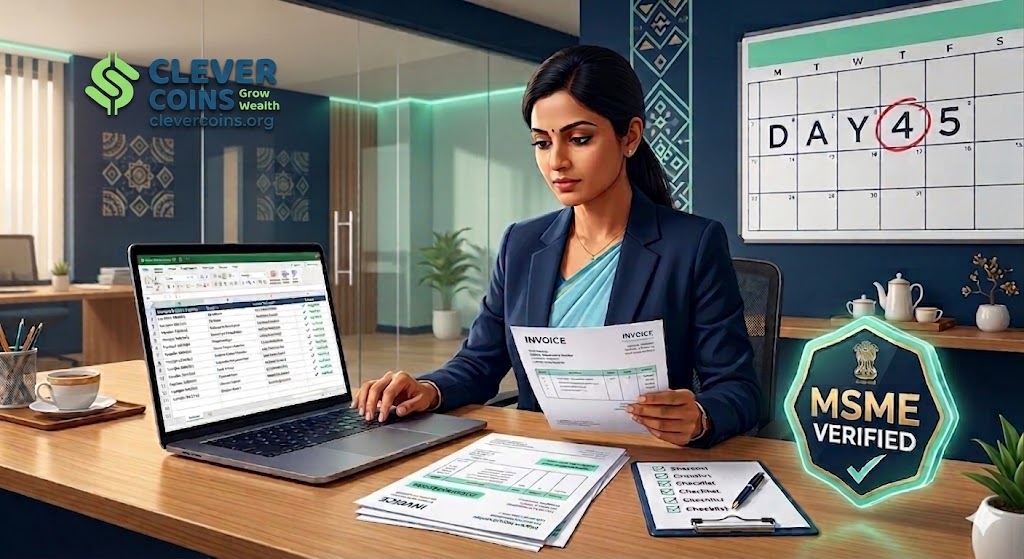
If your company purchases goods or services from vendors in India, you might be sitting on a ticking compliance time bomb — without even knowing it.
Here’s the situation: Under the Micro, Small and Medium Enterprises Development (MSMED) Act, 2006, if any of your vendors hold a valid Udyam Registration (MSME registration), your company is legally obligated to pay them within 45 days of accepting goods or services. Fail to do so, and you face automatic statutory interest at three times the RBI bank rate — plus a mandatory MSME-1 half-yearly filing obligation with the Registrar of Companies (ROC).
⚠️ The challenge? As of today, there is NO official government portal that allows you to directly search or verify whether a specific vendor holds an MSME (Udyam) Registration. This is a real compliance gap — and the wrong approach can expose your company to unintended penalties, interest liability, and regulatory scrutiny.
In this comprehensive guide, CleverCoins walks you through the legally sound, practical, and auditable two-step method to verify your vendors’ MSME status — and how to build a permanent vendor compliance system around it.
1. Why Verifying Your Vendor’s MSME Status Is Critical
Most companies assume that MSME compliance is the vendor’s problem. This is a costly misconception. Here’s why the buying company is at the centre of this compliance framework:
What Triggers When a Vendor Is MSME-Registered?
The moment a vendor holds a valid Udyam Registration Certificate as a Micro or Small Enterprise, three critical obligations activate for your company:
Obligation | What It Means | When It Activates |
45-Day Payment Obligation | Payment must be made within 45 days of acceptance of goods/services | Immediate — on every invoice |
Statutory Interest Liability | Interest at 3x RBI bank rate accrues automatically on overdue amounts | Starts from Day 46 automatically |
MSME-1 Filing Obligation | Half-yearly return to ROC disclosing all dues outstanding beyond 45 days | April 30 and October 31 annually |
CARO Disclosure Requirement | Statutory auditors must flag MSME dues in their audit report under CARO | Annually at time of audit |
SEBI LODR Applicability | Listed companies face additional disclosure requirements under SEBI LODR | Quarterly / Annual |
💡 Important Distinction: Only Micro and Small Enterprises are covered under this framework. Medium Enterprises — even if Udyam-registered — do NOT trigger the 45-day payment rule or MSME-1 reporting obligation.
2. The Core Problem: No Government Lookup Portal Exists
Unlike GST registration (which can be verified on the GSTIN portal) or company registration (verifiable on MCA21), there is currently no government-run searchable database where a buying company can look up a vendor’s Udyam Registration Number by name, PAN, or GST number.
What this means in practice:
- You cannot proactively search ‘Is Vendor ABC registered under MSME?’ on any official platform.
- Even if a vendor has Udyam Registration, you won’t know unless they tell you or show you their certificate.
- Third-party verification services exist, but they require the vendor’s Udyam Registration Number as input — which brings you back to the same dependency on vendor disclosure.
- Statutory auditors increasingly flag the absence of a documented vendor MSME verification process as an audit concern.
This is why a structured, proactive, two-step verification methodology is the only legally defensible approach available to buying companies today.
3. The Two-Step MSME Vendor Verification Method
The following two-step approach is recommended by compliance professionals and is used by the most compliance-conscious companies across India:
STEP 1: Screen All Vendor Invoices for Udyam Registration Details
Since the Udyam Registration portal became operational in 2020, MSME-registered vendors are required to mention their Udyam Registration Number on all invoices. This makes invoice screening your first and most immediate line of verification.
What to look for on invoices:
- Udyam Registration Number (format: UDYAM-XX-00-0000000, e.g., UDYAM-MH-01-0012345)
- Enterprise Classification mentioned on invoice: Micro / Small / Medium
- Udyam Registration Certificate copy attached to the first invoice from a new vendor
How to action invoice screening:
- Train your accounts payable team to flag any invoice that carries a Udyam Registration Number.
- Maintain a log of all such vendors — this becomes the initial population of your Vendor MSME Register.
- For vendors whose invoices don’t mention Udyam status, treat as ‘Status Unknown’ and escalate to Step 2 immediately.
- Always request a copy of the Udyam Registration Certificate from any vendor who mentions their Udyam number — the number alone is not sufficient documentation.
⚠️ Critical Caveat: Invoice screening alone is insufficient and legally incomplete. A vendor may hold Udyam Registration without mentioning it on invoices — especially smaller, less sophisticated suppliers. Relying only on invoice screening leaves your company exposed. Step 2 is not optional.
STEP 2: Send a Formal Written Request to All Vendors
The most reliable, scalable, and legally sound approach is to send a formal, structured written communication to your entire vendor base, requesting self-declaration of their MSME status.
Who should receive this communication?
- All existing vendors — including those with whom you have had no recent transactions.
- All new vendors — as part of your standard vendor onboarding process.
- Any vendor whose status has been classified as ‘Unknown’ or ‘Not Confirmed’ in your register.
- Any vendor whose Udyam Registration Certificate has not been renewed or refreshed in over 12 months.
What should the formal request ask for?
- If MSME-registered: A copy of their valid Udyam Registration Certificate.
- If NOT MSME-registered: A written confirmation (email or letter) that they are not registered under Udyam/MSME.
- If recently registered or status changed: Updated certificate reflecting current classification.
The 15–20 Day Response Rule:
Compliance professionals recommend setting a 15–20 day response deadline in your formal request. The reasoning is sound:
- An MSME-registered vendor has every incentive to respond quickly, as timely payment compliance directly benefits them financially.
- A non-response within the deadline is a reasonable indicator of non-registration — though not conclusive.
- Following up once after the deadline creates a documented audit trail that shows your company made genuine, good-faith efforts to verify status.
4. Sample Vendor Communication Template
Use the following template as your formal MSME status verification request. Customise with your company’s letterhead:
────────────────────────────────────────────────
Subject: Request for MSME/Udyam Registration Status — [Your Company Name]
Dear [Vendor Name / Accounts Team],
We are undertaking our periodic MSME vendor compliance review in accordance with the Micro, Small and Medium Enterprises Development (MSMED) Act, 2006, and the Companies (Furnishing of Information about Payment to Micro and Small Enterprises) Rules, 2019.
In this connection, we request you to kindly confirm your enterprise’s registration status under the Udyam Registration Portal by [Date — 15 days from date of letter].
If you ARE registered under Udyam (MSME):
Please share a copy of your valid Udyam Registration Certificate along with your Udyam Registration Number.
If you are NOT registered under Udyam (MSME):
Please confirm the same in writing via email or letter on your company letterhead.
Timely response to this request will assist us in ensuring compliance with applicable payment timelines and statutory filing requirements.
Thanking you in advance for your prompt co-operation.
Warm regards,
[Authorised Signatory Name][Designation][Company Name] | [Contact Details]────────────────────────────────────────────────
5. Building and Maintaining Your Vendor MSME Register
Sending the verification request is just the beginning. All responses — and importantly, non-responses — must be captured in a structured Vendor MSME Register. This register is the backbone of your MSME-1 filing determination and your 45-day payment monitoring process.
Your Vendor MSME Register should capture the following fields for every vendor:
Register Field | Description | Purpose |
Vendor Name | Company or individual name of the supplier | For identification |
PAN Number | Permanent Account Number of vendor | Cross-reference with IT records |
GSTIN | Goods & Services Tax Identification Number | For invoice matching |
Udyam Registration No. | UDYAM-XX-XX-XXXXXXX format | Core identification field |
Enterprise Classification | Micro / Small / Medium / Not Registered | Determines 45-day applicability |
Certificate Valid Up To | Expiry / renewal date of Udyam Certificate | For annual refresh tracking |
Verification Method | Invoice / Written Request / Certificate Received | Audit trail |
Date of Verification | Date when status was last confirmed | For annual refresh |
Response Status | Responded / Non-Response (Assumed Non-MSME) | Documentation |
45-Day Clock Active? | Yes / No / Under Review | Triggers payment priority |
MSME-1 Reportable? | Yes / No | Determines MSME-1 obligation |
💡 Pro Tip: Set up your Vendor MSME Register in Excel or your ERP system with conditional formatting that automatically flags invoices approaching Day 35 from acceptance date — giving you a 10-day buffer before the 45-day clock expires. CleverCoins can help you build this tracker.
6. Understanding the 45-Day Payment Clock in Detail
The 45-day rule is arguably the most operationally impactful aspect of MSME vendor compliance. Here’s everything you need to know about how it works:
What Is ‘Acceptance’ of Goods or Services?
- Deemed acceptance: If no written objection is raised by the buyer within 15 days of delivery/provision of services, acceptance is automatically deemed to have occurred on the delivery date.
- Actual acceptance: Where the buyer formally acknowledges receipt in writing (PO acknowledgement, GRN — Goods Receipt Note, etc.).
- For most practical purposes, the invoice date is used as a proxy for acceptance date — particularly for services.
When Does Statutory Interest Begin?
Interest under Section 16 of the MSMED Act accrues automatically from Day 46 — no reminder or demand notice is required from the vendor. This is important: the interest liability is created by operation of law, not by any action of the vendor.
Interest Rate: Three times the bank rate notified by the Reserve Bank of India (RBI). As of FY 2024-25, this translates to a significant additional liability on delayed payments.
Must Both Late Payments AND Outstanding Payments Be Reported in MSME-1?
Transaction Scenario | MSME-1 Reporting Required? |
Payment made after 45 days (but before half-year end) | YES — must be reported in MSME-1 for that half-year |
Payment still outstanding beyond 45 days at half-year end | YES — must be reported |
Payment made within 45 days | NO reporting required |
Payment to Medium Enterprise (MSME-registered) | NO reporting required under MSME-1 |
Payment to unregistered vendor | NO reporting required |
7. Form MSME-1 — Your Half-Yearly Reporting Obligation
Form MSME-1 (officially the Half-Yearly Return on Outstanding Payments to Micro and Small Enterprise Suppliers) is an e-form filed with the Registrar of Companies (ROC). Here is everything you need to know:
Who Must File MSME-1?
All companies (public or private, large or small) that:
- Receive goods or services from Micro or Small Enterprises (NOT Medium Enterprises), AND
- Have payments outstanding to such vendors for more than 45 days from the date of acceptance.
There is NO minimum turnover threshold or company size exemption. Even a small private limited company with one MSME vendor and one delayed invoice must file.
Due Dates for MSME-1 Filing
Detail | Information |
Half-Year Period: April 1 to September 30 | Due Date: October 31 |
Half-Year Period: October 1 to March 31 | Due Date: April 30 |
ROC Filing Fees | NIL — the form is filed free of cost |
Late Filing Fees | Also NIL — no additional fees are prescribed for late filing |
Certification Required | Practising Company Secretary (CS) or Chartered Accountant (CA) |
Maximum Entries per Form | 99 vendor entries. File additional forms if more vendors are applicable |
Platform for Filing | MCA21 portal (mca.gov.in) |
Penalty for Non-Filing of MSME-1
Non-filing of MSME-1 (where applicable) constitutes a violation of Section 405 of the Companies Act, 2013, read with the Companies (Furnishing of Information about Payment to Micro and Small Enterprises) Rules, 2019.
Penalty under Section 450 of the Companies Act: Company and every officer in default can be penalised up to ₹20,000 for the first offence, with continuing default attracting ₹1,000 per day of default. In cases of repeated or wilful non-compliance, prosecution is also possible.
8. MSME Classification: Know the Difference
A common source of confusion is how MSME enterprises are classified, and which classification triggers compliance obligations for you as a buyer:
Enterprise Type | Classification Criteria (FY 2024-25) | Buyer’s Obligation |
Micro Enterprise | Investment ≤ ₹1 crore AND Turnover ≤ ₹5 crore | YES — 45-day rule + MSME-1 applicable |
Small Enterprise | Investment ≤ ₹10 crore AND Turnover ≤ ₹50 crore | YES — 45-day rule + MSME-1 applicable |
Medium Enterprise | Investment ≤ ₹50 crore AND Turnover ≤ ₹250 crore | NO — NOT covered under MSME-1 |
Unregistered Vendor | No Udyam Registration | NO — no obligations triggered |
⚠️ Status Can Change: A vendor classified as Small Enterprise today may grow and be reclassified as Medium Enterprise next year — eliminating your 45-day obligation. Conversely, an unregistered vendor may obtain Udyam Registration, immediately activating compliance. Annual refresh of your Vendor MSME Register is not optional.
9. Six Common Mistakes Companies Make in MSME Vendor Verification
Based on common compliance reviews across Indian companies, here are the most frequently observed errors in MSME vendor verification:
- Mistake 1 — Relying solely on invoice disclosures
Invoice screening is necessary but not sufficient. A vendor may hold Udyam Registration without mentioning it on invoices. Without a formal written request backed by certificate collection, your verification process is incomplete and legally indefensible.
- Mistake 2 — Verifying only new vendors
Existing vendors are equally capable of obtaining Udyam Registration at any point. A vendor you’ve been working with for 5 years may have registered under Udyam last month. Only sending verification requests to new vendors leaves your entire existing vendor base unchecked.
- Mistake 3 — Treating Medium Enterprises as Micro/Small
Many companies apply the 45-day payment rule to ALL Udyam-registered vendors, regardless of classification. Only Micro and Small Enterprises trigger the payment timeline and MSME-1 obligation. Medium Enterprises are excluded.
- Mistake 4 — Not following up on non-responses
Leaving a vendor’s MSME status as ‘Unknown’ is a compliance risk. A single follow-up communication and documentation of non-response significantly strengthens your legal position that the vendor is not MSME-registered.
- Mistake 5 — Not refreshing the register annually
MSME vendor status is not static. Udyam Registrations are updated, classifications change, and new registrations occur throughout the year. An annual refresh of your Vendor MSME Register prevents stale classification data from driving faulty compliance decisions.
- Mistake 6 — Not retaining documentation
All email threads, certificate copies, written confirmations of non-registration, and follow-up records must be archived systematically. In any regulatory scrutiny or audit query, documentation is your first — and often only — line of defence.
10. Annual Vendor MSME Compliance Calendar
Build the following events into your company’s annual compliance calendar:
When | What to Do | Responsible Party |
April 1 (Start of new FY) | Refresh Vendor MSME Register — resend verification requests to all vendors | Accounts Payable + CS/CA |
April 30 | File MSME-1 for Oct–Mar half-year (if applicable) | CS/CA + CFO sign-off |
Ongoing — Monthly | Review invoice aging report. Flag invoices approaching Day 35 from MSME vendors | Accounts Team |
September 15 | Pre-audit MSME dues review — clear outstanding dues before half-year end | Finance + Management |
October 31 | File MSME-1 for Apr–Sep half-year (if applicable) | CS/CA + CFO sign-off |
Before Onboarding New Vendor | Mandatory MSME verification as part of vendor KYC process | Procurement Team |
Before Statutory Audit | Provide complete Vendor MSME Register to auditor | Finance + CS |
11. How Third-Party MSME Verification Tools Work (And Their Limitations)
Several third-party compliance technology platforms offer MSME verification services. Understanding how they work — and their limitations — helps you use them appropriately.
How They Work:
- You provide the vendor’s Udyam Registration Number.
- The tool queries the Udyam portal API or maintains a database of registered enterprises.
- You receive back the enterprise name, classification, and registration validity.
Key Limitations:
- The input dependency problem: You still need the vendor’s Udyam Registration Number to use the tool — which brings you back to requesting it from the vendor.
- Database freshness: Third-party databases may not reflect real-time changes in classification or cancellation of registrations.
- No search by name or PAN: Most platforms don’t allow lookup by company name or PAN — only by Udyam Number.
- Cannot confirm non-registration: A vendor who is NOT registered has no number to verify — absence of a number is not a confirmed non-registration.
Conclusion: Third-party tools are useful as a supplementary verification step after you receive a vendor’s Udyam Number — but they cannot replace the formal written verification process.
12. MSME Vendor Compliance and the Statutory Audit (CARO)
If your company’s accounts are audited, MSME vendor dues are now a mandatory area of focus under CARO 2020 (Companies Auditor’s Report Order, 2020).
What CARO 2020 Requires:
Under Clause 15 of CARO 2020, auditors are required to report:
- Whether any transactions/events not recorded in the books of account have been surrendered or disclosed as income during the year in the tax assessments — specifically, any dues to MSMEs.
- Whether the company has outstanding dues to Micro and Small Enterprises that have been outstanding for more than 45 days during the financial year.
- If yes, details of each such enterprise, amount, and reason for delay must be disclosed in the audit report.
This means: If you do not have a proper Vendor MSME Register and verification process, your auditors may flag it — creating a qualified or adverse comment in the audit report, which affects your company’s compliance record and reputation with banks, investors, and regulators.
13. How CleverCoins Helps You Build a Bulletproof MSME Vendor Compliance System
At CleverCoins, we offer an end-to-end MSME vendor compliance service that includes:
- Vendor MSME Register Setup:
- Complete Excel-based or ERP-integrated Vendor MSME Register, customised for your vendor base.
- Verification Drive Management:
- Drafting and sending formal MSME verification requests to all vendors, tracking responses, and chasing follow-ups.
- 45-Day Payment Monitoring:
- Monthly invoice aging reports flagging MSME vendor invoices approaching Day 35.
- MSME-1 Filing Service:
- Half-yearly MSME-1 preparation, CS/CA certification, and MCA21 portal filing.
- Audit Support:
- Complete documentation package for CARO 2020 compliance and statutory audit queries.
- Annual Refresh:
- Proactive annual re-verification drive to keep your Vendor MSME Register current.
📞 Get a FREE MSME Vendor Compliance Audit for your Company | Visit: clevercoins.org | WhatsApp: [Your Number]
14. Frequently Asked Questions (FAQs)
Q1. There is no government portal to check vendor MSME status — what is the officially accepted verification method?
The accepted approach is a two-step method: (1) screening vendor invoices for Udyam Registration details, and (2) sending a formal written request to vendors asking them to self-declare their MSME status and provide their Udyam Registration Certificate. This approach is documented by compliance professionals and accepted by auditors.
Q2. If a vendor doesn’t respond to our MSME verification request, should we assume they are MSME-registered or not?
Non-response within the 15-20 day window is generally treated as an indicator of non-registration — since a registered vendor has strong financial incentive to respond. However, document your follow-up attempts carefully. In regulatory scrutiny, your good-faith verification efforts matter significantly.
Q3. Is there any exemption from MSME-1 filing for small companies or startups?
No. Form MSME-1 is applicable to ALL companies — public, private, small, or large. There is no exemption based on company size or turnover. If you have outstanding dues to Micro or Small Enterprise vendors beyond 45 days, MSME-1 is mandatory.
Q4. Can we avoid MSME-1 filing by paying all dues before the half-year end?
Partially. If all dues are cleared within 45 days (i.e., no payment was made after 45 days during the entire half-year period), then MSME-1 is not required. However, if any payment was made after 45 days — even if settled before the half-year end — it must still be reported. See Section 6 of this guide for the transaction-wise table.
Q5. What if we have more than 99 MSME vendor entries to report?
Form MSME-1 allows a maximum of 99 entries per filing. If you have more than 99 MSME vendor entries requiring disclosure, you must file multiple forms. There is no additional filing fee for either the first or subsequent forms.
Q6. Does MSME-1 apply to foreign companies operating in India?
Yes. All companies registered or operating in India under the Companies Act, 2013 — including foreign subsidiaries and branch offices — are subject to MSME-1 filing requirements if they meet the triggering conditions.
Conclusion: Don’t Leave Vendor MSME Compliance to Chance
The absence of a centralised government lookup portal is a genuine challenge — but it is not an excuse for non-compliance. The two-step methodology described in this guide — invoice screening combined with formal written verification requests backed by a structured Vendor MSME Register — is your best protection against unintended MSME-1 filing defaults, statutory interest liability, and audit qualifications.
In compliance, reactive management is always more expensive than proactive management. Build your Vendor MSME Register today, establish your annual verification cycle, and ensure your 45-day payment monitoring is fully operational — before your next statutory audit or ROC query arrives.
✅ Stay Compliant. Stay Protected. Stay Clever. — CleverCoins | clevercoins.org