Internal Controls Setup Cost, Process and Timeline Explained
Every growing business eventually hits an operational inflection point where informal trust can no longer substitute for structured financial governance. In the early stages of a company, a founder approves every invoice, signs every check, and reviews the bank balance every morning. However, as transaction volumes multiply, departments expand, and external stakeholders—such as institutional investors, statutory auditors, and banking partners—demand verifiable financial accuracy, relying on memory and ad-hoc approvals becomes an existential liability.
Without formal safeguards, companies expose themselves to occupational fraud, duplicate vendor payments, inventory shrinkage, revenue leakage, and qualified audit opinions. Understanding the internal controls setup cost, the exact step-by-step implementation process, and a realistic rollout timeline allows founders, CFOs, and operations leaders to build an institutional-grade financial backbone without paralyzing day-to-day agility.
What Are Internal Controls and Why Do Growing Businesses Need Them?
Internal controls are the policies, procedures, automated system rules, and organizational checks designed to safeguard company assets, ensure the integrity of financial reporting, promote operational efficiency, and guarantee compliance with statutory laws and regulations.
Under the globally recognized COSO (Committee of Sponsoring Organizations of the Treadway Commission) Internal Control—Integrated Framework, an effective control system rests on five interdependent pillars:
Control Environment: The ethical tone set by leadership (“tone at the top”), organizational structure, delegation of authority, and accountability standards.
Risk Assessment: The systematic identification and analysis of internal and external risks that could prevent the business from achieving its financial and operational objectives.
Control Activities: The tangible policies, approvals, reconciliations, verifications, and segregation of duties executed daily to mitigate identified risks.
Information and Communication: The accounting systems, ERP workflows, and reporting channels that capture and distribute accurate data to decision-makers.
Monitoring Activities: Ongoing evaluations, internal audits, and continuous control monitoring to verify that safeguards remain effective over time.
Preventive vs. Detective vs. Corrective Controls
To optimize your internal controls setup cost, you must balance three distinct mechanisms rather than over-engineering a single layer:
Preventive Controls (Proactive): Designed to stop errors or irregularities before they occur. Examples include segregation of duties (SoD), multi-factor authentication, pre-approval purchase order limits, and system role-based access controls (RBAC).
Detective Controls (Reactive): Designed to uncover discrepancies, unauthorized transactions, or process failures after they have occurred. Examples include monthly bank reconciliations, physical inventory cycle counts, variance analysis, and automated exception reports.
Corrective Controls (Remedial): Designed to fix problems identified by detective controls and prevent recurrence. Examples include software patches, disciplinary enforcement, revised standard operating procedures (SOPs), and recovery of overpayments.
The High Cost of Delaying Implementation
According to industry fraud benchmarks, organizations without robust internal controls lose an estimated 5% of annual revenue to occupational fraud and operational leakage—and small-to-midsize enterprises (SMEs) often suffer disproportionately higher median losses because a single trusted employee frequently holds unchecked access across accounting, procurement, and banking. Beyond direct financial loss, weak controls lead to:
Delayed Fundraising and Valuation Haircuts: Venture capital and private equity due diligence teams routinely penalize or walk away from companies unable to substantiate revenue recognition or cash disbursements.
Audit Cost Overruns: When external auditors cannot rely on your internal control environment, they must shift from control testing to exhaustive substantive testing—dramatically inflating statutory audit fees and stretching audit timelines by months.
Regulatory Penalties: Non-compliance with statutory mandates such as Internal Financial Controls over Financial Reporting (IFCoFR) under the Companies Act, Sarbanes-Oxley (SOX) readiness requirements, or tax reconciliation rules triggers fines and director liability.
Internal Controls Setup Cost: Complete Breakdown by Business Size
The total internal controls setup cost varies widely depending on company headcount, transaction complexity, ERP maturity, regulatory exposure, and whether you build internally or engage external advisory specialists. Rather than viewing this expenditure as sunk overhead, finance leaders should categorize costs into one-time setup investments and ongoing maintenance costs.
1. Cost Components Explained
Gap Assessment & Risk Scoping: Reviewing existing workflows, identifying control weaknesses, and drafting a Risk Control Matrix (RCM).
SOP & Policy Documentation: Writing formal Standard Operating Procedures across Procure-to-Pay (P2P), Order-to-Cash (O2C), Record-to-Report (R2R), Payroll, and IT General Controls (ITGC).
Technology & Software Configuration: Configuring approval workflows inside existing accounting software (e.g., Zoho Books, QuickBooks, TallyPrime, NetSuite, SAP) or purchasing dedicated Governance, Risk, and Compliance (GRC) and spend-management tools.
External Consulting & Fractional Advisory: Fees paid to Chartered Accountants, CPAs, risk advisory firms, or fractional controllers to design and validate the framework.
Employee Training & Change Management: Workshops, playbooks, and onboarding hours required to ensure department heads and staff adhere to the new workflows.
Periodic Testing & Monitoring: Quarterly or semi-annual internal control testing to confirm operating effectiveness.
2. Tiered Cost Comparison Table
| Cost Category | Early-Stage Startup (10–30 Employees) | Growing SME (30–150 Employees) | Mid-Market / Pre-IPO Enterprise (150–500+ Employees) |
| Risk & Gap Assessment | $1,500 – $3,500 (₹1.2L – ₹2.8L) | $4,000 – $10,000 (₹3.2L – ₹8L) | $15,000 – $40,000+ (₹12L – ₹32L+) |
| SOP & RCM Documentation | $2,000 – $4,500 (₹1.6L – ₹3.6L) | $5,000 – $15,000 (₹4L – ₹12L) | $20,000 – $60,000 (₹16L – ₹48L) |
| Software & ERP Workflow Setup | $500 – $2,000 (₹40K – ₹1.6L) | $3,000 – $12,000 (₹2.4L – ₹9.6L) | $15,000 – $75,000+ (₹12L – ₹60L+) |
| Training & Rollout Support | $500 – $1,500 (₹40K – ₹1.2L) | $1,500 – $4,000 (₹1.2L – ₹3.2L) | $5,000 – $15,000 (₹4L – ₹12L) |
| Total One-Time Setup Cost | $4,500 – $11,500 (₹3.6L – ₹9.2L) | $13,500 – $41,000 (₹10.8L – ₹32.8L) | $55,000 – $190,000+ (₹44L – ₹1.5Cr+) |
| Annual Ongoing Maintenance & Testing | $2,000 – $5,000 / yr | $6,000 – $18,000 / yr | $25,000 – $85,000+ / yr |
3. In-House vs. Outsourced vs. Hybrid Implementation Models
Choosing the right delivery model is the single biggest lever for controlling upfront expenditure:
Fully In-House (DIY): Lowest cash outlay, relying on your internal finance manager or controller using standard templates. Risk: High opportunity cost, blind spots due to familiarity bias, and potential design flaws if the team lacks audit experience.
Fully Outsourced Advisory: A specialized risk and audit firm conducts interviews, maps processes, drafts SOPs, configures controls, and runs initial testing. Best for: Companies preparing for institutional fundraising, M&A, or statutory IFC/SOX audits under tight deadlines.
Hybrid Co-Sourced Model (Recommended for SMEs): Internal process owners document baseline workflows while an external specialist designs the Risk Control Matrix, Segregation of Duties matrix, and testing protocols. This typically reduces consulting spend by 35% to 50% while maintaining audit-grade rigor.
Key Factors That Influence Internal Controls Setup Cost
Two companies with identical revenue can face vastly different implementation budgets based on six structural variables:
Multi-Entity and Multi-Currency Operations: Operating across multiple subsidiaries, branches, warehouses, or international jurisdictions requires intercompany elimination controls, transfer pricing documentation, and localized tax compliance checks.
Legacy vs. Cloud ERP Infrastructure: Modern cloud ERPs (NetSuite, SAP S/4HANA, Microsoft Dynamics, Zoho One) include built-in approval routing and audit logs. Legacy desktop accounting software often forces businesses to purchase third-party spend management overlays or rely on manual compensating controls.
Regulatory and Industry Mandates: FinTechs, healthcare providers, defense contractors, public companies, and businesses crossing statutory IFC thresholds face stringent compliance standards (SOX 404, SOC 2, ISO 27001, HIPAA, or Companies Act IFC) that require formal walkthroughs and evidence retention.
Inventory and Supply Chain Complexity: Pure SaaS companies primarily focus on O2C, payroll, and cloud spend controls. Manufacturing, retail, and e-commerce firms must build physical warehouse controls, bill-of-materials (BOM) variance checks, and cold-chain or shrinkage monitoring.
Current State of Process Documentation: If your team already maintains updated process flowcharts and job descriptions, consultants spend far less billable time conducting basic discovery interviews.
Degree of Automation: Automated three-way matching and API bank feeds cost more upfront to configure than manual spreadsheet checklists, but they slash recurring compliance labor hours by up to 60%.
Step-by-Step Internal Controls Setup Process
A disciplined rollout prevents bureaucratic gridlock. Follow this structured seven-phase methodology to design and operationalize internal controls without slowing down commercial execution.
Phase 1: Scoping, Governance, and Tone at the Top
Before mapping a single workflow, establish executive sponsorship. Define the project scope by identifying which business units, legal entities, and financial statement line items carry material risk. Establish a clear Delegation of Authority (DoA) Matrix approved by the Board or Founders, explicitly defining who can sign contracts, approve purchase orders, authorize vendor master changes, and release bank payments at specific monetary thresholds.
Phase 2: Enterprise Risk Assessment and Process Mapping
Conduct structured walkthroughs with department heads across core business cycles to document how transactions actually happen today—not just how management assumes they happen. Map end-to-end workflows for:
Procure-to-Pay (P2P): Requisition, vendor onboarding, purchase orders, goods receipt, invoice processing, and disbursement.
Order-to-Cash (O2C): Customer credit approval, contract pricing, fulfillment, invoicing, collections, and credit memos.
Record-to-Report (R2R): Journal entries, month-end close checklists, fixed asset capitalization, and financial statement consolidation.
Hire-to-Retire (Payroll & HR): Employee onboarding, attendance verification, payroll processing, bonus approvals, and offboarding access revocation.
IT General Controls (ITGC): User access provisioning, password policies, database backups, and ERP change management.
Rank every identified vulnerability by likelihood and financial/reputational impact so you address high-severity exposures first.
Phase 3: Designing the Risk Control Matrix (RCM)
The Risk Control Matrix is the master blueprint of your internal control system. For every high- and medium-risk process step, define:
Risk Objective: What could go wrong (e.g., paying a fictitious vendor or paying the same invoice twice).
Control Activity: The exact preventive or detective action required to neutralize the risk.
Control Owner: The specific role accountable for executing the control.
Frequency: Per transaction, daily, weekly, monthly, or quarterly.
Audit Evidence: The verifiable digital artifact proving the control occurred (e.g., timestamped ERP approval log, signed Goods Receipt Note).
Phase 4: Establishing Segregation of Duties (SoD)
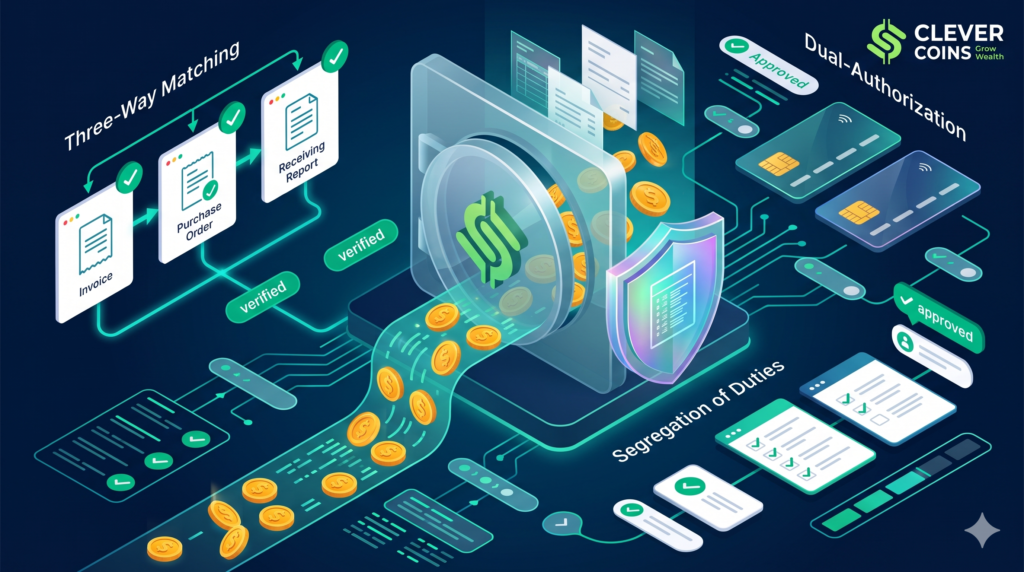
Segregation of Duties ensures that no single individual controls all phases of a financial transaction. Even in lean teams, four incompatible functions must be separated:
Custody of Assets (handling physical inventory, cash, or bank tokens)
Authorization / Approval (approving POs, vendor additions, or write-offs)
Record-Keeping (posting journal entries or updating ledgers)
Reconciliation (comparing bank statements or physical counts against ledger balances)
SME Workaround: When a 15-person startup lacks enough headcount for four separate roles, implement compensating detective controls—such as mandatory founder/CFO review of monthly bank statements directly from the bank portal and automated audit trail alerts whenever vendor bank details are modified.
Phase 5: Drafting SOPs and Configuring ERP Workflows
Translate the Risk Control Matrix into clear, jargon-free Standard Operating Procedures (SOPs). Simultaneously, hardcode preventive controls directly into your software stack:
Enforce mandatory Three-Way Matching (Purchase Order + Goods Receipt Note + Vendor Invoice) before any payment enters the disbursement queue.
Lock closed accounting periods so historical entries cannot be altered retroactively.
Require dual-authorization (“maker-checker”) on corporate banking portals for all wire transfers and ACH/NEFT/RTGS batches.
Restrict master data editing rights so accounts payable clerks cannot create new vendors or alter vendor bank account numbers.
Phase 6: Pilot Testing, Training, and Change Management
Roll out the new controls in a controlled pilot across one high-priority cycle (typically Procure-to-Pay) for 2–3 weeks before company-wide enforcement. Conduct role-specific training sessions that explain why each control protects the team and the business, rather than framing controls as bureaucratic policing. Gather friction feedback from operational staff and refine overly rigid thresholds that bottleneck urgent business needs.
Phase 7: Design & Operating Effectiveness Testing (Continuous Monitoring)
A control that exists on paper but fails in practice offers zero protection. Once live, conduct:
Test of Design (ToD): Walk through one transaction end-to-end to verify the control is capable of preventing or detecting material misstatements.
Test of Operating Effectiveness (ToE): Sample transactions across the operating period (e.g., 25 random invoices across a quarter) to confirm the control operated consistently as intended.
Remediation Loop: Document any control deficiencies, assign root-cause fixes, and re-test within 30 days.
Realistic Internal Controls Implementation Timeline
How long does it take to move from informal processes to an audit-ready internal control environment? For most growing companies, end-to-end implementation takes between 6 weeks and 24 weeks (1.5 to 6 months), depending on company size and system complexity.
Master Implementation Timeline Breakdown
| Phase | Key Deliverables | Startup Timeline (10–30 Staff) | SME Timeline (30–150 Staff) | Mid-Market Timeline (150–500+ Staff) |
| 1. Scoping & DoA Matrix | Project charter, entity scope, Board-approved Delegation of Authority | Week 1 | Weeks 1–2 | Weeks 1–3 |
| 2. Walkthroughs & Risk Assessment | As-is process maps, risk register, prioritized gap analysis | Weeks 1–2 | Weeks 2–4 | Weeks 3–7 |
| 3. RCM & SoD Matrix Design | Complete Risk Control Matrix, Segregation of Duties conflict map | Week 3 | Weeks 5–6 | Weeks 8–11 |
| 4. SOP Drafting & ERP Configuration | Written SOP manuals, maker-checker rules, 3-way match setup | Weeks 4–5 | Weeks 7–10 | Weeks 12–17 |
| 5. Pilot Rollout & Staff Training | Department workshops, pilot run, threshold calibration | Week 6 | Weeks 11–12 | Weeks 18–20 |
| 6. Control Testing & Sign-Off | Sample testing, deficiency remediation, executive sign-off | Weeks 7–8 | Weeks 13–16 | Weeks 21–24 |
| Total Estimated Duration | Full Operational Go-Live & Audit Readiness | 6 – 8 Weeks | 12 – 16 Weeks | 20 – 24 Weeks |
Critical Path Bottlenecks That Delay Timelines
Slow Executive Sign-Off on Authority Limits: Teams often stall for weeks debating whether department heads should approve $2,500 or $10,000 independently. Set pragmatic tiers immediately and adjust at the 90-day review.
Unstructured Master Data: Attempting to automate vendor controls while your ERP holds thousands of duplicate, inactive, or incomplete vendor profiles causes immediate workflow rejections. Dedicate one week to vendor and customer master cleanup before turning on strict system rules.
IT and ERP Admin Bandwidth: Waiting on external ERP implementation partners to build custom approval workflows can add 4 to 6 weeks. Prioritize native out-of-the-box workflow features during Phase 1.
Essential Internal Controls Checklist by Core Business Function
Use this operational checklist to verify that your setup covers the highest-risk control points across every core department:
1. Cash and Treasury Controls
Dual authorization (maker-checker) enforced on all electronic bank portals and corporate credit card issuances.
Monthly bank reconciliations performed within 5 business days of month-end by someone independent of cash disbursements and receipts.
Physical checkbooks, blank stock, and banking security tokens stored in locked dual-custody safes.
Automated bank feed alerts configured for wire transfers exceeding pre-set thresholds or transfers to newly added beneficiaries.
2. Procure-to-Pay (Accounts Payable) Controls
Mandatory competitive quotes (e.g., minimum three bids) required for non-recurring purchases above a defined threshold.
Segregation between the employee who creates/edits vendor master records and the employee who processes vendor invoices.
Mandatory verification of vendor tax IDs (GSTIN/EIN/TIN), bank account ownership, and conflict-of-interest declarations prior to onboarding.
Automated three-way matching (PO, GRN, Invoice) before payment scheduling, plus duplicate invoice number blocking in the ERP.
3. Order-to-Cash (Revenue & Accounts Receivable) Controls
Standardized pricing tiers and formal approval required for non-standard discounts, extended payment terms, or write-offs.
Credit limit checks enforced prior to accepting large B2B orders.
Independent review and approval of all credit memos, customer refunds, and bad-debt write-offs.
Weekly Accounts Receivable aging reviews with automated dunning escalations at 30, 60, and 90 days past due.
4. Inventory and Fixed Asset Controls
Blind cycle counts conducted monthly/quarterly for high-value SKUs, reconciled against perpetual ERP inventory records by finance.
Mandatory Goods Receipt Notes (GRNs) issued by warehouse personnel upon physical inspection before AP records liability.
Unique asset tagging for all capitalized IT hardware, machinery, and vehicles, paired with an annual physical verification audit.
Formal disposal approvals required before scrapping, selling, or writing off damaged inventory or obsolete equipment.
5. Payroll and Human Resources Controls
Formal offer letters and HR system onboarding required before an employee can be added to payroll runs.
Automated integration between biometric/attendance logs, approved leave records, and monthly payroll calculations.
Mandatory reconciliation of gross-to-net payroll variance month-over-month, signed off by both HR and Finance prior to salary disbursement.
Same-day IT and banking access revocation triggered automatically upon employee termination or resignation.