LLP Formation in India: The Complete Step-by-Step Guide 2026 — Registration, Documents, Costs & Compliance
Limited Liability Partnership (LLP) has emerged as one of the most popular business structures in India — particularly for professionals, startups, service providers, and small-to-medium businesses. Combining the flexibility of a partnership with the protection of limited liability and the credibility of a registered corporate entity, the LLP offers a unique and powerful balance that neither a sole proprietorship, traditional partnership, nor a private limited company can match in every scenario.
Since the introduction of the LLP Act, 2008, millions of businesses across India — from CA firms and law practices to tech startups, e-commerce ventures, and consulting companies — have chosen the LLP structure. In 2026, LLP registration continues to be one of the most sought-after business formation services in India.
This comprehensive guide by CleverCoins — India’s trusted tax consultancy — walks you through every step of LLP formation: the legal framework, eligibility criteria, a 12-step registration process, documents required, cost of formation, LLP Agreement essentials, annual compliance calendar, tax treatment, and common mistakes to avoid.
What is an LLP — Limited Liability Partnership?
A Limited Liability Partnership (LLP) is a body corporate formed and incorporated under the Limited Liability Partnership Act, 2008. It is a hybrid business structure that combines:
- The LIMITED LIABILITY of a company (partners are not personally liable for the LLP’s debts beyond their agreed contribution)
- The OPERATIONAL FLEXIBILITY of a partnership (governed by a mutual agreement between partners — not rigid corporate law provisions)
- SEPARATE LEGAL ENTITY status (the LLP can own property, enter contracts, sue and be sued in its own name — separate from its partners)
- PERPETUAL SUCCESSION (the LLP continues to exist even if partners change or one partner dies or retires)
The LLP is regulated by the Ministry of Corporate Affairs (MCA) and registered with the Registrar of Companies (RoC) — making it a fully recognised and compliant corporate entity in India.
✅ CleverCoins Insight: The LLP is especially popular among Chartered Accountants, lawyers, architects, consultants, IT professionals, and startup founders — because it offers corporate credibility and limited liability without the heavy compliance burden of a Private Limited Company.
Why Choose an LLP? — Key Advantages
- Limited Liability Protection
The most powerful advantage of an LLP: each partner’s personal assets are protected. Unlike a traditional partnership where partners face unlimited personal liability (including personal home, savings, and assets) for business debts — in an LLP, each partner’s liability is limited to their agreed contribution to the LLP. Personal assets CANNOT be seized to settle LLP’s debts (except in cases of fraud).
- Separate Legal Entity
An LLP is a legal person — it can own property, maintain bank accounts, enter into contracts, and litigate in courts — all in its own name. This is a fundamental difference from sole proprietorships and traditional partnerships, where all legal actions are in the personal name of the owner/partner.
- No Minimum Capital Requirement
There is no minimum paid-up capital requirement to form an LLP in India. Partners can agree to any capital contribution amount — even Rs. 1 — making it accessible for early-stage startups and professional firms.
- Lower Compliance Burden vs Private Limited
Compared to a Private Limited Company — which requires board meetings, shareholder meetings, complex ROC filings, statutory registers, and a detailed Companies Act framework — an LLP has a relatively simpler compliance structure. Two annual forms (Form 8 and Form 11) and an ITR are the core mandatory filings.
- Tax Efficiency — No Dividend Distribution Tax
LLPs pay income tax at a flat 30% on their net profits. However, when profits are distributed to partners as their share of profit — it is EXEMPT in the partners’ hands under Section 10(2A) of the Income Tax Act. There is no Dividend Distribution Tax (DDT) or secondary-level taxation. This can make the LLP more tax-efficient than a company in certain profit-distribution scenarios.
- Operational Flexibility
The LLP Agreement governs ALL internal matters — profit sharing, rights and duties of partners, decision-making process, admission and exit of partners, and dissolution. There is no rigid statutory framework — partners have the freedom to craft arrangements that suit their business model.
- Perpetual Succession
The LLP continues to exist regardless of changes in the partnership. If a partner retires, transfers their interest, or passes away — the LLP continues. This provides business continuity that a traditional partnership cannot.
- Professional Credibility
An LLP is a registered MCA entity with a unique LLPIN (Limited Liability Partnership Identification Number). It can be onboarded as a vendor by corporates and government bodies, can apply for MSME registration, Startup India recognition, and professional licences — all requiring a registered entity.
LLP vs Private Limited vs Partnership — Complete Comparison
Before choosing the LLP structure, understand how it compares with the two most common alternatives:
Feature | LLP | Private Limited Company | Partnership Firm |
Governing Law | LLP Act, 2008 | Companies Act, 2013 | Indian Partnership Act, 1932 |
Legal Status | Separate legal entity | Separate legal entity | NOT a separate legal entity |
Minimum Members | 2 Designated Partners | 2 Directors + 2 Shareholders | 2 Partners (min) |
Maximum Members | No limit | 200 shareholders | 50 Partners (max) |
Liability of Partners | Limited to contribution | Limited to shareholding | UNLIMITED personal liability |
Minimum Capital | No minimum requirement | No minimum requirement | No minimum requirement |
Registration Required | Mandatory — MCA Portal | Mandatory — MCA Portal | Optional (recommended) |
Compliance Burden | Moderate — annual filings | High — ROC filings, board meetings | Low — minimal filings |
Audit Requirement | Mandatory if turnover > Rs.40L or contribution > Rs.25L | Mandatory every year | Not mandatory (unless tax audit) |
Income Tax Rate | 30% flat (+ surcharge + cess) | 22% / 25% / 30% (base rate) | 30% flat (+ surcharge + cess) |
Dividend / Profit Distribution | No DDT — partners taxed on profit share | Subject to DDT / shareholder taxation | Exempt in partners’ hands (Section 10(2A)) |
Foreign Nationals Allowed | Yes (as partners) | Yes (as directors and shareholders) | Not easily |
Perpetual Succession | YES | YES | NO — dissolves on partner’s death |
Transfer of Ownership | As per LLP Agreement | By share transfer — easier | Requires reconstitution |
Public Disclosure | Financial statements on MCA portal | Full disclosure — annual report public | No public disclosure |
Stamp Duty on Formation | Lower — LLP Agreement | Higher — MOA + AOA | Moderate — Partnership Deed |
💡 CleverCoins Recommendation: Choose LLP if you are a professional firm (CA, law, consulting, architecture), a service startup, or a business where the founders want limited liability without heavy corporate compliance. Choose Private Limited if you plan to raise equity funding (investors prefer Pvt. Ltd.), need ESOPs, or are targeting acquisition. Choose Partnership only for very small, informal, and low-turnover local businesses.
Eligibility Criteria for LLP Formation in India
Who Can Form an LLP?
- Any two or more persons (individuals) who are competent to contract under Indian Contract Act
- A body corporate — companies or LLPs can also be partners in an LLP
- Foreign nationals — Non-Resident Indians (NRIs), foreign nationals, and foreign companies CAN be partners in an Indian LLP
- There is no upper limit on the number of partners in an LLP
Who Must Be a Designated Partner?
Every LLP must have at least 2 Designated Partners (DPs). Designated Partners are responsible for legal compliance and regulatory filings. They must:
- Be individuals (not companies or LLPs)
- At least one DP must be a resident of India (a person who has stayed in India for at least 182 days in the previous year)
- Have a DPIN (Designated Partner Identification Number) — obtainable through the MCA portal
- Not be adjudged an undischarged insolvent, convicted of any offence, or disqualified under any law
⚠️ Important: Designated Partners are personally responsible for filing annual returns (Form 8 and Form 11), intimating changes, and ensuring the LLP’s compliance. In case of wilful fraud or non-compliance, designated partners can face personal liability.
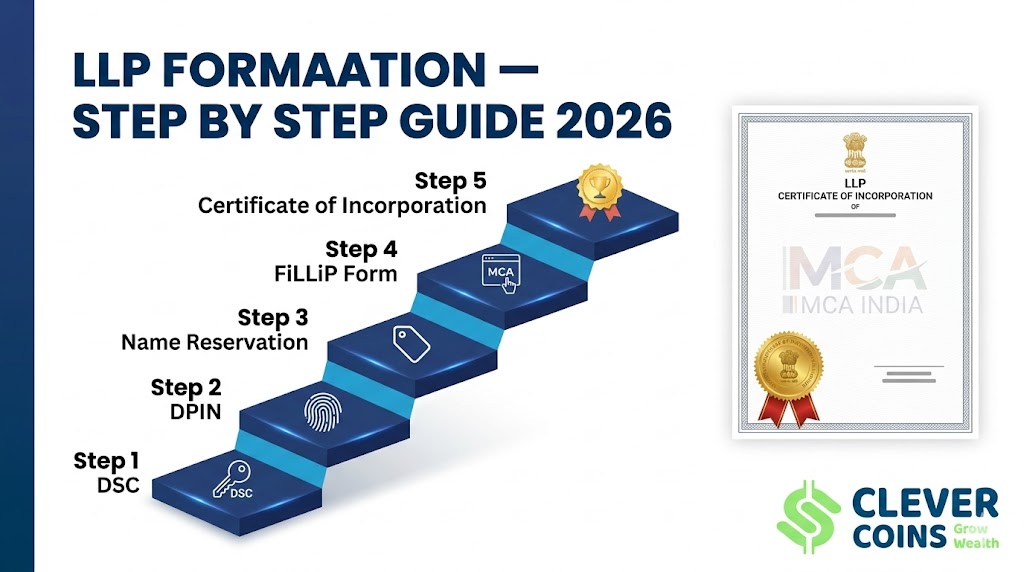
Step-by-Step LLP Formation Process — The Complete 12-Step Guide
The following table provides a comprehensive overview of every step required to form and operationalise an LLP in India:
Step | Activity | Portal / Form | Approx. Time | Key Notes |
1 | Obtain Digital Signature Certificate (DSC) for all Designated Partners | Licensed Certifying Authority (CA — eMudhra, Sify, NSDL) | 1–3 days | Class 3 DSC required. Each DP must have individual DSC. Documents: PAN, Aadhaar, passport photo, email, mobile. |
2 | Apply for Designated Partner Identification Number (DPIN) | MCA Portal — DIR-3 Form (if not already having DIN) | 1–3 working days | Existing DIN holders can use their DIN as DPIN. New applicants file DIR-3 with DSC. |
3 | Name Reservation for LLP — RUN-LLP Form | MCA Portal — RUN-LLP (Reserve Unique Name) | 1–2 working days | Apply for up to 2 name choices. Name must not be identical/similar to existing company or LLP. Approval/rejection by RoC. |
4 | File FiLLiP — Form for Incorporation of LLP | MCA Portal — FiLLiP Form | 3–7 working days | Includes address, DPIN, capital contribution, subscribers’ details. Attach DSC of all DPs. RoC issues Certificate of Incorporation. |
5 | Draft and File LLP Agreement | MCA Portal — Form 3 | Within 30 days of incorporation | Governs partners’ rights, duties, profit-sharing, capital, management. Must be stamped per state stamp duty. File Form 3 within 30 days of incorporation date. |
6 | Obtain PAN and TAN for the LLP | NSDL / UTI Portal — Form 49A (PAN) and Form 49B (TAN) | 5–7 working days | Apply immediately after incorporation. Required for all tax filings, banking, and contracts. PAN needed to open bank account. |
7 | Open a Current Bank Account | Any scheduled commercial bank | 2–5 working days | Documents: Certificate of Incorporation, LLP Agreement, PAN card, address proof, KYC of DPs. Current account in the name of the LLP. |
8 | GST Registration (if applicable) | GST Portal — gst.gov.in | 3–5 working days | Mandatory if turnover > Rs.40 lakh (goods) or Rs.20 lakh (services), or if interstate supply or e-commerce. |
9 | Professional Tax Registration (if applicable) | Respective State Government Portal | 1–3 days | Applicable in states like Maharashtra, Karnataka, West Bengal. Register employer for PT if the LLP will have employees. |
10 | Shops and Establishment Registration (if applicable) | Municipal Authority / State Portal | 2–7 days | Required in most states if the LLP has a physical office or employees. State-specific requirement. |
11 | MSME / Udyam Registration (optional but recommended) | Udyam Portal — udyamregistration.gov.in | Same day (online) | Free registration. Enables access to MSME schemes, priority lending, and government tenders. |
12 | Import Export Code (IEC) — if LLP trades internationally | DGFT Portal — dgft.gov.in | 1–2 working days | Mandatory if LLP imports or exports goods. Apply online with PAN + bank details. |
✅ Total Timeline: From start to Certificate of Incorporation — typically 10 to 21 working days for a straightforward LLP registration. With professional assistance from CleverCoins, most LLPs can be incorporated within 7 to 15 working days.
Step 1 — Digital Signature Certificate (DSC) — Detailed Guide
The Digital Signature Certificate (DSC) is the digital equivalent of a physical signature — required for electronically signing all MCA (Ministry of Corporate Affairs) forms and filings. For LLP formation, every Designated Partner must have a Class 3 DSC.
DSC — What You Need
- Class 3 DSC (individual type) — the only accepted category for MCA filings
- Validity: 1 year or 2 years (2-year DSC is recommended)
- Issued by: Licensed Certifying Authorities (CAs) — eMudhra, Sify Technologies, NSDL e-Governance, Capricorn
- Time to obtain: 1 to 3 working days (with Aadhaar-based eKYC — same day in some cases)
DSC Application Documents
- PAN card (self-attested)
- Aadhaar card (self-attested)
- Passport-size photograph
- Email ID (individual — not shared)
- Mobile number linked to Aadhaar (for OTP verification)
Step 2 — DPIN (Designated Partner Identification Number)
Every Designated Partner must have a Designated Partner Identification Number (DPIN) — a unique 8-digit number issued by the MCA. DPN is essentially the same as DIN (Director Identification Number) used for company directors. If a person already has a DIN from a company directorship — the same number serves as DPIN.
How to Obtain DPIN — DIR-3 Form
- Log in to the MCA portal: mca.gov.in
- Select ‘MCA Services’ → ‘DIN Services’ → ‘New DIN Application’
- Fill Form DIR-3 with personal details, address, educational qualifications
- Attach PAN card, Aadhaar / passport photo, address proof
- Sign the form with your DSC
- Pay the government fee of Rs. 500
- Submit — DIN/DPIN is typically allotted within 1 to 3 working days
⚠️ One Person — One DIN/DPIN: Each individual can have only ONE DIN/DPIN. Applying for a second DIN is an offence under MCA rules. Always check if you already have a DIN before applying.
Step 3 — Name Reservation: RUN-LLP Form
The name of your LLP must be unique, not misleading, and comply with the LLP (Reservation of Name) Rules. The name must end with ‘LLP’ or ‘Limited Liability Partnership’.
Name Selection Guidelines
- Must be unique — not identical or confusingly similar to any existing LLP, company, trademark, or well-known brand
- Must end with ‘LLP’ or ‘Limited Liability Partnership’
- Cannot contain words restricted under the LLP Act (e.g., ‘National’, ‘Government’, ‘Insurance’ — without specific permissions)
- Cannot be offensive, misleading, or contrary to public interest
- Names of government schemes, international organisations without permission are prohibited
RUN-LLP Application Process
- Log in to MCA portal — mca.gov.in
- Go to ‘LLP Services’ → ‘Reserve Unique Name for LLP’
- Enter your 1st and 2nd choice LLP name
- Briefly mention the significance / meaning of the proposed name
- Attach trademark certificate or authorisation letter if using a specific brand name
- Submit — RoC processes the application within 1 to 2 working days
- Approved name is reserved for 90 days — FiLLiP must be filed within this period
✅ Name Reservation Tip: Run a comprehensive name search on the MCA portal and trademark database BEFORE applying for RUN-LLP. This avoids rejection and saves the Rs. 200 government fee. CleverCoins performs a thorough name availability search for all LLP formation clients.
Step 4 — FiLLiP: Form for Incorporation of LLP
FiLLiP (Form for incorporation of Limited Liability Partnership) is the single most important form in the LLP registration process. It is an integrated form that combines name application (if not already reserved), partner details, registered office address, and business activity.
Key Information Required in FiLLiP
- Proposed LLP name (use reserved name from RUN-LLP)
- State and RoC jurisdiction where LLP is being registered
- Registered office address with complete address proof
- Main business activity — description and NIC code
- Details of all partners (DPIN, name, father’s name, address, contribution)
- Details of all Designated Partners with DPIN
- Total capital contribution of all partners
- Whether any partner is a body corporate (company or LLP)
- Declaration and signature of each DP using their DSC
- Subscriber sheet — signed by all partners
Attachments with FiLLiP
- Proof of registered office address (utility bill — not older than 2 months)
- NOC from property owner (if rented / leased premises)
- Subscriber sheet signed by all DPs
- PAN and address proof of each partner (for foreign nationals — passport copy apostilled)
- Consent and declaration of each DP
✅ After successful processing of FiLLiP by the RoC — the MCA issues a CERTIFICATE OF INCORPORATION with a unique LLPIN (Limited Liability Partnership Identification Number). This is the LLP’s birth certificate — the date on this certificate is the official date of formation of the LLP.
Step 5 — Drafting and Filing the LLP Agreement
The LLP Agreement is the most critical constitutional document of an LLP — governing every aspect of the business relationship between partners. It is filed with the MCA on Form 3 within 30 days of the date of incorporation. Failure to file within 30 days means the LLP is governed by the default Schedule I rules of the LLP Act — which may not suit your business.
Essential Clauses in an LLP Agreement
- Name and registered address of the LLP
- Names, addresses, and DPIN of all Designated Partners
- Nature of business and scope of activities
- Capital contribution of each partner — amount, mode (cash/kind), and timeline
- Profit and loss sharing ratio — may differ from capital contribution ratio
- Rights and duties of each Designated Partner and other partners
- Decision-making process — voting rights, quorum, majority required for specific decisions
- Remuneration / salary of working partners (if any) — subject to income tax limits
- Interest on capital contribution — if agreed (maximum 12% p.a. deductible under Income Tax)
- Admission of new partners — conditions, process, and approval
- Retirement of partners — notice period, valuation of interest, settlement process
- Expulsion of a partner — grounds and procedure
- Dissolution of the LLP — conditions, winding up process, distribution of assets
- Dispute resolution mechanism — mediation, arbitration, or court jurisdiction
- Limitations on partner authority — acts requiring partners’ approval
Stamp Duty on LLP Agreement
The LLP Agreement must be printed on stamp paper of appropriate value as per the Stamp Act of the respective state where the LLP is registered. Stamp duty varies significantly by state — Maharashtra typically has higher stamp duty, while states like Rajasthan may have lower rates. Inadequately stamped documents are invalid as evidence in legal proceedings.
⚠️ Many LLP formation mistakes happen here: Partners use a template LLP Agreement without customising it to their specific business arrangement. This can lead to disputes, taxation issues (wrong profit-sharing ratio), and compliance problems later. CleverCoins prepares professionally drafted, customised LLP Agreements for every client.
Documents Required for LLP Formation — Complete Checklist
The following table provides a comprehensive list of all documents required for LLP registration:
Document | Purpose | Format / Requirement |
PAN Card of each Designated Partner | Identity proof — mandatory for DSC and DPIN | Self-attested copy. Must be clearly legible. |
Aadhaar Card of each Designated Partner | Identity + address proof for DSC and MCA filings | Self-attested copy. Aadhaar linked to mobile for OTP. |
Passport (for Foreign Nationals) | Identity proof for foreign Designated Partners | Apostille / notarised copy. Required if any DP is a foreign national. |
Passport-size photograph of each DP | DSC application and MCA portal | Recent colour photograph on white background. |
Residential address proof of each DP | Address verification for DPIN and MCA | Bank statement / utility bill — not older than 2 months. |
Proof of registered office address | LLP’s registered address in FiLLiP form | Utility bill (not older than 2 months) + NOC from owner if rented. |
No Objection Certificate (NOC) from property owner | Required if registered office is a rented / leased premises | On plain paper / stamp paper. Signed by property owner. |
Rent agreement / lease deed | Proof of occupancy of registered office | Registered / notarised rent agreement if address is rented. |
Subscriber Sheet / Consent of Designated Partners | Confirmations in FiLLiP Form | Signed by all DPs with DSC. |
LLP Agreement (draft) | Governs internal management and profit sharing | On appropriate stamp paper as per state stamp duty. Filed as Form 3 within 30 days. |
Digital Signature Certificate of each DP | For electronic filing of all MCA forms | Class 3 DSC. Obtained from licensed Certifying Authority. |
DIN / DPIN of each Designated Partner | Mandatory identifier for directors / partners | Existing DIN accepted. New DPs file DIR-3. |
Email ID and mobile number of each DP | MCA and DSC registration | Individual email and mobile — not shared. |
Details of capital contribution | Mentioned in FiLLiP form and LLP Agreement | Mutual agreed capital — no minimum prescribed. |
Cost of LLP Formation — Detailed Breakdown
One of the major advantages of LLP formation is its relatively low cost compared to a Private Limited Company. Here is a complete cost breakdown:
Component | Approximate Cost | Notes |
Digital Signature Certificate (per DP) | Rs. 800 – Rs. 2,000 | Cost varies by certifying authority and validity (1/2/3 years). Class 3 DSC required. |
DPIN / DIN Application (DIR-3) | Rs. 500 (govt fee) | Only if new DIN needed. Existing DIN holders: No cost. |
Name Reservation — RUN-LLP | Rs. 200 (govt fee) | Per application. If first choice rejected, one more attempt allowed. |
FiLLiP — Incorporation Form | Rs. 500 (govt fee) | One-time government filing fee for LLP incorporation. |
Form 3 — LLP Agreement Filing | Rs. 50 (govt fee) | Plus stamp duty on LLP Agreement (varies by state — typically Rs. 500 to Rs. 5,000+) |
PAN + TAN Application | Rs. 130 + Rs. 65 | Nominal government fees. PAN: Rs. 130, TAN: Rs. 65. |
Professional / CA / CS Fees | Rs. 3,000 – Rs. 15,000 | Varies by professional, city, and complexity of the LLP Agreement. |
Stamp Duty on LLP Agreement | Rs. 500 – Rs. 5,000+ | Varies significantly by state. Maharashtra, Delhi, Karnataka have higher stamp duties. |
GST Registration (if applicable) | Nil government fee | No government fee. Professional service fee: Rs. 500 – Rs. 2,000. |
TOTAL APPROXIMATE COST | Rs. 6,000 – Rs. 25,000 | End-to-end cost including professional fees. Much lower than Pvt. Ltd. formation costs. |
📌 CleverCoins LLP Formation Package: We offer comprehensive end-to-end LLP formation packages starting from Rs. 5,999 — including DSC, DPIN, name reservation, FiLLiP filing, LLP Agreement drafting, Form 3 filing, PAN + TAN application, and GST registration. Contact us at www.clevercoins.org for a free consultation.
LLP Agreement vs Schedule I — Understanding the Default Rules
If an LLP does not file its LLP Agreement on Form 3 within 30 days of incorporation — the default Schedule I of the LLP Act governs the LLP. The Schedule I default rules are:
- All partners have equal rights in the management of the LLP
- No partner shall be entitled to remuneration for acting in the management of the LLP
- Profits and losses are shared equally — regardless of capital contribution
- Decisions require majority consent of partners
- No partner may transfer their interest without consent of ALL other partners
⚠️ The Schedule I default rules are not suitable for most businesses. If there are unequal capital contributions, if some partners are active managers and others are silent investors, or if there are specific profit-sharing arrangements — the LLP MUST file a customised LLP Agreement (Form 3) within 30 days. Once the period passes, an amended agreement can still be filed but with late fees.
Taxation of an LLP — Everything You Need to Know
Income Tax Rate for LLP
- Flat rate: 30% on all taxable profits
- Surcharge: 12% of income tax if taxable income exceeds Rs. 1 crore
- Health and Education Cess: 4% on income tax + surcharge
- Effective tax rate: Approximately 34.944% for income above Rs. 1 crore
- No special lower rate (like 22% for companies that opted for Section 115BAA) — LLPs are taxed at 30% flat
Remuneration to Partners — Tax Deductibility
The LLP Agreement may provide for payment of remuneration (salary) to working Designated Partners. This remuneration is deductible as a business expense for the LLP — subject to the maximum limits under Section 40(b) of the Income Tax Act:
- For the first Rs. 3 lakh of book profit (or loss): Maximum remuneration = Rs. 1.5 lakh or 90% of book profit — whichever is higher
- For book profit above Rs. 3 lakh: Maximum remuneration = 60% of the book profit above Rs. 3 lakh
⚠️ Remuneration in excess of Section 40(b) limits is NOT deductible for the LLP and is taxed in the LLP’s hands at 30%. Always compute the maximum allowable remuneration before deciding partner salaries in the LLP Agreement.
Interest on Capital — Tax Treatment
- Interest paid by LLP to partners on their capital contribution is deductible up to 12% per annum under Section 40(b)
- Interest above 12% is not deductible and is added back to LLP income
- The partner receiving interest must include it in their personal income tax return as ‘Income from Business / Profession’ or ‘Other Sources’
Partners’ Share in LLP Profit — Exempt in Partners’ Hands
This is the greatest tax advantage of an LLP: Under Section 10(2A) of the Income Tax Act, the share of profit received by a partner from the LLP is completely EXEMPT from income tax in the partner’s hands. The LLP has already paid tax at 30% — there is no second level of taxation (unlike a company where dividends are taxed again in shareholders’ hands).
✅ Example: An LLP earns Rs. 20 lakh profit. After paying tax at 30% — the LLP retains Rs. 14 lakh. This Rs. 14 lakh is distributed to partners as their profit share. The partners DO NOT pay any income tax on this Rs. 14 lakh — it is fully exempt under Section 10(2A). Compare this with a company that pays dividend — shareholders would pay further tax on the dividend.
GST for LLP
- LLP is required to register for GST if aggregate turnover exceeds Rs. 40 lakh (goods) or Rs. 20 lakh (services)
- Inter-state supplies: GST registration mandatory regardless of turnover
- LLP must file GSTR-1, GSTR-3B, and GSTR-9 as applicable
- LLP GSTIN is separate from partners’ individual GSTINs
Annual Compliance Calendar for LLP — Complete Guide
Maintaining LLP compliance requires timely filing of statutory forms, income tax returns, and GST returns. The following calendar covers all mandatory obligations:
Compliance | Form / Return | Due Date | Penalty for Non-Compliance |
Annual Return of LLP | Form 11 | 30th May each year (within 60 days of close of FY) | Rs. 100 per day of default — no upper limit |
Statement of Accounts & Solvency | Form 8 | 30th October each year (within 30 days of 6 months of close of FY) | Rs. 100 per day of default — no upper limit |
Income Tax Return | ITR-5 | 31st July (non-audit) / 31st October (audit cases) | Interest u/s 234A + penalty u/s 234F (Rs.1,000 to Rs.5,000) |
Tax Audit (if applicable) | Form 3CB + 3CD | 30th September of AY | 0.5% of turnover or Rs.1.5 lakh — whichever is lower |
GST Returns (if registered) | GSTR-1, GSTR-3B, GSTR-9 | Monthly / Quarterly / Annual | Rs. 50/day (CGST+SGST) up to maximum |
TDS Returns (if applicable) | Form 24Q / 26Q | Quarterly — 31st July, 31st Oct, 31st Jan, 31st May | Rs. 200 per day under Section 234E |
Advance Tax Payments | Challan 280 | 15 June (15%), 15 Sep (45%), 15 Dec (75%), 15 Mar (100%) | Interest under Section 234B and 234C |
Change in Partners — intimation | Form 4 | Within 30 days of change | Rs. 100 per day after 30 days |
Change in LLP Agreement | Form 3 (amendment) | Within 30 days of the change | Rs. 100 per day after 30 days |
Change in Registered Office | Form 15 | Within 30 days of change | Rs. 100 per day after 30 days |
Designated Partner KYC | DIR-3 KYC | Annually — 30th September | Deactivation of DIN/DPIN if not filed |
⚠️ The Rs. 100 per day penalty for Form 8 and Form 11 non-filing has NO upper limit. Many LLPs that remain inactive or whose partners lose interest in compliance have accumulated penalties of lakhs of rupees — making it impossible to close or revive the LLP without a massive penalty settlement. NEVER ignore LLP annual filings, even if the LLP has no transactions.
Common Mistakes in LLP Formation and Compliance
- Not filing Form 3 (LLP Agreement) within 30 days — defaulting to Schedule I which may not suit the business
- Choosing an LLP name that is identical or confusingly similar to an existing trademark — leading to RUN-LLP rejection
- Partners using a shared email ID for DSC — each partner must have an individual email and mobile number
- Not updating MCA when Designated Partners change — Form 4 must be filed within 30 days of any change
- Ignoring annual return filings (Form 8, Form 11) — accumulating unlimited daily penalties
- Not computing Section 40(b) limit correctly — paying partner remuneration beyond deductible limits
- Failing to register for GST despite crossing threshold — leading to GST demand notices
- Not opening a separate LLP bank account — mixing personal and LLP funds creates accounting and legal issues
- LLP Agreement not stamped on correct value stamp paper — making it legally insufficient
- Designated Partners not filing annual DIR-3 KYC — leading to deactivation of DPIN
- Not maintaining proper books of accounts — mandatory under LLP Act (on accrual basis)
- Signing contracts in personal names instead of LLP name — losing limited liability protection
Converting Partnership to LLP — Is It Possible?
Yes. An existing partnership firm can be converted to an LLP under Schedule II of the LLP Act, 2008. This is a popular option for established professional firms (CA firms, law firms) looking to upgrade to the LLP structure for limited liability protection.
Conditions for Conversion
- All partners of the existing firm must become partners of the LLP
- The firm must not have any outstanding creditors who object to the conversion
- Form 17 (Application for Conversion of Partnership to LLP) must be filed with MCA
- LLP Agreement must be prepared and filed within 30 days of conversion
Tax Treatment of Conversion
Conversion of a partnership firm to LLP is tax-neutral under Section 47(xiiib) of the Income Tax Act — meaning no capital gains tax is attracted on the conversion, provided:
- All assets and liabilities of the firm transfer to the LLP
- Partners’ capital accounts remain the same
- There is no change in profit-sharing ratio at the time of conversion
- Partners continue to hold the same profit-sharing ratio for 5 years after conversion
✅ Converting a partnership to an LLP at the right stage — before the business scales significantly — protects the partners from personal liability going forward. CleverCoins handles end-to-end partnership-to-LLP conversion.
Winding Up and Closing an LLP
An LLP can be closed in two ways under the LLP Act:
- Voluntary Winding Up
Partners pass a resolution to wind up the LLP. A liquidator is appointed. Assets are sold, creditors are paid, and any surplus is distributed to partners. Final dissolution order is obtained from the National Company Law Tribunal (NCLT).
- Strike Off — Fast Track Exit (FTE)
If the LLP has no assets, no liabilities, and has not commenced business (or has closed business), it can apply for strike off under the LLP (Winding Up and Dissolution) Rules using Form 24. This is a faster, simpler, and cheaper route than full winding up.
- Conditions: No assets, no liabilities, no pending legal proceedings, all pending returns filed
- Partners must consent to closure
- MCA processes the application and publishes a notice — if no objections, the LLP is struck off
⚠️ Once an LLP is struck off — it is treated as dissolved. All penalties up to strike-off must be settled. An LLP with massive accumulated penalties (due to non-filing) may find it practically impossible to do a clean strike-off without first paying all dues.
How CleverCoins Helps You Form and Manage Your LLP
- End-to-End LLP Formation: DSC procurement, DPIN application, name reservation, FiLLiP filing, LLP Agreement drafting, Form 3 filing — all under one roof
- Custom LLP Agreement: We draft a professionally crafted LLP Agreement tailored to your specific business — not a generic template
- Post-Formation Setup: PAN + TAN application, GST registration, bank account opening assistance, MSME registration
- Annual Compliance: Timely Form 8 and Form 11 filing, ITR-5 preparation and filing, TDS compliance, GST returns
- Tax Planning: Section 40(b) remuneration optimisation, advance tax computation, capital gains planning for LLP assets
- Partnership to LLP Conversion: End-to-end conversion handling — legal, tax, and MCA compliance
- LLP Amendment: Change of partners (Form 4), change of registered office (Form 15), LLP Agreement amendment (Form 3)
- LLP Closure: Form 24 strike-off, FTE application, winding-up support
- Compliance Rescue: If your LLP has missed annual filings and accumulated penalties — we help you regularise and file all pending returns through MCA’s condonation schemes
Ready to Register Your LLP? CleverCoins Makes It Simple & Fast!
www.clevercoins.org | Instagram @clevercoins | Starting at Rs. 5,999
Frequently Asked Questions — LLP Formation
Q1: Can an NRI or foreign national be a partner in an Indian LLP?
Yes. Foreign nationals and NRIs can be partners in an Indian LLP. However, at least one Designated Partner must be an Indian resident (stayed in India for 182+ days in the preceding year). Foreign partners must provide apostilled and notarised identity documents.
Q2: Can a company be a partner in an LLP?
Yes. A company (Indian or foreign) can be a partner in an LLP. However, a company CANNOT be a Designated Partner — only individuals can be Designated Partners.
Q3: Is there a minimum capital requirement for LLP?
No. There is no minimum capital requirement for an LLP. Partners can agree to any capital contribution — even Re. 1. The LLP Act does not prescribe any minimum paid-up capital.
Q4: Can a CA or lawyer form an LLP for professional practice?
Yes. Professional firms of Chartered Accountants, Cost Accountants, Company Secretaries, Lawyers, Architects, and other regulated professions are specifically eligible to form LLPs. This was one of the primary purposes behind the LLP Act 2008 in India.
Q5: What happens if the LLP Agreement is not filed within 30 days?
The LLP will be governed by the default Schedule I rules of the LLP Act, which may not reflect the partners’ actual business arrangement. Additionally, late filing of Form 3 attracts a penalty of Rs. 100 per day of delay. It is strongly advisable to file the LLP Agreement within 30 days of incorporation.
Q6: Can an LLP be converted to a Private Limited Company?
Yes. An LLP can be converted to a Private Limited Company under Section 366 of the Companies Act, 2013. This is a complex procedure requiring NCLT approval, and the tax implications must be carefully evaluated before conversion.
Q7: What is the LLPIN?
LLPIN stands for Limited Liability Partnership Identification Number — a unique alphanumeric number assigned to every LLP upon registration by MCA. It is the LLP’s permanent identity on the MCA portal, similar to CIN for companies. All MCA filings, correspondence, and contracts must include the LLPIN.
Conclusion — LLP is India’s Smartest Business Structure for 2026
The Limited Liability Partnership remains one of India’s most versatile and practical business structures in 2026. Its combination of limited liability, tax efficiency, operational flexibility, lower compliance burden, and professional credibility makes it the ideal choice for professionals, service startups, consulting firms, tech companies, and small-to-medium businesses.
The registration process — from DSC to Certificate of Incorporation — can be completed in 10 to 21 working days with the right professional guidance. With no minimum capital, low formation costs (Rs. 6,000 to Rs. 25,000), and straightforward annual compliance, the LLP is accessible even for first-time entrepreneurs.
At CleverCoins, we handle LLP formation end-to-end — from the first consultation to the Certificate of Incorporation, LLP Agreement, PAN, GST registration, and ongoing annual compliance. Start your LLP journey with us today.