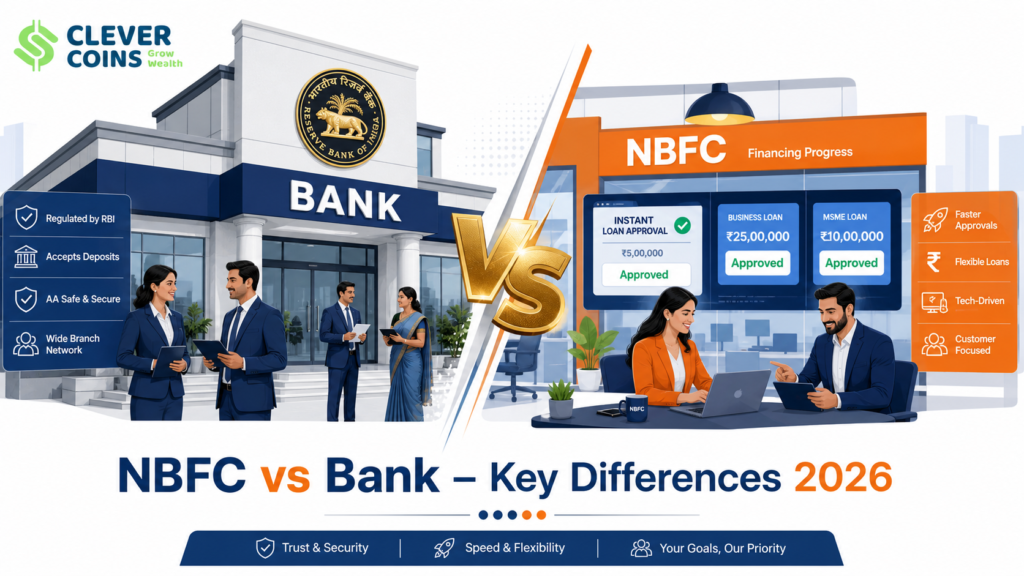
1. India’s financial system is one of the most dynamic in the world, supported by two powerful pillars: Banks and Non-Banking Financial Companies (NBFCs). While both serve the fundamental purpose of channelling credit and financial services to individuals and businesses, they operate under strikingly different regulatory frameworks, offer different products, and cater to different market segments.
As of 2026, India has over 9,500 registered NBFCs with the Reserve Bank of India (RBI), and the country hosts 12 public sector banks, 22 private sector banks, 46 foreign banks, and over 1,500 cooperative banks. Despite their co-existence, confusion between NBFCs and banks remains widespread among borrowers, investors, and even policymakers.
This comprehensive guide will take you through every critical difference between an NBFC and a Bank in India — covering regulatory frameworks, types, services, risks, advantages, and what matters most when choosing between the two.
2. What Is a Bank?
A Bank is a financial institution licensed under the Banking Regulation Act, 1949 and supervised by the Reserve Bank of India (RBI). Banks are authorised to accept deposits from the public, provide credit, and offer a full suite of financial services including payment services, foreign exchange, insurance tie-ups, and wealth management.
2.1 Definition (Legal)
As per Section 5(b) of the Banking Regulation Act 1949, ‘banking’ means the accepting, for the purpose of lending or investment, of deposits of money from the public repayable on demand or otherwise and withdrawable by cheque, draft, order, or otherwise.
2.2 Types of Banks in India (2026)
- Scheduled Commercial Banks: Public Sector Banks (SBI, PNB, Bank of Baroda etc.), Private Sector Banks (HDFC, ICICI, Axis, Kotak etc.), Foreign Banks (Citibank, HSBC, Standard Chartered etc.), Small Finance Banks (AU Small Finance Bank, Jana Small Finance Bank etc.), Payments Banks (Airtel Payments Bank, India Post Payments Bank etc.)
- Cooperative Banks: Urban Cooperative Banks, State Cooperative Banks, District Central Cooperative Banks
- Regional Rural Banks (RRBs): Established to serve rural areas with affordable credit
2.3 Key Characteristics of Banks
- Can accept demand deposits (savings, current accounts)
- Can issue cheques and drafts
- Part of the national payment and settlement system (RTGS, NEFT, IMPS)
- Deposits insured under DICGC up to ₹5 Lakh per depositor per bank (since 2021, effective 2026)
- Must maintain CRR (currently 4.00% as of January 2026)
- Must maintain SLR (currently 18.00% as of January 2026)
- Subject to Priority Sector Lending norms (40% of ANBC for domestic banks)
- RBI acts as the lender of last resort
3. What Is an NBFC?
A Non-Banking Financial Company (NBFC) is a company registered under the Companies Act, 2013 and obtaining a Certificate of Registration (CoR) from the Reserve Bank of India under Section 45-IA of the RBI Act, 1934. NBFCs engage in the business of loans and advances, acquisition of shares/stocks/bonds, leasing, hire purchase, insurance business, and chit business.
3.1 Legal Definition
As per RBI guidelines, a company is treated as an NBFC if its financial assets are more than 50% of its total assets AND income from financial assets is more than 50% of its gross income (the 50-50 test).
3.2 Types of NBFCs in India (2026)
- NBFC-ICC (Investment and Credit Company): Provides loans and advances; the most common type
- NBFC-MFI (Microfinance Institution): Serves economically weaker sections with small-ticket loans
- NBFC-HFC (Housing Finance Company): Specialises in home loans – e.g., LIC Housing Finance, HDFC Ltd (now merged)
- NBFC-IFC (Infrastructure Finance Company): Funds large infrastructure projects
- NBFC-ND (Non-Deposit Taking): Cannot accept public deposits
- NBFC-D (Deposit Taking): Can accept public deposits with restrictions
- NBFC-Factor: Engaged in factoring business (receivables financing)
- NBFC-P2P (Peer-to-Peer Lending): Digital lending platforms connecting borrowers and lenders
- Core Investment Company (CIC): Invests in group companies’ securities
- Account Aggregator (AA): Data-sharing entities licensed by RBI
3.3 Scale-Based Regulation (SBR) Framework – 2026 Update
Effective from October 2022 and fully operational by 2026, RBI introduced the Scale-Based Regulation (SBR) framework categorising NBFCs into four layers:
- Base Layer (NBFC-BL): Small NBFCs with asset size below ₹1,000 Crore; lighter regulations
- Middle Layer (NBFC-ML): Mid-size NBFCs; moderate compliance including NPA classification norms
- Upper Layer (NBFC-UL): Top 10 large NBFCs identified by RBI; near-bank-like regulations
- Top Layer (NBFC-TL): Reserved for systemic risk cases; triggers extraordinary supervisory measures
As of 2026, RBI has identified 16 NBFCs in the Upper Layer including Bajaj Finance, Shriram Finance, Tata Capital, and others, subjecting them to enhanced supervision including capital surcharge and stricter disclosure norms.
4. NBFC vs Bank – Detailed Comparison Table
Parameter | NBFC | Bank |
Full Form | Non-Banking Financial Company | Banking Company / Scheduled Bank |
Regulator | Reserve Bank of India (RBI) | Reserve Bank of India (RBI) |
Governing Act | Companies Act 2013 + RBI Act 1934 | Banking Regulation Act 1949 |
Accepts Deposits | Only certain NBFCs (NBFC-D) can accept public deposits with restrictions | Yes – all types of deposits freely |
Demand Deposits (Current/Savings) | Cannot accept demand deposits | Can accept demand deposits |
Cheque Issuance | Cannot issue cheques independently | Can issue cheques |
Payment & Settlement | Not part of payment & settlement system | Part of payment & settlement system |
Deposit Insurance (DICGC) | Deposits NOT insured by DICGC | Deposits insured up to ₹5 Lakh per depositor |
CRR (Cash Reserve Ratio) | Not required to maintain CRR | Mandatory (currently 4%) |
SLR (Statutory Liquidity Ratio) | Not required to maintain SLR | Mandatory (currently 18%) |
Priority Sector Lending | Not mandatorily applicable | Mandatory – 40% of ANBC |
Foreign Investment Limit | Up to 100% FDI allowed (auto route) | 74% FDI (private sector banks) |
Minimum Capital Requirement | ₹2 Crore (base), upper layer NBFCs more | New private bank: ₹500 Crore+ |
Net Owned Fund (NOF) | Min ₹10 Crore (as of 2024 scale-based) | Not applicable (different framework) |
Interest Rate on Loans | Market-driven, higher flexibility | RBI-regulated, Repo Rate linked |
Loan Products | Specialised: vehicle, microfinance, housing, gold, equipment | Universal – all loan types |
Customer Base | Underserved, rural, SME, subprime segment | Mainstream urban & rural |
Credit Creation | Cannot create credit like banks | Can create credit (money multiplication) |
Lender of Last Resort | RBI not obligated | RBI acts as lender of last resort |
KYC Norms | Applicable (RBI guidelines) | Applicable (RBI guidelines) |
Tax Treatment | Taxed as per Income Tax Act, 1961 | Taxed as per Income Tax Act, 1961 |
5. Regulatory Framework – In-Depth
5.1 Governing Laws
Banks: Primarily governed by the Banking Regulation Act, 1949, RBI Act, 1934, and specific legislation like the State Bank of India Act, 1955 and Nationalisation Acts of 1969 and 1980.
NBFCs: Governed by Chapter III-B of the RBI Act, 1934, SEBI regulations (if listed), Companies Act, 2013, and the NBFC-specific Master Directions issued by RBI. Housing Finance Companies are additionally governed by the NHB Act.
5.2 Capital Requirements (2026 Norms)
- New Private Sector Banks: Minimum paid-up capital of ₹500 Crore at the time of commencement
- Small Finance Banks: Minimum ₹300 Crore paid-up capital
- NBFCs – Base Layer: Minimum Net Owned Fund (NOF) of ₹10 Crore (revised from ₹2 Crore; phased deadline to achieve ₹10 Crore by March 2027)
- NBFCs – Upper Layer: CRAR of at least 15% + capital conservation buffer
5.3 NPA Classification Norms (2026)
Banks classify an asset as NPA if interest or principal is overdue for more than 90 days. Following RBI’s harmonisation directive effective April 2024 (fully applicable 2026):
- NBFC-Middle Layer and above: NPA after 90 days (aligned with banks)
- NBFC-Base Layer: NPA after 90 days (phased alignment completed by 2024)
- NBFC-MFI: Special NPA norms with 60-day overdue threshold for certain categories
6. Deposit Acceptance – Critical Difference
This is arguably the most important distinction between banks and NBFCs. Banks can freely accept all types of deposits. Most NBFCs cannot.
6.1 Bank Deposits
- Savings Account: Interest rate ~3.0% to 7.0% p.a. (varies by bank, 2026)
- Current Account: Typically zero interest
- Fixed Deposit: ~6.5% to 9.5% p.a. depending on tenure and bank type
- Recurring Deposit: ~6.0% to 8.5% p.a.
- DICGC Insurance: Deposits insured up to ₹5,00,000 per depositor per bank
6.2 NBFC Deposits (NBFC-D Only)
- Only NBFCs specifically permitted by RBI as ‘Deposit-Taking NBFCs’ (NBFC-D) can accept public deposits
- Maximum tenure: 1 year to 5 years
- Maximum deposit ceiling: 1.5 times of NOF for NBFC-D
- Deposits are NOT insured by DICGC – investor bears credit risk
- Typical interest rates: 8.5% to 10.5% p.a. (higher than FD rates in banks, 2026)
- Examples: Bajaj Finance FD, Mahindra Finance FD, Shriram Finance FD
⚠️ Important Investor Advisory (2026) Most NBFCs are NON-DEPOSIT TAKING. Depositing money with an NBFC carries higher risk than bank FDs as NBFC deposits are not covered under DICGC insurance. Always verify the credit rating (AAA/AA+ recommended) of NBFC deposits before investing. |
7. Interest Rates & Loan Products – 2026 Comparison
7.1 Home Loans
- Banks (PSU): 8.40% – 9.10% p.a. (linked to RLLR/Repo Rate)
- Banks (Private): 8.75% – 9.50% p.a.
- HFCs/NBFCs: 9.00% – 11.50% p.a. (higher flexibility for self-employed, NRIs)
7.2 Personal Loans
- Banks: 10.50% – 14.00% p.a. (salaried applicants with good credit score)
- NBFCs: 12.00% – 24.00% p.a. (wider approval criteria, serves thin-file customers)
7.3 Vehicle Loans
- Banks: 8.75% – 12.00% p.a.
- NBFCs (specialised like Shriram, Mahindra): 13.00% – 18.00% p.a. (second-hand vehicles, commercial vehicles)
7.4 Gold Loans
- Banks: 8.50% – 12.00% p.a.
- NBFCs (Muthoot Finance, Manappuram): 12.00% – 24.00% p.a. (faster disbursal, lower documentation)
7.5 MSME / Business Loans
- Banks: 10.00% – 15.00% p.a. (MUDRA, CGTMSE backed loans available)
- NBFCs (Fintech-backed): 14.00% – 30.00% p.a. (collateral-free, quick approval, digital-first)
💡 Key Insight (2026) NBFC interest rates are generally higher than banks due to higher cost of funds (NBFCs borrow from banks and capital markets). However, NBFCs compensate with faster processing (24-72 hours vs 7-15 days for banks), lower documentation requirements, and willingness to lend to self-employed, gig workers, and credit-invisible segments. |
8. Advantages and Disadvantages
8.1 Advantages of Banks
- Lower interest rates linked to RBI’s repo rate
- DICGC deposit insurance up to ₹5 Lakh
- Full payment infrastructure (NEFT, RTGS, IMPS, UPI integration)
- Higher credibility and public trust
- Government ownership in PSU banks adds safety
- Access to MUDRA loans, PM Awas Yojana loans, subsidised schemes
8.2 Disadvantages of Banks
- Stringent eligibility criteria – salaried, formal sector bias
- Slower processing – typically 7-21 business days
- Heavy documentation requirements
- Rigid product structures
- Limited reach in rural/semi-urban areas (though improving via BCs
8.3 Advantages of NBFCs
- Faster loan disbursal – some NBFCs disburse within 4 hours digitally
- Flexible eligibility – serve informal sector, self-employed, low credit score borrowers
- Specialised products – gold loans, LAP, vehicle finance, supply chain finance
- Innovation and fintech integration – AI-based underwriting
- Less stringent documentation in many cases
- Higher FD interest rates for investors seeking better returns
8.4 Disadvantages of NBFCs
- Higher interest rates compared to banks
- No DICGC deposit insurance for NBFC deposits
- Cannot offer current/savings accounts
- Cannot issue cheques independently
- Perceived higher credit risk – especially smaller NBFCs
- Asset-liability mismatch risk (IL&FS 2018, DHFL 2019 crisis lessons still apply)
9. NBFC Sector Challenges & RBI Response (2018-2026)
The IL&FS default in September 2018 triggered India’s worst NBFC liquidity crisis. The subsequent DHFL collapse in 2019 and the COVID-19 disruption of 2020-21 further stressed the sector. Here’s how the landscape has evolved by 2026:
9.1 Key Reforms Implemented (2022-2026)
- Scale-Based Regulation (SBR): Risk-proportionate supervision framework launched October 2022
- Prompt Corrective Action (PCA) for NBFCs: Framework operational since December 2021
- Harmonised NPA Norms: 90-day NPA classification aligned with banks
- Digital Lending Guidelines (2022, updated 2024): Regulates fintech NBFC partnerships, bans third-party fee charging
- Microfinance Regulation (March 2022): Caps total loan obligation at 50% of household income
- Liquidity Coverage Ratio (LCR) for NBFCs-UL and ML: Phased implementation by 2025
10. NBFC or Bank – Which Should You Choose? (2026)
Choose a Bank if:
- You want lower interest rates on home loans, car loans, or personal loans
- You are a salaried employee with stable income and good credit score (700+)
- You want safe deposits with DICGC protection
- You need a current account, cheque book, or payment infrastructure
- You are applying for government-subsidised loan schemes (PMAY, MUDRA, etc.)
Choose an NBFC if:
- You are self-employed, a small business owner, or have an irregular income
- You need a loan urgently and want disbursal within 24-72 hours
- You have a low credit score or are a first-time borrower (credit invisible)
- You need a specialised product like gold loan, used vehicle loan, or supply chain finance
- You are an investor seeking higher FD returns (from AAA-rated NBFCs like Bajaj Finance)
11. Major NBFCs vs Major Banks in India (2026)
Top NBFCs by Asset Size (2026)
- Bajaj Finance Ltd – Assets: ₹3.5+ Lakh Crore | Focus: Consumer finance, SME loans, FDs
- Shriram Finance Ltd – Assets: ₹2.5+ Lakh Crore | Focus: Commercial vehicle, two-wheeler loans
- Tata Capital Financial Services – Assets: ₹1.8+ Lakh Crore | Focus: Retail and wholesale lending
- Mahindra & Mahindra Financial Services – Focus: Rural vehicle and SME loans
- Muthoot Finance – India’s largest gold loan NBFC; Assets ₹1 Lakh Crore+
- Manappuram Finance – Gold loans, microfinance, housing
- Piramal Capital & Housing Finance – Real estate and retail housing loans
Top Banks (2026)
- State Bank of India – Largest bank; Total assets ₹65+ Lakh Crore
- HDFC Bank (post HDFC merger) – Largest private sector bank; Assets ₹36+ Lakh Crore
- ICICI Bank – Assets ₹20+ Lakh Crore
- Bank of Baroda, Punjab National Bank – Major PSU banks post-consolidation
- Kotak Mahindra Bank, Axis Bank, Yes Bank – Leading private sector banks
12. The Fintech NBFC Revolution & Future Outlook (2026)
The lines between NBFCs and banks are blurring in 2026, driven by:
- Co-lending Model: NBFCs and banks co-originate loans (60:40 ratio), sharing risk and returns. RBI’s co-lending framework (2020, updated 2023) has scaled this significantly – over ₹1,50,000 Crore disbursed through co-lending by 2026.
- Account Aggregator (AA) Framework: Enables seamless financial data sharing between NBFCs and banks, powering consent-based credit underwriting
- OCEN (Open Credit Enablement Network): Embeds credit products into digital platforms, blurring origination boundaries
- Digital Lending Apps: NBFCs like KreditBee, MoneyView, Slice, and fintechs backed by NBFC licenses have disrupted personal lending
- UPI Credit on RuPay: NBFCs and banks offering pre-approved credit lines directly via UPI
By 2026, RBI’s vision is a well-layered financial system where banks serve as the backbone, upper-layer NBFCs operate as near-banks, and smaller NBFCs continue serving the credit-underserved population – all under proportionate but robust regulation.
13. Frequently Asked Questions (FAQs)
Q1. Is money deposited in an NBFC safe?
NBFC deposits are not insured by DICGC. Only deposits with RBI-approved NBFC-D companies are permitted. Stick to AAA-rated NBFCs like Bajaj Finance for FD investments. Always check RBI’s approved NBFC-D list before investing.
Q2. Can an NBFC become a bank?
Yes. RBI’s ‘on-tap’ licensing allows eligible NBFCs with strong track records to apply for bank licenses. Bandhan Bank and IDFC First Bank were NBFCs that converted to universal banks. The minimum capital requirement for a new private bank is ₹500 Crore.
Q3. Which gives a better home loan – NBFC or Bank?
For salaried employees with good credit scores, banks generally offer better home loan rates (8.40%-9.00% p.a. in 2026). NBFCs are better for self-employed borrowers, NRIs, or those with irregular income, despite slightly higher rates.
Q4. Do NBFCs come under RBI?
Yes. All registered NBFCs are regulated and supervised by the Reserve Bank of India under the RBI Act, 1934. NBFCs must obtain a Certificate of Registration (CoR) from RBI to commence financial activities.
Q5. What is the minimum NOF for an NBFC in 2026?
As per RBI’s revised guidelines under SBR, all NBFCs must have a minimum Net Owned Fund (NOF) of ₹10 Crore by March 2027. The earlier threshold was ₹2 Crore.
Q6. Can I open a savings account with an NBFC?
No. NBFCs cannot open savings or current accounts. Only licensed banks can offer transactional accounts (savings, current). However, Payments Banks (a special bank type) can accept deposits up to ₹2 Lakh per customer.
14. Conclusion
Banks and NBFCs are two complementary pillars of India’s financial architecture. Banks offer safety, lower interest rates, and comprehensive payment services backed by RBI’s safety net. NBFCs offer speed, flexibility, specialisation, and financial inclusion – reaching borrowers that traditional banks have historically overlooked.
In 2026, with RBI’s Scale-Based Regulation maturing, the NBFC sector is more regulated, stable, and investor-friendly than ever before. For borrowers: choose based on your credit profile, urgency, and loan type. For investors: NBFC FDs from top-rated companies offer attractive returns, but always prioritise capital safety over yield.
Understanding the NBFC vs Bank difference is not just academic – it’s a practical financial skill that can save you thousands of rupees in interest costs and protect your hard-earned savings.