New Income Tax Slabs FY 2026-27: Everything You Need to Know About the Latest Tax Regime in India
A New Tax Era for India
The Union Budget 2025-26 brought one of the most significant overhauls to India’s personal income tax structure in recent memory. With the new income tax slabs for FY 2026-27 (Assessment Year 2027-28), the government has doubled down on making the new tax regime the default and preferred choice for the majority of salaried individuals and professionals.
Whether you are a salaried employee, a freelancer, a business owner, or a senior citizen, understanding the new income tax slabs for FY 2026-27 is absolutely essential. This blog breaks down every aspect: the revised slab rates, the key differences between the old and new regimes, exemptions, deductions, surcharges, and the most critical question — which regime is better for you?
What Are Income Tax Slabs?
Income tax slabs are income ranges to which different tax rates apply. India follows a progressive taxation system, meaning higher income attracts a higher percentage of tax. The government periodically revises these slabs in the Union Budget to align with inflation, economic conditions, and policy goals.
For FY 2026-27, the income tax slabs have been revised significantly under the new tax regime, offering individuals higher tax-free income thresholds and simplified rate structures.
New Income Tax Slabs FY 2026-27 (New Tax Regime — Default)
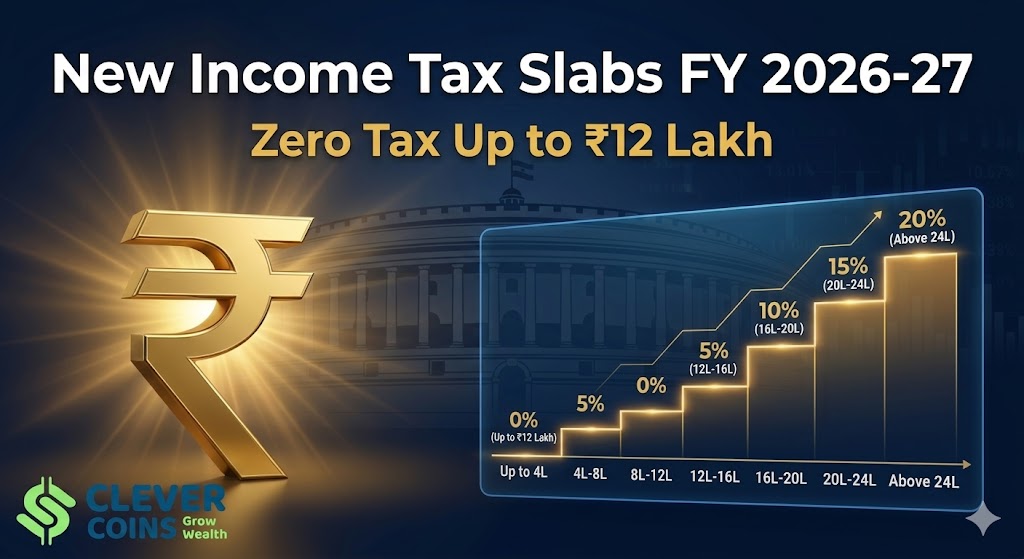
Under the new tax regime, which is now the default regime as per the Finance Act, the income tax slabs for FY 2026-27 for individuals below 60 years of age are as follows:
Income Slab | Slab Range | Tax Rate | Tax on Slab | Cumulative Tax |
Up to Rs 4,00,000 | Nil | 0% | Nil | Nil |
Rs 4,00,001 – Rs 8,00,000 | Rs 4,00,000 | 5% | Rs 20,000 | Rs 20,000 |
Rs 8,00,001 – Rs 12,00,000 | Rs 4,00,000 | 10% | Rs 40,000 | Rs 60,000 |
Rs 12,00,001 – Rs 16,00,000 | Rs 4,00,000 | 15% | Rs 60,000 | Rs 1,20,000 |
Rs 16,00,001 – Rs 20,00,000 | Rs 4,00,000 | 20% | Rs 80,000 | Rs 2,00,000 |
Rs 20,00,001 – Rs 24,00,000 | Rs 4,00,000 | 25% | Rs 1,00,000 | Rs 3,00,000 |
Above Rs 24,00,000 | Balance | 30% | Balance x 30% | — |
Note: The above rates are applicable before adding the applicable surcharge and 4% health and education cess.
Key Highlight — Zero Tax Up to Rs 12 Lakh
One of the biggest announcements in Budget 2025 was a massive increase in the rebate under Section 87A under the new tax regime. As a result, individuals with a net taxable income of up to Rs 12,00,000 will have ZERO tax liability in FY 2026-27.
For salaried individuals, the standard deduction of Rs 75,000 further raises the effective zero-tax threshold to Rs 12,75,000 under the new regime.
Old Tax Regime — Slabs for FY 2026-27
While the new regime is the default, taxpayers still have the option to choose the old (existing) tax regime if it is more beneficial for them. The old tax regime slabs remain unchanged for FY 2026-27:
Income Slab | Tax Rate | Remarks |
Up to Rs 2,50,000 | Nil | Applicable for all individuals below 60 |
Rs 2,50,001 – Rs 5,00,000 | 5% | Rebate u/s 87A makes it zero if income <= Rs 5 lakh |
Rs 5,00,001 – Rs 10,00,000 | 20% | — |
Above Rs 10,00,000 | 30% | — |
For Senior Citizens (60-79 years), the basic exemption limit under the old regime is Rs 3,00,000.
For Super Senior Citizens (80+ years), the basic exemption limit under the old regime is Rs 5,00,000.
New vs Old Regime — A Detailed Comparison for FY 2026-27
Feature | New Regime | Old Regime |
Basic Exemption Limit | Rs 4,00,000 | Rs 2,50,000 |
Zero Tax Threshold | Rs 12,00,000 (via rebate) | Rs 5,00,000 (via rebate) |
Standard Deduction | Rs 75,000 (salaried) | Rs 50,000 (salaried) |
Section 80C Deduction | Not Available | Up to Rs 1,50,000 |
Section 80D (Medical) | Not Available | Available |
HRA Exemption | Not Available | Available |
LTA Exemption | Not Available | Available |
Home Loan Interest (Self-occ.) | Not Available | Up to Rs 2,00,000 |
NPS (Employer) 80CCD(2) | Available | Available |
Leave Encashment Exemption | Available | Available |
Gratuity Exemption | Available | Available |
Default Regime | Yes (Default) | No (Opt-in required) |
Tax Structure | Simpler, lower rates | Complex, higher rates |
Best Suited For | Low-deduction taxpayers | High-deduction taxpayers |
Section 87A Rebate — The Game Changer for FY 2026-27
Section 87A of the Income Tax Act provides a tax rebate that effectively reduces your final tax liability. For FY 2026-27:
- New Tax Regime: Rebate of up to Rs 60,000 (or actual tax, whichever is lower) for individuals with net taxable income up to Rs 12,00,000.
- Old Tax Regime: Rebate of up to Rs 12,500 for individuals with net taxable income up to Rs 5,00,000.
This means that if your total taxable income does not exceed Rs 12,00,000 under the new regime, you effectively pay ZERO income tax.
Surcharge Rates for FY 2026-27
Surcharge is an additional tax levied on individuals with high income. The rates for FY 2026-27 are:
Income Range | New Regime Surcharge | Old Regime Surcharge |
Up to Rs 50 Lakh | Nil | Nil |
Rs 50 Lakh – Rs 1 Crore | 10% | 10% |
Rs 1 Crore – Rs 2 Crore | 15% | 15% |
Rs 2 Crore – Rs 5 Crore | 25% | 25% (old) / 25% (new) |
Above Rs 5 Crore | 25% (capped) | 37% (old) / 25% (new, capped) |
Note: The 4% Health and Education Cess is applicable on (Tax + Surcharge) in both regimes.
Standard Deduction Under New Regime — FY 2026-27
The standard deduction for salaried employees and pensioners has been revised:
- Salaried Employees: Rs 75,000 (up from Rs 50,000)
- Pensioners: Rs 75,000 per year
- Family Pension Deduction: Rs 25,000 or 33.33% of family pension, whichever is lower
This was a crucial change introduced in the interim budget and confirmed for FY 2026-27, benefiting all salaried individuals significantly.
Income Tax Calculation — Practical Examples
Example 1: Salaried Individual, Income Rs 10 Lakh (New Regime)
Particulars | Amount | Remarks |
Gross Salary | Rs 10,00,000 | — |
Less: Standard Deduction | Rs 75,000 | New regime benefit |
Net Taxable Income | Rs 9,25,000 | — |
Tax on Rs 4L to Rs 8L (5%) | Rs 20,000 | On Rs 4,00,000 |
Tax on Rs 8L to Rs 9.25L (10%) | Rs 12,500 | On Rs 1,25,000 |
Total Tax Before Rebate | Rs 32,500 | — |
Less: Rebate u/s 87A | Rs 32,500 | Income < Rs 12L |
Net Tax Payable | Rs 0 | Zero Tax! |
Example 2: Salaried Individual, Income Rs 15 Lakh (New Regime)
Particulars | Amount | Remarks |
Gross Salary | Rs 15,00,000 | — |
Less: Standard Deduction | Rs 75,000 | — |
Net Taxable Income | Rs 14,25,000 | — |
Tax on Rs 0–Rs 4L | Rs 0 | Nil slab |
Tax on Rs 4L–Rs 8L (5%) | Rs 20,000 | — |
Tax on Rs 8L–Rs 12L (10%) | Rs 40,000 | — |
Tax on Rs 12L–Rs 14.25L (15%) | Rs 33,750 | On Rs 2,25,000 |
Total Tax | Rs 93,750 | — |
Add: Cess @ 4% | Rs 3,750 | — |
Net Tax Payable | Rs 97,500 | — |
Example 3: Individual Earning Rs 20 Lakh (Old vs New Regime)
Particulars | New Regime | Old Regime |
Gross Income | Rs 20,00,000 | Rs 20,00,000 |
Standard Deduction | Rs 75,000 | Rs 50,000 |
Sec 80C Deduction | Not Available | Rs 1,50,000 |
Sec 80D (Medical) | Not Available | Rs 25,000 |
HRA Exemption | Not Available | Rs 1,00,000 |
Net Taxable Income | Rs 19,25,000 | Rs 17,25,000 |
Total Tax + Cess | Rs 2,39,200 (approx) | Rs 2,22,300 (approx) |
Better Option | — | Old Regime Wins Here |
Key Deductions Available Under New Tax Regime (FY 2026-27)
While the new regime restricts many deductions, the following are STILL available:
- Standard Deduction of Rs 75,000 for salaried employees
- Employer’s contribution to NPS under Section 80CCD(2) — up to 14% of salary (government employees) or 10% (private sector)
- Agniveer Corpus Fund deduction under Section 80CCH
- Gratuity exemption under Section 10(10)
- Leave encashment exemption under Section 10(10AA)
- House Rent Allowance (HRA) — only for specified categories
- Conveyance and transport allowances for specially-abled individuals
- Voluntary Retirement Scheme (VRS) under Section 10(10C)
- Death-cum-retirement gratuity
- Life insurance maturity proceeds under Section 10(10D)
- Scholarship under Section 10(16)
- Perquisites and allowances for official duties
Deductions NOT Available Under New Tax Regime
The following popular deductions are NOT available if you choose the new tax regime:
- Section 80C — PPF, ELSS, LIC, NSC, Home Loan Principal, etc. (up to Rs 1.5 lakh)
- Section 80D — Health Insurance Premium
- Section 80E — Education Loan Interest
- Section 80G — Donations to charitable organizations
- Section 80TTA / 80TTB — Interest on savings accounts
- Section 24(b) — Home Loan Interest (self-occupied)
- HRA Exemption under Section 10(13A)
- Leave Travel Allowance (LTA) under Section 10(5)
- House Rent paid (self-employed) under Section 80GG
- Section 80EEA — Additional home loan interest benefit
Who Should Choose the New Tax Regime?
The new regime is generally beneficial for:
- Individuals with net taxable income up to Rs 12 lakh (zero tax benefit)
- Young professionals with few investment-based deductions
- Individuals who do not have HRA exemptions or home loans
- Freelancers and self-employed individuals without high Section 80C investments
- Individuals who prefer simpler tax computation without investment planning
- People whose total deductions under old regime would be less than the benefit from lower slab rates under the new regime
Who Should Stick to the Old Tax Regime?
The old regime may still be beneficial if:
- You have significant Section 80C investments (Rs 1.5 lakh or more)
- You have a substantial home loan with interest component above Rs 2 lakh
- You claim high HRA exemptions (major metro residents)
- You have multiple deductions including 80D, 80E, 80G adding up to Rs 3–4 lakh+
- You are a senior citizen with high interest income and 80TTB deductions
Break-Even Analysis — New vs Old Regime
The break-even point for choosing between the two regimes depends on the total deductions you can claim:
Income Range | Recommended Regime | Notes |
Up to Rs 12 Lakh | Always New Regime | Zero tax under new regime |
Rs 12–15 Lakh | New if deductions < Rs 2.5 lakh | Compare both regimes |
Rs 15–20 Lakh | New if deductions < Rs 3 lakh | Old if high HRA + 80C |
Rs 20–30 Lakh | New if deductions < Rs 3.5 lakh | Old if deductions > Rs 4 lakh |
Above Rs 30 Lakh | Depends on individual case | Detailed calculation advised |
TDS Changes for FY 2026-27
Important TDS (Tax Deducted at Source) updates effective FY 2026-27:
- TDS on Salary: Now calculated as per the new tax regime by default unless the employee opts for the old regime in writing.
- TDS threshold on interest income (194A) raised to Rs 1,00,000 for senior citizens.
- TDS threshold on rent (194I) increased to Rs 50,000 per month from Rs 50,000 per annum.
- TDS on e-commerce operators revised under Section 194O.
- Lower Deduction Certificate (Form 13) can be filed to reduce TDS if eligible.
Advance Tax for FY 2026-27 — Due Dates
Individuals (other than senior citizens with no business income) must pay advance tax in installments:
Installment | Due Date | Amount |
1st Installment | On or before June 15, 2026 | 15% of total tax liability |
2nd Installment | On or before September 15, 2026 | 45% of total tax liability (cumulative) |
3rd Installment | On or before December 15, 2026 | 75% of total tax liability (cumulative) |
4th Installment | On or before March 15, 2027 | 100% of total tax liability |
Interest under Section 234B and 234C is levied if advance tax is not paid correctly and on time.
New Tax Regime for Special Categories — FY 2026-27
Senior Citizens (Age 60 to 79 years)
Under the new regime, there is NO separate basic exemption limit for senior citizens. The slab structure is identical to that for individuals below 60 years. However, the rebate of Rs 60,000 under Section 87A ensures zero tax up to Rs 12 lakh.
Super Senior Citizens (Age 80 years and above)
Similar to senior citizens, super senior citizens are subject to the same slab rates under the new regime. The substantial benefit under the old regime (basic exemption up to Rs 5 lakh) makes the old regime worth evaluating for this group.
Women Taxpayers
There is no separate income tax slab for women taxpayers in India for FY 2026-27. Women are taxed at the same rates as all other individual taxpayers.
Non-Resident Indians (NRIs)
NRIs are taxed on income earned or received in India. The new tax regime is applicable to NRIs as well, with the same slab rates. However, NRIs cannot avail the Section 87A rebate under the new regime.
Impact on Different Income Groups
Middle-Class Taxpayers (Rs 8–15 Lakh)
The middle class stands to benefit the most from the new tax slabs. With the zero-tax threshold now at Rs 12 lakh (or Rs 12.75 lakh for salaried individuals with standard deduction), a large portion of the middle class effectively pays zero tax. This leaves more disposable income for savings and consumption.
High-Income Earners (Rs 50 Lakh and above)
High-income earners may benefit from the reduced peak surcharge of 25% (instead of 37%) under the new regime for incomes above Rs 5 crore. However, the loss of major deductions means a detailed calculation is necessary.
Business Owners and Self-Employed
Self-employed individuals can switch between regimes every year if they have no business income. Those with business income can switch only once from the new to the old regime in their lifetime. This makes the choice particularly important for entrepreneurs.
Filing Your Income Tax Return for AY 2027-28
Key ITR filing dates for income earned in FY 2026-27 (Assessment Year 2027-28):
- July 31, 2027 — Last date for individuals (without audit requirement)
- October 31, 2027 — Last date for businesses requiring audit
- November 30, 2027 — Last date for transfer pricing cases
- December 31, 2027 — Belated return filing deadline
The choice of tax regime must be made at the time of filing your ITR. Salaried individuals may indicate their preference to their employer for TDS calculation purposes.
Frequently Asked Questions (FAQs)
Q1. Is the new tax regime mandatory for FY 2026-27?
No, the new tax regime is the default regime, but taxpayers can opt for the old regime at the time of filing their return (for salaried individuals without business income).
Q2. Can I switch between new and old regime every year?
Salaried individuals and those without business income can switch between regimes every financial year. However, individuals with business income can exercise the option to revert to the old regime only once.
Q3. What is the maximum income tax rebate under the new regime in FY 2026-27?
The maximum rebate under Section 87A in the new regime is Rs 60,000, applicable for income up to Rs 12,00,000.
Q4. Is Section 80C available in the new tax regime?
No, Section 80C deductions (PPF, ELSS, NSC, LIC, etc.) are NOT available in the new tax regime.
Q5. What is the effective tax-free income for salaried employees in FY 2026-27?
For salaried employees under the new regime, the effective tax-free income is Rs 12,75,000 (Rs 12,00,000 rebate threshold + Rs 75,000 standard deduction).
Q6. Are senior citizens better off with old or new regime?
It depends on individual circumstances. The old regime with exemptions up to Rs 3,00,000 and deductions may be better for senior citizens with high interest income and medical expenses. A case-by-case calculation is recommended.
Q7. What happens if I don’t choose a regime?
If no choice is made, the new tax regime is applied by default for FY 2026-27.
Tax-Saving Tips for FY 2026-27
- Use the new regime’s zero-tax benefit if your income is at or below Rs 12 lakh.
- Maximize employer’s NPS contribution (Sec 80CCD(2)) — available in both regimes.
- Claim standard deduction of Rs 75,000 if salaried — available in both regimes.
- Plan salary structure to include tax-free components (meal coupons, uniform allowances, etc.).
- If under old regime, ensure full utilization of Section 80C (Rs 1.5 lakh).
- Invest in NPS under Section 80CCD(1B) for an additional Rs 50,000 deduction under old regime.
- Take health insurance to claim Section 80D deductions under old regime.
- File ITR before the due date to avoid interest under Sections 234A, 234B, and 234C.
Conclusion
The new income tax slabs for FY 2026-27 represent a decisive push by the Indian government toward simplifying the tax structure and incentivizing compliance. With zero tax for income up to Rs 12 lakh, reduced slab rates, and a simplified framework, the new regime is especially attractive for salaried individuals and those with fewer deductions.
However, high earners with substantial home loan interest, HRA exemptions, and Section 80C investments may still find the old regime advantageous. The golden rule: always calculate your tax liability under both regimes using the latest tools or consult a qualified chartered accountant before making your choice.
Stay updated with the latest circulars from the Income Tax Department and file your returns on time to avoid penalties. The new tax era is here — make the most of it!