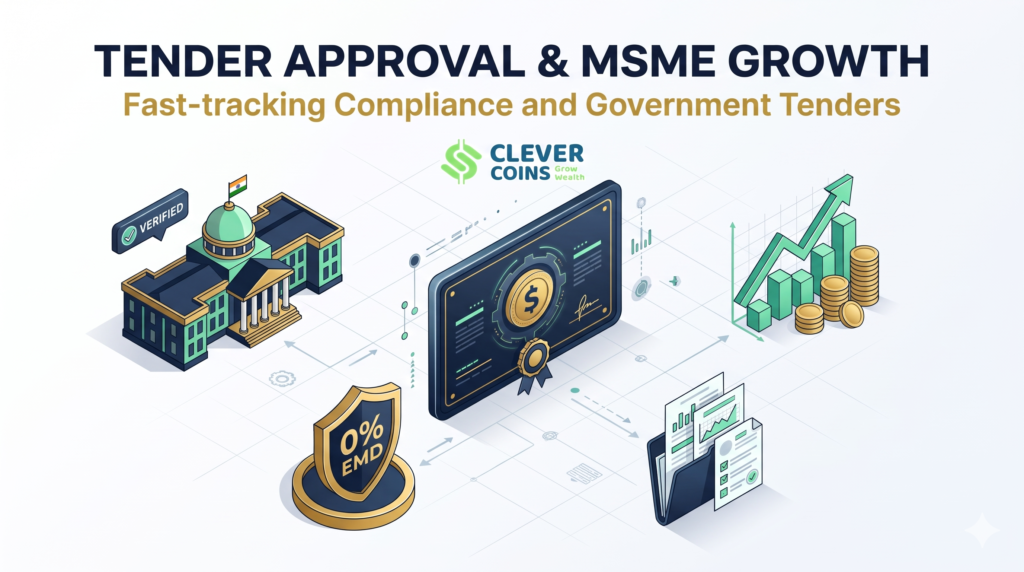
How to Get NSIC Registration in 2025 and Its 5 Major Benefits for MSME Tenders
Winning government contracts in India has historically been an uphill battle for small businesses. Even when a Micro or Small Enterprise (MSE) manufactures superior products or delivers reliable services, strict tender conditions—such as heavy Earnest Money Deposits (EMDs), expensive tender documentation fees, and rigid prior-turnover clauses—frequently block them from even submitting a bid.
To bridge this gap and empower small businesses to compete alongside large corporations, the Government of India operates the Single Point Registration Scheme (SPRS) through the National Small Industries Corporation (NSIC). Whether you run a precision manufacturing unit in Thane, an IT services firm in Bengaluru, or an agro-processing enterprise in Gujarat, obtaining an NSIC Registration Certificate acts as a direct passport to Central Ministries, State Government Departments, and Public Sector Undertakings (PSUs).
In this comprehensive guide, we break down everything you need to know about getting NSIC registration in 2025—including the updated MSME classification slabs effective from April 2025, exact government fee structures, mandatory documents, technical inspection rules, and the 5 major benefits for MSME tenders that can transform your B2G (Business-to-Government) revenue pipeline.
What is NSIC Registration (Single Point Registration Scheme)?
The National Small Industries Corporation (NSIC) is a Mini Ratna PSU established by the Government of India under the Ministry of Micro, Small and Medium Enterprises (MSME). Its primary mandate is to promote, aid, and foster the growth of micro and small enterprises across the country.
Under its flagship Single Point Registration Scheme (SPRS), NSIC evaluates the technical, commercial, and financial capability of eligible Micro and Small Enterprises. Once verified through document scrutiny and a physical or virtual technical inspection, NSIC issues an official SPRS Certificate specifying the exact items or services the enterprise is approved to supply, along with a calculated Monetary Limit based on audited financial performance.
Once an enterprise holds a valid NSIC registration, it is automatically deemed registered with all Central Government Ministries, Departments, and PSUs for the enlisted stores or services—eliminating the need to register separately with dozens of individual government buying agencies.
NSIC Registration vs. Udyam Registration: Understanding the Difference
A common misconception among Indian entrepreneurs is assuming that a free Udyam Registration Certificate automatically unlocks every NSIC tender privilege. While Udyam Registration is the foundational identity for any MSME, NSIC SPRS is a specialized, capability-verified procurement certification.
| Comparison Parameter | Udyam Registration | NSIC Registration (SPRS) |
| Governing Authority | Ministry of MSME (Udyam Portal) | National Small Industries Corporation (NSIC) |
| Eligible Categories | Micro, Small, and Medium Enterprises | Micro and Small Enterprises (MSEs) only |
| Eligible Activities | Manufacturing, Services, and Retail/Wholesale Trade | Manufacturing and Services only (Traders excluded) |
| Registration Cost | Completely Free (₹0) | Turnover-based government fee + inspection charges |
| Physical/Technical Audit | Not required (Self-declaration basis) | Mandatory third-party technical inspection |
| Validity Period | Lifetime validity (subject to annual updates) | 2 Years (1 Year for Provisional Startup Certificate) |
| Monetary Limit Cap | Not applicable | Defined on certificate based on audited turnover |
5 Major Benefits of NSIC Registration for MSME Tenders
Securing an NSIC registration gives your business immediate financial and competitive leverage when bidding on government tenders. Under the Public Procurement Policy for MSEs Order, 2012 (and subsequent amendments), NSIC-registered enterprises enjoy five transformative advantages:
1. 100% Exemption from Earnest Money Deposit (EMD)
In standard government tenders, bidders are required to submit an Earnest Money Deposit (EMD)—typically ranging from 1% to 5% of the estimated tender value—as a security guarantee. For high-value tenders worth ₹50 lakh or ₹2 crore, locking up ₹1 lakh to ₹5 lakh per bid severely strains an MSME’s working capital, especially when bidding on multiple tenders simultaneously.
With a valid NSIC registration certificate, your enterprise is completely exempt from paying EMD across Central Government Ministries, Departments, and PSUs. You can participate in dozens of high-value tenders without blocking a single rupee in bank guarantees or demand drafts, keeping your cash flow available for operations and raw material procurement.
2. Free Issue of Tender Documents (Zero Tender Fee)
Government procurement authorities normally charge a non-refundable Tender Document Fee (ranging from ₹500 to ₹10,000+ per tender) simply to download or purchase the bid specifications, drawings, and terms. Over a financial year, actively bidding on 30 to 40 tenders can cost an MSME tens of thousands of rupees in sunk administrative expenses.
NSIC-registered MSEs are entitled to receive tender sets completely free of cost. Whether bidding through the Central Public Procurement Portal (CPPP) or departmental e-tendering portals, uploading your valid NSIC certificate waives the tender fee requirement immediately.
3. L1 + 15% Price Preference Margin (Matching L1 Advantage)
Price competition is the single biggest hurdle for small businesses competing against large, high-volume corporations that benefit from economies of scale. To ensure fair participation, the Public Procurement Policy grants a crucial Price Preference to NSIC-registered MSEs.
Here is how the L1 + 15% rule works in practice:
Suppose a large non-MSE enterprise quotes the lowest bid (L1) at ₹10,00,000.
Your NSIC-registered MSE quotes ₹11,20,000, which falls within the L1 + 15% price band (up to ₹11,50,000).
Instead of disqualifying your bid, the procuring authority will invite your MSE to match the L1 price of ₹10,00,000.
Once you agree to match L1, your enterprise is guaranteed at least 25% of the total tendered quantity. Furthermore, if the tender item is non-splittable or non-divisible, the entire 100% order may be awarded to the MSE matching the L1 price.
4. Mandatory 25% Annual Procurement Quota & 358 Reserved Items
Under the Public Procurement Policy for MSEs, every Central Ministry, Department, and Central Public Sector Enterprise (CPSE) is legally mandated to procure a minimum of 25% of its total annual goods and services from Micro and Small Enterprises.
Within this mandatory 25% procurement target, specific sub-quotas are earmarked to promote inclusive entrepreneurship:
4% Earmarked Sub-Target: Reserved exclusively for MSEs owned by Scheduled Caste (SC) and Scheduled Tribe (ST) entrepreneurs.
3% Earmarked Sub-Target: Reserved exclusively for MSEs owned by Women entrepreneurs.
358 Exclusively Reserved Items: Beyond the 25% general quota, the Government of India has officially reserved 358 specific product categories—ranging from stationery, textiles, and leather goods to electrical accessories, hardware, and packaging materials—for 100% exclusive procurement from the MSE sector. Large enterprises are barred from bidding on tenders for these 358 items.
5. Exemption from GeM Vendor Assessment & Consortium Bidding Facility
Beyond direct tender fee and EMD savings, NSIC registration streamlines your digital and operational capacity on government platforms:
GeM Vendor Assessment Exemption: On the Government e-Marketplace (GeM), OEMs (Original Equipment Manufacturers) and service providers normally undergo a paid, time-consuming third-party Vendor Assessment before listing products under OEM panels. Holding an active NSIC SPRS certificate exempts your business from GeM Vendor Assessment for the registered product categories, accelerating your onboarding and OEM catalog approval.
Consortia Formation Facility: If a government tender requires a large supply volume or multi-disciplinary execution that exceeds your individual unit’s capacity, NSIC allows registered MSEs to form a legal consortium. NSIC pools the production capacities of multiple small units and bids on large tenders on their behalf, distributing the executed order among the consortium members.
Subsidized Credit & Raw Material Assistance: Registered units gain priority access to NSIC’s Raw Material Assistance Scheme (providing credit support for procuring domestic and imported raw materials) and subsidized credit rating fees through empanelled agencies.
Eligibility Criteria for NSIC Registration in 2025
Before initiating your application, verify that your enterprise satisfies every statutory eligibility condition set by NSIC:
1. Updated MSME Classification Limits (Effective April 2025)
NSIC registration under SPRS is strictly restricted to Micro and Small Enterprises. Medium Enterprises are not eligible for SPRS tender exemptions. Following the revised MSME classification limits effective from 1 April 2025, your enterprise must fall within the following composite criteria (both investment and turnover limits apply):
| Enterprise Category | Investment in Plant & Machinery / Equipment | Annual Turnover Limit | NSIC SPRS Eligibility |
| Micro Enterprise | Up to ₹2.5 Crore | Up to ₹10 Crore | Eligible |
| Small Enterprise | Up to ₹25 Crore | Up to ₹100 Crore | Eligible |
| Medium Enterprise | Up to ₹125 Crore | Up to ₹500 Crore | Not Eligible |
2. Mandatory Udyam Registration & Business Activity
Valid Udyam Certificate: You must possess an active Udyam Registration Certificate with accurate NIC (National Industrial Classification) codes matching the exact products or services you intend to register with NSIC.
Eligible Sectors: Only enterprises actively engaged in Manufacturing or Service Provision qualify.
Strict Exclusions: Pure wholesale traders, retail traders, commission agents, and stockists are ineligible. Additionally, allopathic drug and pharmaceutical manufacturers are excluded (though licensed Ayurvedic, Unani, Siddha, and Homeopathic manufacturers remain eligible). Enterprises currently blacklisted by any government agency or whose proprietors/directors have criminal convictions are disqualified.
3. Special Provision for Startups (Less Than 1 Year Old)
What if you recently launched a manufacturing plant or service startup and have not yet completed one full year of commercial operations or audited balance sheets?
Provisional NSIC Registration: MSEs that have already commenced commercial production or service delivery—but have not completed one year of existence—are eligible to apply for a Provisional Registration Certificate.
Validity & Monetary Cap: The Provisional Certificate is valid for 1 year from the date of issue and carries a fixed Monetary Limit of ₹5,00,000 (₹5 Lakh). Once your business completes one full year of operation and prepares audited financial statements, you can apply to convert it into a full 2-year SPRS registration.
Complete Checklist of Documents Required for NSIC Registration
Preparing an error-free documentation file is critical because incomplete uploads or mismatched figures trigger immediate query memos from NSIC scrutiny officers. Organize your documents into four structured folders before logging into the portal:
A. Entity & KYC Documents
Udyam Registration Certificate: Updated copy reflecting Micro or Small category and relevant NIC codes.
PAN Card: Copy of the enterprise’s PAN card (and proprietor/authorized signatory PAN).
GST Registration Certificate: Active GSTIN certificate (if registered under GST).
Constitution Proof:
Proprietorship: Self-declaration of proprietorship.
Partnership Firm: Registered Partnership Deed and Registration Certificate.
LLP: Certificate of Incorporation, LLP Agreement (Form 2), and Partner Authorization Resolution.
Private/Public Limited Company: Certificate of Incorporation, Memorandum of Association (MoA), Articles of Association (AoA), list of directors/shareholders, and Board Resolution authorizing the NSIC application.
B. Premises & Infrastructure Proof
Premises Ownership or Lease Proof: Registered Sale Deed/Property Tax Receipt (if owned) OR a duly notarized/registered Rent/Lease Agreement along with NOC from the landlord (if rented).
Latest Electricity Bill: Recent commercial/industrial power bill matching the exact unit address.
Plant, Machinery & Equipment List: Itemized schedule of installed machinery, testing instruments, and quality control equipment (for manufacturers) or computers, servers, and specialized tools (for service providers), supported by purchase invoices and original purchase value (undepreciated).
Quality & Statutory Licenses: Copies of BIS/ISI licenses, ISO 9001/14001 certificates, FSSAI license, Pollution Control Board (SPCB) consent, or independent lab test reports, wherever applicable to your industry.
C. Financial & Banking Documents
Audited Financial Statements (Last 3 Years): Audited Balance Sheets, Profit & Loss Accounts, Schedule of Fixed Assets, and Revenue Schedules for the preceding three financial years (or available years for newer entities), duly signed and stamped by a Chartered Accountant.
Income Tax Returns (ITRs): Copies of filed ITRs for the last 3 assessment years.
Banker’s Report (Annexure E): Financial status and conduct report issued by your primary scheduled bank in the prescribed NSIC proforma.
D. Prescribed NSIC Annexures & Operational Records
NSIC Prescribed Annexures:
Annexure B: Statement of Plant & Machinery and Raw Materials/Finished Goods.
Annexure C: CA-certified Statement of Operational Affairs and Sales Turnover for the last 3 years.
Annexure D: Signed Declaration accepting NSIC registration terms and confirming no ownership link with any large-scale industrial unit.
Annexure F / Performance Statement: Details of past government or private purchase orders executed, along with copies of work orders and completion certificates.
Technical Manpower Details: List of technical staff, engineers, supervisors, and skilled workers employed at the unit.
Step-by-Step Process to Apply for NSIC Registration Online in 2025
The entire NSIC SPRS application workflow is digitized through the official NSIC online portal (nsicspronline.com / nsic.co.in). Follow these seven structured steps to complete your registration smoothly:
Step 1: Verify Udyam Details and MSME Data Bank Entry
Ensure your Udyam Registration Certificate reflects the latest turnover and investment figures under the 2025 classification rules and includes the exact NIC codes for the products/services you wish to enlist. Register or update your profile on the MSME Data Bank using your Udyam Registration Number (URN) and PAN.
Step 2: Create Your Login on the NSIC SPRS Portal
Visit the official NSIC Single Point Registration Scheme portal and click on “Fresh Registration”. Register an account using your enterprise PAN, Udyam Registration Number, official email ID, and registered mobile number. Verify your credentials via OTP.
Step 3: Fill Out the Online Application Form
Log in to your dashboard and complete the multi-section application form carefully:
General & Constitution Details: Enter legal entity name, registered office address, factory/works address, GSTIN, and proprietor/partner/director particulars.
Stores / Services Specification: List the exact items or services you want covered under the NSIC certificate, specifying technical standards (BIS/ISO), production capacity per shift/annum, and raw material requirements.
Machinery & Quality Control Details: Input installed plant and machinery values alongside quality testing facilities.
Financial & Performance Data: Enter audited turnover figures for the last three financial years and list major past contracts executed.
Step 4: Upload Scanned Documents and Annexures
Scan all required KYC, premises, audited financial, and signed NSIC annexures (Annexures B, C, D, E) into clear, legible PDF files. Upload each document against its designated checklist slot and verify that names, addresses, and figures match across every document.
Step 5: Select Inspecting Agency and Pay Assessed Fees Online
Once the form and documents are uploaded, the portal calculates your applicable NSIC Registration Fee based on your enterprise category (Micro vs. Small) and latest audited turnover.
Choose an NSIC-empanelled Inspecting Agency (such as RITES, SGS, Bureau Veritas, or MSME-DI) operating in your jurisdiction.
Pay the NSIC registration fee, applicable GST, and separate inspection charges online via net banking, UPI, or card.
Step 6: Technical Scrutiny and Physical Site Inspection
After payment confirmation, your file undergoes preliminary scrutiny by the jurisdictional NSIC Branch Office. If any clarification is needed, respond promptly through the portal’s query module.Next, the appointed inspecting agency schedules a physical technical inspection of your factory or service premises. During the visit, the inspector verifies:
Actual existence and operational status of the unit.
Installed machinery, testing equipment, and raw material stock against your submitted Annexure B.
Quality control processes, technical staff, and realistic production/service capacity.
Step 7: Final Approval and Certificate Download
The inspecting agency uploads its technical inspection report directly to NSIC. Upon satisfactory review, the competent NSIC authority approves your application, fixes your Monetary Limit (generally calculated at 50% of your highest annual turnover during the last three years), and issues your digital NSIC SPRS Certificate. You can download the certificate directly from your portal dashboard and immediately start claiming EMD and tender fee waivers.
NSIC Registration Fees, Timeline, Validity & Renewal Rules
Understanding the exact financial and compliance lifecycle prevents delays and ensures uninterrupted tender eligibility:
1. Official NSIC Fee Structure
NSIC registration fees are structured transparently based on your enterprise category and audited annual turnover (excluding 18% GST and third-party inspection agency charges):
| Audited Annual Turnover Slab | Micro Enterprise Fee | Small Enterprise Fee |
| Up to ₹1 Crore | ₹3,000 | ₹5,000 |
| Above ₹1 Crore | ₹3,000 + ₹1,500 for every additional ₹1 Crore turnover (or part thereof) | ₹5,000 + ₹2,000 for every additional ₹1 Crore turnover (or part thereof) |
| Maximum Fee Cap | Capped at ₹1,00,000 | Capped at ₹1,00,000 |
Special Concessions Available:
SC/ST Entrepreneurs: Eligible MSEs owned by SC/ST entrepreneurs pay a nominal registration fee of ₹100 + GST (subject to active scheme validity/extension notifications).
North Eastern Region (NER): Enterprises located in the North Eastern states receive a 20% concession on the NSIC registration fee (inspection charges remain payable at actuals).
2. Processing Timeline
When all documents are accurate and inspection is scheduled without bottlenecks, the end-to-end NSIC registration process typically takes 2 to 4 weeks (15 to 30 working days).
3. Validity & Renewal Process
Validity: A full NSIC SPRS Certificate is valid for 2 years from the date of issue.
Renewal Window & 50% Fee Discount: You can apply for renewal online up to 6 months prior to the expiry date. Applying on time before expiry entitles your enterprise to a 50% discount on the applicable fresh registration fee (capped at ₹50,000 plus taxes). Allowing the certificate to lapse forfeits the renewal discount and forces you to apply as a fresh registrant.
5 Common Mistakes That Delay or Reject NSIC Applications
Applying as a Trading Business: NSIC strictly rejects applications from traders, dealers, or resellers. Ensure your Udyam certificate clearly reflects Manufacturing or Service NIC codes backed by in-house execution capability.
Mismatched Address Across Documents: If your Udyam certificate, GSTIN, electricity bill, and rent agreement show different door numbers, floor details, or PIN codes, NSIC will place the application on hold until amendments are filed.
Overstating Production Capacity: Declaring unrealistic annual production capacities that do not match your installed machinery or connected electrical load raises red flags during the physical technical inspection.
Submitting Unaudited Provisional Accounts for Full Registration: Full 2-year registration requires CA-audited financial statements. Unaudited balance sheets are only accepted alongside CA-certified operational statements where statutory audit thresholds do not apply.
Unpreparedness During Site Inspection: Failing to keep original machinery purchase invoices, quality testing instruments, and raw material registers ready at the premises during the inspecting agency’s visit delays report submission.
Frequently Asked Questions (FAQs)
1. Is NSIC registration mandatory to bid on government tenders?
No, NSIC registration is not mandatory to participate in government tenders. However, without it, you must pay full Earnest Money Deposits (EMDs) and tender document fees on every bid, and you lose out on streamlined tender exemptions and GeM Vendor Assessment waivers.
2. Can a service-based company apply for NSIC registration?
Yes. Both Micro and Small Enterprises engaged in manufacturing and service delivery (such as IT services, facility management, housekeeping, logistics, consultancy, and maintenance) are eligible for NSIC registration under SPRS.
3. What is the Monetary Limit printed on an NSIC certificate?
The Monetary Limit represents the maximum financial value of government orders your enterprise is assessed as capable of executing at a given time. NSIC calculates this limit based on your audited annual turnover (typically 50% of your best turnover in the last three years), while startups under one year old receive a provisional limit of ₹5 lakh.
4. Can I add new products or services to my existing NSIC certificate?
Yes. You can apply online for an Amendment in Stores/Services or an Enhancement of Monetary Limit at any time during the 2-year validity period by submitting updated machinery/financial records and paying 50% of the applicable registration fee.
5. Does NSIC registration guarantee winning a government tender?
No. NSIC registration removes financial entry barriers (EMD and tender fees) and provides competitive edges like the L1 + 15% price preference and 25% MSE procurement allocation. Winning the contract still depends on meeting the tender’s technical eligibility criteria and quoting a competitive price.