Private Limited vs LLP – Which to Choose?
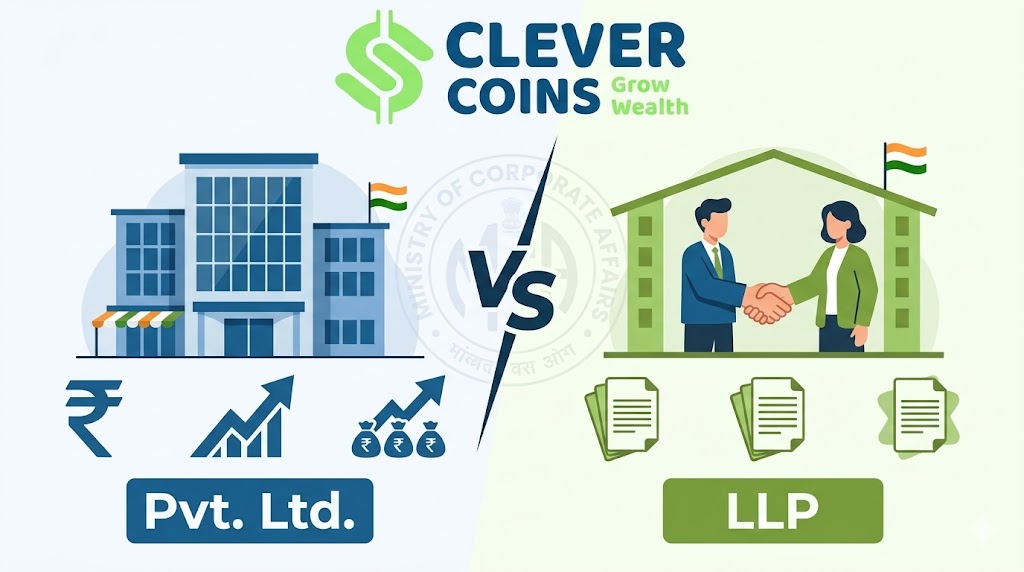
Choosing the right business structure is one of the most critical decisions you’ll ever make as an entrepreneur. It affects everything — from how much tax you pay, to how easily you can raise funding, to the legal liability you carry personally.
In India, the two most popular structures for small and medium businesses are the Private Limited Company (Pvt. Ltd.) and the Limited Liability Partnership (LLP). Both offer limited liability protection and legal recognition, but they differ significantly in governance, compliance burden, taxation, and suitability for different types of ventures.
This comprehensive guide breaks down every major difference between a Private Limited Company and an LLP — so you can make the right choice for your specific goals, team, and business model.
What is a Private Limited Company?
A Private Limited Company is a type of company incorporated under the Companies Act, 2013 in India. It is the most preferred structure for startups and growing businesses.
Key Characteristics:
- Governed by the Ministry of Corporate Affairs (MCA) under Companies Act, 2013
- Minimum 2 and maximum 200 shareholders
- Minimum 2 Directors required (at least one must be a resident of India)
- Shares cannot be listed or traded on public stock exchanges
- Separate legal entity from its owners
- Perpetual succession — the company continues even if directors or shareholders change
- Can raise equity funding from angel investors and venture capitalists
- Must appoint a statutory auditor
What is an LLP (Limited Liability Partnership)?
A Limited Liability Partnership (LLP) is a hybrid business structure that combines the flexibility of a partnership with the limited liability protection of a company. It is governed by the LLP Act, 2008.
Key Characteristics:
- Governed by the Ministry of Corporate Affairs (MCA) under LLP Act, 2008
- Minimum 2 Partners required — no upper limit on partners
- At least one Designated Partner must be a resident of India
- No concept of share capital or shareholders
- Separate legal entity — can own assets and sue/be sued in its name
- Partners are not liable for the wrongful acts of other partners
- Lower compliance burden compared to a Pvt. Ltd. company
- Not suitable for equity funding
Private Limited vs LLP: Head-to-Head Comparison
Criteria | Private Limited Company | LLP |
Governing Law | Companies Act, 2013 | LLP Act, 2008 |
Regulatory Body | Ministry of Corporate Affairs | Ministry of Corporate Affairs |
Minimum Members | 2 Shareholders + 2 Directors | 2 Designated Partners |
Maximum Members | 200 Shareholders | No Limit |
Legal Status | Separate Legal Entity | Separate Legal Entity |
Liability | Limited to Share Capital | Limited to Contribution |
Equity Funding | Yes – Allowed | No – Not Allowed |
Audit Requirement | Mandatory (All Companies) | Only if turnover > ₹40 Lakh |
Annual Compliance | High (ROC filings, Board meetings) | Moderate (Annual Return + Statement) |
Taxation Rate | 22% (domestic) + surcharge | 30% on profit share |
Dividend Distribution Tax | Applicable | Not Applicable |
Transfer of Ownership | Easy via share transfer | Requires LLP Agreement change |
Foreign Investment (FDI) | Allowed under automatic route | Allowed in certain sectors only |
Startup Recognition (DPIIT) | Eligible | Eligible |
Winding Up Process | Complex | Relatively Simpler |
Perpetual Succession | Yes | Yes |
Cost of Registration | ₹7,000 – ₹15,000 approx. | ₹5,000 – ₹10,000 approx. |
Stamp Duty | Varies by state | Varies by state |
Registration Process: Private Limited Company
Registering a Private Limited Company involves the following steps:
Step 1: Obtain Digital Signature Certificates (DSC) for all proposed directors.
Step 2: Apply for Director Identification Numbers (DIN) for all proposed directors.
Step 3: Reserve a unique company name using the RUN (Reserve Unique Name) service on MCA portal.
Step 4: Draft and file Memorandum of Association (MOA) and Articles of Association (AOA).
Step 5: File SPICe+ Form on the MCA portal with all required documents.
Step 6: Receive Certificate of Incorporation (COI), PAN, TAN, and other registrations.
Typical timeline: 7–15 working days.
Registration Process: LLP
Registering an LLP involves the following steps:
Step 1: Obtain DSC for all Designated Partners.
Step 2: Apply for DPIN (Designated Partner Identification Number).
Step 3: Reserve LLP name using the RUN-LLP service.
Step 4: File FiLLiP (Form for Incorporation of LLP) on MCA portal.
Step 5: Draft and file the LLP Agreement within 30 days of incorporation.
Step 6: Receive Certificate of Incorporation from ROC.
Typical timeline: 5–12 working days.
Taxation: Private Limited vs LLP
Private Limited Company – Tax Structure
- Base corporate tax rate: 22% for existing companies; 15% for new manufacturing companies (under Section 115BAB)
- Surcharge and cess applicable — effective rate around 25.17%
- MAT (Minimum Alternate Tax): 15% on book profit
- Dividends paid to shareholders attract DDT / personal income tax in shareholders’ hands
- Can avail various deductions under IT Act (R&D, startup deductions, etc.)
LLP – Tax Structure
- LLP profits taxed at a flat rate of 30% + surcharge + 4% cess
- No Dividend Distribution Tax (DDT) — partners’ profit share is exempt in their personal tax returns
- Partners’ remuneration is deductible as expense, subject to limits under Section 40(b)
- No MAT — AMT (Alternate Minimum Tax) @18.5% applies instead
- Partners not taxed again on their profit share (unlike company dividends)
💡 Key Insight — Tax Efficiency: For small, profitable firms where promoters take profits as remuneration, LLP can be more tax-efficient. For companies planning to retain profits for reinvestment or attract investor funding, a Private Limited Company often wins. |
Compliance Requirements: A Detailed Look
Private Limited Company — Annual Compliance
- Hold minimum 4 Board Meetings per year
- Hold Annual General Meeting (AGM) within 6 months of financial year end
- File Annual Return (MGT-7) with ROC
- File Financial Statements (AOC-4) with ROC
- Mandatory statutory audit by a Chartered Accountant
- Director KYC (DIR-3 KYC) every year
- Filing of income tax return (ITR-6)
- GST filings (if registered)
- Maintaining Minutes of Meetings, Statutory Registers
- Estimated annual compliance cost: ₹20,000 – ₹50,000+
LLP — Annual Compliance
- File Annual Return (Form 11) within 60 days of financial year end
- File Statement of Accounts (Form 8) within 30 days of 6 months after financial year end
- Audit required only if turnover exceeds ₹40 Lakh OR contribution exceeds ₹25 Lakh
- Filing of income tax return (ITR-5)
- GST filings (if registered)
- No mandatory board meeting or AGM requirement
- Estimated annual compliance cost: ₹8,000 – ₹20,000
Funding & Investment: Which Structure Wins?
This is perhaps the most decisive factor for startups and growing businesses.
Private Limited Company — Funding Friendly
- Can issue equity shares to investors
- Eligible for angel investment, venture capital, private equity
- Can issue ESOPs (Employee Stock Options) to attract talent
- Eligible for DPIIT Startup India recognition & tax exemptions
- Can raise funds through Compulsorily Convertible Debentures (CCDs), Preference Shares
- Recognized globally — preferred structure for cross-border investment
LLP — Limited Funding Options
- Cannot issue equity to investors — no concept of shares
- FDI allowed but only in sectors that permit LLPs under automatic route
- No ESOP mechanism
- Cannot get DPIIT tax holiday (80-IAC) unless converted to Pvt. Ltd.
- Suitable for self-funded or bootstrapped professional services businesses
🚀 For Startups Seeking Funding: If you plan to raise external investment, a Private Limited Company is non-negotiable. Investors — especially institutional ones — will not invest in an LLP. |
Who Should Choose a Private Limited Company?
- Tech startups, SaaS companies, or product-led businesses
- Entrepreneurs planning to raise angel or VC funding
- Businesses aiming for rapid scaling or eventual IPO
- Companies that want to offer ESOPs to employees
- Businesses planning FDI (Foreign Direct Investment)
- Founders wanting global recognition and cross-border credibility
- E-commerce ventures requiring multiple stakeholders
- Businesses likely to have high retained profits
Who Should Choose an LLP?
- Law firms, CA firms, consulting & advisory practices
- Family businesses with trusted partners
- Professionals in medicine, architecture, or engineering
- Small B2B service businesses with low compliance appetite
- Businesses that are fully bootstrapped and don’t plan to raise equity
- Traditional trading or manufacturing businesses with stable partner structure
- Businesses focused on passing profits directly to partners every year
- Anyone seeking lower compliance cost and simpler governance
Conversion: Can You Switch Later?
Yes — and this is an important flexibility many entrepreneurs overlook.
LLP to Private Limited Company:
You can convert an LLP into a Private Limited Company under Section 366 of the Companies Act, 2013 using Form URC-1. The process involves filing with the ROC and meeting certain conditions. This is a popular route for businesses that start lean and later decide to raise funding.
Private Limited Company to LLP:
Conversion from Pvt. Ltd. to LLP is governed by Section 56 & 57 of the LLP Act and requires approval from shareholders and relevant filings with the ROC. Tax implications must be evaluated carefully, as this conversion can trigger capital gains in certain scenarios.
⚠️ Pro Tip: Many founders start as an LLP to keep costs low in early stages, then convert to a Private Limited Company when they’re ready to raise funding. This is a valid and legal strategy — but plan ahead for the conversion costs and timeline. |
Liability Protection: Both Structures Explained
One of the most common reasons entrepreneurs choose either structure over a sole proprietorship or general partnership is limited liability protection.
Private Limited Company:
The personal assets of shareholders are protected. Liability is limited to the unpaid amount on shares held. Directors can, however, be held personally liable for fraud or illegal activities.
LLP:
Partners are not personally liable for the debts of the LLP. However, a partner IS personally liable for losses arising out of their own wrongful acts or omissions. Partners are shielded from the misconduct of other partners — a significant advantage over traditional partnerships.
Winding Up & Closure: Which is Easier?
Closing a Private Limited Company:
Options include Strike Off (under Section 248 for dormant companies), Voluntary Winding Up, or NCLT-ordered Winding Up. The process can take anywhere from 3 months to over a year depending on the route chosen.
Closing an LLP:
LLP winding up is comparatively simpler. A solvent LLP can file for voluntary winding up. The process involves passing a resolution, appointing a liquidator, settling liabilities, and filing with the ROC. The process is generally faster than closing a company.
Private Limited vs LLP — Quick Decision Framework
Your Situation | Pvt. Ltd. | LLP |
Planning to raise investor funding | ✅ Yes | ❌ No |
Want lower compliance burden | ❌ Higher | ✅ Yes |
Professionals / service firms | Possible | ✅ Ideal |
Tech startup / product company | ✅ Ideal | Not ideal |
Want to issue ESOPs | ✅ Yes | ❌ No |
Low initial budget | Moderate cost | ✅ Lower cost |
Want to scale internationally | ✅ Yes | Limited |
Fully bootstrapped business | Works well | ✅ Better fit |
Planning an IPO someday | ✅ Required | ❌ Not eligible |
Family business, all partners known | Works | ✅ Simpler |
Conclusion
Both the Private Limited Company and the LLP are excellent legal structures — the right choice depends entirely on your goals, business model, and growth trajectory.
Choose a Private Limited Company if you’re building a scalable, fundable business with multiple stakeholders, growth ambitions, or international aspirations. The higher compliance cost is worth the credibility, flexibility, and funding access it provides.
Choose an LLP if you’re running a professional services firm, a consulting practice, or a small bootstrapped business where simplicity, low cost, and tax pass-through efficiency are your priorities.
And remember — you can always start lean with an LLP and convert to a Private Limited Company when the time is right. Talk to a qualified CA or Company Secretary before making your final decision, as specific details can vary based on your industry, state, and personal circumstances.
📌 Final Word: There is no universally ‘better’ structure. The best structure is the one aligned with your business vision, funding plan, compliance capacity, and long-term goals. |
For the Financial Year 2025-26 (Assessment Year 2026-27), the rules and eligible instruments under Section 80C remain comprehensive, covering a wide spectrum of investment and savings options — from equity-linked savings schemes to life insurance premiums, from PPF contributions to home loan principal repayments.
Understanding and strategically using Section 80C can save you up to ₹46,800 in taxes (at the 30% tax slab plus cess), making it one of the most impactful financial planning tools available. This guide covers everything you need to know — every eligible investment, every eligible expenditure, limits, conditions, and smart strategies.
⚡ Quick Facts – Section 80C at a Glance
Parameter | Details |
Maximum Deduction Limit | ₹1,50,000 per financial year |
Applicable To | Individuals and Hindu Undivided Families (HUFs) |
Tax Regime Applicability | Old Tax Regime ONLY |
Assessment Year | AY 2026-27 (FY 2025-26) |
Maximum Tax Saving (30% slab) | ₹46,800 (including 4% cess) |
Maximum Tax Saving (20% slab) | ₹31,200 (including 4% cess) |
Maximum Tax Saving (5% slab) | ₹7,800 (including 4% cess) |
Combined Limit with 80CCC & 80CCD(1) | ₹1,50,000 (combined ceiling) |
Additional NPS Deduction (80CCD(1B)) | Up to ₹50,000 over and above ₹1.5 lakh |
Complete List of Section 80C Eligible Investments & Expenditures
Section 80C covers two broad categories: (A) Investments in specified instruments, and (B) Payments/expenditures that qualify for deduction. Below is the exhaustive list:
A. Investment-Based Deductions Under Section 80C
1. Equity Linked Savings Scheme (ELSS)
ELSS funds are diversified equity mutual funds with a mandatory lock-in period of 3 years — the shortest lock-in among all 80C instruments. They offer market-linked returns with the potential for wealth creation. ELSS investments qualify for deduction under Section 80C up to ₹1,50,000.
- Lock-in period: 3 years (shortest among 80C options)
- Returns: Market-linked (historically 12–15% CAGR over long term)
- Tax on maturity: LTCG tax @10% on gains above ₹1 lakh per year
- Best for: Young investors, high-risk appetite, wealth creation
- Mode: Lump sum or SIP (Systematic Investment Plan)
2. Public Provident Fund (PPF)
PPF is one of the most trusted government-backed savings instruments. It offers EEE (Exempt-Exempt-Exempt) tax status — meaning investments, interest earned, and maturity proceeds are all tax-free.
- Lock-in period: 15 years (partial withdrawal allowed after 7th year)
- Interest rate: 7.1% p.a. (compounded annually, revised quarterly by Govt.)
- Minimum investment: ₹500 per year
- Maximum investment: ₹1,50,000 per year
- Tax on maturity: Completely tax-free (EEE status)
- Available at: Post offices, nationalized banks, select private banks
3. Employee Provident Fund (EPF)
For salaried employees, the employee’s contribution to EPF (12% of basic salary + DA) is eligible for deduction under Section 80C. The employer’s contribution is not included but is separately exempt.
- Rate: 12% of Basic Salary + Dearness Allowance (DA)
- Interest rate: 8.15% p.a. (for FY 2023-24; revised annually by EPFO)
- Tax on withdrawal: Exempt if withdrawn after 5 continuous years of service
- Note: Voluntary Provident Fund (VPF) contributions are also eligible
4. Voluntary Provident Fund (VPF)
VPF is an extension of EPF where salaried employees can voluntarily contribute more than the mandatory 12%. The additional contribution earns the same EPF interest rate and also qualifies under 80C, subject to the overall ₹1.5 lakh cap.
5. National Savings Certificate (NSC)
NSC is a fixed-income investment scheme by the Indian Postal Service, backed by the Government of India. It is a risk-free, guaranteed return instrument suitable for conservative investors.
- Lock-in period: 5 years (NSC VIII Issue)
- Interest rate: 7.7% p.a. (compounded annually but payable at maturity)
- Minimum investment: ₹1,000; No maximum limit
- Tax: Interest accrued is taxable BUT also eligible for 80C deduction each year (except last year)
- Available at: India Post offices and select banks
6. National Pension System (NPS) – Section 80CCD(1)
Contributions to NPS Tier-I account by an employee are deductible under Section 80CCD(1), which falls within the overall ₹1.5 lakh cap of Section 80C. Additionally, an extra ₹50,000 is available under Section 80CCD(1B).
- Deduction under 80CCD(1): Up to 10% of salary (for salaried) or 20% of gross income (for self-employed), subject to ₹1.5 lakh cap
- Extra deduction under 80CCD(1B): Additional ₹50,000 (over and above ₹1.5 lakh)
- Total NPS tax benefit possible: Up to ₹2,00,000 per year
- Lock-in: Till age 60
- Exit: 60% lump sum (tax-free) + 40% annuity (taxable)
7. Tax-Saving Fixed Deposits (FD)
Bank Fixed Deposits with a 5-year lock-in period (also called Tax Saver FDs) qualify under Section 80C. These are offered by all scheduled commercial banks and post offices.
- Lock-in period: 5 years (premature withdrawal NOT allowed)
- Interest rate: Typically 6.5–7.5% p.a. (varies by bank)
- Tax on interest: Fully taxable as per income slab
- TDS: Applicable on interest if exceeds ₹40,000/year (₹50,000 for senior citizens)
- Also available as: Post Office Time Deposit (5-year)
8. Senior Citizen Savings Scheme (SCSS)
SCSS is a government-backed savings scheme exclusively for senior citizens (age 60 and above, or 55+ for retired defense personnel). It offers one of the highest guaranteed returns for this segment.
- Eligibility: Age 60+ (or 55+ for VRS/superannuation)
- Interest rate: 8.2% p.a. (paid quarterly)
- Maximum investment: ₹30 lakhs
- Lock-in period: 5 years (extendable by 3 years)
- Tax on interest: Taxable; TDS applicable above ₹50,000/year
9. Sukanya Samriddhi Yojana (SSY)
SSY is a government scheme for the girl child, under the ‘Beti Bachao, Beti Padhao’ initiative. It offers the highest interest rate among small savings schemes and carries EEE tax status.
- Eligibility: For girl children below age 10
- Interest rate: 8.2% p.a. (compounded annually)
- Minimum: ₹250/year; Maximum: ₹1,50,000/year
- Maturity: 21 years from account opening (or on marriage after age 18)
- Tax status: Fully EEE (Exempt-Exempt-Exempt)
10. Life Insurance Premium (LIC & Other Insurers)
Premiums paid for life insurance policies covering yourself, your spouse, or your children qualify for deduction under 80C. This includes term plans, endowment plans, ULIPs, and money-back plans.
- Eligible policies: Term insurance, endowment, money-back, ULIP, whole life
- For policies issued on or after 1 April 2012: Premium must not exceed 10% of Sum Assured
- For policies issued before 1 April 2012: Premium must not exceed 20% of Sum Assured
- For persons with disability: Premium up to 15% of Sum Assured is allowed
- Tax on maturity: Exempt under Section 10(10D) if conditions are met
- Note: Premiums for policies covering parents or in-laws do NOT qualify
11. Unit Linked Insurance Plans (ULIPs)
ULIPs combine insurance and investment in a single product. Premium paid towards ULIPs qualifies under Section 80C subject to the same 10% of Sum Assured condition.
- Lock-in period: 5 years
- Returns: Market-linked
- Tax on maturity: Exempt u/s 10(10D) if annual premium does not exceed ₹2.5 lakhs
12. Pension Plans / Annuity Plans (Section 80CCC)
Contributions to pension plans or annuity plans of insurance companies (like LIC Jeevan Akshay, etc.) are eligible under Section 80CCC, which is part of the overall ₹1.5 lakh combined limit.
- Eligible: Contributions to annuity plans approved by IRDA
- Tax on pension received: Taxable as income in the year of receipt
B. Expenditure-Based Deductions Under Section 80C
13. Home Loan Principal Repayment
The principal component of EMIs paid for a home loan taken for purchase or construction of a residential house property qualifies under Section 80C. This is one of the most significant deductions for home buyers.
- Eligible: Principal repayment of home loan from banks, NBFCs, housing finance companies, or government bodies
- Condition: Property should not be transferred/sold within 5 years of possession
- If sold within 5 years: Deductions previously claimed will be added back to income in the year of sale
- Note: Interest component goes under Section 24(b) — not 80C
14. Stamp Duty and Registration Charges
Stamp duty and registration fees paid at the time of purchase of a new house property are eligible for deduction under Section 80C in the year of payment.
- Available only in the year of actual payment
- Can be claimed even if the property is under construction (paid in same year)
- Not available for plot purchase or resale property registration in some cases
15. Tuition Fees for Children
Tuition fees paid for the full-time education of up to 2 children in India are eligible under Section 80C.
- Eligible for: Up to 2 children (biological or legally adopted)
- Covered: School, college, university, or other educational institutions in India
- NOT covered: Donation, development fees, private tuitions, overseas education
- Both parents can claim individually for up to 2 children each (if assessed separately)
16. Five-Year Post Office Recurring Deposit
A 5-year Post Office Recurring Deposit (RD) qualifies for deduction under Section 80C. This is a disciplined monthly saving instrument backed by the government.
- Interest rate: ~6.7% p.a. (compounded quarterly)
- Lock-in: 5 years
- Interest taxable as per income slab
17. Post Office Time Deposit – 5 Year
A 5-year Post Office Fixed Deposit qualifies for 80C deduction, similar to a bank Tax Saver FD.
- Interest rate: 7.5% p.a. (compounded quarterly, paid annually)
- Lock-in: 5 years
18. Infrastructure Bonds (Section 80CCF – now expired)
Note: Infrastructure bonds under Section 80CCF were discontinued after FY 2011-12 and are no longer eligible. Taxpayers should not claim these unless they were specifically offered in a particular year.
19. Nabard Rural Bonds
Certain bonds issued by NABARD (National Bank for Agriculture and Rural Development) for rural infrastructure may qualify under 80C when specifically notified by the government.
20. Notified Annuity Plans of LIC or Other Insurers
Any annuity plans specifically notified by the Central Government under Section 80C qualify for deduction. LIC’s Jeevan Suraksha and similar government-notified plans fall in this category.
Section 80C Investment Comparison Table
Investment | Lock-in | Interest/Returns | Risk Level | Tax on Returns | Best For |
ELSS | 3 Years | 12-15% (market-linked) | High | LTCG @10% above ₹1L | Young investors |
PPF | 15 Years | 7.1% p.a. | Nil | Tax-Free (EEE) | Conservative, long-term |
EPF / VPF | Till retirement | 8.15% p.a. | Nil | Exempt (5+ yrs service) | Salaried employees |
NSC | 5 Years | 7.7% p.a. | Nil | Interest taxable | Safe, short-medium term |
Tax Saver FD | 5 Years | 6.5-7.5% p.a. | Nil | Interest taxable | Capital protection |
SCSS | 5 Years | 8.2% p.a. | Nil | Interest taxable | Senior citizens |
SSY | 21 Years | 8.2% p.a. | Nil | Tax-Free (EEE) | Girl child education |
LIC Premium | Policy term | Depends on plan | Low | Maturity exempt u/s 10(10D) | Insurance + savings |
NPS | Till age 60 | 8-10% (market) | Medium | 60% exempt, 40% annuity | Retirement planning |
Home Loan Principal | Till end of loan | N/A | N/A | N/A | Home buyers |
Who Can Claim Section 80C Deductions?
Section 80C deductions can be claimed by:
- Individual taxpayers (resident or non-resident Indians)
- Hindu Undivided Families (HUFs) — note: limited instruments apply to HUFs
- NOT available to: Companies, firms, partnership firms, LLPs, or Association of Persons (AoP)
HUF-Specific 80C Eligibility
HUFs can invest in specific instruments like:
- Life insurance premium (for any member of HUF)
- ELSS Mutual Funds
- Tax Saver Fixed Deposits
- NSC, Post Office deposits
HUFs CANNOT invest in PPF, EPF, NPS, SCSS, SSY, or claim tuition fees / home loan principal deductions.
Understanding the ₹1.5 Lakh Limit & Related Sections
The deduction under Section 80C is combined with deductions under Sections 80CCC and 80CCD(1) to arrive at the overall ceiling of ₹1,50,000.
Section | What It Covers | Limit |
80C | All investments & expenditures listed above | ₹1,50,000 (combined) |
80CCC | Pension/annuity plans of insurance companies | Part of ₹1,50,000 |
80CCD(1) | Employee contribution to NPS | Part of ₹1,50,000 |
80CCD(1B) | Additional NPS contribution | ₹50,000 EXTRA (over ₹1.5L) |
80CCD(2) | Employer’s NPS contribution | 14% of salary (Govt) / 10% (others) — No limit |
Strategic Insight: A taxpayer can save tax on up to ₹2,00,000 by using ₹1,50,000 under 80C/80CCC/80CCD(1) AND ₹50,000 under 80CCD(1B) for NPS.
Section 80C: Old Tax Regime vs New Tax Regime
One of the most important things taxpayers must know in 2026: Section 80C deductions are ONLY available under the Old Tax Regime. If you opt for the New Tax Regime (which has lower tax rates), you CANNOT claim 80C benefits.
Factor | Old Tax Regime | New Tax Regime |
Section 80C Deduction | Yes – up to ₹1,50,000 | No – not available |
Tax Rates | Higher slabs (5%-30%) | Lower slabs (5%-30% restructured) |
Standard Deduction | ₹50,000 (salaried) | ₹75,000 (salaried) |
HRA Exemption | Available | Not Available |
Complexity | More planning required | Simpler, less paperwork |
Best For | Higher investments/deductions | Lower investment capacity |
Rule of Thumb: If your total deductions and exemptions (80C + HRA + home loan interest + standard deduction, etc.) exceed ₹3.75 lakhs, the Old Tax Regime typically offers greater savings. Otherwise, the New Regime may be more beneficial.
How Much Tax Can You Save with Section 80C?
Tax Slab | Tax Rate | Tax Saved on ₹1.5L (before cess) | After 4% Cess |
₹2.5L – ₹5L (Old Regime) | 5% | ₹7,500 | ₹7,800 |
₹5L – ₹10L (Old Regime) | 20% | ₹30,000 | ₹31,200 |
Above ₹10L (Old Regime) | 30% | ₹45,000 | ₹46,800 |
Note: Surcharge may further increase savings for very high income individuals. Tax saving figures above are approximate and depend on overall income structure.
Smart Tax-Saving Strategies Using Section 80C
Strategy 1: Diversify Across Instruments
Don’t put all ₹1.5 lakhs into a single instrument. A balanced approach might include:
- EPF (auto-deducted): ₹60,000 (automatically invested via salary)
- ELSS SIP: ₹50,000 (for market-linked growth)
- LIC Term Premium: ₹20,000 (pure insurance coverage)
- NPS 80CCD(1B): ₹50,000 (additional, over the ₹1.5L limit)
Strategy 2: Start Early in the Financial Year
Many taxpayers rush to invest in January-March. Starting your SIPs in ELSS from April gives you 12 months of compounding versus investing a lump sum in March.
Strategy 3: Avoid Unnecessary Insurance Products
Endowment plans and money-back plans often give 4-6% returns — much less than PPF or ELSS. Buy pure term insurance separately for coverage and use the remaining 80C allowance for higher-return instruments.
Strategy 4: Maximize NPS for Extra ₹50,000
After exhausting the ₹1.5 lakh 80C limit, additionally invest ₹50,000 in NPS Tier-I for a deduction under Section 80CCD(1B). This is pure additional benefit with no overlap.
Strategy 5: Leverage Children’s Tuition Fees
If you have 2 children in school or college, their actual tuition fees qualify under 80C. This is a real expenditure — use it before investing in other instruments to know how much additional investment you need.
Common Mistakes to Avoid
- Investing more than ₹1.5 lakh in 80C instruments — the deduction is capped at ₹1.5 lakh regardless of investment amount
- Not keeping proof of investments — always save premium receipts, FD certificates, and stamped acknowledgements
- Assuming all insurance premiums qualify — only premiums within 10% of Sum Assured qualify
- Selling ELSS before 3 years — premature redemption doesn’t attract taxation but you lose the lock-in benefit protection
- Surrendering endowment/ULIP policies before 5 years — previously claimed deductions may be reversed
- Not declaring employer’s EPF contribution in Form 12BB — HR may not auto-include your voluntary contributions
- Claiming 80C in New Tax Regime — it is NOT available in the new regime
- Missing the deadline — investments/payments must be made before 31st March of the relevant financial year
Documents Required to Claim Section 80C
Instrument | Document Required |
ELSS / Mutual Fund | Statement from AMC showing investment amount and folio details |
PPF | Passbook copy or account statement from bank/post office |
EPF / VPF | Form 12BB / salary slip showing PF deductions |
NSC | NSC certificates issued by post office |
Tax Saver FD | FD receipt with 5-year tenure clearly mentioned |
Life Insurance Premium | Premium paid receipt from insurer |
NPS | Transaction statement from NPS Trust / CRA |
Home Loan Principal | Home loan statement from bank showing principal repayment |
Tuition Fees | Receipt from school/college specifying tuition fees separately |
SCSS | Account opening certificate and passbook |
Stamp Duty | Registered sale deed and receipt from sub-registrar’s office |
Frequently Asked Questions (FAQs)
Q1. Can I claim 80C deduction if I opt for New Tax Regime?
No. Section 80C deductions are exclusively available under the Old Tax Regime. If you switch to the New Tax Regime, you forfeit all 80C benefits.
Q2. Is there any investment under 80C that gives tax-free returns?
Yes. PPF, EPF/VPF (for 5+ years of service), and Sukanya Samriddhi Yojana offer EEE (Exempt-Exempt-Exempt) status — meaning investment, interest, and maturity are all tax-free.
Q3. Can both husband and wife claim 80C for the same home loan?
Yes, if both are co-borrowers and co-owners of the property, each can independently claim up to ₹1.5 lakh for their share of the principal repayment.
Q4. Can I claim 80C for a second home loan?
Yes, principal repayment of home loans for more than one property is eligible under 80C, subject to the overall ₹1.5 lakh annual cap.
Q5. What happens if I withdraw from PPF before maturity?
PPF allows partial withdrawal from the 7th year. Premature closure (before 15 years) is permitted only in specific cases (serious illness, education). The tax treatment remains exempt.
Q6. Does ULIP purchased after 1 Feb 2021 qualify for 80C?
Yes, ULIPs with annual premium up to ₹2.5 lakhs qualify for 80C deduction. However, if annual premium exceeds ₹2.5 lakhs, the maturity proceeds will be taxable.
Q7. Is the NSC interest accrual eligible for 80C?
Yes. The interest accrued on NSC each year (except the last year) is deemed reinvested and qualifies for Section 80C deduction. This means you get a ‘bonus’ deduction on the accrued interest.
Q8. Can NRIs claim Section 80C deductions?
Yes. Non-Resident Indians (NRIs) can claim Section 80C deductions on certain instruments like ELSS, life insurance premiums, and home loan principal repayment. However, NRIs cannot invest in PPF, SCSS, NSC, or SSY.
Year-End Section 80C Checklist
- Calculate total EPF/VPF contributions for the year
- Add up life insurance premiums paid
- Check tuition fees for 2 children — gather receipts
- Review home loan statement for principal portion
- If total < ₹1,50,000 — top up with ELSS, PPF, or NSC
- Separately invest ₹50,000 in NPS for Section 80CCD(1B) benefit
- Ensure all investments/payments made before 31st March
- Submit Form 12BB to employer (for salaried employees)
- File ITR and claim deductions accurately in Schedule VI-A
Conclusion
Section 80C remains a cornerstone of tax planning for millions of Indian taxpayers. With a ₹1,50,000 deduction limit available through a wide variety of instruments — from the safest PPF to market-linked ELSS, from insurance to EPF, and from home loans to children’s education — there is something for every investor profile.
The key is to not treat 80C as a last-minute tax-saving exercise, but as an integral part of your annual financial plan. Start early, diversify intelligently, align investments with your actual financial goals, and remember to leverage the additional ₹50,000 NPS benefit for maximum tax efficiency.
Always consult a Certified Financial Planner (CFP) or Chartered Accountant (CA) for personalized tax advice tailored to your income structure, family situation, and financial goals.