Sensex vs Nifty – What's the Difference? The Complete Guide for Indian Investors (2026)
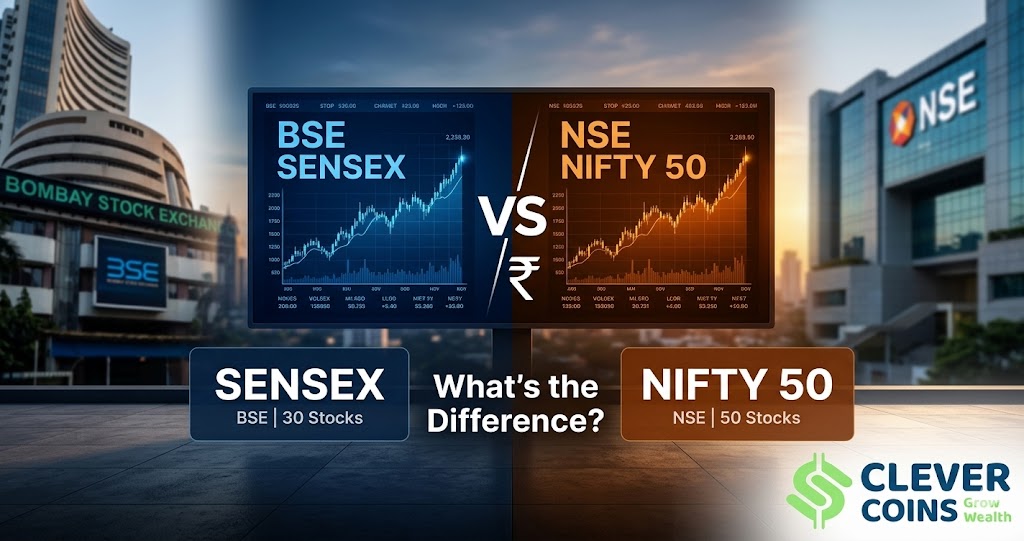
If you have ever watched a news bulletin, checked a financial app, or overheard a conversation at a chai stall, you have almost certainly heard the words ‘Sensex’ and ‘Nifty’. These two numbers dominate India’s financial headlines every single day — going up, going down, hitting all-time highs, or crashing in response to budget announcements, global events, or quarterly earnings.
Yet, for most Indians — even those who invest in mutual funds or have a Demat account — the difference between Sensex and Nifty remains surprisingly unclear. Are they the same thing? Is one better than the other? Why do they move almost identically? And which one should you track when making investment decisions?
In this comprehensive guide, we answer every question you have ever had about Sensex and Nifty — from their basic definitions and history to their precise calculation methodologies, constituent stocks, sectoral representation, historical performance, and practical relevance for investors in 2026. By the end of this article, you will know exactly what each index means, why both matter, and how to use them intelligently.
|
💡 Quick Answer Sensex = BSE’s index of 30 large-cap stocks. Nifty = NSE’s index of 50 large-cap stocks. Both measure the health of India’s stock market. Nifty is broader (more stocks, more sectors); Sensex is older and more globally recognised. For most investors, both move in the same direction — the difference lies in composition, exchange, and usage. |
What is Sensex?
Sensex is the benchmark stock market index of the Bombay Stock Exchange (BSE) — India’s oldest and the world’s 10th largest stock exchange by market capitalisation. The word ‘Sensex’ is a portmanteau of ‘Sensitive’ and ‘Index’, coined by stock market analyst Deepak Mohoni in 1989.
Officially called the BSE SENSEX or S&P BSE SENSEX, it tracks the performance of 30 of the largest, most financially sound, and most actively traded companies listed on the BSE. These 30 companies — often referred to as the ‘Sensex 30’ or ‘BSE 30’ — are leaders across multiple sectors of the Indian economy.
Key Facts About Sensex
|
Parameter |
Details |
|
Full Name |
BSE SENSEX / S&P BSE SENSEX |
|
Exchange |
Bombay Stock Exchange (BSE) |
|
Number of Stocks |
30 companies |
|
Base Year |
1978–79 |
|
Base Value |
100 |
|
Launch Date |
January 1, 1986 |
|
Calculation Method |
Free-Float Market Capitalisation Weighted |
|
Rebalancing |
Semi-annually (reviewed by BSE Index Committee) |
|
Current Level (Approx.) |
~75,000–80,000 (2026 levels) |
|
Owner / Manager |
BSE Ltd. (in partnership with S&P Dow Jones Indices) |
|
Bloomberg Ticker |
SENSEX:IN |
|
Reuters Code |
BSESN |
What is Nifty?
Nifty — officially known as Nifty 50 or CNX Nifty — is the benchmark index of the National Stock Exchange of India (NSE), India’s largest stock exchange by trading volume. The name ‘Nifty’ is derived from combining ‘National’ and ‘Fifty’, reflecting its composition of 50 stocks on the National Stock Exchange.
Nifty 50 represents the weighted average of 50 of India’s largest and most liquid companies across 13 sectors. It is owned and managed by NSE Indices Limited (formerly India Index Services and Products Ltd. — IISL), a subsidiary of NSE.
Key Facts About Nifty
|
Parameter |
Details |
|
Full Name |
NIFTY 50 / CNX Nifty / NSE Nifty |
|
Exchange |
National Stock Exchange of India (NSE) |
|
Number of Stocks |
50 companies |
|
Base Year |
November 3, 1995 |
|
Base Value |
1,000 |
|
Launch Date |
April 22, 1996 |
|
Calculation Method |
Free-Float Market Capitalisation Weighted |
|
Rebalancing |
Semi-annually (reviewed by NSE Indices Committee) |
|
Current Level (Approx.) |
~22,000–24,000 (2026 levels) |
|
Owner / Manager |
NSE Indices Limited (subsidiary of NSE) |
|
Bloomberg Ticker |
NSEI:IN |
|
Reuters Code |
NSEI |
History of Sensex and Nifty — How They Were Born
History of Sensex
The Bombay Stock Exchange was established in 1875 — making it Asia’s oldest stock exchange. However, it wasn’t until January 1, 1986 that BSE officially launched the Sensex as a formal benchmark index. The index was backdated to April 1979 with a base value of 100 to provide historical comparison data.
Key milestones in Sensex history:
- 1990 — Sensex first crossed 1,000 points
- 1992 — Harshad Mehta scam causes Sensex’s first major crash from ~4,500 to ~2,500
- 1999 — IT boom pushes Sensex to 5,000 for the first time
- 2004 — UPA election victory causes single-day crash of 842 points (then-record)
- 2007–2008 — Sensex crosses 21,000; then crashes 60% during Global Financial Crisis
- 2020 — COVID-19 crash takes Sensex from 42,000 to 25,981 in weeks; recovers to 47,000 by year-end
- 2024 — Sensex crosses 85,000, reaching all-time high
- 2026 — Sensex trades in the 75,000–82,000 range
History of Nifty
The National Stock Exchange was established in 1992 and began trading operations in 1994. NSE Nifty 50 was launched on April 22, 1996 with a base value of 1,000 set at November 3, 1995. NSE was established with the explicit objective of bringing electronic trading and transparency to Indian markets, displacing the traditional outcry system.
Key milestones in Nifty history:
- 1996 — Nifty launched at NSE with electronic trading
- 2000 — Nifty first crosses 1,600; Y2K fears cause sharp correction
- 2008 — Nifty peaks at 6,357 before crashing to 2,252 during global financial crisis
- 2014 — Nifty crosses 8,000 after BJP victory in general elections
- 2021 — Nifty crosses 18,000 for the first time
- 2024 — Nifty crosses 26,000, reaching all-time high
- 2026 — Nifty trades in the 22,000–24,500 range
Sensex vs Nifty — Core Differences at a Glance
|
SENSEX (BSE) |
NIFTY 50 (NSE) |
|
Exchange: Bombay Stock Exchange |
Exchange: National Stock Exchange |
|
Stocks: 30 companies |
Stocks: 50 companies |
|
Base Year: 1978–79 |
Base Year: November 1995 |
|
Base Value: 100 |
Base Value: 1,000 |
|
Launch: January 1986 |
Launch: April 1996 |
|
Current Level: ~75,000–80,000 |
Current Level: ~22,000–24,000 |
|
Managed by: BSE + S&P Dow Jones |
Managed by: NSE Indices Ltd. |
|
Ticker: SENSEX |
Ticker: NIFTY |
|
Global Recognition: Very High |
Liquidity: Higher (NSE is bigger) |
|
Derivatives: BSE Sensex Futures/Options |
Derivatives: Most liquid in India |
Detailed Comparison Table — Sensex vs Nifty
|
Parameter |
SENSEX |
NIFTY 50 |
|
Full Name |
BSE SENSEX / S&P BSE SENSEX |
Nifty 50 / CNX Nifty |
|
Stock Exchange |
Bombay Stock Exchange (BSE) |
National Stock Exchange (NSE) |
|
Number of Constituent Stocks |
30 |
50 |
|
Base Year |
1978–79 |
November 3, 1995 |
|
Base Value |
100 |
1,000 |
|
Year of Launch |
1986 |
1996 |
|
Calculation Method |
Free-Float Market Cap Weighted |
Free-Float Market Cap Weighted |
|
No. of Sectors Represented |
~13 sectors |
13 sectors |
|
Index Manager |
BSE Ltd. + S&P Dow Jones Indices |
NSE Indices Limited |
|
Rebalancing Frequency |
Semi-annual |
Semi-annual |
|
Eligibility Criteria |
Top companies by float-adjusted market cap on BSE |
Top companies by float-adjusted market cap on NSE |
|
Derivatives Market |
BSE Sensex Futures & Options |
NSE Nifty Futures & Options (most liquid in India) |
|
ETFs & Index Funds |
Multiple Sensex ETFs and index funds |
Multiple Nifty 50 ETFs and index funds available |
|
Trading Volume |
Lower than NSE |
Higher — NSE accounts for ~90% of equity derivatives volume |
|
Global Recognition |
High — often quoted in global media |
High — preferred by FIIs and global funds |
|
Market Cap Coverage |
~60–65% of total BSE market cap |
~65–70% of total NSE market cap |
|
Correlation with each other |
Very high (above 0.99) |
Very high (above 0.99) |
|
Used by mutual funds |
Yes — Sensex ETFs, index funds |
Yes — Nifty 50 ETFs (more popular) |
|
P/E Ratio (approx. 2026) |
~22–25x |
~22–25x |
How is Sensex Calculated? — The Free-Float Market Cap Method
Both Sensex and Nifty use the Free-Float Market Capitalisation Weighted methodology. Understanding this is key to understanding why these indices move the way they do.
Step 1 — What is Market Capitalisation?
Market Capitalisation = Share Price × Total Number of Shares Outstanding
For example, if a company has 100 crore shares outstanding and its share price is ₹500, its market cap = ₹50,000 crore.
Step 2 — What is Free-Float?
‘Free-Float’ refers to the portion of shares that are actually available for trading in the market — excluding shares held by promoters, government, strategic investors, and those under lock-in periods. The Free-Float Factor (IWF — Investable Weight Factor) ranges from 0.05 to 1.0.
For example: If a company has total market cap of ₹1,00,000 crore but promoters hold 60%, then Free-Float = 40%, so Free-Float Market Cap = ₹40,000 crore.
Step 3 — Sensex Calculation Formula
Sensex Value = (Sum of Free-Float Market Cap of all 30 stocks ÷ Base Market Cap of 1978-79) × 100
The divisor is periodically adjusted for corporate events (splits, rights issues, mergers, stock additions/deletions) to maintain continuity of the index.
|
📊 Why Free-Float Method? The Free-Float method ensures the index reflects only tradeable shares — giving a more accurate picture of what investors can actually buy or sell. A company where promoters hold 80% effectively has far less liquidity than its total market cap suggests. |
How is Nifty 50 Calculated?
Nifty 50 uses the same Free-Float Market Capitalisation Weighted methodology as Sensex. The key difference lies in the base period and composition:
Nifty 50 Value = (Current Market Value ÷ Base Market Capital) × Base Index Value (1000)
Where: Current Market Value = Sum of (Free-Float Market Cap of all 50 stocks), Base Market Capital = Free-Float Market Cap of all 50 index stocks on November 3, 1995
Nifty Eligibility Criteria — How Stocks Qualify
- Must be listed on NSE
- Must be available for trading in NSE’s Futures & Options (F&O) segment
- Must have a listing history of at least 6 months on NSE (3 months for IPOs that are large enough)
- Minimum Average Impact Cost of 0.50% or less for 90% of observations over the past 6 months
- Domicile: The company must be domiciled in India and listed on NSE
- Must have traded for at least 90% of trading days in the past 6 months
Sensex Eligibility Criteria — How Stocks Qualify
- Must be listed on BSE
- Must be in the list of top 100 companies by full market capitalisation
- Must be among the most liquid stocks on BSE — measured by Average Daily Turnover and Impact Cost
- Continuous trading for at least 1 year on BSE
- Must have been listed for at least 1 year (6 months for companies coming through mergers)
Who is in Sensex and Nifty? — Constituent Stocks
Both Sensex and Nifty are dominated by India’s largest companies. The top 10 companies in Sensex are also in Nifty — the main difference is Nifty has 20 additional companies. Here are the typical major constituents (as of 2026):
|
# |
Company |
Sector |
In Sensex? |
In Nifty? |
|
1 |
Reliance Industries Ltd. |
Energy / Conglomerate |
✅ Yes |
✅ Yes |
|
2 |
HDFC Bank Ltd. |
Banking & Financial Services |
✅ Yes |
✅ Yes |
|
3 |
ICICI Bank Ltd. |
Banking & Financial Services |
✅ Yes |
✅ Yes |
|
4 |
Infosys Ltd. |
Information Technology |
✅ Yes |
✅ Yes |
|
5 |
TCS (Tata Consultancy Services) |
Information Technology |
✅ Yes |
✅ Yes |
|
6 |
Bharti Airtel Ltd. |
Telecom |
✅ Yes |
✅ Yes |
|
7 |
State Bank of India |
PSU Banking |
✅ Yes |
✅ Yes |
|
8 |
ITC Ltd. |
FMCG / Conglomerate |
✅ Yes |
✅ Yes |
|
9 |
HUL (Hindustan Unilever) |
FMCG |
✅ Yes |
✅ Yes |
|
10 |
Larsen & Toubro Ltd. |
Infrastructure / Engineering |
✅ Yes |
✅ Yes |
|
11 |
Kotak Mahindra Bank |
Banking |
✅ Yes |
✅ Yes |
|
12 |
Bajaj Finance Ltd. |
NBFC / Financial Services |
✅ Yes |
✅ Yes |
|
13 |
Asian Paints Ltd. |
Paints / Consumer |
✅ Yes |
✅ Yes |
|
14 |
Sun Pharma Ltd. |
Pharmaceuticals |
✅ Yes |
✅ Yes |
|
15 |
Wipro Ltd. |
Information Technology |
✅ Yes |
✅ Yes |
|
16 |
Axis Bank Ltd. |
Banking |
✅ Yes |
✅ Yes |
|
17 |
Tata Motors Ltd. |
Automobiles |
✅ Yes |
✅ Yes |
|
18 |
M&M (Mahindra & Mahindra) |
Automobiles |
✅ Yes |
✅ Yes |
|
19 |
NTPC Ltd. |
Power / Utilities |
✅ Yes |
✅ Yes |
|
20 |
Power Grid Corp. |
Power / Utilities |
✅ Yes |
✅ Yes |
|
21 |
Adani Ports |
Infrastructure |
✅ Yes |
✅ Yes |
|
22 |
UltraTech Cement |
Cement |
✅ Yes |
✅ Yes |
|
23 |
Titan Company |
Consumer Goods |
✅ Yes |
✅ Yes |
|
24 |
Nestle India |
FMCG |
✅ Yes |
✅ Yes |
|
25 |
Dr. Reddy’s Laboratories |
Pharma |
✅ Yes |
✅ Yes |
|
26–30 |
5 more companies (BSE-specific or different selections) |
Various |
✅ Yes |
May vary |
|
31–50 |
20 additional mid-large cap companies |
Various |
❌ Not in Sensex |
✅ Nifty only |
|
📌 Key Insight The top 30 companies by market cap largely overlap between Sensex and Nifty. This is why both indices move in almost perfect correlation (above 0.99). The 20 additional Nifty stocks provide broader market representation but do not significantly alter the direction of the index. |
Sectoral Representation — Sensex vs Nifty
Both indices cover 13 major sectors of the Indian economy. Here is the approximate sectoral weight comparison:
|
Sector |
Sensex Weight % |
Nifty 50 Weight % |
Key Companies |
|
Financial Services (Banks, NBFCs) |
~35–38% |
~33–36% |
HDFC Bank, ICICI, SBI, Bajaj Finance |
|
Information Technology |
~15–17% |
~14–16% |
TCS, Infosys, Wipro, HCL Tech |
|
Oil, Gas & Energy |
~12–14% |
~12–14% |
Reliance, ONGC, IOC, BPCL |
|
Consumer Goods (FMCG) |
~9–11% |
~8–10% |
HUL, ITC, Nestle, Britannia |
|
Pharmaceuticals & Healthcare |
~4–6% |
~4–6% |
Sun Pharma, Dr. Reddy’s, Cipla |
|
Automobiles |
~5–7% |
~5–7% |
Tata Motors, M&M, Hero MotoCorp |
|
Cement & Infrastructure |
~4–5% |
~4–5% |
UltraTech, Grasim, L&T |
|
Metals & Mining |
~2–4% |
~2–4% |
Tata Steel, JSW Steel, Hindalco |
|
Telecom |
~3–5% |
~3–5% |
Bharti Airtel, Indus Towers |
|
Power & Utilities |
~3–4% |
~3–4% |
NTPC, Power Grid, Adani Green |
|
Paints & Consumer Durables |
~2–3% |
~2–3% |
Asian Paints, Titan, Havells |
|
Real Estate |
~0–1% |
~0–1% |
DLF, Godrej Properties |
|
Others |
~1–2% |
~2–3% |
Various sectors |
|
🏦 Why Financial Services Dominate Banking and financial services account for over one-third of both Sensex and Nifty weight. This means when banking stocks perform well (typically when interest rates are favourable and NPAs are low), both indices tend to rise strongly. Conversely, any banking crisis has an outsized impact on both indices. |
Why Do Sensex and Nifty Move Almost Identically?
If you have tracked both indices, you know they move in near-perfect sync. The reason is straightforward:
- The top 10 companies by market cap in India account for approximately 50% of the weight in both indices
- The same companies (Reliance, HDFC Bank, ICICI Bank, TCS, Infosys, etc.) are the top holdings in both
- Both use the same methodology — free-float market cap weighted
- Both respond to the same macroeconomic factors: RBI policy, inflation, foreign investor flows, global markets
- NSE and BSE trade simultaneously with near-instantaneous arbitrage keeping prices aligned
The statistical correlation between Sensex and Nifty is consistently above 0.99 (out of 1.0) — effectively making them two different scales measuring the same underlying market reality. The difference is more about the number of stocks (30 vs 50) and the exchanges (BSE vs NSE) than about actual market direction.
Historical Performance — Sensex vs Nifty Returns
|
Period |
Sensex CAGR |
Nifty 50 CAGR |
Market Context |
|
Since Inception |
~16% (from 1986) |
~14% (from 1995) |
Long-term India growth story |
|
Last 20 Years (2006–2026) |
~13–14% p.a. |
~13–14% p.a. |
Two major crashes; multiple bull runs |
|
Last 10 Years (2016–2026) |
~13–15% p.a. |
~13–15% p.a. |
GST, demonetisation, COVID, recovery |
|
Last 5 Years (2021–2026) |
~16–18% p.a. |
~16–18% p.a. |
Post-COVID bull market |
|
Last 1 Year (2025–26) |
~10–14% (est.) |
~10–14% (est.) |
Global uncertainty, election year |
|
Worst Year (2008) |
−52.45% |
−51.79% |
Global Financial Crisis |
|
Best Year (2009) |
+81.03% |
+75.76% |
Recovery post-2008 crash |
|
2020 (COVID Year) |
−24.4% then +70% |
−26.0% then +71% |
Crash + massive recovery |
|
📈 Long-Term Wealth Creation An investment of ₹1 lakh in a Nifty 50 index fund in 2000 would have grown to approximately ₹25–28 lakh by 2026 — a 25x multiplication in 26 years. This is the power of staying invested in India’s equity market through index investing. |
BSE vs NSE — The Exchanges Behind the Indices
|
Parameter |
BSE (Bombay Stock Exchange) |
NSE (National Stock Exchange) |
|
Established |
1875 (oldest in Asia) |
1992 |
|
Location |
Dalal Street, Mumbai |
Bandra-Kurla Complex, Mumbai |
|
Benchmark Index |
Sensex (S&P BSE SENSEX) |
Nifty 50 |
|
Listed Companies |
~5,500+ companies |
~2,000+ companies |
|
Trading Volume |
Lower daily trading volume |
~90% of India’s equity derivatives volume |
|
Trading System |
BOLT (BSE OnLine Trading) |
NEAT (National Exchange for Automated Trading) |
|
First in India |
First electronic trading, first SME platform |
First derivatives, first electronic clearing |
|
International Status |
World’s 10th largest by market cap |
India’s largest by trading volume |
|
Unique Feature |
Oldest; more companies listed; SME exchange |
Largest; most liquid; most F&O activity |
|
Website |
bseindia.com |
nseindia.com |
Index Funds and ETFs Based on Sensex and Nifty — Investment Options
Nifty 50 Index Funds and ETFs (Most Popular)
- Nippon India ETF Nifty 50 BeES — India’s oldest and most liquid ETF
- HDFC Nifty 50 Index Fund — popular direct plan for SIP investors
- UTI Nifty 50 Index Fund — one of the lowest expense ratio funds
- ICICI Prudential Nifty 50 Index Fund
- SBI Nifty Index Fund
- Motilal Oswal Nifty 50 Index Fund
Sensex Index Funds and ETFs
- HDFC Sensex ETF — tracks Sensex 30 stocks
- SBI Sensex ETF
- ICICI Prudential Sensex Index Fund
- Tata Sensex Index Fund
- Mirae Asset Sensex ETF
|
💰 For Beginners: Which to Choose? For most retail investors just starting with index investing: any Nifty 50 or Sensex index fund from a reputable AMC with a low expense ratio (below 0.10%) works well. The choice between Nifty and Sensex matters less than: (1) Starting early, (2) Staying invested, (3) Using SIP consistently. Both will give you very similar returns over the long term. |
Sensex and Nifty Derivatives — Futures and Options
Both Sensex and Nifty have actively traded derivatives (futures and options contracts). However, Nifty derivatives are significantly more liquid:
- Nifty 50 Futures and Options are the most actively traded derivatives contracts in India — and among the top 5 most traded index derivatives globally by volume
- Nifty Weekly and Monthly options are used by traders, hedgers, and institutions for speculative, hedging, and income-generation strategies
- Sensex derivatives exist on BSE but have far lower liquidity and trading volumes
- For derivatives trading, Nifty (on NSE) is the overwhelming choice in India
|
⚠️ Risk Warning Derivatives (Futures and Options) are complex financial instruments. SEBI data shows that over 90% of retail F&O traders lose money. Index derivatives should only be used by experienced investors with clear understanding of risks, margins, and expiry dynamics. |
How Should Investors Use Sensex and Nifty?
- As a Market Barometer
Both indices serve as the primary gauge of India’s stock market health. When Sensex and Nifty are rising, it generally signals optimism about India’s economic growth, corporate earnings, and investor confidence. Declining indices signal caution or economic headwinds.
- As an Investment Benchmark
Every mutual fund compares its performance against a benchmark — typically Nifty 50 for diversified equity funds. If your fund consistently underperforms the Nifty over 5 years, you might be better served by a low-cost Nifty index fund.
- For Index Investing (Passive Strategy)
Many investors — particularly Warren Buffett-influenced, FIRE (Financial Independence, Retire Early) community members, and time-poor professionals — invest directly in Nifty 50 or Sensex index funds through SIP. This offers:
- Instant diversification across India’s top 30–50 companies
- Extremely low cost (expense ratio as low as 0.05–0.10%)
- Market returns — outperforming most actively managed funds over 10+ years
- Zero need for stock-picking or market timing
- For Portfolio Hedging
Institutional investors and sophisticated retail traders use Nifty futures and options to hedge their portfolio against market declines — protecting the value of their stock holdings during market corrections.
- As an Economic Indicator
Governments, policymakers, foreign investors, and international media all watch Sensex and Nifty as indicators of India’s economic confidence. A rising Sensex attracts foreign direct investment (FDI) and foreign portfolio investment (FPI) into India.
What Causes Sensex and Nifty to Rise or Fall?
|
📈 Factors That Make Them Rise |
📉 Factors That Make Them Fall |
|
Strong GDP growth data |
Weak GDP or recession fears |
|
RBI rate cuts (lower EMIs, cheaper credit) |
RBI rate hikes (tighter money supply) |
|
Foreign Institutional Investor (FII) buying |
FII/FPI selling (capital outflows) |
|
Strong quarterly corporate earnings |
Weak earnings season, margin compression |
|
Government spending, infrastructure investment |
Fiscal deficit, high government debt |
|
Low inflation (CPI/WPI in target range) |
High inflation eroding corporate margins |
|
Monsoon recovery, good agricultural output |
Drought, weak monsoon, rural distress |
|
Stable global markets (US, Europe) |
Global sell-off, US Fed rate hikes |
|
Crude oil price decline (India is a big importer) |
Crude oil price spike (cost inflation) |
|
Pro-business budget / policy reforms |
Tax increases, regulatory shocks |
|
Political stability / election outcomes |
Political uncertainty, coalition issues |
|
Strong rupee vs. US dollar |
Rupee depreciation (import cost pressure) |
How to Read and Interpret Sensex and Nifty Numbers
Understanding Points vs Percentage
When news says ‘Sensex fell 500 points’, what does that mean for you as an investor?
- At Sensex = 80,000 → a 500-point fall = 0.625% decline — relatively minor
- At Sensex = 10,000 → a 500-point fall = 5.0% decline — very significant
- Always look at PERCENTAGE change, not absolute points — it provides context
What the Numbers Mean for Your Investments
- Index UP 1–2%: Normal market day. Positive sentiment. No action needed.
- Index UP 3–5%: Strong rally. May indicate major positive trigger (budget, election result, earnings). Review portfolio.
- Index DOWN 1–2%: Normal correction. No panic. SIP investors may use this to buy more units.
- Index DOWN 3–5%: Significant correction. Review if any fundamental change or temporary sentiment. Consider adding to quality stocks.
- Index DOWN 10%+: Market correction. Historically, corrections recover. SIP investors benefit — more units bought at lower prices.
- Index DOWN 20%+: Bear market territory. Review asset allocation. Strong buying opportunity for long-term investors.
Common Misconceptions About Sensex and Nifty
- Myth 1: ‘Sensex at 80,000 means the market is expensive.’ — The absolute level of the index is meaningless without context. A Sensex at 80,000 in 2026 may be less expensive than Sensex at 20,000 in 2007 — depending on Price-to-Earnings ratios and corporate earnings growth.
- Myth 2: ‘Sensex and Nifty tell you about all stocks.’ — Both cover only 30 and 50 stocks respectively. Over 2,000 stocks on NSE and 5,000+ on BSE are not represented. Small-cap and mid-cap stocks may behave very differently from the indices.
- Myth 3: ‘If Sensex rises, all stocks rise.’ — Index movements reflect the weighted average of their components. Many individual stocks may fall while the index rises (and vice versa).
- Myth 4: ‘Nifty is better than Sensex because it has more stocks.’ — More stocks does not mean better performance. Both have delivered virtually identical returns over any long period.
- Myth 5: ‘Investing in Sensex means investing in all 30 companies equally.’ — Index funds and ETFs weight stocks by free-float market cap. So ~35% of your money goes into financial stocks, ~15% into IT, etc. It is not equal-weighted.
Frequently Asked Questions — Sensex vs Nifty
Q1: Which is more reliable — Sensex or Nifty?
Both are equally reliable and credible indices. Sensex has a longer history (since 1986 vs 1996 for Nifty), while Nifty has greater breadth (50 stocks). For most practical purposes — mutual fund benchmarking, index investing, market tracking — Nifty 50 is more commonly used by domestic investors. Sensex is more commonly cited in global media.
Q2: Why is Sensex at 80,000 and Nifty at 24,000 — are they measuring different things?
The absolute levels differ because they have different base values. Sensex started at a base of 100 in 1978-79, while Nifty started at 1,000 in 1995. So Sensex has had more time to compound from a lower base. You cannot compare the absolute levels — only percentage movements and percentage returns. If Sensex rises 1%, Nifty also rises approximately 1%.
Q3: Can I invest directly in Sensex or Nifty?
You cannot invest directly in an index — it is just a number, not a product. However, you can invest in index funds or ETFs that track Sensex or Nifty. These products replicate the index by buying the same stocks in the same proportion. You can do SIP in Nifty 50 index funds through any mutual fund app or your Demat account.
Q4: Which index should I track for my mutual fund?
For diversified equity mutual funds, Nifty 50 is the most commonly used benchmark. For large-cap index funds, both Nifty 50 and Sensex are benchmarks. For multi-cap or broader funds, Nifty 500 or BSE 500 may be the benchmark. Always check your specific fund’s benchmark in its scheme information document.
Q5: Is there a difference in tax treatment between Sensex and Nifty index funds?
No. Both Sensex and Nifty index funds/ETFs are equity mutual funds and are taxed identically: Short-Term Capital Gains (STCG) at 20% (for holding period less than 1 year) and Long-Term Capital Gains (LTCG) at 12.5% on gains above ₹1.25 lakh per year (for holding period above 1 year), as per Budget 2024 amendments effective July 2024.
Q6: Which is better for a beginner — invest in a Sensex fund or Nifty 50 fund?
For a beginner, either works equally well for long-term wealth creation. If you must choose: Nifty 50 index funds tend to have slightly more options, lower expense ratios on average, and are more widely covered by financial media. Start with a Nifty 50 index fund SIP from a large AMC (UTI, HDFC, SBI, Nippon) with expense ratio below 0.10%.
Q7: What is Nifty 500 and how is it different from Nifty 50?
Nifty 500 is a broader index covering the top 500 companies on NSE — including large-cap, mid-cap, and small-cap stocks. Nifty 50 covers only the top 50. For investors seeking broader market exposure, Nifty 500 index funds offer better diversification across the entire market spectrum, though with slightly higher volatility.
Expert Investment Tips for Retail Investors — Using Sensex & Nifty
- Track PERCENTAGE changes daily, not absolute point movements — context matters
- Use the P/E ratio of Nifty/Sensex to gauge market valuation — below 18x is cheap; above 25x is expensive historically
- SIP in a Nifty 50 or Sensex index fund beats most active funds over 10+ years — choose by evidence, not marketing
- When markets fall 10–20%, increase your SIP amount — buy more units at lower prices
- Do not check your portfolio daily — index investing works over 5–10 year horizons
- Diversify beyond Nifty 50 — add Nifty Next 50 or Nifty 500 for broader coverage
- Foreign investor (FII) activity is a leading indicator — watch FII data alongside Nifty levels
- The Nifty P/E ratio is publicly available on NSE’s website — track it monthly, not daily
Conclusion
Sensex and Nifty are both excellent barometers of India’s stock market — one representing the top 30 stocks on BSE, the other representing the top 50 stocks on NSE. They are more similar than they are different: same methodology, same types of companies, near-perfect correlation, and comparable long-term returns.
For the everyday Indian investor, the most important takeaway is this: instead of debating Sensex vs Nifty, focus on consistently investing in a low-cost index fund tracking either index. India’s economic growth story — reflected in the long-term trajectory of both Sensex and Nifty — has rewarded patient, disciplined investors generously over the past four decades.
Whether you start with a ₹500 SIP in a Nifty index fund or a lump sum in a Sensex ETF, the key is to start, stay invested, and let the power of compounding work over time.
|
🏢 CleverCoins — Financial Planning & Tax Consultancy CleverCoins helps you make smarter investment decisions through tax-efficient investment planning, ITR filing, and financial advisory services. Whether you invest in index funds, stocks, or real estate — we help you optimise your tax liability and grow wealth efficiently. Visit clevercoins.org or WhatsApp us today. |
Disclaimer: This blog is for educational purposes only and does not constitute investment advice. Stock market investments are subject to market risk. Past performance is not indicative of future results. Please consult a SEBI-registered investment advisor before making investment decisions.