Shop & Establishment License – Complete State-wise Guide for India (2025)
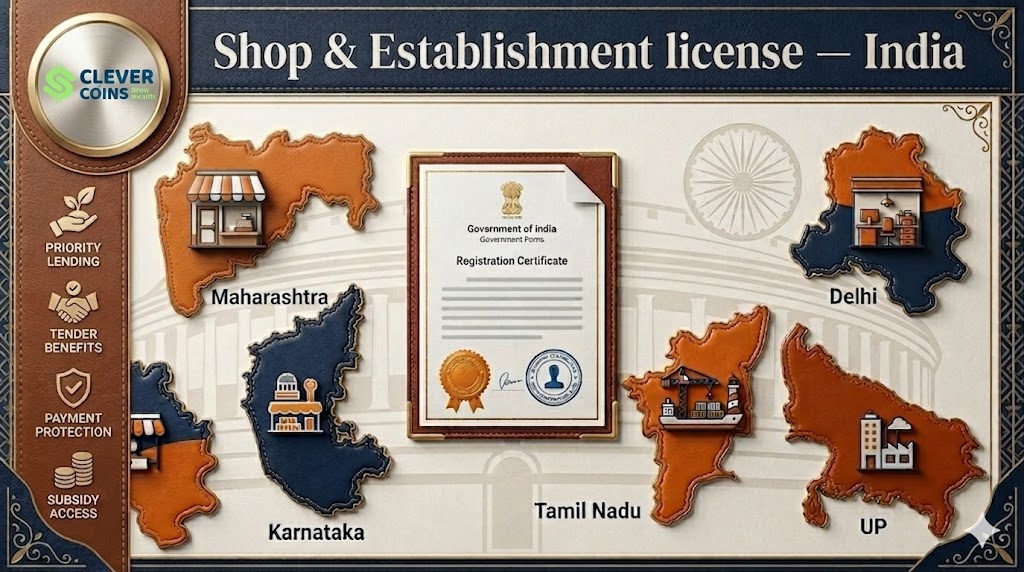
Starting a business in India? Whether you are opening a retail store, a salon, a café, a clinic, an IT office, or any commercial establishment, one of the very first legal requirements you must fulfil is obtaining a Shop & Establishment License. This license is not just a bureaucratic formality — it is a foundational legal document that legitimises your business, protects your employees, and ensures you remain compliant with state labour laws.
In this exhaustive, state-wise guide, we cover everything you need to know about the Shop & Establishment License in India — what it is, why it is mandatory, who needs it, how to apply, which documents are required, how much it costs, and how different states handle the process. Bookmark this page — you will refer to it again and again.
What is a Shop & Establishment License?
A Shop & Establishment License (also called Gumasta License in Maharashtra and some other states) is a legal registration issued under the respective state’s Shops and Establishments Act. It is governed at the state level, which means every Indian state has its own version of the Act with slightly different rules, fees, and procedures.
The license regulates the working conditions of workers and employees in commercial establishments, including:
- Working hours and weekly holidays
- Leave entitlements (casual, earned, sick leave)
- Overtime rules and compensation
- Employment of women and children
- Payment of wages and salary timelines
- Display of notices and maintenance of records
- Conditions of service and termination norms
Essentially, it is the state government’s way of tracking all commercial activity within its jurisdiction and ensuring workers receive basic protections.
Who Needs a Shop & Establishment License?
Almost every commercial entity in India that operates from a fixed physical premises requires this license. The following categories are typically covered:
Mandatory for:
- Retail and wholesale shops (garments, electronics, grocery, etc.)
- Restaurants, cafes, hotels, dhabas, and food outlets
- Salons, beauty parlours, spas, and wellness centres
- Offices (corporate offices, law firms, CAs, consultancies)
- IT companies and software firms
- Warehouses, godowns, and storage facilities
- Hospitals, nursing homes, clinics, diagnostic centres
- Educational coaching centres and tuition institutes
- Gyms, fitness centres, yoga studios
- E-commerce businesses with a physical office or warehouse
- Freelancers and home-based businesses (in some states)
Typically Exempt:
- Factories (covered under the Factories Act, 1948)
- Mines and plantations (covered under their own acts)
- Government offices and public sector undertakings
- Railways, defence establishments
Why is the Shop & Establishment License Important?
Beyond legal compliance, the Shop & Establishment License serves several practical business purposes:
- Business Bank Account Opening
Most banks require the S&E license as proof of business existence when opening a current account.
- GST Registration
The license is a key supporting document when applying for GST registration, especially for sole proprietors.
- MSME / Udyam Registration
To avail government schemes under MSME, you often need the S&E license as proof of your business address.
- Employee ESI and PF Registration
ESIC and EPFO registrations require your establishment to be validly registered under the S&E Act.
- Avoids Legal Penalties
Operating without a license can attract fines ranging from Rs. 2,000 to Rs. 50,000 or more depending on the state, along with the risk of forced closure.
- Builds Credibility
A registered business builds trust with customers, investors, suppliers, and landlords.
Key Documents Required for Shop & Establishment Registration
While requirements vary slightly by state, the following documents are almost universally required:
Identity & Address Proof of Owner:
- Aadhaar Card
- PAN Card
- Passport / Voter ID / Driving Licence (any one as ID proof)
- Utility bill or rent agreement as address proof
Business / Premises Documents:
- Proof of business address (rent agreement / ownership document / NOC from owner)
- Utility bill of the business premises (electricity / water bill)
- Property tax receipt (if owned premises)
Business Details:
- Name of the establishment and nature of business
- Number of employees (with names and addresses)
- Category of establishment (shop / commercial / restaurant, etc.)
- Certificate of Incorporation / Partnership Deed / LLP Agreement (for companies)
- Passport-sized photographs of proprietor/partners/directors
Additional Documents (State-specific):
- FSSAI License (for food businesses)
- Fire NOC (for large establishments)
- Trade License copy
- Professional Tax Registration
State-wise Guide to Shop & Establishment License in India
This is the most comprehensive part of this guide. Below is a detailed, state-by-state breakdown of the applicable act, issuing authority, fees, validity, and online portal for registration.
State / UT | Governing Act | Issuing Authority | Approx. Fee | Validity |
Maharashtra | Maharashtra Shops & Establishments (Regulation of Employment and Conditions of Service) Act, 2017 | Local Municipal Corporation / Labour Dept. | Rs. 0–2,000 | Permanent (post-2017) |
Delhi | Delhi Shops and Establishments Act, 1954 | Labour Department, GNCT of Delhi | Rs. 200–5,000 | 1 Year |
Karnataka | Karnataka Shops and Commercial Establishments Act, 1961 | Dept. of Labour, Karnataka | Rs. 100–3,000 | 5 Years |
Tamil Nadu | Tamil Nadu Shops and Establishments Act, 1947 | Inspector of Labour | Rs. 50–2,000 | 1 Year |
Uttar Pradesh | Uttar Pradesh Dukan Aur Vanijya Adhishthan Adhiniyam, 1962 | District Labour Office | Rs. 100–1,000 | 3 Years |
Gujarat | Bombay Shops and Establishments Act, 1948 (as adopted) | Municipal Corporation / Panchayat | Rs. 100–2,500 | 1 Year |
West Bengal | West Bengal Shops and Establishments Act, 1963 | Labour Commissioner | Rs. 50–3,000 | 3 Years |
Rajasthan | Rajasthan Shops and Commercial Establishments Act, 1958 | Labour Department | Rs. 100–2,000 | 5 Years |
Telangana | Telangana Shops and Establishments Act, 1988 | Dept. of Labour, Telangana | Rs. 200–5,000 | 1 Year |
Andhra Pradesh | AP Shops and Establishments Act, 1988 | Labour Commissioner | Rs. 200–5,000 | 1 Year |
Kerala | Kerala Shops and Commercial Establishments Act, 1960 | Municipal Corporation / Gram Panchayat | Rs. 200–3,000 | 3 Years |
Punjab | Punjab Shops and Commercial Establishments Act, 1958 | Labour Department | Rs. 100–2,000 | 1 Year |
Haryana | Haryana Shops and Commercial Establishments Act, 1958 | Labour Department | Rs. 500–3,000 | 1 Year |
Madhya Pradesh | MP Shops and Establishments Act, 1958 | Labour Commissioner Office | Rs. 200–2,000 | 1 Year |
Bihar | Bihar Shops and Establishments Act, 1953 | Labour Department | Rs. 50–1,500 | 3 Years |
Jharkhand | Jharkhand Shops and Establishments Act, 2013 | Labour Dept, Jharkhand | Rs. 200–2,000 | 3 Years |
Odisha | Odisha Shops and Commercial Establishments Act, 1956 | Labour Commissioner | Rs. 50–1,500 | 1 Year |
Chhattisgarh | CG Shops and Establishments Act, 1958 | Labour Department | Rs. 100–1,500 | 1 Year |
Assam | Assam Shops and Establishments Act, 1971 | Labour Department | Rs. 50–1,000 | 1 Year |
Himachal Pradesh | HP Shops and Commercial Establishments Act, 1969 | Labour Department | Rs. 50–1,000 | 3 Years |
Note: Fees vary based on number of employees, type of establishment, and municipal category. Verify current fees on your state’s official portal.
How to Apply for Shop & Establishment License — Step-by-Step Process
Method 1: Online Application (Recommended)
- Visit your state’s labour department official portal or Shram Suvidha Portal (shramsuvidha.gov.in)
- Register as a new user with your mobile number and email ID
- Fill out the online application form with establishment and owner details
- Upload all required documents in specified format (usually PDF/JPG, max 2MB each)
- Pay the prescribed fee online via net banking, UPI, or debit/credit card
- Submit the application and note your application reference number
- Track status online; certificate is issued digitally within 3–15 working days (state-dependent)
Method 2: Offline Application
- Visit the office of the Inspector of Shops & Establishments or the local labour office
- Obtain the prescribed application form (Form A or Form I depending on state)
- Fill in the form accurately, attach self-attested documents and DD/cash for fee
- Submit to the inspector; receive acknowledgement receipt
- Inspector may visit premises for verification (varies by state)
- Collect physical certificate once approved
Renewal of Shop & Establishment License
Most states require periodic renewal of the S&E license. Failing to renew on time can attract a late fee or, in some cases, cancellation of the license. Here is what you need to know about renewal:
- Submit a renewal application before the expiry date (usually 30–60 days prior)
- Provide updated employee count and any changes to business details
- Pay the renewal fee (usually the same as original fee or slightly lower)
- Submit updated documents if any changes have occurred
- Some states (e.g., Maharashtra post-2017) have made the license permanent, eliminating renewal requirements
- Renewal can typically be done online on the same portal as the original registration
Pro Tip: Set a Calendar Reminder Set a reminder 60 days before your license expiry date. Renewing early avoids late fees and keeps your business compliant. Most portals allow online renewal — keep your login credentials safe. |
Penalties for Non-Compliance
Operating without a Shop & Establishment License — or violating the conditions of the license — can attract serious consequences:
Violation Type | Penalty Range | Additional Action |
Operating without registration | Rs. 2,000 – Rs. 25,000 | Notice to close premises |
Employing beyond permitted hours | Rs. 1,000 – Rs. 10,000 | Show cause notice |
Not maintaining proper records | Rs. 500 – Rs. 5,000 | Inspection + Warning |
Not displaying license prominently | Rs. 500 – Rs. 2,000 | Fine |
Repeated violations | Up to Rs. 50,000 | Criminal prosecution |
Important Obligations After Registration
Once you receive your Shop & Establishment License, you must fulfil certain ongoing obligations:
- Display the license prominently at the business premises at all times
- Maintain a Register of Employees with details of name, designation, wages, and leaves
- Maintain a Wages Register and provide wage slips to all employees
- Follow prescribed working hours — generally 9 hours/day, 48 hours/week
- Grant mandatory weekly off (Sunday or any other day by mutual agreement)
- Grant annual leave as prescribed by the state (usually 1 day per 20 days worked)
- Comply with rules for employment of women during late-night shifts (as applicable)
- Notify the authority within 30 days of any change in employee count, nature of business, or premises
- Maintain a Register of Advances (where applicable)
- Permit inspection by authorised labour inspectors at any time
State-wise Online Portals for Registration
- Maharashtra: aaplesarkar.mahaonline.gov.in or mahakamgar.gov.in
- Delhi: labour.delhi.gov.in
- Karnataka: labour.karnataka.gov.in
- Tamil Nadu: labour.tn.gov.in / TNeGA portal
- Uttar Pradesh: uplabour.gov.in
- Gujarat: labour.gujarat.gov.in
- West Bengal: wblabour.gov.in
- Rajasthan: labour.rajasthan.gov.in
- Telangana: labour.telangana.gov.in
- Andhra Pradesh: labour.ap.gov.in
- Kerala: labour.kerala.gov.in
- Central Portal for some states: shramsuvidha.gov.in
Frequently Asked Questions (FAQs)
Q1. Is a Shop & Establishment License the same as a Trade License?
No. A Trade License is issued by the local municipal body and covers the general operation of a trade. A Shop & Establishment License is issued by the state’s labour department and specifically covers employee working conditions and labour law compliance. Both may be required for certain businesses.
Q2. Can a home-based business get a Shop & Establishment License?
Yes, in most states, even home-based businesses and freelancers operating from a residential address can register under the Shops & Establishments Act. The residential address is treated as the place of business.
Q3. How long does it take to get the license?
Online applications in most states are processed within 3 to 15 working days. Some states (like Maharashtra) have made it instant or same-day. Offline applications may take 15 to 30 days depending on the inspector’s workload.
Q4. Can I operate my business during the application process?
Some states allow provisional operation after submitting the application and paying the fee, with a grace period of 30 days. However, it is always better to obtain the license before commencing operations.
Q5. What if my business has multiple branches?
Each branch at a different address requires a separate Shop & Establishment License for that location. You cannot use one license for multiple premises.
Q6. Is GST registration the same as Shop & Establishment License?
No. GST registration is a central government tax registration for businesses above the turnover threshold. The S&E license is a state-level compliance for labour law purposes. Both are separate registrations with different authorities.
Q7. What happens if I close my business?
You must notify the Registering Authority within 15 to 30 days of closing the establishment (as per your state’s act) and surrender the license certificate. Failure to do so can result in unnecessary renewal notices or penalties.
Q8. Do I need an S&E license if I am a company registered with MCA?
Yes. MCA registration (as a Private Limited Company, LLP, etc.) is a separate central government registration for corporate legal structure. The Shop & Establishment License is a state-level compliance for your physical place of business and employee welfare.
Key Differences: Pre-2017 vs Post-2017 Maharashtra S&E Act
Maharashtra was among the first states to completely overhaul its Shops and Establishments Act in 2017. The new Maharashtra Shops and Establishments (Regulation of Employment and Conditions of Service) Act, 2017 brought in sweeping changes:
- Permanent license with no renewal required — massive relief for businesses
- Self-declaration-based compliance replaces inspector raj
- IT/ITES companies can allow women employees to work night shifts with safety precautions
- Flexible working hours for employees by mutual agreement
- Digital records and e-notices replace paper registers
- Higher penalties for violations to deter non-compliance
Several other states including Karnataka, Tamil Nadu, and Uttar Pradesh are now looking to follow Maharashtra’s model with their own modernised legislation.
Pro Tips for a Smooth Registration
- Double-check the spelling of your establishment name — it must match your signboard and other documents
- Ensure your address proof and business address proof are consistent
- Keep digital copies (PDF format) of all documents ready before starting the online application
- If applying offline, always get a receipt/acknowledgement from the officer
- Keep the original license in a safe, waterproof place and display a laminated photocopy
- Update the license immediately if you hire additional employees beyond the registered count
- Use a professional CA or compliance service if you are registering in a new state for the first time
Conclusion
The Shop & Establishment License is more than just a legal requirement — it is the bedrock of your business’s legal identity in India. It protects your employees, ensures you are compliant with state labour laws, and opens doors to bank accounts, GST registrations, and government schemes.
Whether you are a first-time entrepreneur, a freelancer setting up a home office, or a growing company opening a new branch, this state-wise guide gives you everything you need to navigate the registration process confidently.
Still confused about the specific requirements in your state? Drop your questions in the comments section below, or reach out to our compliance experts for personalised guidance.
Need Help with Registration? Our compliance team helps businesses across India with Shop & Establishment License registration, renewal, and updates. Contact us today for a free consultation — we handle the paperwork so you can focus on growing your business. |