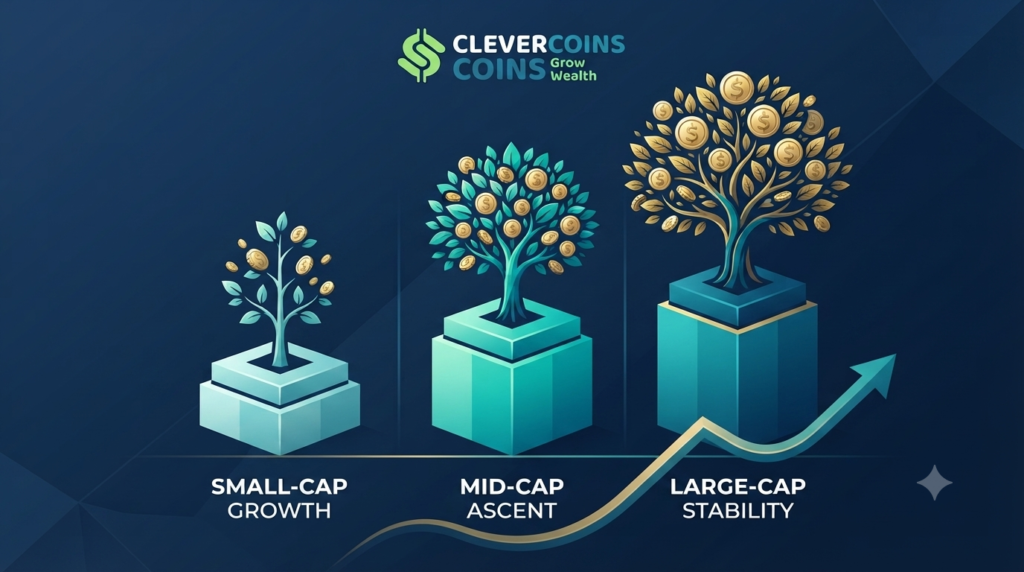
Smallcap vs Midcap vs Largecap Stocks: The Ultimate Wealth Building Guide
When you step into the vast universe of the stock market, one of the earliest and most critical decisions you will face is asset allocation across different market capitalizations. Terms like Largecap, Midcap, and Smallcap are tossed around constantly by financial advisors, news anchors, and seasoned investors. But what do they actually mean? How do they impact your risk appetite, portfolio volatility, and long-term compounding returns?
Understanding the mechanics of market capitalization is foundational to building a resilient, high-performing investment portfolio. Whether you are a novice investor taking your first steps into equity markets or an experienced trader looking to rebalance your holdings, this comprehensive guide will dissect the structural differences, advantages, risks, and strategic alignments of Smallcap, Midcap, and Largecap stocks.
Understanding Market Capitalization: The Baseline
Before diving into the individual categories, we must define what Market Capitalization (Market Cap) actually represents.
Market Capitalization=Current Share Price×Total Number of Outstanding Shares
Market cap is simply the total market value of a company’s publicly traded shares. It gives investors an instant snapshot of a company’s size, scale, market influence, and relative stability. Regulatory bodies and index providers (such as SEBI in India or major global index compilers) classify companies based on their rank in terms of total market capitalization:
Largecap Stocks: Typically rank 1st to 100th by market capitalization.
Midcap Stocks: Typically rank 101st to 250th by market capitalization.
Smallcap Stocks: Rank 251st and beyond.
Let us break down each category individually to analyze their unique DNA.
1. Largecap Stocks: The Giants of Stability
What Are Largecap Stocks?
Largecap stocks represent the behemoths of the corporate world—household names with solid balance sheets, proven business models, dominant market shares, and decades of operational history. Think of global giants or national market leaders in banking, energy, consumer goods, and technology.
Characteristics of Largecap Stocks
High Liquidity: Because millions of shares change hands daily, you can buy or sell large positions instantly without causing massive price swings (low impact cost).
Lower Volatility: While they are still subject to broader market corrections, largecap stocks generally experience softer drawdowns during bear markets compared to their smaller peers.
Consistent Dividend Payouts: Mature largecap companies often generate predictable free cash flows, allowing them to reward shareholders regularly through dividends and stock buybacks.
Economic Moats: They possess strong competitive advantages (brand loyalty, distribution networks, economies of scale) that protect their market share from new entrants.
Advantages of Investing in Largecaps
Capital Protection: They act as the defensive anchor of a portfolio, preserving capital during high macroeconomic uncertainty.
Ease of Research: Information, quarterly earnings reports, analyst coverage, and institutional research are abundantly available for largecaps.
Stress-Free Compounding: Ideal for conservative or moderate investors who prioritize steady, inflation-beating growth over aggressive speculative gains.
Disadvantages and Limitations
Lower Growth Ceiling: Due to their massive scale, doubling or tripling in size takes an extraordinary amount of capital and revenue expansion. Exponential growth is harder to achieve.
Modest Returns: While safer, their long-term percentage returns may lag behind fast-growing midcap and smallcap companies during structural bull runs.
2. Midcap Stocks: The Growth Engines
What Are Midcap Stocks?
Midcap stocks occupy the sweet spot between stability and aggressive expansion. These are companies that have graduated from their startup or regional phases and are actively scaling nationally or globally. They have established business models but still possess significant headroom for market penetration.
Characteristics of Midcap Stocks
Moderate to High Growth Potential: Midcaps often operate in expanding sectors, capturing market share from unorganized players or smaller competitors.
Higher Volatility than Largecaps: They react more sharply to earnings surprises, economic shifts, and changes in institutional sentiment.
Transition Phase: Many of today’s midcaps are tomorrow’s blue-chip largecaps, making this segment a breeding ground for future market leaders.
Advantages of Investing in Midcaps
Balanced Risk-Reward Profile: They offer higher growth potential than largecaps while carrying lower structural risk than smallcaps.
Multibagger Potential: Successful midcaps can scale rapidly, transforming modest investments into substantial wealth over a 5-to-10-year horizon.
Institutional Interest: Growing midcaps frequently catch the eye of mutual funds and foreign institutional investors (FIIs), driving valuation re-ratings.
Disadvantages and Limitations
The “Middle Child” Trap: During severe economic downturns, midcaps can suffer sharp liquidity crunches and prolonged consolidation phases.
Execution Risk: Scaling operations from regional to national levels requires flawless execution; missteps can lead to stagnant growth or financial distress.
3. Smallcap Stocks: The High-Risk, High-Reward Frontiers
What Are Smallcap Stocks?
Smallcap stocks represent emerging companies, niche innovators, regional disruptors, and early-stage enterprises. They have lower market valuations and often operate in sunrise sectors or specialized industrial niches.
Characteristics of Smallcap Stocks
Extreme Growth Potential: A smallcap company starting with a low revenue base can multiply its business manifold if it strikes product-market fit or captures a booming structural trend.
High Volatility and Lower Liquidity: Trading volumes can be thin. Large buy or sell orders can cause erratic price volatility (slippage).
Information Asymmetry: Comprehensive analyst coverage is scarce. Researching smallcaps requires deep fundamental analysis, balance-sheet scrutiny, and corporate governance checks.
Advantages of Investing in Smallcaps
The Ultimate Wealth Creators: Historical market data demonstrates that during secular bull runs, top-tier smallcap baskets frequently outperform all other asset classes.
Early Discovery: Investing in a company before it enters institutional radar allows investors to capture the maximum phase of its corporate life cycle.
Disadvantages and Limitations
Severe Downside Risk: Many smallcap companies lack financial staying power. During credit squeezes or economic recessions, they can face severe liquidity crises or corporate failure.
Governance Vulnerabilities: Smaller enterprises may have less stringent internal controls or transparent reporting standards compared to largecaps.
Comparative Matrix: Smallcap vs Midcap vs Largecap
Parameter | Largecap Stocks | Midcap Stocks | Smallcap Stocks |
|---|---|---|---|
Market Cap Range | Top 100 companies | 101st to 250th companies | 251st company onwards |
Risk Level | Low to Moderate | Moderate to High | High to Very High |
Growth Potential | Moderate / Stable | High | Exceptional / Explosive |
Volatility | Low | Moderate | High |
Liquidity | Extremely High | Moderate | Low to Moderate |
Ideal Investor Profile | Conservative / Long-term | Moderate / Balanced | Aggressive / Risk-tolerant |
The Psychological and Behavioural Challenge
Investing across different market caps is not merely a mathematical exercise; it is an intense test of investor psychology.
The Largecap Test: Requires patience. Investors often get bored during flat market phases because largecaps do not deliver overnight spikes.
The Midcap Test: Requires resilience. Midcaps test your nerves during mid-term corrections when valuations normalize after rapid run-ups.
The Smallcap Test: Requires iron discipline. Watching a quality smallcap portfolio drop 30% to 40% during a market correction tests whether you understand long-term compounding or panic at the bottom.
Strategic Asset Allocation: How to Build Your Portfolio
There is no universal “one-size-fits-all” asset allocation model. Your ideal mix of large, mid, and smallcap stocks depends entirely on your financial goals, risk tolerance, age, and investment horizon. However, financial planners often utilize framework models based on investor lifecycles:
1. The Conservative / Wealth Preservation Approach
Largecap: 70% – 80%
Midcap: 15% – 20%
Smallcap: 0% – 10%
Best for: Retirees, individuals nearing financial goals, or risk-averse investors seeking stable compounding with minimal volatility.
2. The Balanced / Core-Satellite Approach
Largecap: 50% – 60%
Midcap: 25% – 30%
Smallcap: 15% – 20%
Best for: Salaried professionals with a 7-to-10-year horizon looking to balance stable blue-chip holdings with growth accelerators.
3. The Aggressive / Wealth Maximization Approach
Largecap: 30% – 40%
Midcap: 30% – 40%
Smallcap: 30% – 35%
Best for: Young earners with high risk appetite, steady income streams, and a long-term investment horizon exceeding 12 to 15 years.
Pitfalls to Avoid When Investing Across Market Caps
Chasing Past Performance: Simply buying the asset class that performed best last year is a recipe for underperformance. Market cycles rotate constantly.
Ignoring Liquidity Risk in Smallcaps: Always check trading volumes. Buying illiquid smallcap stocks can trap you when you need to exit urgently.
Over-Diversification: Spreading capital thin across 50 different smallcap stocks dilutes potential gains and turns your portfolio into an unmanageable index clone.
Neglecting Rebalancing: Review your portfolio annually. If your midcaps and smallcaps have grown rapidly, their weight in your portfolio will have ballooned, exposing you to higher unintended risk. Rebalance back to your target asset allocation.
Conclusion: Crafting Your Financial Future
Smallcap, midcap, and largecap stocks are not competing enemies; they are complementary teammates in your wealth-building journey. Largecaps provide the ballast that keeps your ship steady through rough economic weather, midcaps supply the engine power for steady cruising speed, and smallcaps provide the turbo boost needed to reach your destination faster.
At CleverCoins, we believe that true financial mastery is built on structured planning, rigorous tax optimization, and disciplined asset allocation. By understanding the unique traits of each market capitalization tier, you can construct a resilient, purpose-driven portfolio that withstands market storms and capitalizes on secular economic growth.
CleverCoins
Take control of your financial destiny today—diversify wisely, invest patiently, and let compounding work its magic.
Disclaimer: Equity investments are subject to market risks. Read all scheme-related documents carefully before investing. Consult a qualified financial advisor or tax consultant at CleverCoins to align your investments with your specific financial goals.
Consult Us Now
Phone: +91 77389 59862
Email: client@clevercoins.org
Address: Ideal Market, Mumbra, Thane-400612
Days
Hours
Minutes
Seconds
Related posts:
GST on Prizes & Awards
GST
GSTR-10 – Final Return on Cancellation: The Ultimate End-to-End Compliance Guide
GST
UPI vs NEFT vs RTGS vs IMPS
GST
GST on Petroleum Products – Future Inclusion?
GST
How to Respond to a GST Notice: A Step-by-Step Guide
GST
Comprehensive Blog Content: What is EBITDA and Why Investors Use It
GST
Detailed Blog Content: GST on Charitable Activities
GST
HRA Exemption 2026
GST
Memorandum & Articles of Association: The Ultimate Corporate Governance Guide
GST
Demystifying GST on Del-Credere Agent (DCA) Services: A Complete Comprehensive Guide
GST