Key Takeaways
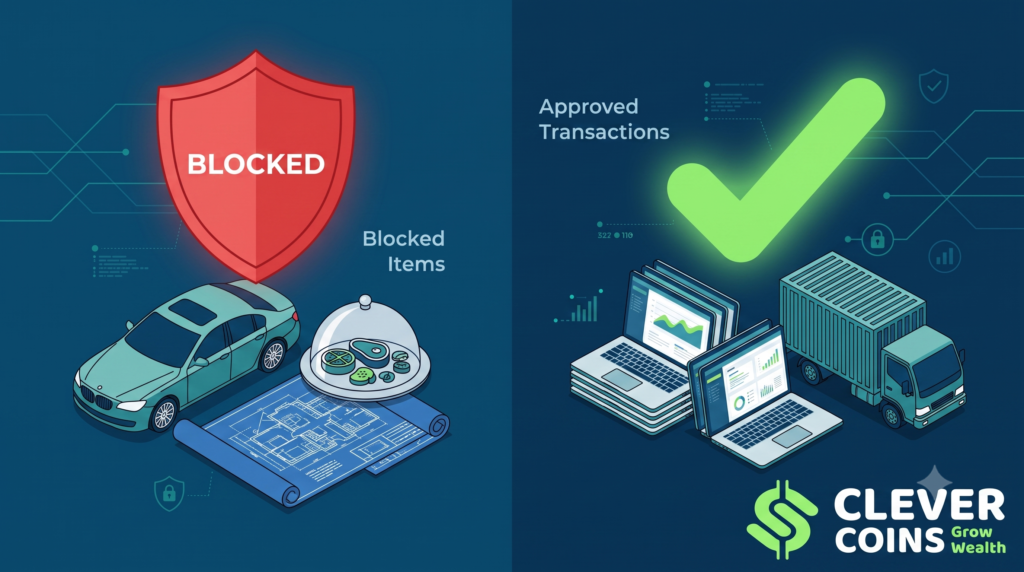
- The Section 17(5) Trap: Even if an expense is 100% genuine and for business purposes, Section 17(5) of the CGST Act specifically blocks Input Tax Credit (ITC) on categories like passenger vehicles, staff meals, and office renovations.
- Passenger Cars vs. Goods Vehicles: You cannot claim ITC on a passenger vehicle with a seating capacity of up to 13 persons unless you run a driving school, taxi service, or car dealership. However, goods carriages (delivery trucks, vans) are fully eligible for ITC.
- The “Team Lunch” Illusion: Food, beverages, outdoor catering, and health club memberships are strictly blocked from ITC claims, even if they are incurred to boost employee morale or entertain corporate clients.
- Immovable Property Constraints: GST paid on civil works, building construction, or extensive office renovations on your own account is a blocked credit. It must be capitalized into the cost of the asset.
- Reversal is Non-Negotiable: If your accounting software auto-claims ITC on a blocked item, you must reverse it immediately in your GSTR-3B to avoid aggressive departmental scrutiny and a mandatory 18% interest penalty.
Introduction: The Frustration of Disallowed Business Expenses
Imagine this scenario: You have just closed the biggest client deal of the year. To ensure operations run smoothly, you purchase a ₹25 lakh SUV registered in the company’s name for client visits. To celebrate the win, you treat your entire team to a lavish corporate lunch, and you finally pull the trigger on a much-needed ₹15 lakh office renovation.
You pay an 18% to 28% Goods and Services Tax (GST) on all these transactions, confidently assuming that because these are genuine business expenses, you will simply claim the Input Tax Credit (ITC) and offset your outward tax liability.
Then, your accountant delivers the bad news: You cannot claim a single rupee of that GST back.
Few things frustrate business owners, startup founders, and CFOs more than paying heavy indirect taxes on legitimate business operations only to be told that the credit is blocked. This scenario plays out in boardrooms across India every day, leading to warped profit projections and unexpected cash flow crunches.
The culprit? Section 17(5) of the Central Goods and Services Tax (CGST) Act. This specific provision lists “blocked credits”—categories of purchases on which ITC is deliberately disallowed by law, regardless of their business utility.
At CleverCoins, we specialize in moving businesses beyond simple return filings into proactive financial strategy. Understanding Section 17(5) before you swipe your corporate card can save you lakhs in unrecoverable tax costs. In this comprehensive 2026 guide, we will break down exactly how blocked credits work, the exceptions that allow you to claim ITC, and how to legally structure your operations to maximize your tax efficiency.
What Are “Blocked Credits” in the GST Regime?
To understand the logic behind blocked credits, we must look at the foundational architecture of the GST system. The core premise of GST is to prevent the cascading effect of taxes (tax on tax) by allowing a seamless flow of credit across the supply chain. Generally, a registered business can claim ITC on any goods or services used in the “course or furtherance of business.”
However, lawmakers introduced Section 17(5) to carve out explicit exceptions. These exceptions were created for two primary reasons:
- High Risk of Personal Consumption: Items like cars, gym memberships, and food are heavily prone to personal use by directors and employees. Tracking the exact percentage of “business use” vs. “personal use” is administratively impossible for the tax department, so they simply block the credit entirely.
- Breaking the Tax Chain: When goods or services reach their end-consumption state (e.g., constructing a building that won’t be sold as a taxable good, or eating a meal), the chain of taxable supplies ends. Therefore, the credit chain must also end.
When you incur an expense that falls under Section 17(5), the GST you pay ceases to be an adjustable tax credit. Instead, it becomes a hard cost that you must absorb or capitalize into the value of the asset.
The Motor Vehicle Trap: Passenger Cars vs. Goods Carriages
The most common and expensive ITC mistake businesses make involves buying vehicles.
Under Section 17(5)(a), Input Tax Credit is explicitly blocked on motor vehicles for the transportation of persons having an approved seating capacity of not more than 13 persons (including the driver).
If you are a marketing agency, an IT firm, or a manufacturing company, and you buy a 5-seater sedan or a 7-seater SUV for your directors or sales team to commute to client meetings, the ITC is blocked. You must capitalize the GST paid into the cost of the vehicle on your balance sheet and claim depreciation under the Income Tax Act instead.
The Exceptions: When Can You Claim ITC on a Passenger Car?
The law provides specific carve-outs where ITC on passenger vehicles (under 13 seats) is fully allowed. You can claim the credit ONLY if you use the vehicle for making the following taxable supplies:
- Further Supply of Such Vehicles: If you are a car dealership buying cars from the manufacturer to sell to consumers.
- Transportation of Passengers: If you run a taxi service, cab aggregator fleet, or a commercial bus service.
- Imparting Driving Training: If you operate a registered motor driving school.
The Goods Carriage Advantage
It is critical to note that the block applies to passenger vehicles. Section 17(5) does not block credit for goods carriages.
If your business purchases a delivery truck, a tempo, or a cargo van to transport raw materials or finished products, the ITC is fully available. This distinction is vital for capital allocation.
Case Study: The ₹20 Lakh Vehicle Dilemma
- Scenario A: TechSolutions Pvt. Ltd. buys a luxury 5-seater SUV for ₹20,00,000 (including ₹5,60,000 GST/Cess) for its CEO to visit investors.
- Outcome: Because the business is IT services, the ₹5.6 Lakhs is blocked under Section 17(5). It becomes a sunk cost.
- Scenario B: The same company spends ₹20,00,000 (including GST) on a customized delivery tempo to transport server racks to client sites.
- Outcome: Because the tempo is classified as a goods carriage, TechSolutions successfully claims the entire GST portion as ITC, directly reducing their outward tax liability and saving lakhs in working capital.
(CleverCoins Pro Tip: If you are debating between an SUV and a cargo utility vehicle for your technical team’s field visits, consulting with our tax strategists beforehand can dictate whether you lose or save 28% in taxes.)
Food, Beverages, and Staff Welfare: The Hidden Costs of Team Building
In 2026, corporate culture thrives on employee welfare—Friday team lunches, outdoor catering for annual days, and sponsored health club memberships. However, the GST department does not subsidize corporate culture.
Section 17(5)(b) strictly blocks ITC on:
- Food and beverages
- Outdoor catering
- Beauty treatment, health services, and cosmetic/plastic surgery
- Membership of a club, health, and fitness center
- Travel benefits extended to employees on vacation (such as leave or home travel concession)
Even if you host a business lunch to close a ₹5 Crore contract, the 18% GST charged by the luxury hotel restaurant cannot be claimed as ITC.
The Legal Exception for Employee Welfare
There is one vital, narrow exception to this rule. The ITC on these blocked items becomes available ONLY IF it is obligatory for an employer to provide the same to its employees under any law for the time being in force.
For example, under the Factories Act, 1948, if a factory employs more than 250 workers, it is legally mandated to provide a canteen. In this highly specific scenario, the GST paid on the outdoor catering contractor running the mandatory factory canteen can be claimed as ITC. If you provide a canteen voluntarily because you have only 50 employees, the ITC remains blocked.
Office Renovations and Immovable Property
Upgrading your corporate headquarters or building a new warehouse is an exciting milestone, but it is fraught with GST complexities.
Section 17(5)(c) and (d) block ITC on:
- Works Contract Services: When supplied for the construction of an immovable property (other than plant and machinery).
- Goods or Services Received by a Taxable Person: For the construction of an immovable property (other than plant and machinery) on his own account, even when such goods or services are used in the course or furtherance of business.
What Does This Mean?
If you hire a contractor to do civil work, lay bricks, install permanent structural frameworks, or build an entire office building, the GST paid to the contractor (and on the cement/steel) is blocked. “Construction” includes reconstruction, renovation, additions, or alterations to the extent of capitalization.
If the renovation expenses are large enough to be capitalized in your books of accounts as “Building” or “Immovable Property,” the ITC is lost.
The “Plant and Machinery” Loophole
The block applies to buildings and civil structures, but it explicitly excludes “Plant and Machinery.” Furthermore, if you carry out minor repairs and maintenance (e.g., painting, fixing tiles) and you record these as revenue expenditure (expenses in your Profit & Loss account) rather than capitalizing them, the ITC is generally allowed.
At CleverCoins, we specialize in structuring your renovation contracts. By legally segregating civil works (blocked) from the installation of movable plant, machinery, modular workstations, and server cooling systems (eligible for ITC), we help businesses recover significant tax credits during expansion phases.
Personal Consumption, Free Samples, and Lost Goods
The final major category of blocked credits revolves around goods that never make it to a taxable sale.
Section 17(5)(g) and (h) block ITC on:
- Goods or services used for personal consumption.
- Goods lost, stolen, destroyed, written off, or disposed of by way of gift or free samples.
The Free Sample Conundrum
Many FMCG and pharmaceutical companies rely heavily on free samples to drive market penetration. Because you do not charge any consideration (money) for a free sample, no outward GST is collected. Consequently, the government mandates that you must reverse the ITC you claimed on the raw materials used to manufacture that free sample.
If a fire destroys your warehouse inventory, or goods are stolen in transit, any ITC previously claimed on those goods during purchase must be immediately reversed and paid back to the government along with applicable interest.
Quick Reference Chart: Expense vs. ITC Eligibility
To simplify your purchasing decisions, refer to this CleverCoins Quick-Check Table:
Expense Category | ITC Allowed? | Statutory Reason / Note |
Car (up to 13 seats) for staff/directors | Blocked | Risk of personal use (Sec 17(5)(a)). |
Trucks, tempos, goods carriages | Allowed | Fully eligible; not a passenger vehicle. |
Team lunch, hotel dining, catering | Blocked | Food & Beverages block (Sec 17(5)(b)). |
Factory Canteen (if legally mandated) | Allowed | Exception for statutorily obligatory services. |
Office Renovation (Capitalized Civil Work) | Blocked | Construction of immovable property on own account. |
Modular Furniture & Computers | Allowed | Classified as movable goods/machinery. |
Laptops, Raw Materials, Subscriptions | Allowed | Genuine business inputs driving taxable output. |
Goods given as Free Gifts/Samples | Blocked | Supply without consideration breaks tax chain. |
The Danger of Ignoring Section 17(5)
In the era of automated digital tax compliance, ignorance is heavily penalized. If you accidentally claim ITC on a blocked item, it is not just a simple correction later on.
When the GST department’s data analytics tools catch the mismatch during a desk audit or a GSTR-2B reconciliation, you will be issued a show-cause notice under Section 73 or 74. You will be forced to reverse the ineligible ITC, pay a mandatory 18% per annum interest for the entire period you held the wrongful credit, and potentially face hefty penalties for misdeclaration.
CleverCoins Compliance Strategy: Tagging at the Source
Prevention is infinitely cheaper than cure. The secret to flawless GST compliance is intercepting blocked credits before they ever enter your GSTR-3B.
At CleverCoins, we implement a rigorous “Source-Tagging” protocol for our corporate clients:
- Pre-Purchase Consultation: Before clients make large capital expenditures (like buying a fleet of vehicles or signing a renovation lease), they consult our tax team to model the GST impact.
- ERP Configuration: We help configure your accounting software (Tally, Zoho, SAP) so that expenses hitting specific ledger heads (e.g., Staff Welfare, Passenger Vehicles, Civil Maintenance) are automatically flagged as “ITC Ineligible.”
- Monthly Audits: Before filing your GSTR-3B, our experts manually comb through your GSTR-2B to weed out hotel bills, restaurant GSTINs, and car dealership invoices, ensuring your claimable ITC pool is 100% legitimate and audit-proof.
Conclusion: Plan Your Purchases, Don’t Just Pay Them
Section 17(5) of the CGST Act is a harsh reality for business owners, transforming what looks like a tax credit into an unrecoverable business cost. However, it does not have to be an unpleasant surprise. By understanding the nuances between goods carriages and passenger cars, or civil works versus plant and machinery, you can make highly informed, tax-efficient purchasing decisions.
Navigating the complexities of GST requires more than just standard bookkeeping software; it demands proactive financial foresight. Do not let auto-populated tax errors drain your working capital through interest and penalties.
Partner with a consultancy that understands how to leverage the law to protect your bottom line. Stop reacting to tax notices and start engineering your compliance for maximum profitability.
Consult CleverCoins Now
- Phone: +91 77389 59862
- Email: client@clevercoins.org
- Address: Ideal Market, Mumbra, Thane-400612.
Frequently Asked Questions (FAQs)
Q1: Can I claim ITC on the repair and insurance of my company car?
No. If the ITC on the purchase of the motor vehicle itself is blocked under Section 17(5) (e.g., a standard 5-seater passenger car), the ITC on its servicing, repairs, and insurance is also strictly blocked.
Q2: What if my business is entirely focused on event management? Can I claim ITC on catering?
Yes, if you are in the same line of business. If you are an event manager and you hire an outdoor caterer for an event you are organizing for a client, you can claim the ITC on the caterer’s bill, because you are using it to make an outward taxable supply of the same category (event/catering services).
Q3: I bought laptops and ergonomic chairs for my employees working from home. Is this ITC blocked?
No. Laptops, software, and movable office chairs are not blocked under Section 17(5). These are considered standard business assets and machinery, meaning you can fully claim the ITC on these purchases.
Q4: If I reverse blocked ITC voluntarily, do I still have to pay a penalty?
If you identify the error and voluntarily reverse the wrongfully claimed ITC (along with the applicable 18% interest) before any departmental notice is issued, you generally avoid the heavy penalties associated with tax suppression or fraud. Proactive monthly reviews by CleverCoins prevent these situations entirely.