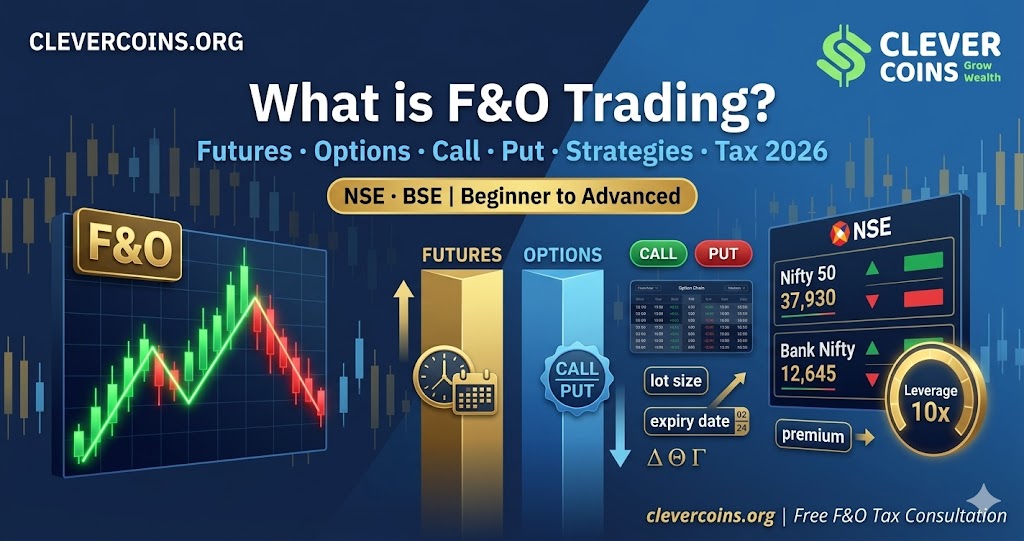
The World of Derivatives — Power, Leverage & Responsibility
Every trading day, millions of Indians open their trading apps and place orders in Nifty 50 options, Bank Nifty futures, and individual stock derivatives. India’s F&O market is one of the largest derivatives markets in the world by contract volume — and yet, a significant number of participants don’t fully understand what they are trading or the financial and tax implications involved.
Futures and Options (F&O) are financial derivatives — instruments whose value is derived from an underlying asset such as a stock index, individual stock, commodity, or currency. They are powerful tools used by institutional investors for hedging (risk management) and by traders for speculation (profit generation). However, in the wrong hands — without knowledge — they can wipe out capital rapidly.
This comprehensive guide by CleverCoins covers everything you need to know about F&O trading in India: what futures are, what options are, how they work mechanically, the key terminology, types of orders, strategies, risk management, taxation of F&O income in India (a critical and often misunderstood area), and the regulatory framework under SEBI.
📊 India F&O Market Fact: India’s NSE (National Stock Exchange) is consistently ranked among the top 3 derivatives exchanges globally by number of contracts traded. The Indian F&O market processes crores of contracts daily, making it crucial for every serious investor and trader to understand these instruments. |
What Are Financial Derivatives? — The Foundation
Before understanding Futures and Options, you must understand derivatives. A derivative is a financial contract whose value depends on (is ‘derived from’) the price of an underlying asset. The underlying asset can be:
- A stock index — Nifty 50, Bank Nifty, Midcap Nifty, Sensex
- Individual stocks — Reliance, TCS, HDFC Bank, Infosys (F&O eligible stocks only)
- Commodities — Gold, Silver, Crude Oil, Natural Gas, Agricultural products
- Currencies — USD/INR, EUR/INR, GBP/INR, JPY/INR
- Interest rates — Government bond yields (Interest Rate Futures)
Derivatives are traded on organised exchanges (NSE, BSE, MCX) under SEBI and RBI regulation. They allow participants to take a position on the future price direction of an asset without necessarily owning the asset itself.
Derivative Value = f (Price of Underlying Asset + Time + Volatility + Interest Rates + Other Factors) |
What Are Futures Contracts? — Deep Dive
A futures contract is a standardised, legally binding agreement between two parties to buy or sell a specified quantity of an underlying asset at a predetermined price on a specified future date (the expiry date). Both parties are obligated to honour the contract — unlike options, there is no choice involved.
Key Characteristics of Futures Contracts
Feature | Detail |
Standardised | Lot size, expiry date, tick size, and settlement method are all pre-defined by the exchange |
Obligatory | Both buyer and seller are OBLIGATED to fulfil the contract — no right to walk away |
Margin-Based | You don’t pay full contract value — only pay a margin (typically 10–20% of contract value) |
Mark-to-Market (M2M) | Daily settlement — profits/losses are credited/debited to your account every day |
Expiry Dates | Monthly contracts — last Thursday of each month (for NSE index futures) |
Cash Settled (mostly) | Most index futures are cash-settled; stock futures can be physically settled |
Leverage | High leverage — small margin controls a large contract value |
How a Futures Contract Works — Step by Step
Let’s take a Nifty 50 Futures contract as an example (illustrative values):
- Current Nifty 50 spot price: 24,500. You are bullish — you expect it to rise.
- You BUY 1 Nifty Futures contract at ₹24,500. Lot size = 25 units. Contract value = 24,500 × 25 = ₹6,12,500.
- Margin required: Approximately 10% = ₹61,250 (actual margin varies and is set by exchange/broker).
- If Nifty rises to 24,800: Your profit = (24,800 − 24,500) × 25 = ₹7,500.
- If Nifty falls to 24,200: Your loss = (24,200 − 24,500) × 25 = −₹7,500.
- Daily M2M: These gains/losses are settled daily — profit added to, or loss deducted from, your trading account.
- Expiry: If held to expiry, settlement happens at the final settlement price (closing spot value on expiry Thursday).
⚠️ Leverage Risk: While you only paid ₹61,250 as margin, your exposure is ₹6,12,500. A 1% move in Nifty = ₹6,125 profit or loss on your ₹61,250 investment — that is a 10% return OR loss on margin in a single day. This leverage is what makes futures both powerful and dangerous. |
Types of Futures Available in India
Category | Examples | Exchange |
Index Futures | Nifty 50, Bank Nifty, Midcap Nifty, Nifty Financial Services, Sensex | NSE / BSE |
Stock Futures | Reliance, TCS, HDFC Bank, Infosys, ITC, ICICI Bank (F&O eligible stocks) | NSE / BSE |
Commodity Futures | Gold, Silver, Crude Oil, Natural Gas, Copper, Cotton, Soybean, Chana | MCX / NCDEX |
Currency Futures | USD/INR, EUR/INR, GBP/INR, JPY/INR | NSE / BSE / MSEI |
Interest Rate Futures | 91-Day T-Bills, 2Y/5Y/10Y Government Bond Futures | NSE / BSE |
What Are Options Contracts? — Deep Dive
An options contract gives the BUYER the RIGHT — but NOT the obligation — to buy or sell an underlying asset at a specified price (the Strike Price) on or before the expiry date. The seller of the option (the writer) is obligated to fulfil the contract if the buyer chooses to exercise it.
For this right, the buyer pays a premium to the option seller. The premium is the maximum loss for the buyer. The seller collects the premium and takes on potentially unlimited risk (in the case of uncovered option writing).
The Two Types of Options — Call and Put
Option Type | CALL Option | PUT Option |
Definition | Right to BUY the underlying at the strike price | Right to SELL the underlying at the strike price |
When to Buy | When you are BULLISH (expect price to rise) | When you are BEARISH (expect price to fall) |
Buyer’s Max Loss | Limited to premium paid | Limited to premium paid |
Buyer’s Max Gain | Theoretically unlimited (for calls) | Strike Price minus zero (for puts) |
Seller’s (Writer) Max Gain | Limited to premium received | Limited to premium received |
Seller’s (Writer) Max Loss | Theoretically unlimited | Strike Price minus zero |
Example | Buy Nifty 24,500 CE (Call) — profit if Nifty > 24,500 | Buy Nifty 24,500 PE (Put) — profit if Nifty < 24,500 |
Options Moneyness — ITM, ATM, OTM Explained
The relationship between the current market price and the strike price of an option determines its ‘moneyness’:
Moneyness | Call Option | Put Option |
In-The-Money (ITM) | Strike < Current Price (e.g., 24000 CE when Nifty at 24500) | Strike > Current Price (e.g., 25000 PE when Nifty at 24500) |
At-The-Money (ATM) | Strike = Current Price (e.g., 24500 CE when Nifty at 24500) | Strike = Current Price (e.g., 24500 PE when Nifty at 24500) |
Out-of-The-Money (OTM) | Strike > Current Price (e.g., 25000 CE when Nifty at 24500) | Strike < Current Price (e.g., 24000 PE when Nifty at 24500) |
💡 Premium Insight: ITM options have the highest premium (intrinsic value + time value). OTM options have only time value — if the market doesn’t move in your favour, OTM options can expire worthless, losing 100% of premium paid. This is why buying far OTM options ‘for a lottery’ is an extremely high-risk strategy. |
Key Options Terminology Every Trader Must Know
Term | Definition |
Strike Price | The pre-agreed price at which the option can be exercised |
Premium | The price paid by option buyer to option seller for the right |
Expiry Date | The last date on which the option can be exercised (Thursday for NSE index options — weekly/monthly) |
Lot Size | Minimum quantity per contract — e.g., Nifty lot size = 25 units |
Open Interest (OI) | Total number of outstanding (unsettled) contracts in the market |
Implied Volatility (IV) | Market’s expectation of future price volatility — higher IV = higher premium |
Time Decay (Theta) | Options lose value as expiry approaches — especially harmful for buyers |
Delta | Change in option price for 1-unit change in underlying price (ranges 0 to 1 for calls; -1 to 0 for puts) |
Gamma | Rate of change of Delta with respect to underlying price movement |
Vega | Change in option price for 1% change in Implied Volatility |
Rho | Change in option price for 1% change in interest rates (less significant for short-term traders) |
Exercise | Buyer choosing to use the right to buy/sell at strike price |
Assignment | When seller (writer) is obligated to fulfil a buyer’s exercise |
Expiry at NSE | Weekly: Every Thursday. Monthly: Last Thursday of each month. |
Futures vs Options — The Master Comparison
Parameter | Futures | Options |
Obligation | Both buyer & seller OBLIGATED | Buyer has RIGHT; Seller is OBLIGATED |
Upfront Cost | Margin deposit (no premium) | Premium paid by buyer (no margin for buyer; margin for seller) |
Maximum Loss (Buyer) | Theoretically unlimited (can lose more than margin) | Limited to premium paid |
Maximum Gain (Buyer) | Theoretically unlimited | Theoretically unlimited (calls) / limited (puts) |
Daily M2M Settlement | YES — daily profit/loss adjustment | NO — only premium changes in value daily |
Leverage | Very high (margin-based) | High for buyers; very high risk for sellers |
Complexity | Moderate | Higher — Greeks, strikes, expiry selection involved |
Use Case | Hedging, directional trading, arbitrage | Hedging, income generation (selling), directional trading, spread strategies |
Time Decay Effect | Not applicable | Affects buyer negatively; seller benefits from time decay |
Suitable For | Experienced traders with risk management skills | Both beginners (as buyers) and advanced traders (as sellers/writers) |
The Option Greeks — Understanding What Drives Option Prices
Option prices are not just determined by the underlying asset price. They are influenced by a set of risk measures known as ‘The Greeks’ — named after Greek letters. Understanding them is essential for anyone trading options seriously.
Delta (Δ) — Price Sensitivity
Delta measures how much an option’s price changes for every ₹1 change in the underlying asset price. A Delta of 0.5 means the option price moves ₹0.50 for every ₹1 move in the underlying.
- ATM options typically have Delta of ~0.50
- Deep ITM options approach Delta of 1.0 (or -1.0 for puts)
- Deep OTM options have Delta close to 0
Theta (Θ) — Time Decay
Theta represents the daily loss in option value purely due to the passage of time, with all else constant. This is the options seller’s best friend and the options buyer’s enemy.
- A Theta of -5 means the option loses ₹5 in value every day due to time decay
- Time decay accelerates exponentially as expiry approaches — especially in the final week
- Weekly expiry options experience massive Theta decay — OTM weekly options can lose 50-80% of value in the last 2 days before expiry
⚡ Trader Insight: This is why many professional traders in India SELL options (collect premium) rather than BUY options. Option sellers earn from time decay every single day. However, option selling requires a much higher margin and carries significant risk if the market makes a large unexpected move. |
Vega (V) — Volatility Sensitivity
Vega measures an option’s price sensitivity to changes in Implied Volatility (IV). Higher IV means higher option premiums (for both calls and puts).
- Before major events (Budget, RBI Policy, Election results, quarterly results): IV spikes → premiums inflate
- After the event passes: IV crashes (IV crush) → premiums fall sharply even if the underlying moves in your favour
- Buying options just before a big event can result in loss even if your directional view is correct — because IV crush post-event erodes premium value
Gamma (γ) — Rate of Delta Change
Gamma measures how fast Delta changes with respect to the underlying price movement. High Gamma means the option’s Delta changes rapidly — this creates both opportunity and risk near expiry.
Popular F&O Trading Strategies for Indian Markets
F&O instruments can be combined in various ways to create defined risk-reward strategies. Here are the most widely used ones:
1. Long Call — Bullish View
Buy a Call option when you expect a price rise. Maximum loss = premium paid. Maximum gain = unlimited. Best for controlled risk bullish bets.
2. Long Put — Bearish View
Buy a Put option when you expect a price fall. Maximum loss = premium paid. Maximum gain = strike price (if underlying falls to zero). Best for hedging or bearish bets with limited risk.
3. Short (Sell) Call — Mildly Bearish / Neutral
Sell a Call option to collect premium when you expect price to stay flat or fall. Maximum gain = premium received. Maximum loss = unlimited. Requires margin. High risk if market unexpectedly rallies.
4. Short (Sell) Put — Mildly Bullish / Neutral
Sell a Put option to collect premium when you expect price to stay flat or rise. Maximum gain = premium received. Maximum loss = strike price − zero. Used by investors to generate income or acquire stock at lower prices.
5. Bull Call Spread
Buy a lower-strike Call and Sell a higher-strike Call. Reduces premium cost but caps upside profit. Defined risk and defined reward — ideal for traders who want to reduce premium expenditure on bullish bets.
6. Bear Put Spread
Buy a higher-strike Put and Sell a lower-strike Put. Reduces premium cost but caps downside profit. Defined risk and defined reward for bearish positions.
7. Iron Condor
Sell an OTM Call and Put while buying further OTM Call and Put for protection. Profits when the market stays range-bound within a defined zone. Very popular for weekly Nifty options when low volatility is expected.
8. Straddle and Strangle — Volatility Plays
Buy both a Call and a Put (same or different strikes) when you expect a large move but don’t know the direction. Useful before major events. The underlying must move significantly enough to overcome the combined premium cost.
9. Covered Call — Income Strategy
Hold the underlying stock and sell a Call option against it. Generates income from the premium received. Caps upside beyond the strike but provides partial downside protection equal to premium received.
10. Protective Put — Hedging Strategy
Hold the underlying stock and buy a Put option as insurance. Limits downside while retaining full upside. The cost is the premium paid — like buying portfolio insurance.
Hedging vs Speculation — Two Sides of F&O
Hedging: Risk Management Tool
Hedging is using derivatives to protect an existing position from adverse price movements. Think of it as insurance.
- Portfolio Hedging: Fund managers buy Nifty Puts to protect their equity portfolio from a market crash
- Commodity Hedging: A jeweller buys Gold Futures to lock in prices and protect against rising gold costs
- Currency Hedging: An IT exporter sells USD/INR Futures to protect against rupee appreciation reducing their export revenue
- Importer Hedging: An oil importer buys Crude Oil Futures to protect against price rise
Speculation: Profit Generation
Speculators take positions based on their market view — they have no underlying exposure to protect. They provide liquidity to hedgers.
- Directional traders: Buy Nifty Calls if bullish, Buy Nifty Puts if bearish
- Volatility traders: Trade based on expected change in IV (not price direction)
- Event traders: Take positions ahead of RBI policy, quarterly results, budget announcements
- Arbitrageurs: Exploit price differences between spot, futures, and options markets
✅ Balanced View: Derivatives markets need BOTH hedgers and speculators to function efficiently. Hedgers transfer risk to speculators who willingly accept it for potential reward. Without speculators, derivatives markets would be illiquid and unable to serve their primary hedging purpose. |
How to Start Trading F&O in India — Step by Step
Step 1: Open a Trading + Demat Account with F&O Activation
Not all brokers provide F&O trading by default. You need to specifically activate the F&O segment. Major brokers offering F&O:
- Discount brokers: Zerodha (Kite), Upstox, Angel One, 5paisa, Dhan, Groww
- Full-service brokers: ICICI Direct, HDFC Securities, Kotak Securities, Motilal Oswal
Requirement: Complete KYC, provide income proof (for F&O — annual income proof typically ₹1.5 lakh or above is required by SEBI guidelines), and sign the F&O risk disclosure document.
Step 2: Understand Margin Requirements
F&O trading requires maintaining specific margins in your account:
Margin Type | Definition |
SPAN Margin | Standard Portfolio Analysis of Risk — the minimum initial margin required to take a futures/options selling position |
Exposure Margin | Additional margin over SPAN to cover adverse price movements |
Total Initial Margin | SPAN + Exposure Margin — required upfront to enter a position |
MTM (Mark-to-Market) Margin | Additional margin call if your position moves against you — must be topped up by next day |
Premium (Options Buyer) | Option buyer pays only the premium — no SPAN margin required for buying options |
Margin (Options Seller) | Option seller/writer must maintain full SPAN + Exposure margin |
Step 3: Learn the NSE F&O Contract Specifications
- Index options (Nifty, Bank Nifty): Weekly expiry every Thursday + monthly last Thursday expiry
- Stock options: Monthly expiry — last Thursday of the month
- Check lot size before trading: Nifty = 25 units; Bank Nifty = 15 units (subject to change by exchange)
- Strike price intervals: Nifty — 50-point intervals; Bank Nifty — 100-point intervals
- Settlement: Index options are cash settled; stock options/futures may be physically settled
Step 4: Choose Your Trading Approach
Based on your risk tolerance and time availability, choose your approach:
Approach | Time Horizon | Suitable For |
Intraday F&O | Same-day buy and sell | Experienced, full-time traders only |
Swing Trading | 2–15 days | Part-time traders with market knowledge |
Positional Trading | 15+ days to expiry | Investors taking longer-term derivative views |
Hedging (Investors) | Ongoing portfolio protection | Long-term equity investors protecting portfolios |
Options Selling / Writing | Collect weekly/monthly premium | Advanced traders with large capital and risk management skills |
Regulatory Framework — SEBI, NSE, BSE and RBI Rules
F&O markets in India are tightly regulated to protect investors and maintain market stability:
SEBI (Securities and Exchange Board of India)
- SEBI is the primary regulator for equity and currency derivatives in India
- Sets rules for broker eligibility, margin requirements, position limits, contract specifications
- Investor protection: SEBI mandated new margin pledge system from 2020 to prevent broker misuse of client securities
- SEBI circular — Peak Margin Rules: Intraday margin shortfall penalised from 2021 onwards
- SEBI 2023-24 F&O reforms: Increased lot sizes, reduced weekly expiries, enhanced margin requirements to control retail F&O speculation losses
SEBI October 2023 F&O Regulatory Changes
SEBI introduced significant reforms in October 2023 to address concerns about excessive retail speculation in F&O:
- Upfront premium collection from option buyers mandatory
- Revised position limits for index derivatives
- Increased contract sizes for index futures and options over time
- Rationalisation of weekly expiries — only one weekly expiry per exchange allowed (NSE: Nifty; BSE: Sensex)
- Minimum contract size increase — to reduce very small retail speculative bets
📌 SEBI Study: SEBI’s own study revealed that over 90% of individual retail traders who traded F&O made a net loss over a 3-year period. SEBI’s 2023 regulatory changes were directly aimed at protecting retail participants from the high-risk nature of leveraged derivatives trading. |
NSE F&O Segment Highlights
- NSE is the dominant exchange for equity F&O — accounts for over 99% of equity derivative volumes in India
- Products: Index Futures, Index Options, Stock Futures, Stock Options, Interest Rate Futures
- Nifty 50 is the most liquid index derivatives product globally by number of contracts
- Trades settle via NSCCL (NSE Clearing Corporation Limited) — guaranteed settlement
Taxation of F&O Income in India — Critical Knowledge for Every Trader
F&O taxation in India is governed by the Income Tax Act, 1961, and it has very specific rules that are different from equity investing. Getting F&O taxation wrong can lead to income tax notices, penalties, and significant financial consequences.
Classification: Business Income — Not Capital Gains
🚨 VERY IMPORTANT: F&O income is classified as BUSINESS INCOME (Non-Speculative Business Income) under Section 43(5) of the Income Tax Act — NOT as Capital Gains. This is true even for individuals who trade F&O on a part-time basis. This single distinction changes your entire tax treatment. |
Key Tax Rules for F&O Income
Parameter | F&O Tax Rule |
Nature of Income | Non-Speculative Business Income (Section 43(5) of IT Act) |
Tax Rate | Slab rate (as per applicable income tax bracket — up to 30%) |
ITR Form to Use | ITR-3 (Individuals/HUF with business income) — NOT ITR-2 (Capital Gains form) |
Tax Audit Threshold | If F&O turnover > ₹10 crore — mandatory tax audit under Section 44AB |
Presumptive Tax (44AD) | NOT available for F&O income — Section 44AD explicitly excludes speculation and F&O is non-speculative but 44AD does not apply to it under the practical interpretation confirmed by CBDT |
Loss Set-Off — Same Year | F&O loss can be set off against any other business income (except salary) in the same year |
Loss Carry Forward | F&O losses can be carried forward for 8 years and set off against future business income |
Deductible Expenses | Brokerage, STT, exchange transaction charges, internet costs, software subscription fees for trading |
STT (Securities Transaction Tax) | STT is deductible as business expense for F&O traders (unlike equity investors under capital gains) |
Advance Tax | Mandatory if total tax liability exceeds ₹10,000 — pay in quarterly instalments |
What Is F&O ‘Turnover’ for Tax Purposes?
F&O turnover for tax audit purposes is NOT the total contract value. It is calculated as:
F&O Turnover = Absolute Profit + Absolute Loss (Sum of absolute values of all settled profits and losses during the year) |
Example: If you made a profit of ₹50,000 in January and a loss of ₹80,000 in February, and a profit of ₹30,000 in March:
- F&O Turnover = ₹50,000 + ₹80,000 + ₹30,000 = ₹1,60,000 (sum of absolute values)
- Net Income = ₹50,000 − ₹80,000 + ₹30,000 = ₹0
- For options (premium-based): Some practitioners also include the premium received on sale in turnover — check with your CA for the applicable method
F&O Tax Audit Requirements
Scenario | Tax Audit Required? |
F&O Turnover < ₹2 crore AND Profit > 6% of Turnover AND All income < ₹1 crore (new regime) | NO audit required — can file under presumptive scheme (if eligible — check with CA) |
F&O Turnover < ₹10 crore AND Turnover is 95%+ digital (most F&O is) | No mandatory audit — but should maintain books and file ITR-3 |
F&O Turnover > ₹10 crore | MANDATORY Tax Audit under Section 44AB by CA |
F&O Loss declared AND want to carry forward | ITR must be filed BEFORE DUE DATE (July 31 / Oct 31) to carry forward losses |
Total income (including salary/business) > Basic Exemption Limit | Must file ITR even if F&O profit is zero or in loss |
⚖️ CleverCoins Advisory: F&O taxation is one of the most complex areas of Indian income tax. Many traders lose thousands in unnecessary tax by using the wrong ITR form, missing deductions, or not carrying forward losses properly. Always consult a qualified tax professional for your F&O income reporting. CleverCoins specialises in F&O ITR filing. |
Risks of F&O Trading — Why 90% of Retail Traders Lose
SEBI’s own data has consistently shown that the vast majority of retail F&O traders lose money. Understanding WHY helps you either avoid the pitfalls or trade smarter:
1. Leverage Risk
Leverage amplifies both gains AND losses. A 5% adverse move in the underlying can wipe out 50-100% of your margin in futures trading.
2. Time Decay (Theta) for Option Buyers
Every day you hold a long options position, the option loses value purely due to time passage. Weekly options especially decay rapidly — an OTM option bought on Monday can lose 80% of its value by Thursday expiry even if the market barely moves.
3. Volatility Risk — IV Crush
Buying options before a major event (Budget, election results, RBI policy) seems smart — but if IV is already high, a ‘buy the rumour, sell the news’ scenario causes IV to crash after the event, destroying option value even if your directional call was correct.
4. Margin Calls — Forced Exits
If your position moves adversely and your margin drops below the minimum required, your broker will issue a margin call. If you can’t top up immediately, positions are forcibly squared off at market price — often at the worst possible time.
5. Gap Risk for Overnight Positions
Markets can open with significant gaps due to overnight global events. If you held a short call over a weekend and the market opens 2% higher on Monday, your loss materialises instantly before you can react.
6. Emotional Trading and Overtrading
The fast-paced, high-leverage nature of F&O markets makes emotional discipline extremely difficult. Revenge trading (trying to recover losses with bigger positions), FOMO (fear of missing out), and overconfidence are the biggest destroyers of F&O trading capital.
🚨 SEBI F&O Study (2024): SEBI’s study found that 93% of individual traders in equity F&O made a net loss in FY 2021-22. The average loss per loss-making trader was ₹1.1 lakh. Only 1% of traders made profits exceeding ₹1 lakh. These statistics should be soberly considered before allocating significant capital to F&O trading. |
Risk Management in F&O — The Survival Rules
Professional traders who consistently make money in F&O share one trait: disciplined risk management. Here are the non-negotiable rules:
- Position Sizing: Never risk more than 1-2% of your total trading capital on a single trade
- Stop-Loss Discipline: Define your stop-loss BEFORE entering a trade and NEVER override it
- Never Average Down Losing Futures: Adding to a losing futures position in hope of recovery is a recipe for catastrophic loss
- Understand Your Greeks: Before selling options, fully understand Delta, Gamma, and Vega exposure
- Don’t Sell Naked Options Without Hedges: Sell options with defined risk (via spreads) — unlimited risk naked selling can destroy accounts overnight
- Know Your Expiry Schedule: Weekly expiry options have extreme theta decay — beware of holding long options into the final day
- Separate Trading Capital from Life Savings: Only trade F&O with capital you can afford to lose entirely
- Paper Trade First: Simulate trades without real money before committing capital
Is F&O Trading Right for You? — An Honest Assessment
Suitable for F&O Trading | NOT Suitable for F&O Trading |
Experienced equity investors (2+ years) | Complete beginners with no stock market knowledge |
Those who understand leverage and risk | People using borrowed money or savings for trading |
Traders with dedicated time to monitor markets | Individuals who cannot monitor positions daily |
Those with disciplined, rule-based approach | Emotionally driven decision-makers |
Investors hedging an existing equity portfolio | Retail investors treating F&O as a ‘get rich quick’ scheme |
Finance professionals with derivatives knowledge | People without understanding of options pricing and Greeks |
CleverCoins: Your F&O Tax Filing & Financial Advisory Partner
F&O trading generates complex tax situations that require specialised knowledge. CleverCoins helps F&O traders navigate every aspect of their financial and tax obligations:
- F&O ITR-3 filing with complete Schedule BP (Business Income) — accurate and timely
- F&O turnover calculation (absolute value method) for both futures and options
- Business expense identification and deduction optimisation (brokerage, STT, internet, platform fees)
- F&O loss carry-forward planning and set-off against other income
- Tax audit compliance for high-turnover F&O traders
- Advance tax computation and payment scheduling for traders
- GST advisory for F&O traders who also have business income
- Income Tax notice response for F&O trading queries from department
📊 CleverCoins — India’s Tax Partner for Traders. F&O ITR filing, loss carry-forward, tax audit, advance tax — we handle it all. Visit www.clevercoins.org | Free F&O Tax Consultation Available. |
Conclusion: Power Comes with Knowledge and Discipline
Futures and Options are among the most sophisticated financial instruments available to Indian retail investors. They offer unparalleled flexibility — to profit in rising markets, falling markets, and even sideways markets. They serve as powerful risk management tools for institutional investors, farmers, exporters, and large companies.
But F&O is not a shortcut to wealth. It is a high-stakes, leveraged game where knowledge, discipline, and risk management are the difference between consistent profitability and devastating losses. For every successful F&O trader, there are many who have lost significant capital due to insufficient preparation.
If you choose to explore F&O trading, do so with education first, small positions initially, strict risk management always, and proper tax compliance as a non-negotiable foundation. CleverCoins is here to support the tax and compliance side of your trading journey.
Disclaimer: This blog is for educational and informational purposes only. F&O trading involves significant financial risk. Past performance is not indicative of future results. Consult a SEBI-registered investment advisor before trading. For tax matters, consult a qualified Chartered Accountant.