
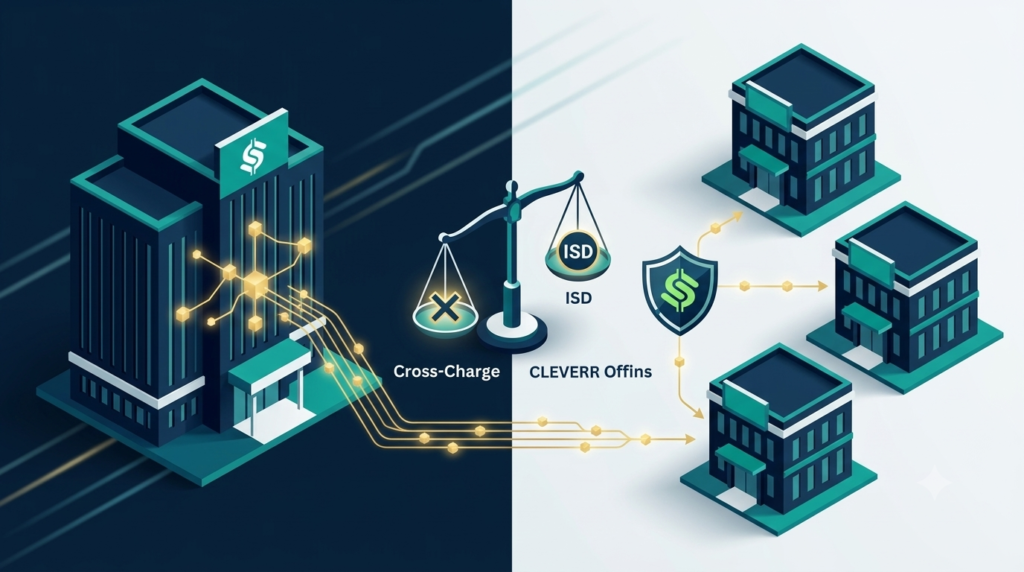
Cross-Charge vs. Input Service Distributor (ISD): Allocating Shared Head-Office Costs Under GST
Executive Summary
For multi-locational entities operating in India under the Goods and Services Tax (GST) framework, allocating Head Office (HO) expenses to distinct branch offices located across different states is one of the most complex tax management challenges. Because each state registration under GST is treated as a distinct legal person, common operational costs—such as IT infrastructure, central management salaries, legal retainer fees, software licenses, and corporate branding—must be correctly tracked and passed along to recipient units.
Historically, taxpayers have faced significant ambiguity over whether to use the Input Service Distributor (ISD) mechanism or the Cross-Charge mechanism. Following recent legislative amendments introduced via the Finance Act 2024 and clarifying circulars issued by the Central Board of Indirect Taxes and Customs (CBIC), the compliance landscape has shifted permanently.
This comprehensive guide breaks down the statutory foundations, practical differences, valuation rules, landmark judicial precedents, and step-by-step implementation workflows for allocating shared Head Office expenses under GST.
1. Introduction & Statutory Framework
Under Indian GST law, a taxpayer operating across state boundaries cannot treat the business as a single unified taxpayer. Instead, the framework relies on the concept of Distinct Persons.
Statutory Definitions
-
Section 25(4) of the CGST Act, 2017: Establishes that a person who has obtained or is required to obtain more than one registration, whether in one State or Union territory or more than one State or Union territory, shall, in respect of each such registration, be treated as distinct persons for the purposes of the Act.
-
Section 25(5) of the CGST Act, 2017: Clarifies that where a person who has obtained or is required to obtain registration in a State or Union territory in respect of an establishment has an establishment in another State or Union territory, then such establishments shall be treated as establishments of distinct persons.
-
Section 7(1)(c) read with Schedule I of the CGST Act: Mandates that the supply of goods or services (or both) between distinct persons, when made in the course or furtherance of business, constitutes a taxable supply, even if made without consideration.
Because transactions between distinct persons attract GST regardless of monetary exchange, shared corporate expenses incurred at a central Head Office must be attributed to the branches that benefit from them.
2. Conceptual Overview: Cross-Charge vs. Input Service Distributor (ISD)
While both mechanisms deal with distributing costs and tax credits from a central office to regional branches, they apply to different types of expenses and operate under distinct statutory rules.
What is Input Service Distributor (ISD)?
Defined under Section 2(61) of the CGST Act, an ISD is an office of the supplier of goods or services (or both) that receives tax invoices issued under Section 31 towards the receipt of input services. The ISD issues a prescribed document (an ISD Invoice) for the purpose of distributing the Input Tax Credit (ITC) of GST paid on those third-party services to the distinct regional units.
-
Primary Purpose: Pure distribution of third-party ITC accrued on common input services.
-
Key Characteristic: The ISD office itself does not add value or perform an independent service; it acts purely as a conduit for passing along input tax credits.
What is Cross-Charge?
Cross-Charge refers to the process where one unit of an entity (typically the HO) supplies internally generated services or administrative support to another unit (Branch Offices) of the same legal entity. Under Schedule I, these internal activities constitute a taxable supply of services between distinct persons.
-
Primary Purpose: Taxing supply of internally generated services provided by the HO to branches.
-
Key Characteristic: Involves an element of internal value addition (such as work performed by HO employees, utilization of centralized capital assets, or internal management overheads).
3. Deep Dive: The Cross-Charge Mechanism
Scope & Practical Application
The Cross-Charge mechanism applies whenever the Head Office provides internally generated support services to its branch offices. Examples include:
-
Centralized human resource management, payroll administration, and recruitment functions.
-
In-house legal, accounting, compliance, and internal audit support.
-
Centralized IT technical support and software maintenance performed by HO employees.
-
Senior management decision-making and strategic oversight benefiting the entire business structure.
Taxability & Invoice Generation
-
Supply Classification: These services are classified as a supply of management or administrative services between distinct persons under Schedule I.
-
Invoicing: The HO must issue a regular Tax Invoice under Section 31 of the CGST Act to each recipient branch office.
-
Tax Rate & Payment: The HO charges IGST (for inter-state cross-charges) or CGST+SGST (for intra-state cross-charges). The HO pays this tax using its accumulated ITC or cash, and the recipient branch claims ITC on the tax billed.
Valuation Rules for Cross-Charge
Valuing internal services between distinct persons is governed by Section 15 of the CGST Act read with Rule 28 of the CGST Rules.
-
Rule 28 Proviso (Full ITC Available): Where the recipient branch office is eligible for full Input Tax Credit, the value declared in the tax invoice issued by the HO is deemed to be the Open Market Value (OMV) of the services.
-
Significance: The HO can invoice any nominal value (even ₹0 or an amount that excludes employee salary costs), and tax authorities cannot challenge the valuation.
-
-
Recipient Not Eligible for Full ITC: If the recipient branch produces exempt goods/services or operates under a tax framework where ITC is restricted:
-
The Proviso to Rule 28 does not apply.
-
The HO must determine the true Open Market Value under Rule 28 or compute costs under Rule 30 (Cost of Provision + 10%).
-
Employee Salaries: In this scenario, the cost of HO employees contributing to shared services must be included in calculating the taxable value.
-
4. Deep Dive: The Input Service Distributor (ISD) Framework
Scope & Mandatory Requirements
The ISD framework applies strictly to third-party input services procured by the Head Office on behalf of one or more branch offices.
Common examples include:
-
Third-party audit and consulting fees invoiced directly to the HO.
-
Enterprise Resource Planning (ERP) software licenses or cloud computing infrastructure hostings purchased centrally.
-
Nationwide marketing campaigns or media buys executed through external agencies.
-
Third-party security, maintenance, or catering contracts arranged for multiple regional offices.
Legislative Overhaul: Pre-2024 vs. Post-2024 Amendment
Prior to 2024, taxpayers frequently debated whether using the ISD mechanism was mandatory or optional. Many organizations chose to distribute third-party service credits using Cross-Charge invoices instead of obtaining a separate ISD registration.
To end this dispute, the Parliament amended Section 20 of the CGST Act via the Finance Act 2024, making ISD registration statutorily mandatory.
| Legal Aspect | Pre-Amendment (Prior to Finance Act 2024) | Post-Amendment (Finance Act 2024 Onward) |
| Statutory Status | Interpretive ambiguity; taxpayers opted between ISD and Cross-Charge. | Mandatory under amended Section 20. |
| Distribution Method | Allowed cross-charging third-party ITC if structured appropriately. | Third-party service credits must be distributed exclusively via ISD. |
| Registration | Separate ISD registration was optional in practice. | Separate ISD registration is compulsory for entities allocating shared third-party input credits. |
| RCM Services | Ambiguity surrounding distribution of Reverse Charge Mechanism (RCM) credits. | Explicitly includes services under Reverse Charge Mechanism (RCM) within the ISD scope. |
Mechanics of Credit Distribution under ISD (Rule 39)
Under Rule 39 of the CGST Rules, Input Tax Credit must be distributed based on clear, standardized rules:
-
Distribution Basis: Credit must be distributed to recipient branches in proportion to their turnover during the relevant operational period.
-
Turnover Ratio Formula:
$$\text{ITC Allocated to Branch} = \text{Total Distributable ITC} \times \left( \frac{\text{Turnover of Branch } X}{\text{Total Aggregate Turnover of All Recipient Units}} \right)$$ -
Proportionate Allocation Window: The turnover calculation is derived from the previous financial year. If a branch has no turnover in the previous financial year, the turnover of the last quarter prior to the month of credit distribution is used.
-
Eligible vs. Ineligible Credit: The ISD must segregate and distribute eligible and ineligible ITC separately. Ineligible credits (such as services blocked under Section 17(5)) remain ineligible in the hands of the recipient branches.
-
Tax Type Parity:
-
CGST and SGST credits on inter-state distribution are converted and distributed as IGST.
-
IGST credits are distributed as IGST.
-
CGST and SGST credits distributed intra-state remain CGST and SGST.
-
5. Detailed Comparative Analysis
Understanding the core operational differences between Cross-Charge and ISD is essential for managing tax liability and ensuring audit compliance.
| Comparative Attribute | Cross-Charge Mechanism | Input Service Distributor (ISD) |
| Primary Statutory Basis | Section 7(1)(c) read with Schedule I & Section 15. | Section 20 read with Rule 39. |
| Nature of Supply | In-house, internally generated services supplied by HO to branches. | Distribution of ITC on third-party services procured centrally. |
| Registration Requirements | Managed under the regular GSTIN of the Head Office. | Requires a separate GST registration as an Input Service Distributor. |
| Document Issued | Regular Tax Invoice under Section 31. | ISD Invoice under Rule 54(1). |
| Valuation Rules | Open Market Value / Cost + 10% (Rule 28/30); Proviso permits nominal value if recipient gets full ITC. | No value addition; credit is distributed based on exact invoiced amounts. |
| Allocation Methodology | Flexible; based on actual usage, headcounts, or reasonable cost driver metrics. | Strictly based on the turnover ratio of recipient units during the relevant period. |
| Inclusion of Employee Salaries | Optional if recipient gets full ITC (CBIC Circular 199/11/2023). Mandatory if recipient is exempt. | Not applicable; employee salaries are not third-party services. |
| Return Compliance | Reported in regular GSTR-1 and GSTR-3B returns. | Requires filing monthly GSTR-6 returns. |
| Applicability to RCM Costs | Applied when HO internalizes an RCM service and cross-charges a composite supply. | Expressly covers distribution of tax paid under Reverse Charge Mechanism (RCM). |
6. Judicial Precedents & Legal Clarifications
To understand how these rules apply in practice, it helps to examine key legal rulings and official clarifications issued by the tax authorities.
Key Advance Rulings
1. Re: Columbia Asia Hospitals Pvt. Ltd. (Karnataka AAAR – 2018)
-
Issue: Whether employee salaries at the Head Office supporting branch locations must be included in the cross-charge value.
-
Ruling: The Appellate Authority for Advance Rulings (AAAR) held that the HO and branches are distinct persons. Employees working at the HO perform activities that benefit the branches; therefore, employee salary costs must be included in the cross-charge invoice value.
-
Impact: Created widespread concern across multi-state corporate entities regarding how to track and assign executive employee hours across regional units.
2. Re: Cummins India Limited (Maharashtra AAR – 2021)
-
Issue: Whether an entity can distribute third-party input service credits using Cross-Charge instead of establishing an ISD.
-
Ruling: The Authority held that third-party input service credits cannot be passed along via Cross-Charge tax invoices. Doing so bypasses the turnover distribution formula required under ISD rules.
-
Impact: Reinforced the strict legal distinction between third-party service distribution (ISD) and internal services (Cross-Charge).
CBIC Circular No. 199/11/2023-GST: The Landmark Clarification
To resolve ongoing litigation caused by early Advance Rulings, the CBIC issued Circular No. 199/11/2023-GST, providing crucial legal protections:
-
Option for Third-Party Credit Distribution (Pre-2024): Clarified that for past periods, distributing third-party service ITC via Cross-Charge was acceptable provided a valid tax invoice had been issued.
-
Valuation Flexibility Under Rule 28 Proviso: Reaffirmed that if the recipient branch office is eligible for full Input Tax Credit, the value declared on the HO invoice is deemed to be the Open Market Value.
-
Exclusion of Salary Costs: Explicitly stated that inclusion of HO employee salary costs in the cross-charge invoice is NOT mandatory, even if those employees support regional branch operations, provided the recipient branch is entitled to full ITC.
-
Zero Value Acceptance: If the HO does not issue an invoice for internally generated services to a branch eligible for full ITC, the value of those services is deemed to be NIL/Zero, satisfying all compliance requirements.
7. Step-by-Step Compliance & Implementation Framework
To maintain full compliance with GST regulations, corporate taxpayers should adopt a dual-track allocation model that separates internal HO costs from third-party service e
ction Plan for Tax Teams
Step 1: Corporate Cost Mapping & Classification
-
Review every line item in the Head Office expense ledger.
-
Categorize each cost into Category A (Third-Party Input Services) or Category B (Internal Head Office Operations).
Step 2: Establish ISD Registration Infrastructure
-
Apply for a separate ISD Registration under the regular legal entity name in the state where the Head Office operates.
-
Ensure vendor systems are updated so third-party input service invoices (e.g., software vendors, national legal advisors) are billed directly to the ISD GSTIN.
Step 3: Implement the ISD Allocation Workflow
-
Calculate the turnover of each branch office monthly or quarterly.
-
Apply the proportional formula defined in Rule 39 to allocate Input Tax Credit across branches.
-
Issue formal ISD Invoices and file monthly GSTR-6 returns by the 13th of each following month.
Step 4: Implement the Cross-Charge Management Framework
-
Identify all internally generated support activities provided by HO employees to branches.
-
Evaluate the ITC eligibility status of each recipient branch office:
-
For Branches with 100% ITC Eligibility: Apply the Proviso to Rule 28. Issue a cross-charge tax invoice based on operational cost drivers. Excluding employee salary costs is legally permissible.
-
For Branches with Restricted/Exempt ITC: Perform a comprehensive cost analysis (including allocated salary costs, management overheads, and central IT infrastructure) using the Cost + 10% method (Rule 30).
-
-
Issue standard tax invoices under the HO regular GSTIN and report them in GSTR-1 and GSTR-3B filings.
8. Common Pitfalls, Risks & Avoidance Strategies
Navigating HO cost allocations involves avoiding several common operational and legal errors:
Pitfall 1: Distributing Third-Party ITC via Regular Tax Invoices Post-2024
-
The Risk: Following the amendments introduced in the Finance Act 2024, using Cross-Charge invoices to pass along third-party input credits is a statutory violation.
-
Consequence: Audit queries, rejection of ITC at the recipient branch level under Section 16, and interest penalties under Section 50.
-
Remedy: Transition all shared third-party vendor contracts to the dedicated ISD GSTIN immediately.
Pitfall 2: Neglecting Branches That Produce Exempt Supplies
-
The Risk: Assuming that the flexibility offered by the Proviso to Rule 28 applies universally across all units.
-
Consequence: If a recipient branch produces tax-exempt supplies, it is not eligible for full ITC. Invoicing nominal values or omitting employee salary costs in these cases will lead to tax underpayment assessments under Section 73 or 74.
-
Remedy: Conduct an annual audit of each branch’s product and service mix to confirm full ITC eligibility before setting cross-charge invoice values.
Pitfall 3: Mismatched Turnover Figures in ISD Calculations
-
The Risk: Using outdated, unverified, or inconsistent turnover figures when calculating proportional ISD allocations under Rule 39.
-
Consequence: Imbalanced credit distribution resulting in excess ITC claims at certain branches and shortfalls at others, triggering system flags in the GST portal.
-
Remedy: Automate turnover tracking by linking ERP accounting data directly to the GSTR-6 filing module.
9. Conclusion & Strategic Roadmap
Managing Head Office cost allocations requires a clear operational separation between Cross-Charge and ISD mechanisms. Following recent legislative developments, multi-locational businesses must align their internal systems with two clear rules:
-
Input Service Distributor (ISD) is the mandatory statutory channel for allocating Input Tax Credits derived from third-party services procured centrally by the Head Office.
-
Cross-Charge is the required framework for taxing internally generated support services provided by Head Office staff and infrastructure to regional branches.
By establishing a dedicated ISD registration, automating turnover-based credit distribution, and applying sound valuation principles under Rule 28 for internal cross-charges, organizations can build a compliant tax framework that withstands regulatory scrutiny.
Summary Checklist for Tax Teams
-
[ ] Is a separate ISD GSTIN active for the Head Office location?
-
[ ] Are third-party vendors billing shared input services directly to the ISD GSTIN?
-
[ ] Is the monthly ISD distribution strictly following the turnover ratio formula under Rule 39?
-
[ ] Are monthly GSTR-6 returns being filed on or before the 13th of each month?
-
[ ] Are internal HO support activities mapped and invoiced via regular Cross-Charge Tax Invoices?
-
[ ] Have you verified the ITC eligibility profile (full vs. restricted) for every recipient branch office?
-
[ ] Is your cost allocation methodology fully documented in an internal corporate GST policy?
Phone: +91 77389 59862
-
Email: client@clevercoins.org
-
Address: Ideal Market, Mumbra, Thane-400612
Related posts:
What is Short Selling in India? A Complete Comprehensive Guide
GST on Real Estate 2026
Comprehensive Blog Content: Stock Market Terminology A–Z (Part 1)
India-UK Free Trade Agreement Status 2026: The Comprehensive Implementation Breakdown
Smallcap vs Midcap vs Largecap Stocks: The Ultimate Wealth Building Guide
Form DRC-01C Explained: How to Respond to ITC Discrepancies Between GSTR-3B and GSTR-2B
Kisan Vikas Patra (KVP): Rates, Rules, and Complete Guide
Comprehensive Guide to GST on Entertainment and Events: Rates, Compliance, and Industry Impact
Customs Broker License Requirements and Procedure in India (2026 Guide)
GST Portal Helpdesk & Grievance
Related posts:
 Comprehensive Guide: GST on Employee Benefits & CTC Components in India
 Comprehensive Marketing Team Deliverable: GSTR-2B – Auto-Drafted ITC Statement
 ISD – Input Service Distributor Mechanism: The Complete 2026 Compliance Guide
 GST on Goods Transport by Road (GTA): The Complete 2026 Compliance Guide

