ISD – Input Service Distributor Mechanism: The Complete 2026 Compliance Guide
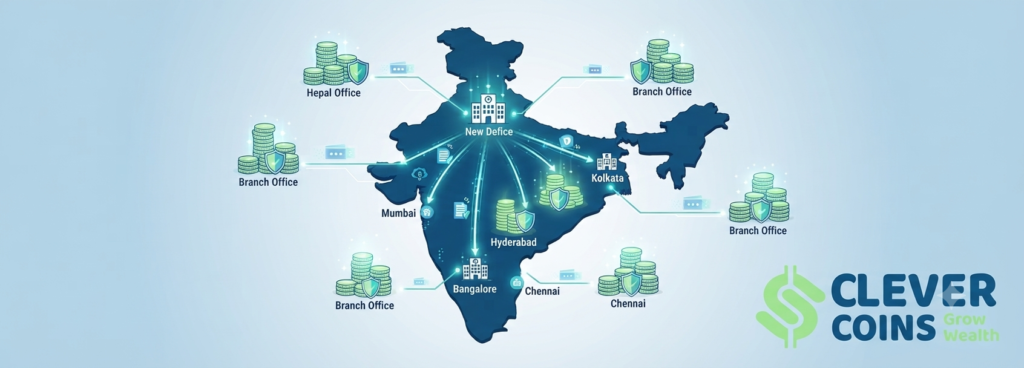
Modern multi-location businesses face a complex puzzle when managing centralized expenses. Imagine a corporate head office in Mumbai procuring a centralized software license, a nationwide marketing campaign, or legal advisory services that benefit branch offices spread across Delhi, Bengaluru, and Chennai. Under India’s Goods and Services Tax (GST) framework, how do these individual branches claim their rightful share of the Input Tax Credit (ITC) on common invoices billed solely to the head office?
The answer lies in the Input Service Distributor (ISD) mechanism.
Recent legislative amendments, statutory clarifications, and evolving digital portal mandates have transformed ISD from a discretionary option into a mandatory compliance requirement for businesses with multi-state operations.
In this comprehensive guide, curated by the tax experts at CleverCoins, we break down everything you need to know about the ISD mechanism, its legal framework, registration procedures, distribution rules, and strategic best practices to insulate your enterprise from litigation.
1. What is an Input Service Distributor (ISD) Under GST?
To understand ISD, we must look at how centralized corporate functions operate. Under Section 2(61) of the Central Goods and Services Tax (CGST) Act, an Input Service Distributor (ISD) is defined as an office of the supplier of goods or services which receives tax invoices issued under Section 31 towards the receipt of input services and issues a prescribed document for the purposes of distributing the credit of central tax (CGST), state tax (SGST), union territory tax (UTGST), or integrated tax (IGST) paid on the said services to a supplier of taxable goods or services having the same Permanent Account Number (PAN) as that of the office distribution.
Core Characteristics of an ISD:
Separate Registration: An ISD must obtain a separate registration under GST, distinct from the normal taxpayer registration (GSTIN) obtained in states where it operates.
No Outward Supply: An ISD does not provide any commercial goods or services of its own. Its primary function is the receipt of common invoices and the subsequent relay or distribution of tax credits.
PAN Consistency: The branches receiving the distributed credit must share the exact same PAN as the office functioning as the ISD. Cross-PAN distribution is legally impermissible.
2. The Evolution: From Optional Provision to Strict Mandate
Historically, businesses had a choice: they could either register as an ISD or use the Cross-Charge mechanism (issuing tax invoices from the head office to branches for internal services rendered) to transfer tax credits. This ambiguity led to widespread confusion, conflicting Authority for Advance Ruling (AAR) pronouncements, and frequent departmental audits.
To eliminate ambiguity, the GST Council and subsequent statutory amendments introduced crucial changes:
Mandatory Registration: If a business has multiple registered business verticals or locations across different states that share common services, registering as an ISD has transitioned from being merely permissive to mandatory for specific centralized functions.
Clarity on Scope: The definition of input services eligible for distribution has been tightened, ensuring that invoices strictly pertain to services utilized by recipient branches.
3. How the ISD Mechanism Operates: Step-by-Step FlowProcurement:
Intake & Validation: The ISD unit logs the invoice, verifies its authenticity against GSTR-2B matching protocols, and checks whether the service genuinely benefits the recipient locations.
Computation: The total tax credit is calculated and apportioned among the operational units (branches) that benefited from the service, based on a structured formula.
Distribution Document: The ISD issues an ISD invoice or ISD credit note detailing the exact tax quantum transferred.
Filing & Claiming: The ISD files its monthly return in Form GSTR-6, allowing recipient branches to view and claim the distributed ITC in their respective electronic credit ledgers.
4. Distinction Between ISD and Cross-Charge
Many corporate accountants confuse ISD with Cross-Charge. Understanding the difference is critical to avoiding tax penalties:
Parameter | Input Service Distributor (ISD) | Cross-Charge |
Primary Purpose | Distributing ITC paid on third-party invoices to applicable branches. | Billing for internal goods, services, or management support provided by one unit to another. |
Applicability | Applies strictly to input services received from external vendors. | Applies to internal transfers of services, use of centralized assets, or manpower deployment between distinct persons under one PAN. |
Compliance Vehicle | Monthly filing of Form GSTR-6. | Declared through regular outward supplies reporting in GSTR-1 and GSTR-3B. |
Valuation Complexity | Straightforward proportionate distribution based on turnover. | Requires adherence to open market value principles under Rule 28 of CGST Rules. |
5. Rules for Distribution of Credit (CGST Section 20)
The distribution of input tax credit by an ISD must follow rigid statutory formulas to prevent revenue leakage or arbitrary allocation. The core principles governing credit distribution include:
A. Distribution of IGST, CGST, and SGST/UTGST
IGST Credit: Can be distributed as IGST to any recipient location, regardless of whether the recipient is in the same state or a different state.
CGST & SGST/UTGST Credit:
If the ISD and the recipient branch are located in the same state, CGST is distributed as CGST, and SGST/UTGST is distributed as SGST/UTGST.
If the ISD and the recipient branch are located in different states, CGST and SGST/UTGST must be converted and distributed collectively as IGST.
B. The Pro-Rata Distribution Formula
Credit must be distributed to recipient branches pro-rata based on their turnover in states/union territories.
The formula is expressed as:
$$\text{Credit Distributed to Branch} = \frac{\text{Turnover of Branch in Relevant Period}}{\text{Aggregate Turnover of All Recipient Branches}} \times \text{Total Credit Available for Distribution}$$
Crucial Caveat: The turnover of a recipient branch is calculated for the preceding financial year. If some branches had no turnover in the preceding financial year, the turnover of the quarter preceding the month during which credit is distributed is taken into account.
Exclusions: Exempt supplies and non-taxable supplies generated by a branch must be factored out when calculating the qualifying turnover ratio.
6. Conditions and Restrictions for Claiming ISD Credit
To ensure compliance and protect your business during departmental audits, the recipient branches must verify that the following statutory prerequisites are met:
Valid Registration: The distributing office must hold a valid ISD registration throughout the tax period.
Maximum Credit Cap: The total amount of credit distributed cannot exceed the total credit available with the ISD on the invoice.
Distinct Recipients: Credit must be distributed only to those taxable persons to whom the input services are attributable. If a service is exclusively used by Branch A, the entire credit must go to Branch A and cannot be diluted across Branches B and C.
Tracking Ineligible Credit: If an input service is used for activities that do not qualify for ITC (e.g., blocked credits under Section 17(5) such as food, beverages, or personal consumption), the ISD must explicitly isolate and not distribute such credit.
7. Compliance Roadmap: Filing GSTR-6 and Maintaining Records
Managing an ISD registration requires disciplined monthly workflows:
Due Date: Form GSTR-6 must be filed electronically by the 13th day of the succeeding month following the tax period in which the distribution occurred.
Annual Return: ISD entities are also required to file an annual summary return in Form GSTR-9A (where applicable, alongside standard corporate compliance) reconciling total credits received versus total credits distributed.
Record Retention: Books of accounts relating to ISD distribution, original invoices, and computation sheets must be maintained for a minimum of 72 months (6 years) from the due date of filing the annual return for that financial year.
8. Common Pitfalls and Litigation Risks
Mismanaging the ISD structure can trigger severe audit penalties, interest liabilities, and demand notices from tax authorities. Watch out for these common missteps:
Using Cross-Charge for Third-Party Invoices: Relying entirely on cross-charging third-party vendor expenses instead of setting up an ISD can invite scrutiny for improper document issuance.
Incorrect Turnover Ratios: Utilizing outdated or erroneous branch turnover figures leads to disproportionate credit distribution, attracting differential tax demands and 18% per annum interest.
Failure to Register Distinctly: Operating multiple branches and distributing credits without acquiring a dedicated ISD registration violates core provisions of the CGST Act.
Distributing Blocked Credits: Passing on credits restricted under Section 17(5) makes both the ISD and the recipient branches jointly liable for recovery proceedings.
9. How CleverCoins Secures Your Multi-State Tax Architecture
Navigating the nuances of multi-branch GST compliance, tracking state-wise turnovers, filing timely GSTR-6 returns, and aligning your corporate invoicing models requires specialized expertise.
At CleverCoins, our seasoned chartered accountants and indirect tax strategists provide end-to-end support for businesses scaling across India:
ISD Eligibility Assessment: We evaluate your corporate structure to determine whether mandatory ISD registration applies to your operations.
Seamless Registration & Setup: We handle your state-specific and ISD registrations with absolute accuracy.
Automated ITC Distribution Protocols: We deploy robust frameworks to compute accurate pro-rata distribution ratios, ensuring zero mismatch in GSTR-6 filings.
Litigation Defense & Advisory: From responding to departmental notices to proactive tax structuring, we safeguard your bottom line so your enterprise can grow without compliance friction.
Stop letting complex multi-state tax hurdles drain your working capital. Partner with CleverCoins today and turn regulatory compliance into your competitive advantage.
Contact CleverCoins:
Phone: +91 77389 59862Email: client@clevercoins.orgAddress: Ideal Market, Mumbra, Thane-400612
Days
Hours
Minutes
Seconds
Related posts:
Understanding the Engine of Shareholder Wealth
GST
Navigating GST on Manpower Supply Services: The Ultimate Compliance and Strategic Guide
GST
GST on Freelancers & Consultants: The Ultimate Compliance & Tax Guide
GST
Startup Funding Stages Explained: A Complete Founder's Guide
GST
Shop & Establishment License
GST
GSTR-7: The Ultimate Guide to TDS Under GST (2026)
GST
CGST vs SGST vs IGST vs UTGST
GST
GST on Works Contract – Budget 2026 Changes: A Comprehensive Guide for Contractors & DevelopersG...
GST
Comprehensive Blog Content: GST on Transfer of Business / SLMP
GST
GST on Agricultural Produce in India: Complete Guide 2026
GST