
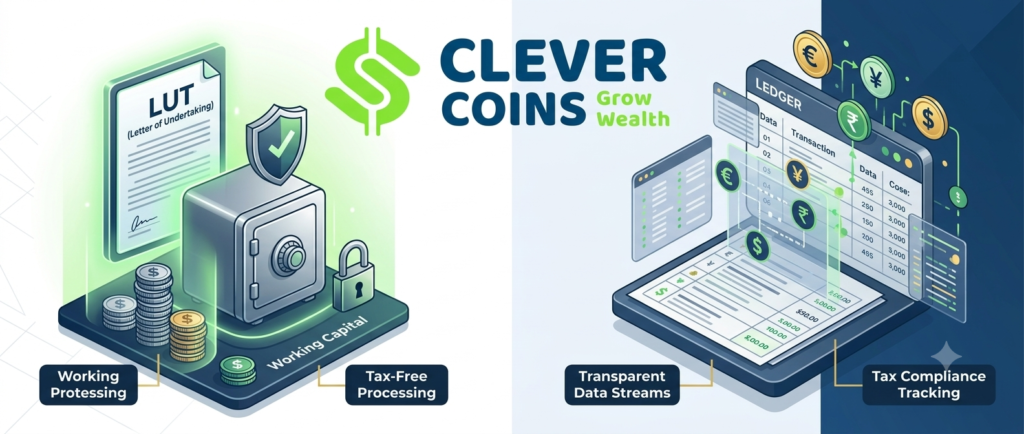
Export of Services Under GST: Letter of Undertaking (LUT) vs. IGST Payment with Refund
1. Comprehensive Detailed-Oriented Blog Content
Introduction: Decoding Global Exports from India Under GST
India has rapidly evolved into a global powerhouse for service exports, ranging from software development, IT-enabled services (ITeS), engineering design, and digital marketing to legal, financial, and management consultancy. For Indian businesses expanding their horizons globally, navigating the Goods and Services Tax (GST) framework is one of the most critical operational milestones.
Under the Indian GST regime, the export of services is treated as a “Zero-Rated Supply” under Section 16 of the Integrated Goods and Services Tax (IGST) Act, 2017. This core principle ensures that India does not export its taxes, making our domestic service providers globally competitive by relieving them of indirect tax burdens.
However, achieving this tax-neutral status requires choosing between two distinct compliance pathways:
-
Exporting without payment of integrated tax under a Letter of Undertaking (LUT).
-
Exporting with payment of IGST and subsequently claiming a cash refund.
Choosing the right mechanism can profoundly impact your business’s working capital, compliance overhead, cash flow projections, and liquidity management. This comprehensive masterclass breaks down everything an exporter, finance manager, or tax consultant needs to know about LUT vs. IGST Payment with Refund, helping you build a bulletproof export compliance strategy.
What Exactly Constitutes an “Export of Services” Under GST?
Before diving into the procedural mechanics of LUT and IGST refunds, you must ensure that your transaction legally qualifies as an export of services. Under Section 2(6) of the IGST Act, a transaction is classified as an export of services only if all five of the following cumulative conditions are met:
-
Location of the Supplier: The supplier of the service must be located in India.
-
Location of the Recipient: The recipient of the service must be located outside India.
-
Place of Supply: The place of supply of services must be outside India (governed strictly by Section 13 of the IGST Act).
-
Consideration: The payment for the service must be received by the supplier in convertible foreign exchange or in Indian Rupees (INR) wherever permitted by the Reserve Bank of India (RBI) (e.g., via Special Rupee Vostro Accounts).
-
Entity Relationship: The supplier of services and the recipient of services are not merely establishments of a distinct person or related parties whose relationship would fail the “arm’s length” test under the law.
If even one of these criteria fails, your service supply will be treated as a domestic intra-state or inter-state supply, attracting standard GST rates (such as 18%).
Pathway 1: Export of Services Under Letter of Undertaking (LUT)
What is a Letter of Undertaking (LUT)?
A Letter of Undertaking (LUT) is a statutory declaration filed electronically by a registered taxpayer on the GST portal via Form GST RFD-11. By filing an LUT, an exporter undertakes that they will fulfill all requirements specified under the GST law regarding the export of goods or services within the stipulated timelines, without paying IGST upfront.
Key Characteristics of LUT
-
Zero Upfront Tax: No IGST is charged on the invoice or paid at the time of export.
-
Validity: An LUT is valid for one financial year (from April 1st to March 31st). It must be renewed online every single financial year before making any subsequent zero-rated exports.
-
Eligibility: Any registered taxpayer who has not been prosecuted under the CGST Act or the Integrated Goods and Services Tax Act, 2017, for any offense where the tax evaded exceeds ₹2.5 crore, is eligible to file an LUT.
How to File/Renew LUT Online
-
Log in to the official GST Portal with your credentials.
-
Navigate to Services > User Services > Furnish Letter of Undertaking (LUT).
-
Select the relevant Financial Year for which the LUT is being applied.
-
Upload the previous year’s LUT reference number (if applicable) and fill in the details of two independent witnesses.
-
Check the mandatory declaration boxes confirming compliance with export rules.
-
Submit the form using a Digital Signature Certificate (DSC) (mandatory for companies and LLPs) or Electronic Verification Code (EVC) for proprietorships/partnerships.
-
Instantly download the ARN (Application Reference Number) and the generated LUT reference letter.
Unutilized Input Tax Credit (ITC) Refund Under LUT
When you export services under an LUT, your invoices do not carry any output IGST. However, your business still incurs operational expenses (rent, software subscriptions, professional fees, hardware purchases, internet bills) that carry domestic GST (CGST, SGST, or IGST). This tax paid on your business purchases accumulates as Input Tax Credit (ITC).
Because zero-rated supplies allow you to claim refunds on unutilized input tax credits, you can file an online refund application via Form RFD-01 to claim a cash refund of your accumulated ITC under Section 54(3) of the CGST Act.
Pathway 2: Export of Services With Payment of IGST & Claiming Refund
The Concept of Exporting with IGST Payment
Alternatively, an exporter can choose to treat their export invoice as a standard taxable inter-state supply. Under this route, you explicitly charge and collect (or legally account for) IGST on your export invoice raised to your overseas client. You pay this collected tax liability through your electronic cash ledger or by utilizing available Input Tax Credit when filing your monthly GSTR-3B return.
Once the IGST is paid to the government exchequer, you can claim a 100% direct refund of the IGST paid on the exported services by filing a refund application on the GST portal.
Why Would Any Exporter Choose to Pay IGST?
At first glance, paying tax only to claim it back as a refund sounds counterintuitive and cumbersome. However, sophisticated finance teams opt for this route under specific operational scenarios:
-
Utilization of Blocked or Aging ITC: If a company has massive piles of accumulated ITC that are prone to technical disputes, delayed verification, or complex refund restrictions under inversion formulas, exporting with IGST allows seamless consumption of credit balances.
-
Perceived Processing Speed in Specific Jurisdictions: Historically, certain automated refund validation pathways for IGST payments offered streamlined processing, though contemporary risk-management systems scrutinize both equally.
Detailed Comparison: LUT vs. IGST Payment with Refund
| Parameter | Export Under LUT (Without IGST) | Export With IGST Payment & Refund |
| Upfront Tax Outflow | Zero tax paid at the time of invoice issuance or shipment. | Full IGST amount must be paid out via cash or ITC ledger. |
| Working Capital Impact | Highly favorable. Protects and preserves working capital. | Blocked capital. Ties up cash until the government processes and disburses the refund. |
| Filing Requirement | Form GST RFD-11 needs annual online renewal. | No LUT requirement; standard outward taxable reporting. |
| Refund Mechanism | Refund of unutilized Input Tax Credit (ITC) via Form RFD-01. | Refund of paid IGST via Form RFD-01. |
| Documentation Complexity | Requires matching of statement of invoices, bank realization certificates (FIRC/BRC), and ITC statements. | Requires rigorous matching of tax payment challans, GSTR-1, GSTR-3B, and foreign remittance realizations. |
| Risk Profile | Minor risk of ITC formula rejections during scrutiny; highly favored by SMEs. | Higher risk of cash blockages if refund audits raise queries on matching metrics. |
Step-by-Step Compliance & Documentation Checklist
To ensure your service exports remain audit-ready and free from departmental penalties, maintain a rigorous compliance file containing:
-
Master Service Agreements (MSAs) & Statements of Work (SOWs): Clearly proving the scope of services delivered to the foreign entity.
-
Tax Invoices: Containing all mandatory fields under Rule 46 of CGST Rules (including recipient’s overseas address, remark “SUPPLY MEANT FOR EXPORT ON PAYMENT OF IGST” or “SUPPLY MEANT FOR EXPORT UNDER LETTER OF UNDERTAKING (LUT)”).
-
Bank Realization Evidence: Foreign Inward Remittance Certificates (FIRC), Electronic Bank Realization Certificates (e-BRC), or direct bank advice notes proving receipt in convertible foreign currency.
-
GST Return Filings: Timely and error-free filing of GSTR-1 (reporting exports under Table 6A) and GSTR-3B.
Common Pitfalls and Legal Traps to Avoid
-
Failure to Realize Payments Within RBI Limits: Under GST regulations, payment for exported services must be received within the time limits prescribed under the Foreign Exchange Management Act (FEMA), 1999 (generally 9 months from the date of export). If you fail to realize foreign exchange within this window, the transaction ceases to be an export, and you will be legally liable to pay the applicable GST along with heavy compounding interest (18% p.a.) and penalties.
-
Missing Annual LUT Renewal Deadlines: Failing to renew your LUT before executing a new financial year’s first export invoice can force you into retrospective IGST payment liabilities. Always complete your LUT filing by March 31st.
-
Incorrect Place of Supply Interpretation: Misclassifying intermediary services or performance-based services under general export rules can invalidate your zero-rated claims entirely.
Conclusion: Strategic Takeaway for Exporters
For 95% of service exporters in India, exporting under a Letter of Undertaking (LUT) remains the undisputed gold standard. It protects cash flow, eliminates unnecessary liquidity blockages, and simplifies routine compliance. However, businesses with unique tax credit profiles should evaluate both routes alongside professional tax advisors.
Navigate your tax season and export compliance framework with total precision. Partner with Clever Coins to optimize your global invoicing, streamline GST filings, and secure your refunds seamlessly.





