1.Why GST on Equipment Leasing Matters in 2026
India’s leasing and renting market for equipment has grown at a compound annual rate exceeding 14% over the last five years, and the sector is projected to touch ₹4.5 lakh crore by FY 2027. From construction cranes to IT servers, medical imaging machines to agricultural harvesters — businesses across every industry depend on rented or leased equipment to manage capital expenditure and maintain operational agility.
With the Goods and Services Tax (GST) framework now firmly established and continually refined through successive GST Council meetings (the 53rd Council met in June 2024 and the 55th Council met in December 2024), understanding how GST applies to leasing and renting transactions is no longer optional — it is a core compliance requirement that directly impacts cash flow, pricing strategy, and the availability of Input Tax Credit (ITC).
This comprehensive guide covers every dimension of GST applicability on equipment leasing and renting in India as updated for 2026 — from basic definitions to advanced ITC scenarios, reverse charge mechanism (RCM), SAC codes, e-invoicing obligations, and practical compliance tips.
📌 All rates and provisions in this guide are aligned with the CGST Act, 2017, IGST Act, 2017, and the latest GST Council decisions up to early 2026. Always verify with a qualified tax professional for transaction-specific advice.
2. Understanding the Key Terms — Leasing vs. Renting vs. Hiring
Before diving into tax treatment, it is essential to establish a clear distinction between these three commonly used terms, which are often used interchangeably but carry different legal and tax implications under Indian law.
2.1 What is Equipment Leasing?
Leasing is a contractual arrangement whereby the owner (lessor) grants the right to use an asset to another party (lessee) for a defined period in exchange for periodic payments (lease rentals). Under Indian accounting standards (Ind AS 116) and for GST purposes, leases are broadly classified into two categories:
- Finance Lease (Capital Lease): The lessee assumes substantially all risks and rewards of ownership. At the end of the lease term, ownership may transfer to the lessee. Examples include equipment leased for its entire economic life with a bargain purchase option.
- Operating Lease: The lessor retains the risks and rewards of ownership. The equipment is returned at the end of the lease term. This is the most common arrangement in equipment leasing markets.
2.2 What is Equipment Renting?
Renting is generally a short-term arrangement with greater flexibility — rentals can be daily, weekly, or monthly — without any intent of ownership transfer. Equipment rental is prevalent in the construction, events, agriculture, and logistics sectors.
2.3 What is Equipment Hiring?
Hiring is functionally similar to renting but often implies a service element — such as hiring a crane along with its operator. The GST treatment can differ when a service element is bundled with the equipment use. This is known as a composite supply or mixed supply and requires careful analysis.
Parameter | Finance Lease | Operating Lease / Renting | Hiring (with Operator) |
Ownership Transfer | Possible at end of term | No | No |
Duration | Long-term (3–10 yrs) | Short to medium term | Short-term / Project-based |
GST Nature | Supply of Service | Supply of Service | Composite Supply |
GST Rate (General) | 18% | 18% | 18% (on principal supply) |
ITC Available to Lessee | Yes (for business use) | Yes (for business use) | Yes (with conditions) |
3. GST Applicability on Equipment Leasing & Renting
Under the GST framework, the leasing and renting of equipment is treated as a supply of services. This classification has significant implications for the rate of tax, the time of supply, the place of supply, and the availability of ITC.
3.1 Is Equipment Leasing a Supply of Goods or Services?
This is the most foundational question. The GST Act provides a clear answer:
- Where the lease involves transfer of the right to use goods (without transfer of title), it is a supply of services — specifically classified under ‘Transfer of the right to use any goods for any purpose (whether or not for a specified period) for cash, deferred payment or other valuable consideration.’
- Where a finance lease results in the effective transfer of ownership (title transfer), it may be treated as a supply of goods, and GST on the sale value of the goods applies at the relevant rate.
📌 As per Schedule II of the CGST Act, 2017 — ‘any lease or letting out of the building including a commercial, industrial, or residential complex for business or commerce, either wholly or partly, is a supply of service.’ Similarly, leasing of moveable property (equipment) is a supply of service.
3.2 GST Rate Structure for Equipment Leasing & Renting (2026)
The applicable GST rate depends on the type of equipment, the nature of the arrangement, and specific notifications issued by the GST Council. Below is a comprehensive rate chart:
Equipment / Service Type | SAC Code | CGST | SGST | IGST | Total GST |
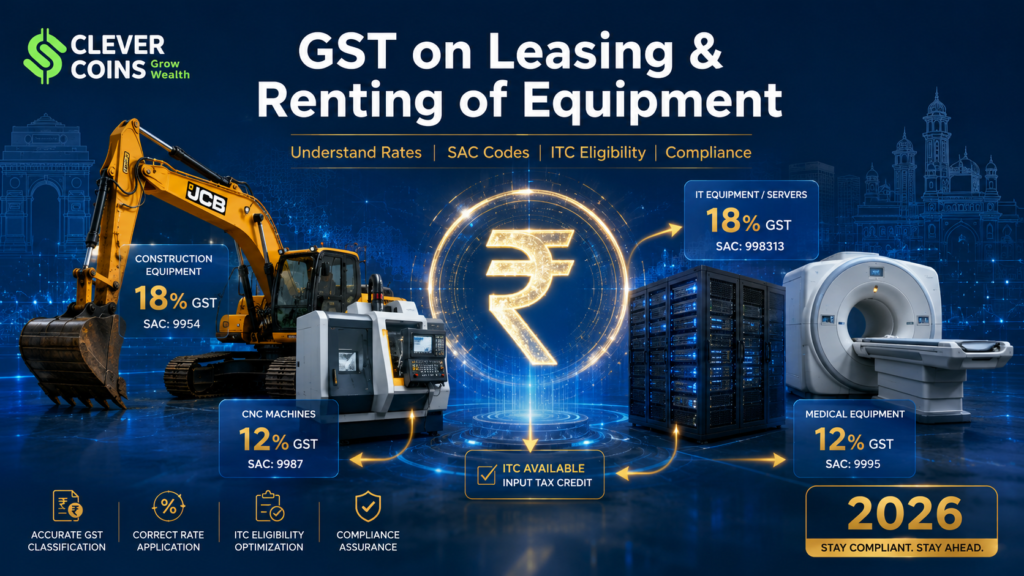
General Equipment Leasing/Renting | 997313 | 9% | 9% | 18% | 18% |
Leasing of Motor Vehicles (>13 seats) for Passenger Transport | 996601 | 2.5% | 2.5% | 5% | 5% |
Renting of Motor Vehicles (<=13 seats) for Personal Use | 996601 | 9% | 9% | 18% | 18% |
Leasing of Agricultural Equipment / Machinery | 997319 | 6% | 6% | 12% | 12% |
Equipment Renting with Operator (Construction Machinery) | 997316 | 9% | 9% | 18% | 18% |
IT Equipment / Computers on Lease | 997313 | 9% | 9% | 18% | 18% |
Medical Equipment Leasing to Hospitals | 999315 | 9% | 9% | 18% | 18% |
Finance Lease — Ownership Transfer at End | 997211 | 9% | 9% | 18% | 18% |
📌 SAC = Services Accounting Code. These codes are used in GST invoices and returns to classify services. Always verify the applicable SAC code with a CA or GST practitioner before filing returns.
4. Time of Supply for Equipment Leasing & Renting
Correctly identifying the time of supply determines when GST liability arises and when ITC can be claimed by the recipient. For services (including leasing and renting), the time of supply rules under Section 13 of the CGST Act, 2017 apply.
4.1 General Rule
- Date of Invoice — if the invoice is issued within 30 days of the provision of service
- Date of provision of service — if the invoice is not issued within 30 days
- Date of receipt of payment — whichever is earlier
4.2 Continuous Supply of Services (Most Common for Leasing)
Equipment leasing and renting qualifies as a ‘Continuous Supply of Services’ under Section 2(33) of the CGST Act. For such arrangements:
- If the due date of payment is ascertainable from the contract: Time of supply = due date of payment
- If the due date is not ascertainable: Time of supply = date of receipt of payment
- Where payment is linked to a completion event: Time of supply = date of completion of that event
📌 Practical implication: For monthly rental agreements with a fixed due date (e.g., 1st of every month), the GST liability arises on the 1st of the month, even if actual payment is received later. Lessors should ensure invoices are raised on or before the due date.
5. Place of Supply — Determining CGST/SGST vs. IGST
For services relating to the leasing and renting of moveable property (equipment), the place of supply is governed by Section 12 and Section 13 of the IGST Act, 2017.
5.1 When Both Parties Are in India
- General Rule: Place of supply = Location of the recipient of service
- If the recipient is GST-registered: Place of supply = State of the recipient’s registration
- If the recipient is not GST-registered: Place of supply = Location where the service is actually performed/equipment is used
5.2 Practical Illustration
ABC Equipment Pvt. Ltd. (registered in Maharashtra) leases a JCB to XYZ Constructions Pvt. Ltd. (registered in Gujarat). Since the recipient is in a different state, IGST @ 18% will apply. If XYZ were also registered in Maharashtra, then CGST @ 9% + SGST @ 9% would apply.
5.3 Cross-Border Leasing — Imports & Exports
- Import of leasing services (foreign lessor, Indian lessee): GST applies under RCM. The Indian lessee is liable to pay IGST.
- Export of leasing services (Indian lessor, foreign lessee): Treated as zero-rated supply. The lessor can claim refund of ITC or export under bond/LUT.
6. Input Tax Credit (ITC) on Equipment Leasing & Renting
ITC is the lifeblood of the GST system. Understanding ITC eligibility on leased and rented equipment is critical for managing working capital. This section covers ITC from both the lessor’s and the lessee’s perspective.
6.1 ITC for the Lessee / Renter (Service Recipient)
The lessee can claim ITC on the GST paid on lease rentals / rental charges, provided all the following conditions are satisfied:
- The equipment is used for business purposes (furtherance of business)
- The supplier has filed their GSTR-1 and the invoice appears in the lessee’s GSTR-2B
- The lessee possesses a valid tax invoice from the lessor
- Payment (including GST) has been made to the lessor within 180 days of the invoice date
- The equipment is not used for personal consumption or exempt supplies
6.2 Key ITC Restrictions — What You Cannot Claim
Section 17(5) of the CGST Act blocks ITC in certain scenarios even when the equipment is leased for business:
- Motor Vehicles with seating capacity up to 13 persons (including driver): ITC is blocked UNLESS the vehicle is used for transportation of goods, transportation of passengers (as a business activity), imparting training on such vehicles, or further leasing/renting.
- Aircraft and Vessels: ITC blocked unless used for the taxable supply of transport of goods/passengers or for training.
- Food and Beverages Equipment: ITC blocked if used for providing food and beverages that are not part of a restaurant/catering business registered under GST.
📌 Important Clarification (Circular No. 172/04/2022-GST): ITC on leasing of trucks, trailers, forklifts, and other goods-carrying commercial vehicles is available as these fall outside the ‘motor vehicles for personal transport’ restriction.
6.3 ITC for the Lessor (Service Provider)
When a lessor purchases equipment to lease out, they can claim ITC on:
- GST paid on the purchase price of the equipment
- GST paid on any capital goods used for providing the leasing service
- GST paid on services (insurance, maintenance, freight) related to the leasing activity
The lessor must ensure that the equipment is not used for providing exempt supplies, otherwise, proportionate ITC reversal under Rule 42/43 of the CGST Rules will be required.
6.4 Practical ITC Calculation Example
Scenario: A manufacturing company (ABC Pvt. Ltd.) rents a CNC machine from XYZ Leasing Ltd. for ₹5,00,000 per month.
Description | Amount (₹) |
Monthly Rental (Base Amount) | ₹5,00,000 |
GST @ 18% | ₹90,000 |
Total Invoice Amount | ₹5,90,000 |
ITC Claimable by ABC Pvt. Ltd. (lessee) | ₹90,000 per month |
Net GST cost to lessee (if ITC claimed) | NIL |
Annual ITC Saving for Lessee | ₹10,80,000 |
📌 This is a simplified illustration. The actual ITC available depends on the GSTR-2B matching, the nature of final supplies made by the lessee, and compliance with all conditions under Section 16 of the CGST Act.
7. Reverse Charge Mechanism (RCM) in Equipment Leasing
Under the Reverse Charge Mechanism (RCM), the liability to pay GST shifts from the supplier (lessor) to the recipient (lessee). This is a critical compliance area where many businesses err.
7.1 When Does RCM Apply?
- Section 9(3) — Specific Notifications: RCM applies when the service is sourced from a specific category of unregistered or exempt suppliers as notified by the Government. Currently, services of renting from a government authority may trigger RCM.
- Section 9(4) — Unregistered Suppliers: If a GST-registered business receives renting/leasing services from an unregistered person, RCM applies on the taxable portion. (Applicable when annual supply from unregistered persons crosses ₹5,000 per day from a single supplier — though practical thresholds may vary.)
- Import of Services: Leasing services received from a foreign lessor (e.g., equipment leased from a Singapore-based company) attract IGST under RCM on the Indian lessee.
7.2 RCM Compliance Steps for Lessees
- Self-invoice: The lessee must issue a self-invoice for the service received under RCM (Rule 47A of CGST Rules).
- Payment of tax: GST must be paid in cash (not from ITC) for RCM liabilities.
- ITC on RCM: The lessee can subsequently claim ITC on the GST paid under RCM, subject to eligibility conditions.
- Reporting: RCM transactions must be reported in GSTR-3B (Table 3.1(d)) and GSTR-9 annual return.
📌 Common Mistake: Businesses often forget to pay GST under RCM for leased equipment sourced from unregistered vendors. This results in interest liability @ 18% per annum and potential penalties under Section 73/74 of the CGST Act.
8. SAC Codes for Equipment Leasing & Renting — Complete Reference
The Services Accounting Code (SAC) is used to classify services under GST. The correct SAC code must appear on every GST tax invoice. Using an incorrect SAC code can result in demand notices during GST audits.
SAC Code | Service Description | GST Rate | Notes |
997311 | Financial leasing services — Finance lease | 18% | Ownership transfer possible |
997312 | Operating leasing services — without operator | 18% | Most common SAC for equipment rentals |
997313 | Leasing of intellectual property on time-charge or flat fee | 18% | Software, patents, etc. |
997314 | Renting/leasing of transport equipment (freight) | 18% | Trucks, trailers |
997315 | Renting of passenger-carrying vehicles | 5% / 18% | Depends on seating capacity |
997316 | Renting/leasing of construction equipment with operator | 18% | JCBs, cranes, excavators |
997317 | Renting of agricultural machinery | 12% | Tractors, harvesters |
997319 | Other operating leasing and rental services n.e.c. | 18% | Catch-all for equipment not classified above |
9. GST Invoice Requirements for Equipment Leasing
Every supply of equipment leasing or renting services must be supported by a proper GST tax invoice complying with Rule 46 of the CGST Rules, 2017. For suppliers whose aggregate turnover exceeds ₹5 crore, e-invoicing is mandatory under the CGST (Amendment) Rules, 2023.
9.1 Mandatory Fields on a GST Invoice for Equipment Rental
- Name, address, and GSTIN of the supplier (lessor)
- Consecutive serial number of the invoice
- Date of issue
- Name, address, and GSTIN (if registered) of the recipient (lessee)
- HSN/SAC code of the service
- Description of service: Type of equipment, lease period, lease reference number
- Taxable value of supply
- Rate of GST (CGST + SGST or IGST)
- Amount of GST charged (CGST + SGST or IGST separately)
- Place of supply (State name and code)
- Whether tax is payable on reverse charge (Yes/No)
- Signature or digital signature of the authorised representative
9.2 E-Invoicing for Equipment Leasing Businesses
As of 2026, e-invoicing is mandatory for all GST-registered businesses with aggregate annual turnover exceeding ₹5 crore in any preceding financial year. For equipment leasing companies, this means:
- Every B2B invoice must be uploaded to the Invoice Registration Portal (IRP) in real-time
- The IRP generates an Invoice Reference Number (IRN) and a QR code
- The QR-coded invoice is the valid tax document
- Failure to comply with e-invoicing attracts a penalty of ₹10,000 per invoice under Section 125 of the CGST Act
10. Sector-Specific GST Analysis for Equipment Leasing
10.1 Construction & Infrastructure Sector
Construction is the largest consumer of rented equipment in India — accounting for nearly 45% of total equipment rental market demand. Key equipment includes:
- Earthmoving equipment: Excavators, bulldozers, motor graders (SAC: 997316, GST: 18%)
- Lifting equipment: Mobile cranes, tower cranes, forklifts (SAC: 997316, GST: 18%)
- Concrete equipment: Batching plants, transit mixers, concrete pumps (SAC: 997312, GST: 18%)
📌 ITC Alert: Construction companies can claim ITC on rented equipment used for taxable construction activities but must reverse ITC proportionately if the construction is for own use (blocked under Section 17(5)(d) for construction of an immovable property for own account).
10.2 IT & Technology Sector
IT companies frequently lease computers, servers, networking equipment, and office technology. This is a clean, straightforward 18% GST scenario with full ITC availability since the output supplies (IT services) are taxable at 18%.
10.3 Healthcare Sector
Hospital equipment leasing has unique complexities. While the leasing of medical equipment itself attracts 18% GST, the healthcare services provided using that equipment by hospitals are often exempt from GST. This creates a partial ITC reversal obligation:
- Hospitals must calculate the ratio of taxable to exempt supplies
- ITC on equipment used solely for exempt services (like providing healthcare to patients) must be reversed under Rule 42
- ITC on equipment used for other taxable services (like pharmacy, diagnostic services with separate billing) can be retained
10.4 Agricultural Sector
Agricultural machinery rental (tractors, harvesters, irrigation equipment) attracts a concessional GST rate of 12%. This is a deliberate policy concession to reduce the cost of mechanisation for farmers. The suppliers of such rental services are required to:
- Charge GST @ 12% (CGST 6% + SGST 6%) on rentals
- Use SAC code 997317
- Ensure their registration category is correct if they are small operators approaching the ₹20 lakh annual turnover threshold
10.5 Aviation & Aerospace Equipment
Aircraft leasing to scheduled airlines for passenger transport was previously exempt but is now taxed at a reduced rate of 5% (without ITC). The 55th GST Council meeting (December 2024) reaffirmed the treatment of aircraft leasing under IGST with discussions around rationalising input stage exemptions for domestic airline operators.
11. GST Return Filing & Compliance Calendar for Leasing Businesses
Equipment leasing businesses must adhere to the GST compliance calendar diligently. Missing deadlines triggers late fees (₹50/day for GSTR-3B; ₹200/day for GSTR-9) and interest at 18% p.a. on delayed tax payments.
GST Return | Frequency | Due Date | Relevant for Leasing Business |
GSTR-1 | Monthly (Quarterly for QRMP) | 11th of following month | Report all outward supplies (lease invoices) |
GSTR-3B | Monthly | 20th of following month | Net tax payment, ITC claimed, RCM paid |
GSTR-2B | Auto-generated Monthly | 14th of following month | Lessee verifies ITC eligibility |
GSTR-9 | Annual | 31st December of next FY | Annual reconciliation of all supplies & ITC |
GSTR-9C | Annual (if T/O > ₹5 Cr) | 31st December of next FY | Self-certified reconciliation statement |
12. Common GST Mistakes in Equipment Leasing — And How to Avoid Them
Mistake 1: Incorrect Classification of Finance vs. Operating Lease
Treating a finance lease (which may involve supply of goods at completion) the same as an operating lease can result in underpayment or overpayment of GST. Engage a CA to correctly classify each lease agreement.
Mistake 2: Claiming ITC on Blocked Vehicles
Claiming ITC on GST paid on the rental of small motor vehicles (≤13 persons) used for employee transport rather than passenger transport business is a common audit trigger.
Mistake 3: Wrong SAC Code
Using SAC 997313 (IP leasing) for physical equipment leasing when SAC 997312 (operating lease) is correct can attract scrutiny. Always match the SAC to the nature of the agreement.
Mistake 4: Missing RCM on Unregistered Vendors
Many businesses rent equipment from small unregistered operators (e.g., a small JCB operator who is below the GST threshold). The business must pay GST under RCM and issue a self-invoice.
Mistake 5: Not Reconciling GSTR-2B Before Claiming ITC
Since the Taxnomics System Portal (TaxSP) linkage and ITC matching rules were strengthened in 2023-24, claiming ITC that does not appear in GSTR-2B without following the proper ITC reversal and reclaim procedure triggers automated GSTR-3B scrutiny notices.
Mistake 6: Non-Compliance with E-Invoicing
Businesses with turnover exceeding ₹5 crore that issue physical invoices (without IRP-generated IRN) for equipment rental transactions are exposing themselves to penalty risk of ₹10,000 per invoice.
13. Recent GST Council Updates Affecting Equipment Leasing (2024–2026)
Council Meeting | Key Decision | Impact on Equipment Leasing |
53rd GST Council (June 2024) | Clarified ITC availability on repair and maintenance services for equipment used in business. | Lessors can claim ITC on maintenance services paid for leased-out equipment. |
54th GST Council (Sept 2024) | Rate rationalisation discussions initiated for certain categories of equipment rentals. | Agricultural equipment rental continues at 12%; other rates unchanged at 18%. |
55th GST Council (Dec 2024) | Mandatory e-invoicing compliance enforcement tightened; IRP integration upgraded. | All leasing businesses >₹5 Cr must ensure real-time e-invoice generation. |
CBIC Circular 2025 | Clarification on treatment of sale-and-leaseback transactions under GST. | Sale-and-leaseback treated as two separate transactions — sale of goods + lease of service — each taxed independently. |
14. GST Planning Tips for Equipment Leasing Businesses
- Structure long-term leases as operating leases where possible to maintain clarity on GST treatment as service supply.
- Register in all states where equipment will be operated for extended periods (> 30 days) to ensure correct CGST/SGST vs. IGST treatment.
- Negotiate lease agreements to explicitly state the GST-exclusive base rental amount and GST separately — avoid all-inclusive pricing which creates difficulties in return filing.
- Implement automated invoice management systems integrated with the IRP for e-invoicing compliance.
- Review ITC ledger monthly to ensure GSTR-2B matching before filing GSTR-3B.
- Conduct an annual GST health check with your CA to identify potential ITC reversals and compliance gaps before GSTR-9 filing.
- For RCM liabilities, create a separate payment schedule — RCM cannot be paid from ITC ledger; it must be paid in cash from the Electronic Cash Ledger.
- If operating as a lessee with mixed supplies (taxable + exempt), maintain clear cost centre-wise records of equipment usage to calculate correct ITC reversal under Rule 42.