
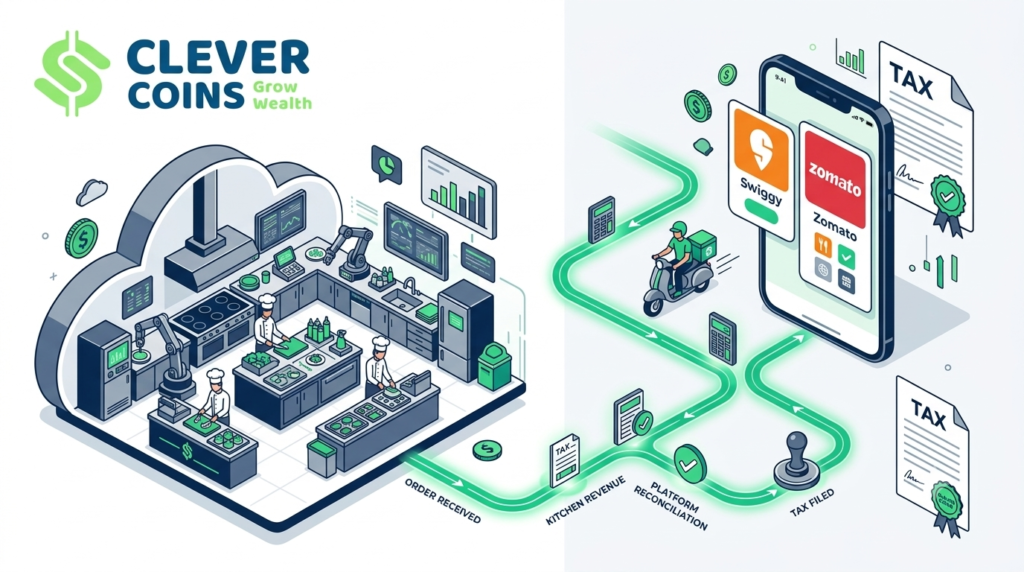
Decoding GST on Restaurants, Cloud Kitchens, and Delivery Platforms: Deep Dive into Section 9(5)
The evolution of India’s food tech and restaurant industry has been nothing short of meteoric. From dine-in legacy spots and independent neighborhood eateries to hyper-growth cloud kitchens and app-driven delivery models powered by giants like Swiggy and Zomato, how India eats has fundamentally transformed. However, with digital transformation comes regulatory complexity.
For restaurant owners, dark kitchen operators, and food tech entrepreneurs, understanding the Goods and Services Tax (GST) framework—specifically the mechanics of Section 9(5) of the CGST Act, 2017—is no longer optional; it is a matter of financial survival. Missteps in classification, compliance, or tax deposit liabilities can trigger severe audits, interest charges, and penalties.
This comprehensive guide breaks down everything you need to know about GST compliance for restaurants and cloud kitchens, dissects the operational earthquake brought by Section 9(5), and maps out actionable strategies to keep your food business audit-proof.
1. The Core Taxonomy: Defining Restaurants and Cloud Kitchens Under GST
Before examining electronic commerce operator (ECO) liabilities, we must establish how tax authorities classify culinary operations.
What Constitutes a “Restaurant Service”?
Under India’s GST tariff notifications, restaurant service is defined as the supply of food or any other article for human consumption or any drink, provided by way of or as part of any service. Crucially, this classification covers both traditional dine-in restaurants and establishments offering takeaway or doorstep delivery.
The Cloud Kitchen Phenomenon
A cloud kitchen (also known as a ghost kitchen, dark kitchen, or central kitchen) operates without a traditional dine-in front-end. They focus exclusively on food preparation, packaging, and fulfillment through online orders.
The Central Board of Indirect Taxes and Customs (CBIC) via Circular No. 164/20/2021-GST explicitly clarified that services provided by way of cooking and supplying food by cloud kitchens or central kitchens qualify as “restaurant services”. Consequently, they attract the same structural GST treatment as brick-and-mortar restaurants:
GST Rate: 5%
TaxGuruInput Tax Credit (ITC): Not admissible (the 5% slab is extended on the explicit condition that businesses forego claiming ITC on raw materials, packaging, and general overheads).
2. Understanding Section 9(5) of the CGST Act: The Regulatory Turning Point
Prior to January 1, 2022, the tax compliance burden for orders placed through digital aggregators rested squarely on the individual restaurants. Restaurants collected the 5% GST, managed invoice sequences, and deposited taxes independently—a system marred by widespread under-reporting and tax leakage.
To plug this gap, the government invoked Section 9(5) of the CGST Act, 2017.
What Does Section 9(5) Mandate?
Section 9(5) empowers the government to specify categories of services supplied through an Electronic Commerce Operator (ECO) where the tax on such services shall be paid by the electronic commerce operator.
When a customer orders food via platforms like Swiggy or Zomato:
The Legal Fiction of Supply: The ECO (Swiggy/Zomato) is treated as the deemed supplier for that transaction.
ScribdLiability Shift: The statutory liability to collect and deposit the 5% GST on the restaurant service shifts entirely from the kitchen/restaurant to the aggregator.
Invoicing Shift: The ECO issues the tax invoice to the end consumer for the restaurant service component and bears the cash remittance obligation.
IndiaFilings
3. Operational Mechanics: How Swiggy, Zomato, and Cloud Kitchens Interact
The implementation of Section 9(5) fundamentally altered the day-to-day accounting and operational workflows for cloud kitchens. Let’s break down how transactions flow under this model.
No Input Tax Credit (ITC) Utilization by ECO on Restaurant Supply: CBIC clarifications explicitly state that an ECO cannot utilize its own accumulated Input Tax Credit to discharge the GST liability on restaurant services collected under Section 9(5); it must be paid strictly in cash.
IndiaFilingsExclusion from Section 52 TCS: For restaurant services notified under Section 9(5), the traditional Tax Collected at Source (TCS) requirement under Section 52 does not apply to the ECO because they are paying the primary tax directly. However, TCS still applies to non-restaurant merchandise sold on platforms (e.g., packaged goods, retail items).
IndiaFilingsAggregate Turnover Calculation: Even though the ECO deposits the tax, the value of these supplies must still be included by the restaurant/cloud kitchen in their Aggregate Turnover calculations to determine registration thresholds and composition scheme eligibility.
4. Registration Nuances: Thresholds and Mandatory Clauses
Navigating GST registration can be tricky for food entrepreneurs balancing multiple revenue channels (dine-in, direct delivery website, and aggregator platforms).
General Thresholds (Section 22)
Under Section 22 of the CGST Act, businesses engaged exclusively in the supply of goods or services must register if their aggregate turnover exceeds INR 20 Lakhs (INR 10 Lakhs in special category/northeastern states).
The E-Commerce Trap (Section 24)
However, Section 24(ix) mandates that any person supplying goods or services through an electronic commerce operator who is required to collect tax at source must register regardless of turnover.
Critical Compliance Note: If a cloud kitchen operates exclusively through its own proprietary website or physical walk-ins, it can enjoy the INR 20 lakh threshold exemption. The moment it lists on Swiggy or Zomato, GST registration becomes mandatory from rupee one, regardless of annual turnover, due to Section 24 activation.
5. The Composition Scheme Dilemma for Cloud Kitchens
Many small cloud kitchens look at the Composition Scheme (under Section 10 of the CGST Act) as an attractive avenue to pay a lower tax rate (typically 1% for manufacturers/traders or 5% for composition restaurants) with minimal compliance friction.
Can Cloud Kitchens on Swiggy/Zomato Opt for Composition?
Statutory restrictions under Section 10 clarify that a registered person cannot supply goods or services through an electronic commerce operator who is required to collect tax under Section 52, or participate in models that conflict with e-commerce constraints. Furthermore, composition dealers cannot make inter-state outward supplies.
Because listing on Swiggy or Zomato involves e-commerce fulfillment dynamics, cloud kitchens utilizing aggregators generally find themselves disqualified from the composition scheme, forcing them into the Regular Taxation Scheme.
6. Compliance Checklist for Restaurant & Cloud Kitchen Owners
To protect your business from notices, audits, and frozen accounts, establish a bulletproof internal compliance rhythm:
Accurate GSTR-1 and GSTR-3B Reporting:
Report supplies made through ECOs under Section 9(5) in the designated tables of GSTR-1 and Table 3.1(c) of GSTR-3B. Ensure these are segregated from your direct offline/website sales.
IndiaFilings
Reconciliation of Aggregator Statements:
Match your monthly payout statements and settlement sheets provided by Swiggy and Zomato against your internal POS sales reports to catch discrepancies in commission deductions, delivery fees, and tax collections.
Correct Bill of Supply / Tax Invoice Issuance:
Understand who issues what. For orders via ECOs, the platform manages the tax invoice generation as the deemed supplier. For direct orders via your proprietary app, your kitchen is responsible for issuing proper bills.
Monitor Ancillary Items:
Remember that items sold alongside food that fall outside “restaurant services” (such as bottled water, packaged retail items, or branded merchandise) are taxed under their respective commodity rates and follow standard ECO-TCS rules under Section 52.
IndiaFilings
7. Future Outlook and Strategic Takeaways
As India’s digital public infrastructure and tax administration systems (like e-invoicing and automated data matching) become more deeply integrated, tax transparency is at an all-time high.
For traditional restaurants expanding into delivery, and cloud kitchens scaling multi-outlet models across state borders, treating GST as an afterthought is a recipe for closure. By understanding the structural division of labor under Section 9(5), maintaining clean digital reconciliation books, and working closely with specialized tax advisors, food entrepreneurs can insulate their ventures from regulatory friction and focus on what matters most: scaling culinary excellence.
Frequently Asked Questions (FAQs)
Q1: Do I need a GST registration if my cloud kitchen only sells through my own website and not via Zomato or Swiggy?
Answer: If you operate exclusively through your own website or offline channels, GST registration is mandatory only if your aggregate annual turnover exceeds the threshold limit of INR 20 Lakhs (INR 10 Lakhs for special category states). However, listing on Swiggy or Zomato triggers mandatory registration from day one.
Q2: Who deposits the 5% GST on food orders placed via Swiggy or Zomato?
Answer: Under Section 9(5) of the CGST Act, the Electronic Commerce Operator (Swiggy or Zomato) is designated as the deemed supplier and is legally responsible for collecting and depositing the 5% GST directly to the government in cash.
Q3: Can cloud kitchens claim Input Tax Credit (ITC) on raw materials?
Answer: If your cloud kitchen operates under the standard 5% restaurant service GST rate, no Input Tax Credit (ITC) can be claimed on raw materials, packaging, or kitchen equipment. The 5% rate is granted specifically on the premise that ITC is foregone.





