MSME Idea Hackathon 4.0 2025: How to Win ₹15 Lakh Grant for Your Idea
Every groundbreaking enterprise begins as a raw spark—an observation on a factory floor, a late-night engineering sketch in a college hostel, or a smarter way to help a traditional artisan reach global buyers. Yet across India, thousands of promising innovations stall before they ever reach the market because of one persistent hurdle: early-stage prototype funding. Traditional banks rarely lend to pre-revenue concepts, and angel investors typically demand a working Minimum Viable Product (MVP) before writing a check.
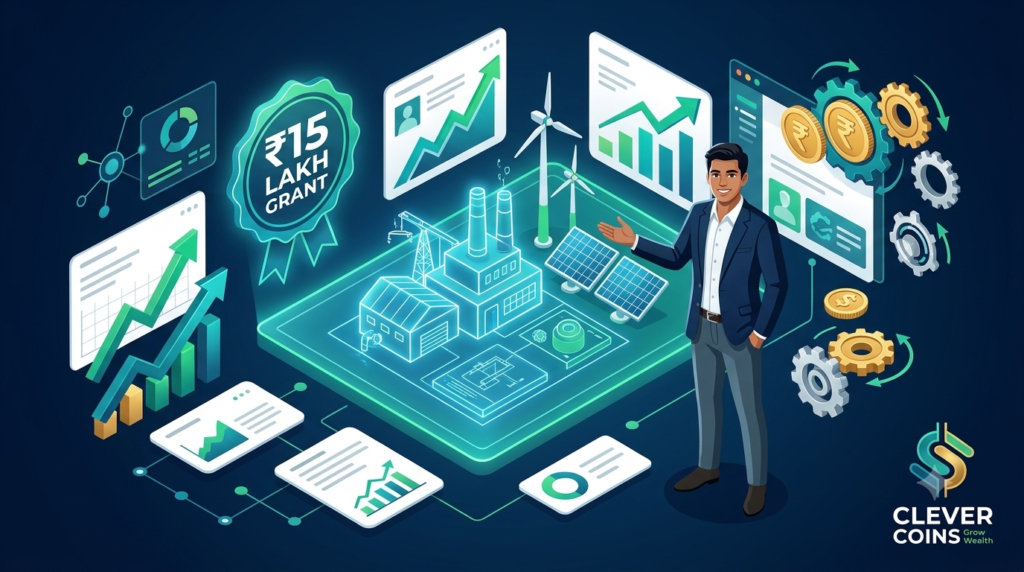
To bridge this exact “valley of death” between ideation and commercialization, the Ministry of Micro, Small and Medium Enterprises (MoMSME), Government of India, launched the flagship MSME Idea Hackathon 4.0 under the MSME Innovative Scheme (Incubation Component). Aligned with the national vision of Viksit Bharat @2047: Voice of Youth, this initiative offers young innovators, students, and existing micro-enterprises non-dilutive financial assistance of up to ₹15 Lakh per approved idea, alongside dedicated technical mentorship and laboratory infrastructure at accredited Host Institutions (HIs) across India.
Whether you are an engineering undergraduate building an IoT sensor, an independent researcher working on biodegradable packaging, or a Udyam-registered MSME aiming to indigenize imported machinery, winning this grant can transform your blueprint into a commercial reality without giving up a single percent of equity.
In this comprehensive guide, our team breaks down every detail of the MSME Idea Hackathon 4.0—from strict eligibility rules and co-funding structures to the four priority themes, the four-stage evaluation pipeline, and insider strategies to craft a concept note that clears the Project Monitoring & Advisory Committee (PMAC).
1. What is the MSME Idea Hackathon 4.0?
The MSME Idea Hackathon 4.0 is a nationwide innovation challenge administered by the Office of the Development Commissioner (DC-MSME), Ministry of Micro, Small and Medium Enterprises. Operating under the umbrella of the MSME Innovative Scheme (Incubation, Design, and IPR), the hackathon is specifically engineered to identify, nurture, and financially support untapped creativity among India’s youth and grassroots entrepreneurs.
Unlike conventional coding marathons that last 48 hours and end with a slide deck, the MSME Idea Hackathon is an incubation-linked grant program. When your idea is selected, the Government of India channels grant funding—up to a ceiling of ₹15,00,000 (Rupees Fifteen Lakhs)—through a recognized Host Institution (HI) (such as an IIT, NIT, leading private university, or government research center) chosen by you during application.
Key Objectives of the Scheme
De-risking Early-Stage R&D: Providing grant capital specifically for prototyping, raw materials, testing, and machinery access where private capital is reluctant to enter.
Strengthening Academia-Industry Linkages: Connecting grassroots innovators and MSMEs with premier Business Incubators (BIs) housed inside top academic and technical institutions.
Accelerating Atmanirbhar Bharat: Reducing India’s reliance on imported components, software, and industrial machinery through indigenous product development.
ScribdModernizing Traditional Livelihoods: Infusing technology, design, and modern marketing into India’s 18 traditional artisan trades under the PM Vishwakarma ecosystem.
Scribd
2. Quick Snapshot: MSME Idea Hackathon 4.0 at a Glance
Before diving into the granular eligibility criteria and application workflows, review this structured summary of the scheme’s core parameters:
| Parameter | Official Scheme Details |
|---|---|
| Governing Ministry | Ministry of Micro, Small and Medium Enterprises (MoMSME), Govt. of India |
| Parent Scheme | MSME Innovative Scheme (Incubation Component) |
| Target Age Group | 18 to 35 years (Indian citizens/origin) |
| Applicant Categories | 1. Student (Valid Academic ID) 2. MSME (Valid Udyam Registration) 3. Others (Individual Innovators / Startups) |
| Maximum Grant Support | Up to ₹15 Lakh per approved idea |
| Co-Funding Ratio (GoI : Applicant) | • Students: 100% Govt. Grant (0% applicant contribution) • MSME / Others: 85% Govt. Grant + 15% Applicant Contribution |
| Official Application Portal | [https://innovative.msme.gov.in/](https://innovative.msme.gov.in/) |
| Implementation Partner | Approved Host Institutions (HIs) / Business Incubators (BIs) across India |
| Evaluation Stages | 4 Stages: Host Institute Panel → MoMSME PMU Screening → DESC → PMAC Final Approval |
3. Detailed Eligibility Criteria: Who Can Apply?
One of the greatest strengths of the MSME Idea Hackathon 4.0 is its inclusive structure. You do not need an incorporated Private Limited company or years of audited balance sheets to apply. However, you must satisfy specific age, nationality, and category requirements.
Core Eligibility Rules for All Applicants
Age Limit (18–35 Years): The applicant must be between 18 and 35 years of age as of the cutoff date specified in the official notification. A government-issued photo ID (preferably an Aadhaar Card) is mandatory as proof of age and identity.
MY MSME+ 1Nationality: Open to innovators of Indian origin residing in India with a valid mobile number and email address.
MSME Services | MSME Loan Schemes & Online Applications in …One Idea Rule: Each applicant is permitted to submit only one idea under a single chosen category and through a single Host Institution. Duplicate submissions across multiple HIs result in automatic disqualification.
MSME Services | MSME Loan Schemes & Online Applications in …+ 1Prototype Intent: The proposal must strictly aim at developing a working prototype, proof-of-concept (PoC), model, or marketable product/process—purely theoretical research papers without commercial or prototype outcomes are not eligible.
MY MSME
The Three Registration Categories
Applicants must classify themselves under one of three distinct tracks during portal registration:
A. Student Category
Who qualifies: Undergraduate, postgraduate, diploma, or doctoral students enrolled in any recognized Indian educational institution.
Mandatory Document: A valid Student Identity Card for the current academic year (alongside Aadhaar for age verification).
MSME Services | MSME Loan Schemes & Online Applications in …Commitment Clause: Student applicants must commit to completing the prototype development even if they graduate or finish their academic program during the incubation period.
MY MSMEFinancial Advantage: Students enjoy 100% grant funding from the Ministry of MSME up to ₹15 Lakh, with zero mandatory matching contribution.
B. MSME Category
Who qualifies: Existing micro, small, or medium enterprises looking to develop a new innovative product, upgrade machinery, or commercialize a novel technology.
Mandatory Document: A valid Udyam Registration Number (URN). If you run a small business without Udyam registration, you must register on the official Udyam portal first before applying.
MSME Services | MSME Loan Schemes & Online Applications in …+ 1Co-Funding Requirement: Under scheme guidelines, MSME applicants contribute 15% of the approved project cost to the Host Institution, while the Ministry of MSME funds the remaining 85% (up to ₹15 Lakh).
DCMSME
C. Others Category
Who qualifies: Independent innovators, freelancers, scientists, early-stage startup founders (whose entities are not yet Udyam-registered or who apply as individuals), and working professionals aged 18–35.
MSME Services | MSME Loan Schemes & Online Applications in …Mandatory Document: Government-issued ID proof (Aadhaar/PAN) and relevant educational/professional credentials.
MY MSMECo-Funding Requirement: Similar to the MSME category, applicants under “Others” bear 15% of the approved project cost, with 85% covered by the government grant.
DCMSME
4. Deep Dive into the 4 National Priority Themes
To ensure national impact, MSME Idea Hackathon 4.0 channels innovation into four strategic themes. Selecting the right theme—and framing your problem statement using the exact terminology of that vertical—is critical for passing the Domain Expert Selection Committee (DESC).
Theme 1: PM Vishwakarma – 18 Trades
India’s traditional artisans and craftspeople form the backbone of the rural and semi-urban economy, yet many still rely on century-old tools that limit productivity and cause physical strain. This theme invites innovations that modernize, mechanize, or digitally empower the 18 traditional trades recognized under the PM Vishwakarma Scheme:
Carpenter (Suthar)
ScribdBoat Maker
ScribdArmourer
ScribdBlacksmith (Lohar)
Hammer and Tool Kit Maker
ScribdLocksmith
ScribdSculptor (Moortikar / Stone Carver)
ScribdStone Breaker
ScribdGoldsmith (Sonar)
Potter (Kumhaar)
Cobbler (Charmkar / Footwear Artisan)
ScribdMason (Rajmistri)
Basket / Mat / Broom Maker / Coir Weaver
ScribdDoll & Toy Maker (Traditional)
ScribdBarber (Naai)
ScribdGarland Maker (Malakaar)
ScribdWasherman (Dhobi)
ScribdTailor (Darzi) & Fishing Net Maker
Scribd
Winning Idea Examples: Ergonomic battery-assisted pottery wheels, solar-powered blacksmithing forges, AI-driven design-to-loom software for weavers, smart IoT-enabled sustainable fishing nets, or B2B traceability platforms connecting traditional toy makers directly with export buyers.
Theme 2: Frontier Technology in MSME
Indian MSMEs often struggle to compete with global manufacturing giants due to manual bottlenecks, high defect rates, and energy inefficiencies. This theme focuses on bringing Industry 4.0 technologies—Artificial Intelligence (AI), Machine Learning (ML), Internet of Things (IoT), Robotics, Drone Tech, 3D Printing, and Industrial Automation—within affordable reach of small enterprises.
Winning Idea Examples: Low-cost computer vision systems for automated quality inspection on textile lines, predictive maintenance IoT sensors for CNC machines, autonomous agricultural spraying drones, or AI-based aquaculture water-quality monitoring systems.
Theme 3: Export Enhancement and Indigenisation
India imports billions of dollars worth of specialized components, medical devices, electronics, and industrial sub-assemblies every year. Under this theme, the Ministry seeks proposals that either substitute strategic imports through indigenous engineering or elevate the quality, packaging, and compliance standards of Indian MSME products to boost exports.
Winning Idea Examples: Indigenous nickel-plated copper busbars for EV lithium-ion battery packs, locally manufactured precision medical diagnostic sensors, smart shelf-life extension packaging for horticulture exports, or cost-effective conductance spectroscopy instruments.
IIT Bhubaneswar- Research and Entrepreneurship Park
Theme 4: Sustainable Development
As global supply chains enforce strict Environmental, Social, and Governance (ESG) norms, green innovation is no longer optional. This theme rewards solutions rooted in clean energy, circular economy principles, waste-to-wealth conversion, water conservation, and decarbonization.
Winning Idea Examples: Biodegradable bioplastic packaging derived from agricultural residue, decentralized Black Soldier Fly (BSFL) organic waste-to-protein converters, solar-powered reverse osmosis systems for rural irrigation, or eco-friendly pulp and paper extraction from agro-waste.
5. Financial Breakdown: How the ₹15 Lakh Grant Works
A common misconception among first-time applicants is that the ₹15 Lakh grant is wired directly into their personal savings account as a lump-sum cash prize. In reality, the MSME Innovative Scheme follows strict milestone-based utilization rules managed jointly by the incubatee and the Host Institution.
Understanding the Funding Split
For Students:
Government of India Grant: 100% (up to ₹15,00,000)
Student Contribution: ₹0
For MSMEs & Others:
Government of India Grant: 85% (up to ₹15,00,000)
DCMSMEIncubatee Contribution: 15% of total approved project cost (deposited with the Host Institution)
DCMSME
Example Calculation: Suppose an independent innovator (“Others” category) submits a budget of ₹10,00,000 for building a robotic cleaning prototype, and the committee approves the full ₹10,00,000. The Ministry of MSME will provide ₹8,50,000 (85%), and the innovator will deposit ₹1,50,000 (15%) with their chosen Host Institution. If a student submits the exact same ₹10,00,000 budget and gets approved, the Ministry covers the entire ₹10,00,000 (100%).
DCMSME
Permissible Heads of Expenditure
Under the DC-MSME guidelines, the grant funds are released to the Host Institution (via PFMS) and utilized strictly for converting your idea into a working prototype:
Technology & Machine Usage Charges: Rental or usage fees for specialized lab equipment, CNC machining, 3D printing, and testing facilities.
Raw Materials & Consumables: Electronic components, sensors, polymers, chemicals, metals, and fabrication supplies required to build iterations of the prototype.
Software, Cloud & Prototyping Tools: Specialized CAD/CAM licenses, cloud compute credits for AI training, and embedded firmware development tools.
Technical Consultancy & Mentorship: Fees for external domain experts, industrial designers, or certified testing labs (NABL-accredited) for product validation.
Budget Flexibility Rule: Once your project budget is approved, the guidelines allow up to a 25% variation across approved sub-heads within the overall sanctioned ceiling, giving founders practical room to adapt as engineering realities evolve.
Note: Grant funds cannot be used to pay founder salaries, purchase real estate/buildings, or clear past debts.
6. The Role of Host Institutions (HIs): Choosing Your Launchpad
Your choice of Host Institution (HI) is arguably the single most important strategic decision in your application. Host Institutions are universities, engineering colleges, technical institutes, and research organizations accredited by the Ministry of MSME as Business Incubators.
Why Your Host Institution Matters
First Gatekeeper: Every application goes first to your selected Host Institution. If the HI’s internal expert panel does not shortlist your idea, the Ministry of MSME will never even see it.
MY MSME+ 1No Change Allowed: Once you submit your application on the portal, no request to change your Host Institution is entertained under any circumstances.
MY MSMEInfrastructure & Lab Access: During the 1-year incubation phase, you will rely on your HI’s workshops, wet labs, fabrication centers, and mentor network to build your prototype.
How to Select the Best Host Institution
Check State/UT Availability First: The portal encourages you to select an approved HI within your own State or Union Territory. If your state lacks an HI with relevant facilities, you are permitted to select an HI in another State/UT.
MSME Services | MSME Loan Schemes & Online Applications in …+ 1Match Lab Infrastructure to Your Domain: If you are building a biotech or food-processing innovation, do not select a purely software-focused incubator. Look for HIs with wet labs, NABL testing centers, or specialized Centers of Excellence (e.g., IITs, NITs, CIPET, or specialized agricultural/pharma universities).
Evaluate Historical Track Record: Check how many ideas the HI successfully got approved in previous editions (Hackathon 1.0, 2.0, and 3.0). Active incubators conduct pre-submission pitch clinics to help refine your concept note before forwarding it to the Ministry.
Contact the Incubator Manager Before Applying: Reach out to the HI’s incubation cell via email or phone before locking your choice on the portal. Discussing your idea beforehand ensures they have the technical bandwidth to mentor you.
7. Step-by-Step Application Process on the MSME Portal
Applying for the MSME Idea Hackathon 4.0 is completely online and free of any application fee. Follow this step-by-step workflow to submit an error-free application:
Step 1: Prepare Your Mandatory Documents & Technical Assets
Before opening the portal, keep the following files ready in clear PDF/JPEG formats:
Government Photo ID: Aadhaar Card (front and back) for age and identity verification.
MY MSMECategory Proof:
Students: Current academic year Student ID Card.
MSME Services | MSME Loan Schemes & Online Applications in …MSMEs: Udyam Registration Certificate.
MSME Services | MSME Loan Schemes & Online Applications in …Others: PAN Card / Educational qualification certificate.
Blind Concept Note: A structured write-up detailing the problem, proposed solution, novelty, market potential, and budget.
Blind Block Diagram / Process Flowchart: A clean architectural diagram illustrating how your product, system, or process works.
Step 2: Visit the Official Portal & Register
Navigate to the official MSME Innovative Portal:
[https://innovative.msme.gov.in/](https://innovative.msme.gov.in/)(or the dedicated Hackathon registration link onmy.msme.gov.in).Click on “MSME Idea Hackathon 4.0” and select “New Registration”.
Enter your personal details (Name as per Aadhaar, Date of Birth, Gender, Category—General/SC/ST/OBC/Women/Divyangjan, Mobile Number, and Email ID).
Verify your mobile number and email via OTP to generate your login credentials.
Step 3: Select Category and Host Institution
Log in to your applicant dashboard and choose your applicant category (MSME, Student, or Others).
Select your State/UT and browse the dropdown list of approved Host Institutions (HIs). Double-check your selection, as it locks permanently upon submission.
MSME Services | MSME Loan Schemes & Online Applications in …
Step 4: Fill in the Innovation & Theme Details
Choose one of the four primary themes (PM Vishwakarma, Frontier Technology, Export Enhancement & Indigenisation, or Sustainable Development).
ScribdEnter your Project Title (keep it crisp, descriptive, and devoid of your personal or company brand name).
Fill out the structured questionnaire covering:
Problem Statement & Target Beneficiaries
Proposed Technological Solution & Novelty
Eight Innovation Process Parameters (Ideation, Technology, Business Model, Marketing & Branding, Co-creation, Social Innovation, Entrepreneurship, Open Innovation)
ScribdItemized Budget Estimate (up to ₹15 Lakh) and Project Timeline
Step 5: Upload Blind Documents & Final Submit
Upload your Concept Note, Block Diagram, ID Proof, and Category Certificate.
MSME Services | MSME Loan Schemes & Online Applications in …Preview the entire form carefully. Ensure there are no broken links, blurred scans, or identity leaks in the blind attachments.
Click Final Submit and download the acknowledgment receipt containing your unique Application Reference Number (e.g.,
IDEA...) for tracking.
8. The 4-Stage Evaluation Pipeline: How Winners Are Chosen
Understanding how evaluators score your proposal gives you a massive competitive edge. Every submitted idea undergoes a rigorous, four-tier filtration process:
[Stage 1: Host Institute Expert Panel (3–5 Experts)]
                     │
                     ▼ (Shortlisted & Scored Theme-wise)
[Stage 2: MoMSME PMU & Programme Division Screening]
                     │
                     ▼ (Verified for Completeness & Eligibility)
[Stage 3: Domain Expert Selection Committee (DESC)]
                     │
                     ▼ (Evaluated by Industry, Academia & Govt Experts)
[Stage 4: Project Monitoring & Advisory Committee (PMAC)]
                     │
                     ▼
         [FINAL GRANT APPROVAL & SANCTION]
Stage 1: Evaluation by the Host Institute (HI)
Your selected HI forms an evaluation panel consisting of 3 to 5 domain experts (entrepreneurs, technical specialists, financial analysts, and thematic experts). You will typically be invited for a 10–15 minute virtual or physical pitch presentation. The HI scores all applicants theme-wise and forwards only the most meritorious ideas to the Ministry portal.
Stage 2: Screening by the MoMSME PMU
The Project Management Unit (PMU) at the Ministry of MSME conducts an administrative and compliance audit of all ideas forwarded by HIs. Applications with incomplete documents, invalid Student IDs, age mismatches, or incoherent concept notes are eliminated at this stage.
Stage 3: Evaluation by Domain Expert Selection Committees (DESCs)
Screened proposals are segregated into the four thematic verticals and reviewed by national-level Domain Expert Selection Committees (DESCs) comprising senior scientists, industry leaders, and government officials. Because DESC reviews anonymized (“blind”) concept notes and block diagrams, your technical merit and commercial viability speak entirely for themselves.
Stage 4: Final Approval by PMAC
The top-scoring recommendations from the DESCs are placed before the Project Monitoring & Advisory Committee (PMAC) chaired by senior officials of the Ministry of MSME. PMAC holds the final authority to approve the idea, ratify or rationalize the sanctioned grant amount (up to ₹15 Lakh), and authorize fund disbursement to the Host Institution.
9. Critical Do’s and Don’ts: Avoid Automatic Disqualification
Every year, hundreds of technically brilliant ideas get rejected on purely procedural grounds. Memorize these official Do’s and Don’ts from the DC-MSME participation manual:
Mandatory Do’s
Highlight Novelty & Societal Impact: Clearly articulate how your solution is superior to existing alternatives and how it reduces costs or improves quality of life for Indian citizens and MSMEs.
MY MSMEDemonstrate Scalability: Show that your prototype can be mass-produced or replicated across multiple MSME clusters in India.
Include All 8 Innovation Dimensions: Explicitly address the Ministry’s eight mandated innovation pillars—Ideation, Technology, Business Model, Marketing & Branding, Co-creation, Social Innovation, Entrepreneurship, and Open Innovation.
MSME Services | MSME Loan Schemes & Online Applications in …Prioritize Clean & Green Elements: Even if you apply under Frontier Tech or Export Enhancement, highlighting lower energy consumption or reduced material waste earns bonus favor.
MSME Services | MSME Loan Schemes & Online Applications in …
Strict Don’ts (Instant Red Flags)
NEVER Reveal Your Identity in the Concept Note or Block Diagram: This is the #1 reason for rejection during blind evaluation. Do not include your name, phone number, email address, college name, company brand name, or mentor’s name inside the uploaded Concept Note or Block Diagram.
MY MSMEDo Not Cite Personal Research Papers or News Articles: Avoid inserting links or citations to your published papers or press coverage that could indirectly identify you or your firm.
MY MSMEDo Not Submit Scientifically Impossible Claims: Ideas that violate established laws of physics or thermodynamics (e.g., perpetual motion machines) are summarily rejected.
MY MSMEDo Not Be Your Own Mentor: The incubatee and the technical mentor cannot be the same individual.
MY MSMEAvoid Plagiarism: Copying existing commercial products without a clear, defensible technological upgrade will fail DESC scrutiny.
10. Pro Blueprint: How to Write a Winning Concept Note & Block Diagram
To stand out among tens of thousands of applicants, treat your Concept Note like an institutional R&D investment memo rather than a college essay. Use this proven 6-part structure:
1. Executive Problem Statement (Quantified)
Avoid vague statements like “Farmers face water issues.” Instead, quantify the pain point:
“Smallholder horticulture farmers in semi-arid regions lose 35–40% of irrigation water due to flood irrigation, while commercial automated fertigation controllers cost upwards of ₹1.8 Lakh—putting them out of reach for 85% of Indian marginal farmers.”
2. The Proposed Solution & Core Novelty
Explain what you are building and why it is fundamentally new:
“We propose a solar-powered, edge-AI soil moisture and NPK sensing controller priced under ₹18,000. Unlike cloud-dependent imported controllers, our unit uses LoRaWAN mesh networking to operate reliably in zero-internet rural zones.”
3. The Blind Block Diagram (Visual Clarity Wins)
Evaluators spend less than 3 minutes scanning each initial file. A crisp, high-resolution Block Diagram (created using tools like Draw.io, Lucidchart, or Figma) makes complex engineering immediately digestible:
Show Inputs (Sensors, Raw Materials, Power Source) →\rightarrow→ Core Processing Unit (Microcontroller, Chemical Reactor, Mechanical Assembly) →\rightarrow→ Outputs (Finished Product, Dashboard Alerts, Treated Water).
Label every subsystem with technical specs (e.g., ESP32-S3 Microcontroller, 12V LiFePO4 Solar Battery, Ultrasonic Transducer)—and remember, zero personal or brand names.
4. Addressing the 8 Mandated Innovation Processes
Include a dedicated mini-table in your concept note mapping your project directly to the Ministry’s 8 required innovation processes:
Ideation: Origin of the core concept.
Technology: Core engineering/scientific breakthrough improving functionality.
Business Model: How you will price, sell, and generate sustainable revenue (B2B, B2C, SaaS, or licensing).
Marketing & Branding: Customer acquisition strategy and superior user experience.
Co-creation: How end-users (artisans, factory owners, farmers) are involved in testing prototypes.
Social Innovation: Employment generation, rural upliftment, or safety improvements.
Entrepreneurship: Go-to-market execution roadmap.
Open Innovation: Collaborations with Host Institution labs, industry vendors, and supply chain partners.
5. Realistic, Itemized ₹15 Lakh Budget Plan
Do not blindly ask for ₹15.00 Lakh in round numbers without justification. Evaluators respect founders who ask for ₹11.40 Lakh with exact quotes for every sensor, PCB fabrication run, CNC housing, and lab test. Break your budget into quarterly milestones (Q1: Design & Component Procurement, Q2: Alpha Prototype Assembly, Q3: Field Trials & Calibration, Q4: Beta Commercial Prototype & Certification).
6. Commercialization & IP Strategy
Conclude by explaining what happens after the prototype is built. Mention your plan to file an Indian Patent or Design Registration (which is also subsidized under the IPR component of the same MSME Innovative Scheme!) and outline your first 100 target MSME customers.
11. Post-Selection Roadmap: Turning Your Grant into a Scalable Business
Winning the MSME Idea Hackathon 4.0 is just the starting line. Once the PMAC approves your idea and sanctions the grant, you enter a structured 12-month incubation lifecycle:
Signing the Incubation Agreement: You sign a formal tripartite/bilateral agreement with your Host Institution defining milestone deliverables, workspace access, and IP ownership (your IP remains yours!).
Tranche-Based Fund Release: The Ministry releases funds to the HI, which disburses payments against verified vendor invoices and milestone reviews. If you applied under MSME/Others, you deposit your 15% matching share.
DCMSME+ 1Entity Incorporation & Compliance: If you applied as a Student or individual under “Others,” this is the ideal time to incorporate a Private Limited Company or One Person Company (OPC), obtain Udyam Registration, and register for DPIIT Startup India recognition—unlocking tax holidays, angel tax exemptions, and public procurement preferences.
Additional MSME Scheme Leverage: Once your prototype is ready, you can seamlessly apply for the Design Component (up to ₹40 Lakh for industrial design intervention) and IPR Component (up to ₹5 Lakh for patent reimbursement) under the same MSME Innovative Scheme.
12. Frequently Asked Questions (FAQs)
1. Is the ₹15 Lakh under MSME Idea Hackathon 4.0 a loan or a grant?
It is a 100% non-dilutive, collateral-free government grant, not a loan. You do not have to repay the money or give equity to the Government of India, provided you utilize the funds strictly for the approved prototype milestones.
2. Can a team apply, or is it only for individuals?
The application is submitted in the name of a primary applicant (incubatee) aged 18–35 years, though a team of co-founders/students can work together on developing the prototype at the Host Institution. Ensure the primary applicant meets all age and category criteria.
3. What happens if I cross 35 years of age during the incubation period?
Your eligibility is determined strictly on the cutoff date specified in the hackathon notification. As long as you are between 18 and 35 years old on that cutoff date, turning 36 during prototype development will not affect your grant.
4. Can I apply if my startup is already incorporated as a Private Limited Company?
Yes! If your company is registered as a Micro, Small, or Medium Enterprise with a valid Udyam Registration Number, you can apply under the MSME Category (provided the primary applicant/director is aged 18–35). If your startup does not yet have Udyam registration, you can either obtain Udyam registration first or apply under the Others Category.
5. How long does it take from application submission to receiving funds?
Typically, the four stages of evaluation (Host Institute review, PMU screening, DESC thematic evaluation, and PMAC final approval) take approximately 3 to 5 months from the close of the application window. Fund disbursement begins shortly after PMAC ratification and agreement execution with the Host Institution.
6. Can I submit the same idea to two different Host Institutions to increase my chances?
No. Submitting the same or a substantially similar idea to multiple Host Institutions or under multiple categories is strictly prohibited and leads to immediate disqualification of all your applications.
Ready to Turn Your Funded Prototype into a Compliant, Investor-Ready Company?
Securing up to ₹15 Lakh in non-dilutive grant funding through the MSME Idea Hackathon 4.0 is one of the smartest ways to launch an innovation-led business in India. Once your idea gets shortlisted, building a rock-solid legal and financial foundation—from Udyam Registration and Private Limited / OPC Incorporation to Trademark Protection, GST Compliance, and Startup India Certification—ensures you are ready to scale commercially and attract institutional venture capital.
At CleverCoins, our team of Chartered Accountants, Company Secretaries, and startup advisors helps young Indian founders navigate business registration, intellectual property, and regulatory compliance effortlessly—so you can stay 100% focused on building breakthrough products.
Related posts:
NSIC Single Point Registration Scheme: How MSMEs Get Tender Benefits
FAME III Scheme 2025: Subsidy for EV Manufacturing MSMEs in India – Eligibility, Benefits, Governmen...
National Logistics Policy Benefits for MSME Exporters: The Complete Cost Reduction Guide
Credit Guarantee Scheme for Exporters (CGSE): New 2025 Scheme for MSME Exporters
CGTMSE Revised 2025: Collateral-Free Loan Limit Increased to ₹10 Crore for MSMEs
GST Invoice Management System (IMS) from October 2024: New Rules for MSMEs to Accept or Reject ITC
Procurement and Marketing Support Scheme: Reimbursement for MSME Trade Fairs – Complete Guide
MSME Competitive (LEAN) Scheme: How Indian Enterprises Can Claim 90% Government Support for Lean Cer...
Self Reliant India (SRI) Fund: Rs 50,000 Cr Equity Infusion for MSMEs Explained
PMEGP Urban vs Rural Subsidy 2025: The Ultimate Guide to Funding, Eligibility, and Location Strategy...
Related posts:
 NSC Interest Rate 2026-27: National Savings Certificate Returns, Tax Benefits & How to Invest
 Self Reliant India (SRI) Fund: Rs 50,000 Cr Equity Infusion for MSMEs Explained
 ONDC Seller Incentive Scheme 2025: How Small Sellers Get Free Delivery Support
 MSME Competitive (LEAN) Scheme: How Indian Enterprises Can Claim 90% Government Support for Lean Certification