Sales Compensation Plan vs Outsourcing: What to Choose
Introduction
Building a successful sales operation is one of the biggest challenges for startups, small businesses, and growing companies. Every business wants to attract more customers, increase revenue, expand into new markets, and establish a strong competitive position. However, achieving these objectives requires an effective sales strategy, skilled professionals, proper financial planning, and consistent execution.
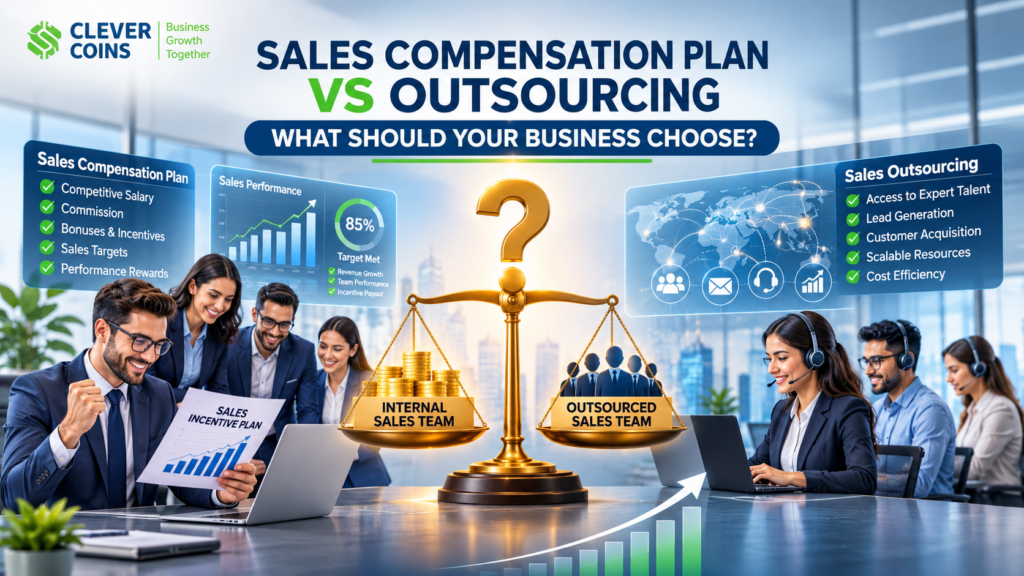
One important decision business owners must make is whether to develop an internal sales team using a structured sales compensation plan or outsource sales activities to an external agency or service provider.
Both approaches can help businesses generate revenue, acquire customers, and expand operations. However, they operate differently and have different financial implications, management requirements, performance expectations, and long-term benefits.
A sales compensation plan focuses on motivating and rewarding sales professionals through salaries, commissions, bonuses, incentives, and performance-based rewards. It allows businesses to build an internal sales culture in which employees work toward clearly defined revenue targets.
Sales outsourcing, on the other hand, involves assigning selected sales activities or the entire sales function to an external organization, independent professionals, or specialized sales agency. Instead of building and managing every sales resource internally, businesses pay an external provider to perform agreed-upon sales responsibilities.
The question is not simply which option is cheaper. The real question is which model provides the best combination of sales performance, cost efficiency, customer experience, operational flexibility, and sustainable growth.
For example, a technology startup introducing a new software product may benefit from an internal sales team because its representatives need extensive product knowledge and direct customer relationships. However, a business testing a new geographical market may find outsourcing more practical because it can access external sales expertise without immediately establishing a permanent team.
In this comprehensive guide, we will explore sales compensation plans vs outsourcing, their definitions, differences, advantages, disadvantages, financial implications, implementation processes, and practical examples. We will also explain how startups, MSMEs, and established businesses can select the right model.
1. What Is a Sales Compensation Plan?
A sales compensation plan is a structured system that determines how sales employees are financially rewarded for their contributions toward business objectives.
It generally combines fixed compensation with variable performance-based earnings. These rewards encourage sales representatives to achieve revenue targets, acquire new customers, retain existing accounts, sell strategic products, and contribute to overall business growth.
Unlike a conventional salary-only structure, a sales compensation plan directly connects some portion of employee earnings to measurable performance.
A well-designed plan establishes transparency between the organization and its sales professionals. Employees understand what they are expected to achieve, how their performance will be measured, and what financial rewards they can receive.
1.1 Main Components of a Sales Compensation Plan
A comprehensive sales compensation structure can contain several elements.
A. Base Salary
Base salary is the fixed amount paid to sales employees regardless of their individual sales performance, subject to their employment terms.
It provides income stability and helps companies attract qualified professionals.
For example, a business may offer a sales executive a monthly salary of ₹30,000.
B. Sales Commission
Commission is variable compensation calculated according to sales generated or another agreed performance measure.
For example, if a sales representative generates ₹5,00,000 in eligible sales and receives a 5% commission, the commission is ₹25,000.
Commission structures can be based on:
Total sales revenue.
Collected revenue.
Gross profit.
Number of units sold.
New customers acquired.
Successful contract closures.
Recurring subscription revenue.
The business must clearly define when a sale becomes eligible for commission.
C. Performance Bonuses
Bonuses are additional financial rewards given when employees achieve specific performance milestones.
For example, a company may offer a ₹10,000 bonus when a representative achieves 100% of their monthly target.
Bonuses can reward individual, team, quarterly, or annual performance.
D. Sales Incentives
Sales incentives are rewards designed to encourage particular behaviors or business outcomes.
Examples include:
Rewards for acquiring new customers.
Incentives for selling high-margin products.
Rewards for achieving quarterly targets.
Special incentives for launching new products.
Rewards for cross-selling and upselling.
Recognition for customer retention.
E. Accelerators
Accelerators increase commission rates when sales representatives exceed predetermined targets.
For example:
Up to 80% target achievement: 2% commission.
80%–100% achievement: 4% commission.
Above 100% achievement: 6% commission.
These are illustrative rates, not universal industry standards.
Accelerators can encourage high-performing sales professionals to continue generating revenue after achieving their initial targets.
F. Non-Financial Rewards
Not every sales reward needs to be monetary.
Companies can also provide:
Recognition certificates.
Professional development opportunities.
Promotions.
Leadership responsibilities.
Additional paid leave.
Performance awards.
Team celebrations.
These benefits can contribute to employee engagement and retention.
1.2 Types of Sales Compensation Plans
Different sales roles require different compensation structures.
1. Salary-Only Compensation
Employees receive a fixed salary without individual sales commissions.
This model is appropriate when representatives focus on customer education, account management, relationship building, or activities that are difficult to measure through immediate revenue.
2. Commission-Only Compensation
Employees earn compensation based primarily on sales generated.
It may reduce fixed payroll commitments, but it can create income uncertainty and may not be suitable for every role or employment arrangement.
Businesses must also consider applicable employment laws and contractual obligations.
3. Salary Plus Commission
This is a commonly used structure.
Employees receive a fixed salary along with variable commission based on performance.
It balances income stability with performance motivation.
4. Tiered Commission Structure
Commission rates increase when sales representatives achieve higher revenue targets.
This approach rewards employees who exceed expectations.
5. Profit-Based Commission
Instead of calculating commission solely on revenue, businesses calculate incentives using gross profit or another profitability measure.
This helps discourage excessive discounting and encourages healthier sales.
6. Team-Based Compensation
Employees receive incentives based on the collective performance of their sales department.
This can encourage collaboration between business development representatives, account executives, and customer success teams.
7. Hybrid Compensation Plan
A hybrid structure combines different compensation elements.
For example, a company may provide a fixed salary, individual commission, quarterly performance bonuses, and team incentives.
1.3 Why Businesses Use Sales Compensation Plans
Businesses use structured compensation systems to align employee activities with commercial objectives.
Some important reasons include:
Encouraging employees to achieve revenue targets.
Improving sales productivity.
Attracting skilled sales professionals.
Retaining high-performing employees.
Creating measurable performance standards.
Supporting customer acquisition.
Encouraging profitable sales.
Improving accountability.
Developing a performance-oriented culture.
However, a compensation plan must be carefully designed. An aggressive commission structure that rewards only revenue can encourage unnecessary discounts, unsuitable customer acquisition, or poor-quality sales.
The objective should be sustainable and profitable growth rather than revenue generation at any cost.
2. What Is Sales Outsourcing?
Sales outsourcing is a business arrangement in which a company hires an external service provider to perform some or all of its sales activities.
Instead of recruiting, training, supervising, and maintaining every sales employee internally, the company works with an external agency or specialist that provides sales-related services.
The outsourcing provider may supply trained sales representatives, appointment setters, business development professionals, account executives, telemarketing teams, or complete outsourced sales departments.
Businesses generally pay according to an agreed commercial arrangement, which may include monthly retainers, project fees, hourly charges, commissions, or a combination of these.
2.1 Types of Sales Outsourcing
A. Lead Generation Outsourcing
External providers identify prospective customers and generate qualified leads.
Their responsibilities may include:
Identifying target businesses.
Researching potential customers.
Building prospect lists.
Conducting outbound outreach.
Qualifying interested prospects.
Scheduling sales meetings.
The internal sales team may then handle negotiations and closing.
B. Telemarketing Outsourcing
Companies hire external teams to conduct sales calls, customer surveys, appointment scheduling, and promotional campaigns.
This approach can be useful when a business needs to contact a large number of prospects.
C. Appointment Setting Outsourcing
The external team contacts potential customers and schedules meetings for internal sales representatives.
It can help businesses reduce the time their account executives spend searching for prospects.
D. Business Development Outsourcing
External professionals help identify new markets, build partnerships, develop prospect relationships, and generate business opportunities.
E. Full-Cycle Sales Outsourcing
An external organization manages several stages of the sales process, potentially including prospecting, lead qualification, demonstrations, negotiations, closing, and follow-up.
The exact responsibilities depend on the service agreement.
F. Channel Sales Outsourcing
Businesses work with external distributors, resellers, referral partners, or channel representatives to reach customers.
G. International Sales Outsourcing
Companies use external sales partners to enter overseas markets without immediately creating a full local sales operation.
This may help with market testing, although businesses must consider local regulations, language requirements, customer expectations, and commercial risks.
2.2 Why Businesses Choose Sales Outsourcing
Sales outsourcing can help businesses:
Access experienced sales professionals.
Reduce recruitment responsibilities.
Enter new markets.
Expand outreach capacity.
Test new sales channels.
Handle temporary sales campaigns.
Reduce certain fixed operating commitments.
Access specialist sales technologies.
Scale sales activities according to demand.
However, outsourcing does not automatically eliminate management responsibilities. Businesses still need to establish targets, supervise performance, protect customer information, and maintain brand consistency.
3. Sales Compensation Plan vs Outsourcing: Key Differences
Although both approaches aim to increase sales, their operational structures are different.
A compensation plan determines how internal employees are rewarded, while outsourcing determines who performs selected sales activities and how an external provider is engaged.
The following comparison highlights the major differences.
| Comparison factor | Sales compensation plan | Sales outsourcing |
|---|---|---|
| Workforce | Internal employees | External service provider |
| Payment model | Salary, commission, bonuses | Retainer, project fee, commission, or hybrid |
| Recruitment | Managed internally | Primarily managed by provider |
| Training | Company-managed | Provider-managed, with company input |
| Supervision | Internal sales managers | Shared through service governance |
| Brand control | Generally higher | Depends on contract and oversight |
| Product knowledge | Can become deeply specialized | Requires onboarding and continuous updates |
| Scalability | Depends on hiring and capacity | Often faster for suitable standardized activities |
| Employee development | Directly managed | Primarily provider-managed |
| Customer relationships | Direct internal ownership and interaction | Requires explicit ownership and handover rules |
| Cost structure | Payroll and incentive expenses | Contractual service expenses |
| Long-term capability | Builds internal expertise | Provides external capability |
| Flexibility | Depends on staffing arrangements | Can support project-based requirements |
3.1 Ownership and Control
An internal sales compensation model allows the business to manage its employees directly.
Management can establish work processes, monitor customer interactions, develop sales strategies, and build long-term employee relationships.
In outsourcing, the external provider manages the delivery of agreed services. The business must define the provider’s responsibilities, reporting requirements, service standards, and escalation processes.
Which is better?
An internal team may be preferable when direct control, specialized knowledge, and customer relationship ownership are critical.
Outsourcing may be preferable when the business needs specialized execution capacity without building an entire internal department.
3.2 Cost Structure
Internal sales teams generally involve:
Fixed salaries.
Employer-related statutory costs.
Recruitment expenses.
Training costs.
Sales management expenses.
Software subscriptions.
Office infrastructure.
Performance incentives.
Outsourcing expenses may include:
Monthly retainers.
Service fees.
Project charges.
Campaign management fees.
Technology or data costs.
Performance-based payments.
Contract transition expenses.
The cheapest headline price is not necessarily the most economical option.
Businesses should compare total costs against qualified leads, customer acquisition, collected revenue, gross profit, and customer retention.
3.3 Recruitment and Training
Building an internal sales team requires sourcing candidates, interviewing, onboarding, training, and performance management.
Outsourcing can reduce the company’s direct involvement in these activities because the provider generally supplies its own personnel.
However, external representatives still need sufficient training to understand the company’s products, target audience, brand positioning, and customer expectations.
3.4 Flexibility and Scalability
Outsourcing can offer faster access to additional sales capacity, particularly for standardized activities such as lead generation and appointment setting.
Internal teams provide more direct control over workforce development and can become more valuable as the business develops specialized products and customer relationships.
Neither model guarantees effortless scaling. Outsourced capacity depends on provider availability and contractual terms, while internal capacity depends on recruitment, training, and management.
4. Advantages of a Sales Compensation Plan
A structured sales compensation plan can create several advantages for a growing business.
4.1 Better Employee Motivation
Employees understand that strong performance can lead to higher earnings.
A transparent incentive structure can encourage representatives to pursue opportunities, improve conversion rates, and work toward business objectives.
4.2 Greater Control Over Sales Activities
Internal teams operate within the company’s management structure.
Businesses can directly communicate changes in product positioning, pricing, customer requirements, and sales priorities.
4.3 Stronger Product Knowledge
Internal representatives can develop detailed knowledge of complex products and services.
This is especially important in industries where customer education, technical demonstrations, compliance requirements, or customized solutions influence buying decisions.
4.4 Better Customer Relationship Development
Internal representatives can develop long-term relationships with prospects and customers.
They can understand customer preferences, identify expansion opportunities, collect feedback, and coordinate with other departments.
4.5 Alignment With Business Goals
Compensation plans can reward specific outcomes, such as new customer acquisition, recurring revenue, gross profit, and customer retention.
This allows the company to align sales behavior with its broader strategy.
4.6 Development of Internal Expertise
Over time, internal employees develop valuable knowledge about customer behavior, market conditions, competitor activities, and sales objections.
This knowledge can become an important organizational asset.
4.7 Better Cross-Department Collaboration
Internal sales teams can work closely with marketing, finance, product development, operations, and customer support.
This collaboration can improve lead quality, pricing decisions, product positioning, and customer experience.
4.8 Greater Continuity
A well-managed internal sales department can provide consistent customer engagement and preserve institutional knowledge.
However, businesses must invest in employee retention, succession planning, and proper documentation.
5. Disadvantages of a Sales Compensation Plan
Despite its benefits, an internal compensation model also creates challenges.
5.1 Higher Fixed Operating Costs
Businesses may need to pay salaries, employment-related expenses, and infrastructure costs even when sales performance is below expectations.
This can create financial pressure for early-stage startups.
5.2 Recruitment Challenges
Finding experienced sales professionals can be difficult, particularly in competitive industries.
Hiring mistakes can increase recruitment expenses and delay business growth.
5.3 Training Requirements
Internal sales representatives require onboarding and continuous development.
For complex products, training may involve technical education, product demonstrations, compliance procedures, and customer communication skills.
5.4 Employee Attrition
When skilled employees leave, businesses may lose customer relationships, sales knowledge, and active opportunities.
Replacing experienced representatives can require considerable time and money.
5.5 Compensation Disputes
Poorly documented commission policies can create disagreements regarding:
Lead ownership.
Revenue attribution.
Shared deals.
Refunds and cancellations.
Payment timing.
Territory allocation.
Target revisions.
Clear written policies are essential.
5.6 Management Responsibilities
Internal teams require leadership, coaching, performance reviews, payroll administration, and operational supervision.
These responsibilities can consume valuable management time.
5.7 Risk of Incorrect Incentives
If employees are rewarded only for closing deals, they may prioritize short-term revenue over customer satisfaction and profitability.
Businesses should design balanced performance measures.
6. Advantages of Sales Outsourcing
Outsourcing can be an effective growth strategy when external specialists can perform defined sales activities efficiently.
6.1 Access to Experienced Professionals
Specialist providers may already have trained sales representatives, campaign managers, prospecting processes, and operational systems.
This can reduce the time required to establish sales operations.
6.2 Lower Initial Setup Requirements
Companies may avoid establishing an entire internal department before testing whether a sales channel is commercially viable.
Instead, they can engage a provider for a specific campaign or service.
6.3 Faster Market Expansion
Outsourcing may help businesses access new regions, industries, or customer segments.
This can be especially valuable when a company needs to test market demand before committing to permanent expansion.
6.4 Operational Flexibility
Businesses can negotiate project-based engagements or defined service periods.
This may help when sales demand changes seasonally or campaign requirements are temporary.
6.5 Focus on Core Business Activities
Founders and management teams can devote more attention to product development, operations, customer experience, financial planning, and strategy.
6.6 Access to Specialized Technology
Some outsourcing partners provide access to CRM platforms, calling systems, reporting dashboards, prospecting tools, and sales enablement resources.
The business should confirm which tools are included and who owns the resulting data.
6.7 Reduced Direct Recruitment Work
The outsourcing provider generally manages recruitment and personnel administration for its own team.
This reduces the company’s direct involvement in hiring and day-to-day employee administration, subject to the contractual and legal arrangement.
6.8 Opportunity to Test Sales Strategies
Businesses can use an external provider to test a particular campaign, audience, region, or outreach method.
The results can help management decide whether to scale internally or continue outsourcing.
7. Disadvantages of Sales Outsourcing
Outsourcing also introduces risks that businesses should evaluate before signing an agreement.
7.1 Limited Direct Control
External representatives are managed through the service provider’s operating structure.
The company must establish clear reporting and communication channels to maintain alignment.
7.2 Brand Representation Risks
Sales representatives communicate directly with potential customers.
If they misunderstand product features, pricing, or company values, they may create an inconsistent customer experience.
7.3 Less Specialized Product Knowledge
External teams may work with several clients.
Without adequate training, they may not understand complex products as deeply as dedicated internal employees.
7.4 Data Security and Confidentiality
Outsourced teams may access customer information, sales pipelines, pricing details, and confidential business materials.
Businesses should establish appropriate confidentiality, access control, data-processing, retention, and deletion requirements.
7.5 Dependence on External Providers
If a provider changes its team, reduces capacity, or ends the engagement, sales operations may be disrupted.
Businesses should retain access to important CRM records, prospect histories, and sales documentation.
7.6 Quality and Performance Concerns
Some providers may prioritize activity volume over actual business outcomes.
For example, a provider may generate hundreds of unqualified leads without producing meaningful sales opportunities.
Performance should be evaluated using agreed quality standards.
7.7 Hidden or Additional Costs
The initial outsourcing quotation may exclude software, data acquisition, campaign setup, additional reporting, travel, or other services.
Companies should calculate the complete contractual cost before making a decision.
7.8 Communication Challenges
Differences in working hours, processes, languages, reporting systems, and management expectations can create delays.
A structured communication process is necessary.