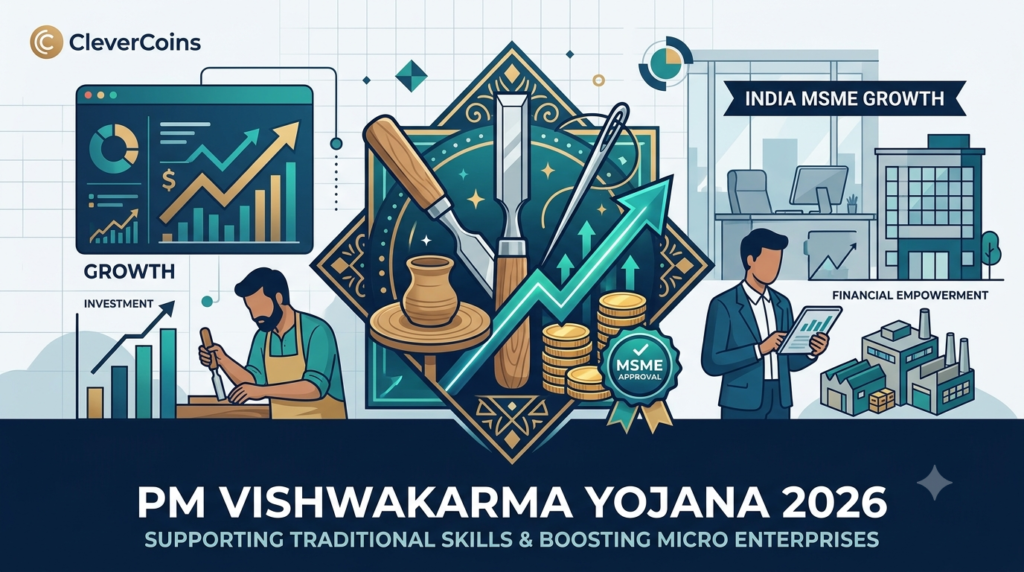
PM Vishwakarma Yojana 2026: Benefits, Eligibility and Online Apply for MSMEs
India’s economic backbone has always rested on the skilled hands of its traditional artisans, craftspeople, and micro-entrepreneurs. For generations, carpenters, blacksmiths, potters, goldsmiths, tailors, masons, and weavers have sustained local economies across rural villages and bustling urban neighborhoods. Yet, despite their foundational contribution to India’s socio-economic fabric, millions of traditional practitioners have historically remained trapped in the informal sector—cut off from institutional credit, forced to rely on high-interest local moneylenders, lacking modern equipment, and unable to access national or digital marketplaces.
To bridge this structural gap, the Government of India launched the PM Vishwakarma Yojana (Pradhan Mantri Vishwakarma Kaushal Samman), a landmark Central Sector Scheme administered jointly by the Ministry of Micro, Small and Medium Enterprises (MoMSME), the Ministry of Skill Development and Entrepreneurship (MSDE), and the Ministry of Finance. Backed by a massive financial outlay of ₹13,000 crore spanning five financial years from FY 2023–24 to FY 2027–28, the scheme continues in full swing in 2026 as one of the most comprehensive formalization and credit-enablement initiatives for micro-enterprises.
Unlike piecemeal subsidy schemes that offer isolated cash handouts, PM Vishwakarma Yojana 2026 delivers an integrated, end-to-end ecosystem. It takes an individual artisan from informal self-employment to a formally recognized, digitally enabled, and creditworthy MSME. From official identity certification and paid skill upgradation to a ₹15,000 toolkit grant, collateral-free loans up to ₹3 lakh at a fixed 5% interest rate, digital payment cashback, and onboarding onto the Udyam Assist Platform (UAP), the scheme addresses every bottleneck a traditional micro-enterprise faces.
In this exhaustive 2026 guide prepared for MSME owners, tax professionals, and traditional entrepreneurs, we break down every facet of the PM Vishwakarma Yojana—including all 18 eligible trades, strict family-level eligibility rules, loan tranche structures, documentation checklists, the mandatory Common Service Centre (CSC) biometric application process, three-tier verification workflows, and strategic post-approval MSME compliance steps.
1. What is PM Vishwakarma Yojana 2026? Overview & Strategic Vision
PM Vishwakarma Yojana is a 100% centrally funded Central Sector Scheme designed specifically to uplift traditional artisans and craftspeople (Vishwakarmas) who work primarily with their hands and traditional tools in the unorganized or informal sector.
In traditional Indian communities, skills are frequently passed down through the Guru-Shishya Parampara (mentor-disciple tradition) or within families from one generation to the next. However, because these craftspeople operate without formal company registrations, GST numbers, audited balance sheets, or collateral assets, traditional commercial banks historically viewed them as high-risk borrowers.
The strategic objectives of PM Vishwakarma Yojana in 2026 center on four core pillars:
Formal Identity and MSME Integration: Recognizing artisans as legitimate entrepreneurs by issuing a PM Vishwakarma Certificate and ID Card, and simultaneously onboarding them onto the Udyam Assist Platform (UAP) so they gain formal MSME status.
Press Release Page | Press Information BureauModernization Without Losing Heritage: Upgrading traditional craftsmanship with modern tools, ergonomic equipment, and contemporary design training without replacing the artisan’s core manual skill.
IIFL FinanceInstitutional Credit Inclusion: Replacing predatory informal borrowing with structured, collateral-free institutional credit backed by Government of India interest subvention and credit guarantees.
Press Release Page | Press Information BureauValue-Chain and Digital Market Access: Integrating micro-artisans into India’s Unified Payments Interface (UPI) economy and connecting them directly with domestic and global buyers through e-commerce platforms like the Government e-Marketplace (GeM), ONDC, and trade exhibitions.
Press Release Page | Press Information Bureau
Key Highlights of PM Vishwakarma Yojana 2026 at a Glance
| Scheme Parameter | Official Details (2026 Guidelines) |
|---|---|
| Scheme Name | Pradhan Mantri Vishwakarma Yojana (PM Vishwakarma Kaushal Samman) |
| Scheme Type | Central Sector Scheme (100% Funded by Government of India) |
| Nodal Ministries | Ministry of MSME, Ministry of Skill Development & Entrepreneurship, Ministry of Finance |
| Implementation & Tech Partner | Small Industries Development Bank of India (SIDBI) & Common Service Centres (CSCs) |
| Total Financial Outlay | ₹13,000 Crore (FY 2023–24 to FY 2027–28) |
| Covered Occupations | 18 Traditional Hand-and-Tool Trades |
| Official Recognition | PM Vishwakarma Digital Certificate, ID Card & Udyam Assist Registration |
| Skill Training & Stipend | 5–7 Days Basic Training + 15+ Days Advanced Training with ₹500/day stipend |
| Toolkit Grant | Up to ₹15,000 via e-RUPI / e-Voucher (Non-repayable grant) |
| Collateral-Free Loan Limit | Up to ₹3,00,000 in two tranches (Tranche 1: ₹1 Lakh; Tranche 2: ₹2 Lakh) |
| Concessional Interest Rate | Fixed 5% per annum (with up to 8% interest subvention paid by GoI) |
| Loan Repayment Tenure | 18 months for Tranche 1 (₹1 Lakh); 30 months for Tranche 2 (₹2 Lakh) |
| Digital Transaction Incentive | ₹1 per eligible digital transaction (up to 100 transactions/month = ₹1,200/year) |
| Application Mode | Online via nearest Common Service Centre (CSC) with Aadhaar Biometric Auth |
| Official Portal | pmvishwakarma.gov.in |
2. Six Core Benefits of PM Vishwakarma Yojana for MSMEs and Artisans
The architecture of PM Vishwakarma Yojana is deliberately sequential. Each benefit unlocks the next stage of business maturity, ensuring that financial capital is paired with technical capability and market readiness.
Benefit 1: Formal Recognition & Udyam Assist MSME Onboarding
Once an artisan’s application clears the three-tier verification process, the government issues two critical credentials:
PM Vishwakarma Digital Certificate and Physical/Digital ID Card: This serves as official government validation of the artisan’s trade expertise and occupational identity.
Press Release Page | Press Information BureauOnboarding on Udyam Assist Platform (UAP): Developed by SIDBI under the Ministry of MSME, UAP formally registers informal micro-enterprises without requiring a PAN card or GSTIN initially. The resulting Udyam Assist Certificate is treated at par with standard Udyam Registration for Priority Sector Lending (PSL) by commercial banks, regional rural banks, and NBFCs.
Vikaspedia – Schemes
Benefit 2: Paid Skill Upgradation (Basic & Advanced Training)
Recognizing that traditional artisans lose daily wages whenever they step away from their workshops, the scheme compensates them directly for learning:
Skill Verification & Basic Training (5 to 7 Days / ~40 Hours): Focuses on modernizing traditional techniques, improving product finishing, understanding quality standards, workplace safety, financial literacy, and using modern power/precision tools.
Advanced Training (15 Days or More / ~120 Hours): Optional specialized upskilling for artisans who wish to master complex design innovation, entrepreneurial management, and high-value product development.
Daily Wage Compensation Stipend: Every beneficiary receives ₹500 per day directly into their Aadhaar-seeded bank account via Direct Benefit Transfer (DBT) for every day of attended training. In addition, board and lodging at designated residential vocational training centers are provided free of charge.
Paisabazaar+ 1
Benefit 3: ₹15,000 Toolkit Incentive Grant (e-RUPI Voucher)
Outdated manual tools restrict productivity and cause physical strain. Upon completing skill assessment during Basic Training, beneficiaries receive a non-repayable toolkit grant of up to ₹15,000.
The grant is disbursed digitally as a purpose-bound e-RUPI / e-Voucher directly to the beneficiary’s registered mobile number.
SIDBIIt can be redeemed exclusively at authorized procurement centers or through India Post doorstep delivery for trade-specific, standardized modern toolkits (for example, electric potter wheels for Kumhaars, heavy-duty motorized sewing machines for Darzis, precision cordless drills and routers for Suthars, or modern grooming stations for Naais).
SIDBI
Benefit 4: Collateral-Free Enterprise Development Loans up to ₹3 Lakh at 5% Interest
Access to affordable working capital and equipment finance is the centerpiece of PM Vishwakarma Yojana. Eligible beneficiaries receive collateral-free Enterprise Development Loans up to ₹3,00,000 without needing property mortgages, third-party guarantors, or even a prior CIBIL credit history.
| Loan Tranche | Maximum Loan Amount | Repayment Tenure | Interest Rate Paid by Artisan | Government Subvention & Guarantee | Key Unlock Condition |
|---|---|---|---|---|---|
| Tranche 1 | Up to ₹1,00,000 | 18 Months | 5% p.a. (Fixed) | GoI pays up to 8% interest subvention + 100% Credit Guarantee Fee | Successful completion of 5–7 days Basic Skill Training |
| Tranche 2 | Up to ₹2,00,000 | 30 Months | 5% p.a. (Fixed) | GoI pays up to 8% interest subvention + 100% Credit Guarantee Fee | Full, timely repayment of Tranche 1 (standard account) + adoption of digital transactions OR completion of 15-day Advanced Training |
Important Financial Note: Furthermore, there is no prepayment penalty if an artisan chooses to repay the loan ahead of schedule after 6 months of disbursement.
Benefit 5: Digital Transaction Cashback Incentives
To encourage micro-entrepreneurs to build a verifiable digital cash-flow trail—which later helps them qualify for larger MSME loans—PM Vishwakarma rewards UPI and digital payment adoption:
Beneficiaries earn ₹1 per eligible digital transaction (either receiving payment from a customer or paying a supplier digitally).
Press Release Page | Press Information BureauThis applies to up to 100 transactions per month (up to ₹100/month or ₹1,200/year), credited directly to the beneficiary’s Aadhaar-linked bank account through the Aadhaar Payment Bridge System (APBS).
Paisabazaar
Benefit 6: End-to-End Marketing, Branding & E-Commerce Support
Even the finest craftsmanship fails if it cannot reach paying customers. The National Committee for Marketing (NCM) under the Ministry of MSME provides comprehensive market linkage assistance:
Quality Certification & GI Tagging: Assistance and cost reimbursement for obtaining quality certifications and geographical indication recognition.
PaisabazaarBranding & Packaging Design: Professional support to create modern brand logos, product catalogs, and export-grade packaging.
PaisabazaarE-Commerce Onboarding: Direct listing and catalog support on major platforms including the Government e-Marketplace (GeM), Open Network for Digital Commerce (ONDC), and leading private B2B/B2C marketplaces.
Press Release Page | Press Information BureauTrade Fairs & Exhibitions: Sponsored stalls, travel assistance, and buyer-seller meets at regional, national, and international craft exhibitions.
3. Complete List of 18 Eligible Trades Covered Under PM Vishwakarma 2026
PM Vishwakarma Yojana strictly covers 18 traditional, family-based trades where work is performed primarily by hand and hand tools in the unorganized sector. Factory workers, salaried employees, and purely mechanized mass-production units are excluded.
Below is the complete, categorized breakdown of all 18 notified trades:
A. Wood-Based & Construction Trades
Carpenter (Suthar / Badhai): Craftspeople engaged in traditional woodworking, handcrafted furniture making, doors, window frames, architectural woodwork, and wooden utility items.
Press Release Page | Press Information BureauBoat Maker: Artisans constructing and repairing traditional wooden fishing boats, ferries, and inland water vessels using manual carpentry and joinery skills.
Press Release Page | Press Information BureauMason (Rajmistri): Skilled construction craftspeople specializing in brickwork, stone masonry, plastering, tiling, and traditional structural building work.
IIFL Finance
B. Metal-Based & Precision Engineering Trades
Blacksmith (Lohar): Artisans forging iron and steel by hand to manufacture agricultural implements, gates, grills, kitchen utensils (tawas, kadhais), and rural hardware.
IIFL FinanceHammer and Tool Kit Maker: Craftspeople who forge and fabricate manual hand tools—such as hammers, chisels, pliers, sickles, and specialized kits—used by other artisans and farmers.
Press Release Page | Press Information BureauLocksmith: Skilled technicians designing, manufacturing, repairing, and duplicating traditional locks, keys, and mechanical security latches.
Armourer: Traditional metalworkers who craft ceremonial swords, shields, traditional decorative weapons, and metallic armor pieces.
Press Release Page | Press Information BureauGoldsmith (Sonar): Master artisans engaged in handcrafting gold, silver, and precious metal jewelry, filigree work, and traditional ornaments.
Press Release Page | Press Information Bureau
C. Clay, Stone & Sculpture Trades
Potter (Kumhaar): Craftspeople shaping clay on wheels or by hand to produce earthenware, diyas, terracotta decor, water pots (matkas), and ceramic utility items.
PM Vishwakarma NewsSculptor (Moortikar / Stone Carver) & Stone Breaker: Artisans carving religious idols (moortis), architectural stone reliefs, garden sculptures, and manually dressing stone blocks.
Press Release Page | Press Information Bureau
D. Leather, Fibre, Coir & Traditional Toy Trades
Cobbler (Charmkar / Shoesmith / Footwear Artisan): Craftspeople designing, stitching, repairing, and embellishing traditional leather footwear (Mojris, Kolhapuris), bags, and leather goods.
IIFL FinanceBasket / Mat / Broom Maker / Coir Weaver: Artisans weaving natural fibers—including bamboo, cane, reed, grass, and coconut coir—into baskets, mats, brooms, and eco-friendly household goods.
Doll and Toy Maker (Traditional): Craftspeople creating indigenous, non-mechanized wooden, clay, cloth, or lac toys and traditional dolls.
IIFL Finance
E. Textile, Grooming & Essential Community Service Trades
Barber (Naai): Traditional haircutting, shaving, and personal grooming practitioners operating independent neighborhood salons or mobile setups.
PM Vishwakarma NewsGarland Maker (Malakaar): Artisans crafting fresh floral garlands, ceremonial arrangements, torans, and traditional wedding/temple floral decor.
IIFL FinanceWasherman (Dhobi): Traditional laundry, fabric washing, stain removal, and steam/coal ironing service providers.
IIFL FinanceTailor (Darzi): Independent garment makers specializing in custom stitching, ethnic wear tailoring, and clothing alterations.
IIFL FinanceFishing Net Maker: Artisans who manually weave, knot, and repair fishing nets for coastal and inland fishing communities.
IIFL Finance
4. Strict Eligibility Criteria & Disqualification Rules in 2026
Before visiting a Common Service Centre, applicants must verify that they satisfy every statutory condition set by the Ministry of MSME. Even minor technical discrepancies can cause automatic rejection during database cross-checks.
Mandatory Eligibility Requirements
Citizenship & Residency: The applicant must be a citizen of India residing in either a rural or urban area.
Minimum Age: The applicant must be at least 18 years of age on the date of registration. There is no upper age limit, meaning senior master artisans are fully eligible.
MSME+ 1Self-Employment Status: The applicant must be actively engaged in one of the 18 notified trades on a self-employment basis in the unorganized sector, working primarily with hands and tools.
Press Release Page | Press Information BureauIndividual Registration Only: Registration must be completed in the name of an individual artisan, not as a registered Private Limited Company, LLP, or Partnership Firm.
Crucial Exclusions & Disqualification Criteria
Strict “One Member Per Family” Rule: Only one member per family is permitted to register and receive benefits under PM Vishwakarma Yojana. Under the scheme’s official definition, a “family” comprises the husband, wife, and their unmarried children. If both a husband (carpenter) and wife (tailor) apply separately, one application will be automatically rejected via Ration Card / Aadhaar family-tree verification. However, a married son living with his parents constitutes a separate family unit and may apply independently.
Check Government Scheme EligibilityGovernment Employees Excluded: Any individual currently employed in Central or State Government service—as well as any member of their immediate family (spouse and unmarried children)—is strictly ineligible.
Prior Credit-Based Self-Employment Schemes (5-Year Cooling Period): The applicant must not have availed loans under similar credit-based Central or State Government self-employment schemes—such as PMEGP (Prime Minister’s Employment Generation Programme), PM SVANidhi, or MUDRA Loans—during the past 5 years (calculated from the date of loan sanction).
Important Exception: Beneficiaries of PM SVANidhi or MUDRA who have fully repaid their previous loans are eligible to apply under PM Vishwakarma, provided they belong to one of the 18 trades.
5. Documents Required for PM Vishwakarma Registration
Because registration relies on real-time digital authentication through UIDAI, NPCI, and state civil supplies databases, having accurate, linked documents is mandatory:
Aadhaar Card (Mandatory): Must be valid and linked to an active mobile number for real-time OTP and biometric authentication.
SIDBIActive Mobile Number: Must be the exact number linked to the applicant’s Aadhaar card.
SIDBIBank Account Details (Passbook / Cancelled Cheque): An active savings or current bank account in the applicant’s name that is Aadhaar-seeded and DBT-enabled (Direct Benefit Transfer) to receive the ₹500/day training stipend and ₹1/transaction digital cashback. (If an applicant does not have a bank account, the CSC operator assists them in opening one first.)
PaisabazaarRation Card (Mandatory where available): Used by the portal to auto-fetch family member details and enforce the “one member per family” rule. (If the applicant does not possess a Ration Card, they must provide the Aadhaar numbers of all family members—spouse and unmarried children.)
Trade & Business Details: Information regarding years of experience, nature of craft, work location (home-based, own shop, or local market), and monthly income estimate.
kanilkumar.inCaste / Category Certificate (If applicable): Required in certain states or for demographic reporting (SC/ST/OBC/General).
kanilkumar.in
6. Step-by-Step Online Application Process via CSC (2026)
A common misconception among applicants is that they can complete PM Vishwakarma registration entirely from home on a smartphone. To prevent fraudulent ghost applications, the Government of India mandates in-person Aadhaar biometric authentication through an authorized Common Service Centre (CSC). Furthermore, registration is 100% free of cost—the government pays the CSC operator directly, and no artisan should ever pay a fee or bribe for enrolment.
Step 1: Locate and Visit Your Nearest Common Service Centre (CSC)
Carry your original Aadhaar Card, Aadhaar-linked mobile phone, Ration Card (or family Aadhaar numbers), and Bank Passbook to the nearest authorized CSC (Jan Seva Kendra / Maha e-Seva Kendra).
Step 2: CSC Portal Login & Eligibility Screening
The Village Level Entrepreneur (VLE) / CSC operator visits the official portal (pmvishwakarma.gov.in), clicks Login -> CSC – Register Artisans, and answers the initial eligibility screening questions (confirming non-government employee status and absence of active PMEGP/MUDRA loans).
Step 3: Aadhaar OTP & Biometric e-KYC Authentication
The operator enters your Aadhaar-linked mobile number and Aadhaar number.
mySchemeYou provide the 6-digit OTP received on your phone, followed by fingerprint or iris biometric verification on the CSC biometric scanner.
myScheme
Step 4: Fill the Artisan Registration Form
Once e-KYC succeeds, the portal auto-populates your name, address, date of birth, and gender from UIDAI. The operator then enters:
Family Details: Fetched automatically via your Ration Card number (or manually entered via family Aadhaar numbers).
Profession / Trade Details: Selection of your exact trade from the 18 notified categories, years of experience, and business address.
kanilkumar.inBank Account Details: Bank name, IFSC code, and account number for DBT transfers.
kanilkumar.inCredit & Toolkit Preferences: Selection of whether you wish to avail of the ₹1,00,000 collateral-free loan (and selection of your preferred bank branch), the ₹15,000 toolkit e-voucher, and digital payment onboarding.
Paisabazaar
Step 5: Submission & Application Reference Number
Review all entered details carefully before final submission. Upon clicking Submit, the portal generates a unique PM Vishwakarma Application Number. Print or save the acknowledgment receipt for real-time status tracking.
7. Understanding the Three-Tier Verification & Approval Workflow
After submission at a CSC, your application does not approve instantly. Instead, it undergoes a rigorous three-tier verification architecture designed to confirm genuine craftsmanship:
Tier 1: Gram Panchayat / Urban Local Body (ULB) Verification
For rural applicants, the Gram Panchayat Pradhan / Sarpanch verifies that the applicant resides in the village and genuinely practices the claimed traditional trade.
Press Release Page | Press Information BureauFor urban applicants, the designated Urban Local Body (Municipal Corporation / Municipality / Nagar Panchayat) official conducts physical or local verification.
Press Release Page | Press Information Bureau
Tier 2: District Implementation Committee (DIC) Vetting
Once cleared at the local level, the application moves to the District Implementation Committee, chaired by the District Collector/Magistrate alongside representatives from MSME, Lead District Manager (LDM), and skill agencies. The DIC vets eligibility compliance and bank linkage feasibility.
Tier 3: Screening Committee Final Approval
The State/Central Screening Committee grants final formal approval.
mySchemeImmediately upon Tier 3 approval, your PM Vishwakarma Digital Certificate and ID Card become available for download on
pmvishwakarma.gov.in, and you are queued for Basic Skill Training.
8. Post-Approval Roadmap: How to Maximize MSME Growth & Compliance
For micro-entrepreneurs looking to scale beyond informal subsistence into a structured, tax-compliant MSME, receiving the PM Vishwakarma ID Card is just the starting line. Here is how savvy artisans can leverage the scheme alongside India’s broader MSME regulatory framework:
1. Convert Udyam Assist into Full Udyam MSME Registration
PM Vishwakarma automatically registers you on the Udyam Assist Platform (UAP). As your business grows with the ₹1 lakh and ₹2 lakh credit tranches and you obtain a business PAN, migrate to full Udyam Registration (udyamregistration.gov.in). Full Udyam status unlocks:
Protection Under the 45-Day Payment Rule (Section 43B(h) of the Income Tax Act): Corporate and large buyers must pay registered micro and small enterprises within 15 to 45 days, or lose their tax deduction for that expense.
50% Concession on Trademark Registration Fees: When you build a brand name or logo for your handcrafted furniture, footwear, jewelry, or pottery through National Committee for Marketing (NCM) support, registering your trademark as a Udyam-certified MSME cuts government filing fees in half (₹4,500 instead of ₹9,000).
PaisabazaarGeM Tender Preferences: Exemption from Earnest Money Deposit (EMD) and purchase preference in central and state government procurement tenders.
2. Build a Clean Credit History for Larger MSME Loans
Many artisans fail to unlock the ₹2,00,000 Tranche 2 loan simply because they miss an EMI on Tranche 1 or fail to use digital payments. By maintaining 100% on-time repayments on your 5% interest loan and routing at least 100+ customer receipts per month through your UPI QR code, you simultaneously earn ₹1,200/year in cashback and build a strong CIBIL and cash-flow score—qualifying you later for CGTMSE collateral-free loans up to ₹10 crore or MUDRA Tarun loans.
3. Understand GST Thresholds as Your Revenue Scales
Most individual artisans starting under PM Vishwakarma fall well below the mandatory GST registration threshold (₹40 lakh annual turnover for goods in most states; ₹20 lakh for services). However, if you onboard your craft products onto e-commerce marketplaces or begin selling inter-state across India, evaluate whether simplified GST registration or the GST Composition Scheme makes sense for your margins.
9. Common Mistakes That Delay or Reject Applications (And How to Avoid Them)
Applying Without Linking Mobile Number to Aadhaar: If your mobile number is outdated in UIDAI records, e-KYC fails at the CSC. Update your mobile number at an Aadhaar Seva Kendra before applying.
Duplicate Family Applications: Submitting applications for both spouses or unmarried adult children residing in the same household triggers automatic disqualification. Choose the primary earning artisan in the household.
Inactive or Non-DBT Bank Accounts: Even if your loan is approved, the ₹500/day training stipend and ₹1 digital transaction incentives will bounce if your bank account is not mapped with NPCI for Direct Benefit Transfer (DBT). Verify DBT status at your bank branch.
PaisabazaarSkipping Basic Skill Training: Some applicants assume they can skip the 5–7 day training and directly demand the ₹15,000 toolkit voucher or ₹1 lakh loan. Both the toolkit voucher and Tranche 1 loan are strictly locked until Basic Training attendance and assessment are recorded.
Press Release Page | Press Information BureauPaying Unofficial Agents or Websites: Never enter your Aadhaar or bank details on fake third-party websites claiming “instant PM Vishwakarma approval,” and never pay a CSC operator for enrolment—the government covers 100% of registration charges.
TenderShark
10. Frequently Asked Questions (FAQs) About PM Vishwakarma Yojana 2026
Q1. Is there any last date to apply for PM Vishwakarma Yojana in 2026? No. PM Vishwakarma Yojana is an ongoing Central Sector Scheme running through FY 2027–28. There is no fixed annual deadline; eligible artisans can register year-round at any authorized Common Service Centre (CSC), though training batches and toolkit vouchers are allocated sequentially after verification.
Q2. Is the ₹3 lakh under PM Vishwakarma Yojana a free grant or a loan?The ₹3,00,000 is a collateral-free Enterprise Development Loan provided in two tranches (₹1 lakh + ₹2 lakh) at a heavily subsidized fixed interest rate of 5% per annum. It must be repaid over 18 months (Tranche 1) and 30 months (Tranche 2). Only the ₹15,000 toolkit e-voucher, the ₹500/day training stipend, and the ₹1/transaction digital cashback are non-repayable grants/incentives.
Q3. Can I apply for PM Vishwakarma Yojana if I have a low CIBIL score or no credit history? Yes. The scheme is explicitly designed for informal sector artisans who lack formal banking history or collateral. Having no prior credit score does not disqualify you, provided you have no active loan defaults.
Q4. Can a tailor or carpenter who already has a shop in a city apply? Yes. PM Vishwakarma covers eligible artisans in both rural and urban areas. Whether you operate from home, a rented neighborhood workshop, or a local market stall, you qualify as long as you work with hands and tools in one of the 18 trades and meet the family/income criteria.
Q5. How can I check my PM Vishwakarma application status online? Visit the official portal at pmvishwakarma.gov.in, click Login -> Applicant / Beneficiary Login, enter your Aadhaar-linked mobile number, verify via OTP, and view your real-time status across Tier 1 (Gram Panchayat/ULB), Tier 2 (District Committee), and Tier 3 (Screening Committee).
Q6. What is the official helpline number for PM Vishwakarma Yojana queries? For technical issues, CSC verification delays, or toolkit voucher queries, artisans can call the dedicated toll-free helpline at 1800-267-7777 or 17923, or email pm-vishwakarma@dcmsme.gov.in.
Need assistance formalizing your micro-enterprise, migrating from Udyam Assist to full Udyam MSME Registration, protecting your craft brand with a Trademark, or navigating GST and tax compliance as your business scales? Connect with the tax and MSME advisory experts at CleverCoins (clevercoins.org) to turn your traditional craft into a compliant, high-growth enterprise.
Lorem ipsum dolor sit amet, consectetur adipiscing elit. Ut elit tellus, luctus nec ullamcorper mattis, pulvinar dapibus leo.
Related posts:
PMEGP Urban vs Rural Subsidy 2025: The Ultimate Guide to Funding, Eligibility, and Location Strategy...
Design Clinic Scheme for MSMEs: Get 75% Subsidy for Product Design & IPR
Procurement and Marketing Support Scheme: Reimbursement for MSME Trade Fairs – Complete Guide
Self Reliant India (SRI) Fund: Rs 50,000 Cr Equity Infusion for MSMEs Explained
FAME III Scheme 2025: Subsidy for EV Manufacturing MSMEs in India – Eligibility, Benefits, Governmen...
CGTMSE Revised 2025: Collateral-Free Loan Limit Increased to ₹10 Crore for MSMEs
ONDC Seller Incentive Scheme 2025: How Small Sellers Get Free Delivery Support
GST Appellate Tribunal 2025 Is Live: How MSMEs Can File Appeal Online
Credit Guarantee Scheme for Exporters (CGSE): New 2025 Scheme for MSME Exporters
NSC Interest Rate 2026-27: National Savings Certificate Returns, Tax Benefits & How to Invest
Related posts:
 Self Reliant India (SRI) Fund: Rs 50,000 Cr Equity Infusion for MSMEs Explained
 Credit Guarantee Scheme for Exporters (CGSE): New 2025 Scheme for MSME Exporters
 Agri Infra Fund for Food Processing MSMEs: Complete Guide to 3% Interest Subvention, Eligibility, Benefits and Application Process
 GST on Corporate Guarantee to Subsidiary MSME: New Valuation Rule 2025 – Complete Guide to Rule 28(2), 1% GST Valuation and ITC